Why Do I Get Angry So Quickly
In this post
- The Small Thing Is Rarely the Whole Story
- What Builds Up Before the Anger Arrives
- Tiredness, Hunger and a Body Running Low
- Stress That Has Nowhere to Go
- Expectations, Hurt Feelings and Unfinished Business
- Why the Same Thing Bothers You on Some Days and Not Others
- What the Aftermath Tells You About the Pattern
- My Take:
Most people who ask why they get angry so quickly are not asking about one big fight. They are asking about the small moments: a cup left in the sink, a slow queue, a remark that would normally pass without notice, and suddenly their voice is raised, their hands are tense, and they have said something they wish they could take back. Afterwards comes the confusing part. The thing that set them off was tiny, and they know it was tiny, yet the anger felt large and fast, as if it had been waiting just under the surface. That feeling is worth taking seriously, because it usually tells the truth. Quick anger is rarely about the last small thing alone. It is about everything that came before it during the day, and sometimes during the week, quietly adding up until there was no room left for one more irritation.
Anger itself is not strange or shameful. It is a normal human feeling, and it has a purpose. It tells you that something feels unfair, that a limit has been crossed, or that you are under too much pressure. The problem is not that you feel anger. The problem is when it arrives so fast that you have no time to think, and when it lands on the wrong target, the person who happened to be standing nearest when the pressure finally spilled over. This article looks at that pattern in plain words: what builds up inside before a small thing triggers anger, why the build-up is often invisible to the person feeling it, and why the same small thing can pass unnoticed on a good day and feel unbearable on a bad one. It is general information only, not a diagnosis, and not a treatment plan. Its aim is simpler: to help you recognise the pattern in your own life, so the next time it starts, you can see it coming a little earlier.
The Small Thing Is Rarely the Whole Story
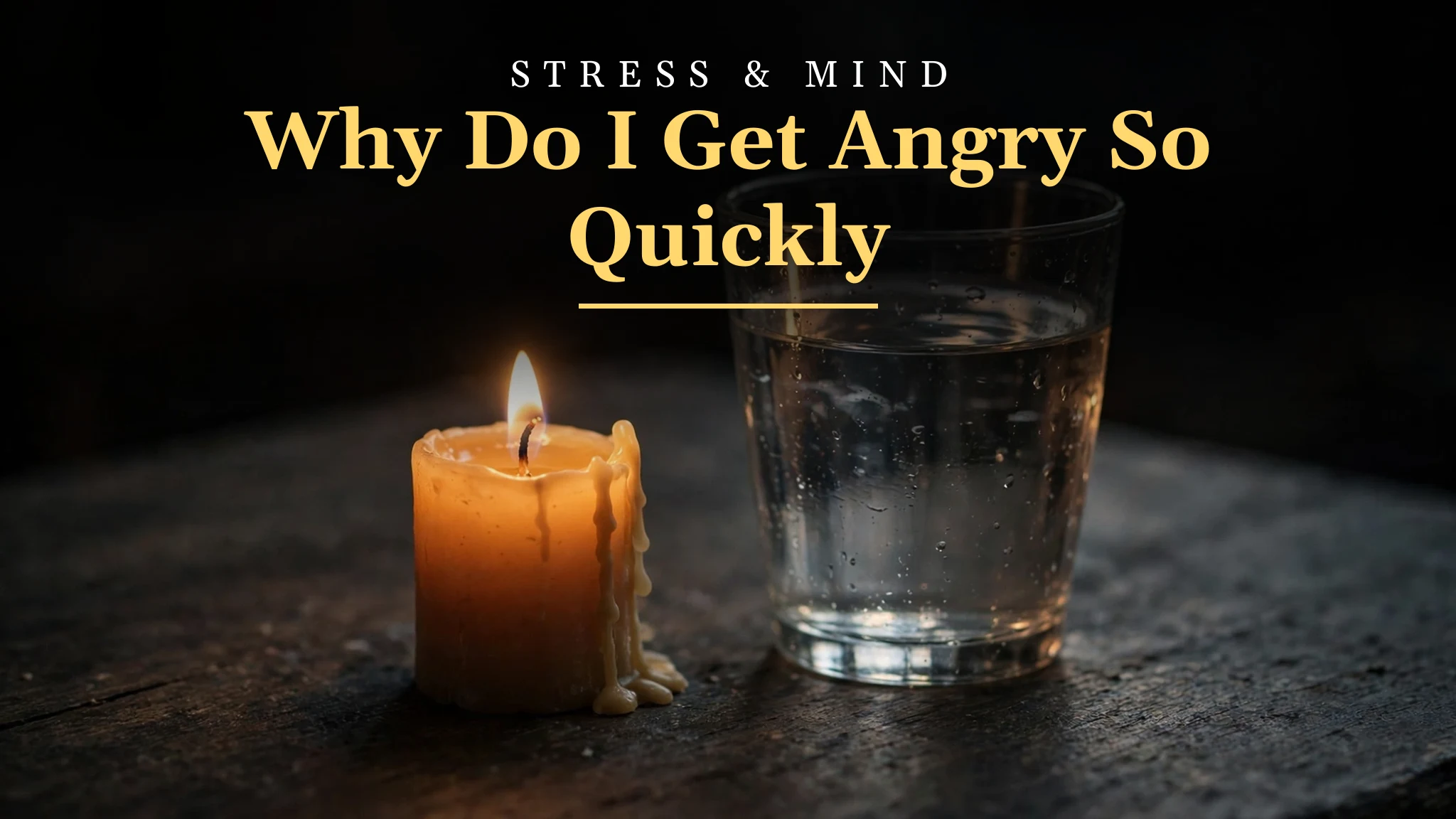
Think of a glass being filled drop by drop all day. One drop is a bad night of sleep. Another is skipping breakfast and working through lunch. Another is a message you have been meaning to answer. Another is a worry about money that you pushed aside in the morning and that came back at noon. None of these drops feels like anger on its own. Each one is small, and you can cope with each one separately. But the glass keeps filling, and by late afternoon it is almost full. Then someone leaves a wet towel on the bed, or a driver cuts in front of you, or a child asks the same question for the third time, and that is the last drop. The glass overflows. To anyone watching, it looks as if the towel or the driver caused the whole flood. To you, in the moment, it can feel that way too. But the flood was made by the whole day, not by the last drop alone.
This is why quick anger so often comes with confusion and regret. Ten minutes later, when the heat has passed, you look back and think that your reaction did not match the cause. You apologise, or you go quiet, or you feel embarrassed, and you promise yourself that next time you will stay calm. Then next time comes, and the same thing happens again, because the promise was aimed at the last drop, not at the glass. Staying calm in the moment is hard when the glass is already full. The useful question is different: what has been filling the glass all day, and could some of it have been emptied earlier, before the small thing arrived?
It helps to notice that the small trigger is often not even the real subject of the anger. A person who shouts about dishes in the sink may really be tired after a long shift, worried about a bill, and frustrated by a conversation that went badly at work. The dishes are simply the thing in front of them. The anger borrows the nearest available reason. That is why arguing about the dishes rarely solves anything. The dishes get washed, and the anger is still there, waiting for the next small thing. When you start to see this pattern, the trigger stops looking like the enemy, and the build-up becomes the thing worth understanding.
There is also a difference between a person who is angry all the time and a person who is usually calm but snaps quickly when life piles up. Many people who ask this question belong to the second group. They are patient with strangers, kind to their family, and steady at work, until a hard week arrives, and then their patience runs out much faster than usual. That does not mean their character has changed. It means their capacity has shrunk for a while, because so much of it is already being used elsewhere. A person carrying a heavy bag can still walk, but a small stone on the path is enough to make them stumble. The stone is not the problem. The weight is.
What Builds Up Before the Anger Arrives
The build-up before anger is usually made of ordinary things, not dramatic ones. It is rarely one big event. It is more often a string of small pressures that never get a proper pause. A morning that starts late, a phone that keeps buzzing, a task that takes twice as long as expected, a plan that changes without warning, a meal eaten in a hurry, a noise that never stops in the background: each one takes a little patience, and patience is not unlimited. When you spend it all morning, there is less of it left in the evening. This is not a failure of character. It is how human energy works. A person can only carry so much before the next small demand feels like too much.
Unfinished business is one of the heaviest parts of this build-up, and it is easy to miss because it is invisible. An argument that ended without a proper ending, a request you made that was never answered, a decision you have been putting off, a worry you have not spoken about: these things do not disappear just because you stop thinking about them for an hour. They sit quietly in the background, using up attention and patience. You may feel fine on the surface while they are there, but your tolerance for new irritation is lower, because part of your mind is still busy holding the unfinished thing. When a small new irritation arrives, it has to compete for space that is already taken, and the competition comes out as anger.
Expectations play a large part too. Most of us carry a picture in our heads of how the day should go: the bus should come on time, the work should be finished by five, the house should be tidy, people should listen the first time. When the real day does not match that picture, the gap between the two creates tension. A small gap is easy to accept. A day full of small gaps feels like the world is refusing to cooperate, and anger is the feeling that rises when that gap gets too wide. The trigger may be a late reply to a message, but the feeling behind it is the whole day of things not going as planned. The more rigid the expectation, the faster the anger, because there is less room for ordinary mess and delay.
Noise, crowding, heat and rushing also add to the build-up in ways people often underestimate. A hot room, a crowded bus, a long queue, a television playing in the background while you are trying to think: none of these is a reason to be angry on its own, but all of them wear down your patience. Your body is working harder than usual just to stay comfortable, and your mind is working harder to filter out what it does not need. By the time a small annoyance arrives, you are already tired from the effort of coping with the surroundings. This is one reason the same remark can feel harmless at home in the morning and unbearable in a hot, noisy place in the afternoon. The words did not change. The amount of patience left did.
Tiredness, Hunger and a Body Running Low
Of all the things that fill the glass before anger, tiredness is one of the most powerful, and one of the least noticed. When you have not slept well, everything feels harder. Sounds seem louder, waiting feels longer, and other people’s mistakes feel more personal. That is not imagination. Sleep is when the mind and body recover from the day, and when that recovery is cut short, you start the next day already partly used up. A person who slept badly is not necessarily in a bad mood, but they have less room for frustration, and a small thing that they would normally brush aside can feel like the last straw. Many quick tempers are simply tired bodies trying to get through the day.
Hunger works in a similar way, and it is so common that it has become a joke in many families, yet the feeling behind it is real. When you have not eaten for a long time, your blood sugar drops, your energy falls, and your body sends signals that it needs fuel. Those signals can feel like irritability, restlessness and a short temper. A person who skipped lunch and then snaps at a colleague at four in the afternoon may not be an angry person. They may be a hungry person whose body is asking for food in the only language it has. Eating a proper meal does not solve every problem, but it restores a basic level of energy, and with that energy comes a little more patience. It is hard to stay calm when your body is running low.
Being unwell, even mildly, has the same effect. A headache, a sore throat, a cold, a stiff back, or simply the heavy feeling that comes before an illness: all of these take up energy and attention. When your body is already busy dealing with discomfort, it has less to spare for patience. You may not even realise you are unwell yet. You only notice that you are snapping at people, and you wonder why. Later, when the illness arrives properly, the earlier irritability makes sense. The body was already struggling, and the temper was an early sign of that struggle, not a separate problem.
It is also worth thinking about the rhythm of the day. Most people have times when their patience is naturally higher and times when it is lower. Early morning, after rest and food, is often a steadier time. Late afternoon, after hours of work and decisions, is often a thinner time. Evenings, when the day’s tiredness has gathered, can be the thinnest of all. If your quick anger usually happens at the same time of day, that is useful information. It suggests that the pattern is linked to energy and tiredness, not to the people around you. A person who only snaps in the evening is not an evening hater. They are a person whose patience has run out by evening, and who needs rest, food and quiet more than they need another argument.
Stress That Has Nowhere to Go
Stress is the word people use for pressure that stays too long without relief, and it is one of the strongest reasons anger arrives so quickly. When you are under stress, your body stays in a state of readiness, as if it is waiting for something difficult to happen. Your muscles stay a little tense, your breathing stays a little shallow, and your mind keeps scanning for the next problem. That readiness is useful in a short burst, when you need to deal with something urgent. But when it goes on for days or weeks, it becomes exhausting, and it leaves no space for calm. A small new demand lands on a system that is already braced, and the reaction comes out louder and faster than the demand deserves.
One of the hardest things about stress is that it often has no single cause you can point to. It is the combination of many things: work pressure, money worry, family responsibilities, a health concern, a deadline, a relationship that needs attention. Each one alone might be manageable. Together, they create a background hum of pressure that never fully switches off. You may not even call it stress. You may just say you are busy, or tired, or that life is a lot right now. But the body keeps the score, and the temper is often where the score shows up first. A person under long stress does not need a big reason to get angry. They need only a small one, because the stress has already done most of the work.
Another part of stress is the feeling of having no control. When you can decide what happens next, even small problems feel manageable. When everything feels decided for you, when plans keep changing, when you are waiting for news, or when you are stuck in a situation you cannot change, the feeling of helplessness builds up, and anger is often the feeling that follows helplessness. It is the mind’s way of pushing back, of saying that something needs to change, even when it cannot say what. This is why quick anger often appears in situations where a person feels trapped, rushed, or unheard. The anger is not really about the small thing. It is about the larger feeling of having no room to breathe.
It is also important to say that stress does not always look stressed from the outside. A person under stress can look calm, organised and in control, while inside they are holding a great deal of tension. They may keep going, meeting deadlines, looking after others, and handling everything, until one small thing breaks the surface. To others, the outburst looks sudden and out of proportion. To the person, it can feel like a relief, and then like shame, because they know they held it together for so long and then lost it over something small. That cycle, holding it in and then letting it out suddenly, is one of the most common patterns behind quick anger, and it is worth recognising, because it shows that the problem is not the outburst alone, but the long period of holding everything in without rest or support.
Expectations, Hurt Feelings and Unfinished Business
Much quick anger has its roots in feelings that were never fully dealt with. A comment that stung yesterday, a promise that was broken last week, a feeling of being overlooked or disrespected, a conversation that ended badly: these things do not vanish when the day ends. They stay, quietly, and they lower the threshold for the next irritation. The next day, when someone makes a small remark, it lands on top of the older hurt, and the reaction is bigger than the remark alone would cause. The person making the remark may have no idea about the older hurt, and may be confused by the strength of the response. That confusion is understandable, because they only saw the last part of the story.
Feeling unheard is a particularly strong trigger. When you have explained something several times and it still has not been understood, or when you have asked for help and it has not come, the frustration builds with each repetition. The first time you ask, you are calm. The second time, you are firmer. The third time, your voice rises, not because the third request is worse than the first, but because it carries the weight of the first two. Quick anger in these moments is often a sign that a person has been patient for a long time and has finally run out of patience, not that they are impatient by nature. The history matters, and without the history, the anger looks unreasonable. With the history, it makes sense.
Expectations about other people can work the same way. We all carry quiet rules about how people should behave: they should reply promptly, they should remember what matters, they should notice when we are tired, they should say thank you. When those rules are broken, even in a small way, it can feel like a lack of care, and the feeling behind it is hurt as much as anger. A person who snaps because their partner forgot to buy something may not really be angry about the shopping. They may be feeling that their needs are not being noticed, and the forgotten item is simply the moment that feeling came to the surface. Seeing the hurt underneath the anger does not excuse shouting, but it does explain why the reaction was so fast and so strong.
There is also the matter of old habits. Some people grew up in homes where anger was the normal way of expressing frustration, and they learned early that a raised voice was how you got attention or solved a problem. Others grew up holding everything in, and learned that anger was not allowed, so it comes out suddenly when it can no longer be held back. Neither pattern is a life sentence, but both shape how quickly anger appears. A person who learned that anger works will reach for it sooner. A person who learned to suppress it will hold it until it bursts. In both cases, the speed of the anger is not a mystery. It is a habit formed over years, and habits can be noticed, understood, and slowly changed, though that change takes time and patience, and often help from others.
Why the Same Thing Bothers You on Some Days and Not Others
Almost everyone who gets angry quickly has noticed the same puzzle: a joke that made them laugh on Monday makes them furious on Thursday. A noise that they ignored yesterday drives them mad today. A question that was fine in the morning feels like an attack in the evening. This is not inconsistency or dishonesty. It is the clearest sign that the trigger is not the whole story. The thing that changed between Monday and Thursday was not the joke. It was everything else in the day: how much sleep you had, how much you had eaten, how much stress you were carrying, how many small frustrations had already piled up. The joke was the same. The glass was fuller.
Context matters too. A remark from a stranger is easier to ignore than the same remark from someone close to you, because the remark from a loved one carries history and meaning. A delay when you have plenty of time is a small inconvenience. The same delay when you are already late feels like a disaster. A mess in a room you are about to clean is nothing. The same mess in a room you have just cleaned feels like a personal insult. The event is the same, but the meaning changes with the situation, and the anger follows the meaning, not the event. This is why trying to fix quick anger by avoiding triggers rarely works for long. You cannot avoid every joke, every noise, every delay. What you can do is notice the conditions that make you more likely to react, and give yourself more room on the days when those conditions are present.
It also helps to notice the difference between a bad day and a bad pattern. A bad day is a day when everything goes wrong at once, and you snap at something small. That happens to almost everyone, and it passes. A bad pattern is when the snapping happens most days, over weeks, and it starts to damage your relationships, your work, or your own peace of mind. A bad day needs rest and a kind word to yourself. A bad pattern needs a closer look at what is filling the glass every day, and whether something in your life needs to change, or whether you need support to deal with it. Telling the difference is important, because it stops you from treating a normal bad day as a personal failure, and stops you from ignoring a pattern that genuinely needs attention.
Another useful thing to notice is what happens just before you snap. For many people, there is a short warning: a tightening in the chest, a heat in the face, a clenching of the jaw, a feeling of impatience rising. That warning may last only a few seconds, but it is there, and learning to spot it is one of the most practical skills for anyone who gets angry quickly. The warning does not stop the anger, but it gives you a moment of choice, a small gap between feeling and speaking. In that gap, you can step away, take a breath, drink some water, or simply say that you need a minute. Those small actions do not fix the deeper build-up, but they stop the anger from landing on the nearest person, and they give you time to deal with the real cause when you are calmer.
What the Aftermath Tells You About the Pattern
What happens after you get angry quickly is often as informative as what happened before. Some people feel relief for a moment, then guilt. Some feel embarrassed and go quiet. Some feel justified and keep arguing. Some feel exhausted, as if the anger used up all their energy. Each of these reactions tells you something about the pattern. Guilt often means you know the reaction was bigger than the cause. Exhaustion often means the anger was the release of a long build-up. Going quiet often means you are worried about what you said and how it was received. None of these feelings is wrong. They are information, and they are worth listening to, because they show you the cost of the pattern, and the cost is often what motivates a person to look at it more closely.
The effect on other people matters too, and it is worth thinking about honestly. When a person snaps quickly, the people around them learn to be careful. Children learn to watch for the signs. Partners learn to choose their words. Colleagues learn to avoid certain topics. That carefulness may look like respect, but it is often fear, and it slowly changes the relationship. People stop sharing things, stop asking questions, and stop being themselves, because they do not want to trigger the next outburst. That is a heavy price for a pattern that started with tiredness and stress, and it is one of the strongest reasons to take quick anger seriously, not as a personal flaw, but as something that affects the people you care about most.
It is also worth noticing whether the anger is followed by repair. After a quick outburst, do you go back and apologise, explain what was really going on, and try to make it right? Or does the argument hang in the air, unspoken, until the next one arrives? Repair matters more than perfection. No one stays calm all the time. What protects a relationship is not never getting angry, but coming back afterwards, owning the part that was yours, and talking about what was really happening underneath. A sincere apology, and a short explanation that you were tired or stressed, does not undo the words that were said, but it does stop the hurt from hardening into a pattern of its own. Over time, repair builds trust, and trust makes the next difficult moment easier to handle.
Finally, it is worth asking whether the anger is trying to tell you something important. Sometimes quick anger is a signal that a real need is not being met: you need more rest, more help, more time alone, a change at work, or a conversation that you have been avoiding. In those cases, the anger is not the problem to be solved. It is the messenger, pointing to the problem that needs solving. Ignoring the messenger does not make the message go away. It only makes the messenger shout louder. Listening to what the anger is pointing at, even when the anger itself is uncomfortable, is often the most useful thing you can do. It turns a pattern you are ashamed of into information you can use, and that is a much kinder and more practical way to think about it.
My Take:
When I think about why some people get angry so quickly, the first thing I want to say is that I do not see it as a sign of a bad person. I see it as a sign of a full glass. I have watched this pattern in ordinary life, in families, in workplaces, in busy homes where everyone is tired, and the story is almost always the same. The person who shouts about a small thing is not really shouting about that thing. They are shouting about a day that asked too much of them, a week that gave them no rest, a worry they have not spoken about, a need they have not named. If you only look at the last moment, the anger looks unreasonable. If you look at the whole day, it makes sense, and making sense of it is the first step towards changing it, because you cannot fix what you do not understand.
I think the glass picture is the most honest way to explain quick anger, and I keep coming back to it because it matches what people actually describe. Nobody says they woke up angry for no reason. They say they woke up tired, then the day piled on, then one small thing happened, and they lost it. That is a glass filling up, drop by drop, until it overflows. The drops are not dramatic. They are a late bus, a cold meal, a message ignored, a bill, a headache, a child asking the same question again. Each one is small enough to cope with alone. Together, they are too much. I believe that if more people understood this picture, there would be less shame around quick anger, and more practical action, because the solution is not to become a different person. It is to empty the glass a little earlier, before it overflows.
What strikes me most is how often tiredness and hunger are at the bottom of the glass, and how often they are ignored. We live in a world that treats sleep as a luxury and food as something to fit in between tasks, and then we are surprised when people lose their temper in the afternoon. I am not surprised at all. A body that has not slept and has not eaten is a body running on empty, and a body running on empty does not have patience to spare. I think this is one of the simplest and most overlooked truths about anger. Before you ask yourself why you are so angry, ask yourself when you last slept properly and when you last ate a real meal. The answer may explain more than any deep analysis. I am not saying that food and sleep solve everything. I am saying that they are the foundation, and without the foundation, everything else is harder.
I also think stress deserves more honest attention than it usually gets. People say they are stressed as if it were a small thing, a word to describe a busy week, but long stress changes how a person reacts to everything. It keeps the body braced, the mind scanning, the muscles tense, and after weeks of that, a small irritation feels like a threat. I have seen calm, kind people become quick to anger during a hard period, and then become calm again when the pressure lifts. That tells me the anger was not their character. It was their circumstances. I think we should be slower to judge a person’s temper and quicker to ask what pressure they are under. The question is not only why did you get angry, but what has been pressing on you, and for how long, and who is helping you carry it.
There is another part of this that I feel strongly about, and it is the part about being unheard. I think many quick tempers are really voices that have been patient for too long. A person asks once, calmly. They ask twice, firmly. They ask a third time, and their voice rises, and then they are called angry, as if the anger started at the third ask. It did not. It started at the first ask, when the need was not met, and it grew with each repetition. I think this matters, because it changes how we should respond. If someone snaps after asking three times, the useful response is not to tell them to calm down. It is to listen to what they have been asking for, and to deal with it. Calm down is a command that helps no one. Listening is an action that helps everyone.
I want to be honest about the other side too, because quick anger does real damage, and it is not fair to pretend otherwise. When a person snaps at the people closest to them, those people learn to be careful. Children watch for the signs. Partners choose their words. Friends stop sharing. That carefulness looks like peace, but it is not peace. It is fear, and fear slowly changes a relationship. I think anyone who gets angry quickly needs to hear this plainly, not as blame, but as truth. Your anger may make sense to you, because you know what filled your glass, but the people around you only see the overflow, and the overflow hurts them. Understanding your own pattern is important. Taking responsibility for its effect on others is equally important. Both can be true at the same time, and both need to be held together.
My own view is that repair matters more than perfection. I do not believe in a person who never gets angry. I believe in a person who comes back afterwards, says sorry properly, explains what was really going on, and tries to make it right. That is what protects a family, a friendship, a workplace. A quick apology that means nothing does not help. A real one does. It sounds like this: I was tired and stressed, and I took it out on you, and that was not fair. I am sorry. That is a short sentence, but it does a lot of work. It owns the behaviour, it names the real cause, and it shows respect for the other person. I think if more people practised that kind of repair, quick anger would do less lasting damage, because the hurt would not be left to harden into resentment.
I also believe that the warning signs before anger are worth learning, because they give you a small moment of choice. For many people, the warning is physical: a tight chest, a hot face, a clenched jaw, a restless feeling in the hands. That warning may last only a few seconds, but it is a real gap between feeling and speaking, and in that gap you can do something different. You can step outside for a minute. You can drink a glass of water. You can say, I need a moment, and walk away. None of those actions is dramatic. None of them solves the deeper problem. But they stop the anger from landing on the nearest person, and that matters. I think the skill is not to suppress anger, which only stores it up for later, but to notice it early enough to choose where it goes.
There is a question I hear often, and it is whether quick anger means something is wrong with you. My answer is that it usually means something is wrong with the load you are carrying, not with you. A person carrying too much will stumble over a small stone, and the stumble does not mean they are a bad walker. It means the load is too heavy. If you get angry quickly most days, over weeks, and it is hurting your relationships or your work, then it is worth looking closely at the load, and worth talking to someone who can help you carry it, whether that is a friend, a family member, or a health professional. That is not a sign of weakness. It is a sign of sense. Asking for help is how a heavy load gets lighter, and a lighter load means a slower temper.
I think we should also be honest about habits. Some people learned anger early, in homes where shouting was how problems were solved, or where feelings were held in until they burst. Those habits are deep, and they do not change in a week. But they can change, slowly, by noticing the pattern, by practising a pause, by repairing afterwards, and by changing the conditions that fill the glass. I do not believe in quick fixes for this. I believe in small, steady changes: more sleep, regular meals, a walk, a conversation that has been avoided, a task shared instead of carried alone. Each small change empties a drop from the glass, and over time the glass has more room, and the small things stop overflowing it.
What I hope a reader takes from this is not guilt, but clarity. If you recognise yourself in this article, that is not a reason to feel ashamed. It is a reason to feel understood, and to start looking at your own days with kinder eyes. Ask yourself what filled your glass today. Was it tiredness? Was it hunger? Was it stress? Was it a hurt you have not spoken about? Was it a feeling of being unheard? The answer will not be the same every day, and that is fine. The point is to ask the question, and to listen to the answer, because the answer tells you what needs attention. A person who understands their own pattern is already halfway towards changing it.
I will end with the thought I return to most often. Quick anger is not a mystery, and it is not a verdict on your character. It is a signal, and signals are useful. It tells you that your glass is full, that your body is tired, that your mind is under pressure, that a need is not being met. You can ignore the signal, and it will get louder. Or you can listen to it, and ask what it is pointing at. I would choose listening, every time. Listening does not mean excusing every outburst. It means understanding it well enough to change it, and changing it well enough to protect the people you love. That, in my view, is the most practical and the most hopeful way to think about why we get angry so quickly.
If a friend told me they get angry too quickly and they are ashamed of it, I would start by telling them they are not alone, and that shame is not the way forward. I would ask them to keep a simple note for a week, not a long diary, just a few lines each evening: how they slept, what they ate, what was stressful, and when they snapped. After a week, the pattern usually shows itself clearly, and seeing it written down is often a relief, because it turns a vague feeling of being an angry person into a clear picture of a tired person, or a stressed person, or a hungry person, and a clear picture can be worked with. I would also tell them to talk to the people closest to them, not to make excuses, but to explain what they have noticed, and to ask for a little patience while they work on it. Most people respond well to honesty, especially when it comes with a real effort to change.
I would also say something about patience with yourself, because change in this area is slow, and expecting it to happen overnight only adds another pressure to the glass. You will still snap sometimes, even when you are trying. That does not mean you have failed. It means you are human, and the work is still in progress. What matters is that the snapping happens less often, that you catch it earlier, that you repair it better afterwards. Those small improvements are real progress, even if they do not feel dramatic. I think we should measure progress in this area the way we measure it in any other: not by perfection, but by direction. Are you moving towards calmer days, more often? Are your relationships a little safer than they were? If the answer is yes, even a little, then you are doing the work, and the work is worth doing.
One last thing I want to say is about the people around someone who gets angry quickly. If you live with such a person, or work with one, it is easy to take the anger personally, and sometimes it is personal, but often it is not. Often it is the overflow of a full glass, and the person is as confused by it as you are. That does not mean you should accept being shouted at. You should not. It means that the most useful response is often a calm boundary, not a counter-attack. You can say, I understand you are stressed, but I will not be spoken to like that, and we can talk when things are calmer. That protects you, and it gives the other person a chance to come back and repair. I think both sides of this pattern deserve understanding, and both sides deserve respect, and when both sides have that, quick anger stops being a cycle of hurt and starts being a problem that two people can work on together.
Frequently Asked Questions
Is why do i get angry so quickly a normal part of everyday life?
Quick anger can be a normal part of everyday life, especially on days when you are tired, hungry, stressed or under pressure. Most people snap at a small thing from time to time, and that alone does not mean something is seriously wrong. It becomes more of a concern when it happens most days, over weeks, and starts to damage your relationships, your work, or your own peace of mind. In that case it is worth looking closely at what is building up each day, and talking to someone you trust, or a health professional, about what you are noticing.
How long does why do i get angry so quickly usually last in a normal day?
The sharp feeling of anger itself usually passes within minutes, once the immediate moment is over and your body begins to settle. The tension underneath it can last much longer, though, especially if the tiredness, stress or unfinished worry that fed it is still there. If the cause is hunger or tiredness, a meal and rest can help you feel steadier within an hour or two. If the cause is ongoing stress or an unresolved hurt, the readiness to snap again can linger for the rest of the day, until you get a proper pause, some rest, or a chance to talk about what is really bothering you.
Can why do i get angry so quickly affect sleep and rest?
Yes, it can, in both directions. A bad night of sleep leaves you with less patience the next day, so you are more likely to snap quickly. And a day full of quick anger can make it harder to sleep, because your mind keeps replaying what happened, what you said, and what you wish you had said instead. That creates a cycle: poor sleep leads to quick anger, and quick anger leads to poor sleep. Breaking the cycle usually starts with the basics, regular rest, regular meals, and a calmer evening routine, rather than with trying to force yourself to stay calm while you are still exhausted.
What is the simplest way to handle why do i get angry so quickly?
The simplest start is to notice what fills your glass before the anger arrives. Keep a short note for a week about your sleep, your meals, your stress, and the moments when you snapped. That note usually shows a clear pattern, and once you can see the pattern, you can act on it: rest earlier, eat regularly, share a task, or have a conversation you have been avoiding. In the moment itself, the simplest step is a short pause, stepping away for a minute, drinking water, or saying you need a moment before you reply. A pause does not solve the deeper cause, but it stops the anger from landing on the nearest person.
Does why do i get angry so quickly feel the same for everyone?
No, it does not feel or work the same for everyone. Some people feel heat in the face and a tight chest. Others go quiet first and then explode. Some snap at strangers and stay calm at home, while others are calm at work and snap at the people closest to them. Differences in sleep, routine, stress, health, and past habits all shape how anger shows up. What is common is the pattern underneath: a build-up of pressure, a small trigger, a fast reaction, and then regret or exhaustion afterwards. The details differ, but that shape is shared by many people.
When should I talk to someone about why do i get angry so quickly?
It is worth talking to someone when quick anger happens often, feels hard to control, or is starting to hurt your relationships, your work, or your daily life. A trusted friend or family member can be a good first step, especially if you can explain what you have noticed about your own pattern. If the anger feels overwhelming, lasts a long time, or is linked to low mood, poor sleep, or other worries, it is sensible to speak to a qualified health professional. General information in an article can help you understand the pattern, but it cannot replace personal advice about your own situation.
Sources
- NHS — Mental Health
- World Health Organization — Mental Health
- Centers for Disease Control and Prevention — Mental Health
- Healthline — Mental Health
- Mayo Clinic — Stress
This article is general information only. It is not medical advice and it does not diagnose, treat, or cure anything. For personal concerns, speak to a qualified health professional.


