Why Do Planes Have Two Pilots? Explained Simply
In this post
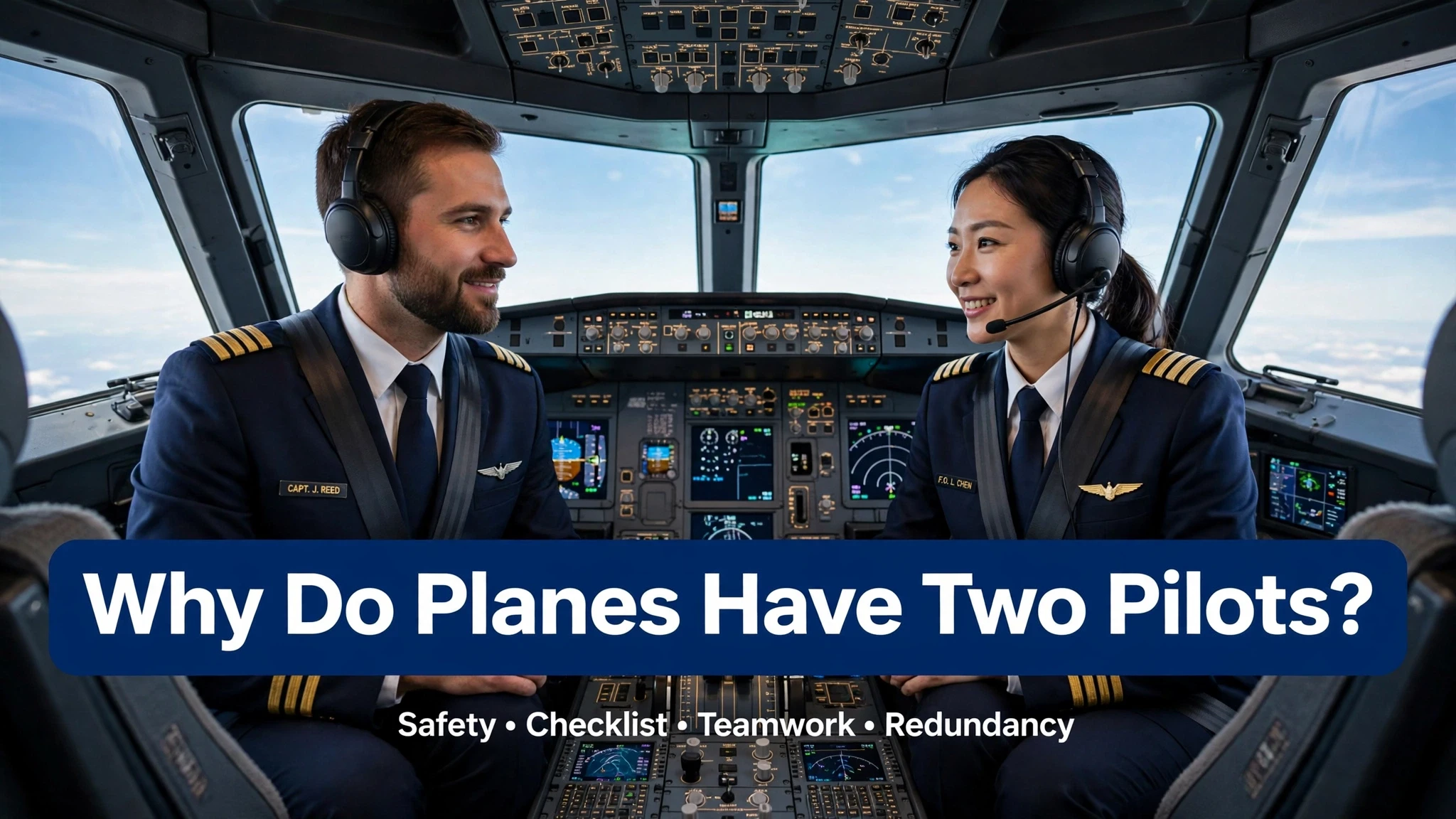
Every airliner you board has two pilots in the cockpit, a captain and a first officer, and that second person is not a spare or a student watching the captain work. Both are fully qualified to fly the aeroplane, both have passed the same type of training for that aircraft, and both take turns actually flying it. The reason airlines pay for two pilots on every flight is redundancy, which is the aviation word for having a backup when something goes wrong. If one pilot falls ill, becomes incapacitated, or needs to leave the cockpit, the other can land the aeroplane alone. If one pilot makes a mistake, the other is there to catch it before it becomes a problem. And on a long flight, two pilots can share the work so neither becomes so tired that their judgement fails. The system is called the two-pilot crew, and it has been standard on airliners since the jet age, because the industry learned long ago that the most dangerous thing in a cockpit is a single human being with nobody to check them.
Captain and First Officer: Who Does What
The captain is the pilot in command, which means they hold the final responsibility for the flight, the passengers and the aeroplane, and they make the final decision when the crew disagree. The captain usually sits in the left seat and wears four stripes on their uniform, while the first officer sits in the right seat and wears three stripes. The first officer is not a junior trainee, they are a fully licensed airline pilot who has passed the same examinations and simulator checks as the captain, and on many airlines a first officer has thousands of flying hours. The difference is seniority and command experience, not the ability to fly, and a first officer who has just joined an airline may have flown smaller aircraft for years before moving to a large jet.
On each flight the two pilots divide the work into pilot flying and pilot monitoring, and they swap these roles on the next flight so both stay practised. The pilot flying handles the controls, the takeoff and the landing, while the pilot monitoring handles the radios, the checklists, the navigation and the systems, and watches the pilot flying for errors. That division matters because flying an airliner involves far more than steering: there are air traffic control instructions to read back, fuel and weather to monitor, and checklists to run at every stage. A single pilot trying to do all of it while also flying through bad weather would be overloaded, and overload is when mistakes happen. Two pilots also mean two pairs of eyes on the instruments, two memories for the checklist, and two opinions when a decision is difficult.
The Day One Pilot Could Not Fly
The most obvious reason for two pilots is the one nobody wants to think about: a pilot can become suddenly unwell. It is rare, but it happens, and aviation history holds several cases where a captain collapsed at the controls and the first officer landed the aeroplane safely with the passengers unaware of how close the situation came to disaster. In 2009, a Continental Airlines captain died during a flight from Brussels to New York, and the first officer, with help from a relief pilot on board, landed the aircraft safely. In 2015, a Germanwings flight ended in tragedy precisely because the system that should have kept two people in the cockpit at all times was not followed, and regulators around the world tightened the rule that a second crew member must be present whenever a pilot leaves the cockpit. Those cases are the reason the rule exists in its current form, and they are also the reason airlines treat pilot health checks seriously, with medical examinations every six to twelve months depending on age.
Incapacitation does not have to mean a heart attack. A pilot can be affected by food poisoning, a sudden migraine, severe fatigue or a minor injury that makes it unsafe to continue flying, and in each case the other pilot takes over without drama. The handover is practised in the simulator: the fit pilot announces they have control, flies the aeroplane, declares an emergency to air traffic control, and diverts to the nearest suitable airport. Cabin crew are trained to help, and on long-haul flights a third relief pilot may be on board, so there is always a qualified pilot available. The system is designed so that the loss of one pilot is an emergency, not a catastrophe, and that design choice is worth every penny it costs the airline.
Two Heads Catch More Mistakes
Aviation safety experts have a name for the value of a second pilot: crew resource management, or CRM, which is the study of how a team in the cockpit works together to catch errors. Before CRM became standard in the 1980s, many accidents were caused by a captain making a mistake and a junior pilot staying silent because they did not want to challenge the boss. The Tenerife disaster of 1977, in which two Boeing 747s collided on the runway and 583 people died, was partly caused by a captain who began takeoff without clearance while the first officer hesitated to speak up. After that accident, airlines began training pilots to speak plainly, to challenge each other respectfully, and to treat the quietest voice in the cockpit as worth hearing. Today a first officer is expected to say, clearly and immediately, if they think the captain is making an error, and a captain is trained to welcome that challenge.
The checklist is the other half of this system. Every important action in the cockpit is done as a challenge and response, with one pilot reading the item and the other confirming it, so a missed step is caught by the second person rather than by the aeroplane. Cross-checking is the habit of verifying the other pilot’s work: when the pilot flying sets a new altitude, the pilot monitoring reads the setting back and checks the display. When the pilot flying enters a new route into the computer, the other pilot checks the entry against the clearance. These habits sound slow, but they take seconds, and they prevent the kind of small error, a wrong altitude, a wrong runway, a missed flap setting, that can turn into a serious incident. A single pilot can follow a checklist too, but they cannot cross-check themselves, and that is the difference that matters.
Long Flights, Tired Pilots and Rest Rules
Fatigue is one of the greatest risks in aviation, because a tired pilot makes slower decisions, misses radio calls and misreads instruments, and the effect is similar to being over the legal alcohol limit for driving. Two pilots help because they share the workload, but on a long-haul flight the crew also needs real sleep, which is why flights over about eight hours carry extra pilots. A typical long-haul crew has three or four pilots, with one or two resting in a bunk or a business-class seat while the other two fly, and they rotate on a schedule so that the pilots landing the aircraft are the most rested. Aviation regulators set strict limits on flying hours, usually around one thousand hours a year and one hundred hours a month, with minimum rest periods between duties, and airlines that break those limits face serious penalties.
The cockpit itself is designed to keep pilots alert. The two pilots talk through the flight plan, they take turns making radio calls, and they run checklists at every change, which keeps both of them engaged even when the autopilot is flying the aeroplane. On a very long flight the autopilot does most of the steering, but the pilots monitor the fuel, the weather ahead and the systems, and they plan the descent and the approach together. Short-haul pilots, who may fly four or five sectors in a day, face a different kind of tiredness: the repeated takeoffs and landings are demanding, and the short turnarounds leave little time to eat or rest. That is why airlines build rest days into the roster and why pilots report fatigue without fear of punishment, because a pilot who admits they are too tired to fly is doing the safest thing possible.
What Happens When a Pilot Leaves the Cockpit
On a short flight, neither pilot leaves the cockpit except in a real need, because the rules require two qualified people at the controls during takeoff and landing. On a longer flight, when one pilot needs to use the toilet or stretch, the other pilot stays at the controls, and a member of the cabin crew comes into the cockpit so that there are always two people present. That rule became mandatory in many countries after the Germanwings tragedy in 2015, when a pilot locked the other out of the cockpit, and although the details of that case are distressing, the lesson is clear: the cockpit must never be occupied by a single person alone. The door itself is armoured and locked from the inside, which protects the crew from intrusion but creates a risk if the person inside becomes incapacitated, so the procedures balance security against safety in a way that is reviewed after every incident.
The handover when a pilot leaves is formal and practised. The pilot who is staying announces they have control, the pilot who is leaving confirms it, and the cabin crew member who enters is briefed to watch for any sign that the remaining pilot is unwell and to open the door if needed. On flights with a relief pilot, the relief pilot takes the seat, so the cockpit still holds two qualified pilots. These procedures may sound bureaucratic, but they exist because aviation safety is built from small rules that each close a specific gap, and the gap left by a single pilot alone in a locked cockpit is one that the industry will not leave open again. Passengers rarely notice any of this, which is exactly how it should be, because the safety system works best when it is invisible.
Could One Pilot Fly an Airliner Alone?
Modern airliners are so automated that, in theory, a single pilot could fly one from takeoff to landing using the autopilot, the autothrottle and the automatic landing system, and in a simulator a skilled pilot can do exactly that. Small business jets and cargo aircraft already fly with a single pilot, and some military aircraft are flown by one person. The question is not whether the machine can do it, but whether it is safe when something goes wrong, because automation fails, weather changes, and emergencies require two people to manage at the same time. A single pilot facing an engine failure, a fire and a diversion to an unfamiliar airport would have to fly, navigate, talk to air traffic control, run the emergency checklist and brief the cabin, all at once, and that workload is beyond what one person can reliably do under stress.
For that reason, regulators in Europe and America have not approved single-pilot operation for large airliners carrying passengers, and the major pilot unions oppose it strongly. Manufacturers have discussed a future in which a single pilot flies with a ground-based co-pilot who can take over remotely, but that idea raises new questions about radio links, cyber security and the time it would take a remote pilot to understand an emergency they cannot see or feel. For now, and for the foreseeable future, your flight will have two pilots, and that is a deliberate choice by an industry that has learned, through painful experience, that a second qualified human being in the cockpit is the cheapest and most reliable safety system ever invented. When you see two pilots walk through the terminal, you are seeing the reason flying is so safe, and it is worth a moment of appreciation.
When the Autopilot Flies and the Pilots Watch
The autopilot is often misunderstood by passengers, who imagine that it flies the aeroplane while the pilots sit back and relax, but the reality is different. The autopilot is a tool that holds the aeroplane steady on a course, altitude and speed set by the pilots, and it does the physical steering on most of the flight, especially in cruise. The pilots, however, remain responsible for everything: they programme the autopilot, they monitor the fuel, they talk to air traffic control, they watch the weather ahead, and they take over immediately when the autopilot cannot cope, such as in severe turbulence or when a system fails. A good way to think of it is like cruise control in a car: the car holds its speed, but the driver still steers, watches the road, and brakes when needed. On takeoff and landing, the pilots usually fly by hand, because those are the phases where judgement matters most, and even an automatic landing is monitored closely by both pilots, ready to take over. Automation has made flying safer, but it has not made the pilots unnecessary, because the autopilot cannot make decisions, it can only follow instructions, and decisions are what keep a flight safe.
My Take:
I think the two-pilot rule is the most honest admission in all of aviation, and I mean that as praise. The industry does not pretend that pilots are perfect, it does not pretend that training removes all error, and it does not pretend that a human being can stay sharp for twelve hours without help. It simply puts a second qualified person in the room and says, we know one of you will make a mistake one day, and we want the other one there when it happens. That humility is why flying is safe, and I wish more industries were as honest about human limits. Hospitals, for example, have begun to copy aviation checklists, because they learned the same lesson: a second pair of eyes is not a luxury, it is the system.
My strongest feeling is about the first officer, because that role is misunderstood by almost everyone outside aviation. Passengers hear the word first and assume it means junior, or trainee, or assistant, and that could not be further from the truth. A first officer on a wide-body jet has usually flown for years, passed the same examinations as the captain, and can land the aeroplane in a storm if the captain falls ill. The difference between the two seats is command experience, not flying ability, and the fact that airlines trust a first officer with hundreds of lives on every flight should tell you how good they are. I think we should stop calling them co-pilots as if they were helpers, and start calling them what they are: pilots, full stop.
I also believe crew resource management is one of the great unsung achievements of the last fifty years, because it changed a culture, not just a procedure. Before CRM, cockpits were run like ships, with a captain whose word was law, and that hierarchy killed people. After CRM, a junior pilot is expected to speak up, a captain is expected to listen, and a challenge is treated as a gift rather than an insult. That is a hard change to make in any workplace, and aviation made it because the cost of not making it was measured in funerals. I think every organisation that deals with safety, from hospitals to construction sites, should study how aviation did it, because the lesson is universal: the person with the least power in the room often sees the danger first, and a system that silences them is a system that will fail.
Another belief I hold is about fatigue, and how casually we treat it in everyday life compared with how seriously aviation treats it. A pilot who says they are too tired to fly is praised, not punished, and their flight is covered by someone else. A nurse, a driver or a parent who says they are too tired is often told to push through, as if tiredness were a weakness rather than a physical state. Aviation understands that a tired brain makes mistakes at the same rate as a drunk brain, and it builds rest into the roster because it cannot afford those mistakes. I would like to see that understanding spread, because the world would be safer if we treated fatigue as a real risk in every job that affects other people, not only in the cockpit.
Finally, I think the argument about single-pilot airliners misses the point, because it treats the second pilot as a cost to be saved rather than a value to be kept. The saving would be small compared with the price of a ticket, and the risk, however small, would be borne by the passengers, not by the people making the decision. Automation is wonderful, and it has made flying safer, but it has not made the human being unnecessary, because automation fails in ways that are hard to predict, and a machine cannot feel the aeroplane the way a pilot can. I am happy to pay for two pilots, I am happy to wait while they run their checklists, and I am happy to know that if one of them falls ill, the other will bring me home. That is not old-fashioned, it is wise, and wisdom is worth more than a small saving on a ticket.
I also think the cockpit is a model for how any team should work, because it is built on the idea that the person in charge is not always right, and that the team is safer when everyone speaks. In most workplaces, the boss speaks and the others nod, and that is comfortable until it is dangerous. In a cockpit, the first officer is trained to challenge the captain, the captain is trained to listen, and the checklist is trained into both of them, so that no single person can make a mistake alone. I would like to see that model in hospitals, in construction, and in government, because the cost of silence in those places is also measured in lives. A team that cannot challenge its leader is a team that will fail, and aviation is the proof that a different way is possible.
There is one more thing I care about, and it is the quiet professionalism of pilots, because they do a difficult job without drama. They wake up at three in the morning, they fly through storms, they land in fog, and they do it without complaining, because complaining does not help the passengers. They check the weather, they check the fuel, they check each other, and then they fly, and when the flight is over, they go home and do it again the next day. I think that kind of professionalism is undervalued, because it is invisible when it works, and it is only noticed when it fails. I am grateful for it, and I think the next time you hear the captain’s voice on the speaker, calm and clear, you should remember that behind that calm is years of training, and a first officer sitting beside them, ready to help.
I also believe the two-pilot system is a reminder that safety is not a single device or a single rule, it is a culture, and a culture is built by people who speak up, who check each other, and who admit when they are tired. That culture took decades to build, and it was built on the lessons of accidents, on the courage of junior pilots who spoke up, and on the humility of captains who listened. I think that culture is the real reason flying is safe, more than any engine or computer, because a machine can fail, but a team that trusts each other and follows its checklists will catch the failure before it becomes a disaster, and that is a lesson worth carrying into every part of life.
Frequently Asked Questions
Why do planes have two pilots instead of one?
Airliners carry two pilots so one can take over if the other falls ill, so mistakes can be caught by a second person, and so the workload and fatigue can be shared, especially on long flights.
What is the difference between a captain and a first officer?
The captain is the pilot in command with final responsibility, while the first officer is a fully qualified pilot who shares the flying and monitoring. The difference is seniority and command experience, not flying ability.
Can a first officer land the plane alone?
Yes. A first officer is trained and licensed to fly and land the aircraft type, and in simulator training they regularly practise landing alone after a captain becomes incapacitated.
Who flies the plane, the captain or the first officer?
They take turns. On one flight the captain may be pilot flying while the first officer monitors, and on the next flight they swap, so both stay practised in both roles.
How many pilots are on a long-haul flight?
Flights over about eight hours usually carry three or four pilots, with extra pilots resting in bunks so the crew landing the aircraft are rested.
Will planes ever fly with only one pilot?
Small jets already do, but regulators have not approved single-pilot operation for large passenger airliners, because one person cannot safely manage an emergency, navigation and radios at the same time.