Why Do Planes Leave White Trails?
In this post
- The Short Answer: Clouds Made by Jets
- Why Altitude and Cold Air Matter So Much
- Engine Types, Fuel, and Trail Appearance
- Contrails, Cirrus Clouds, and Climate
- Contrails Versus Chemtrails: What the Evidence Shows
- How to Observe and Photograph Trails
- When Trails Look Unusual
- Trails and the Sky You See From Below
- My Take:
The Short Answer: Clouds Made by Jets
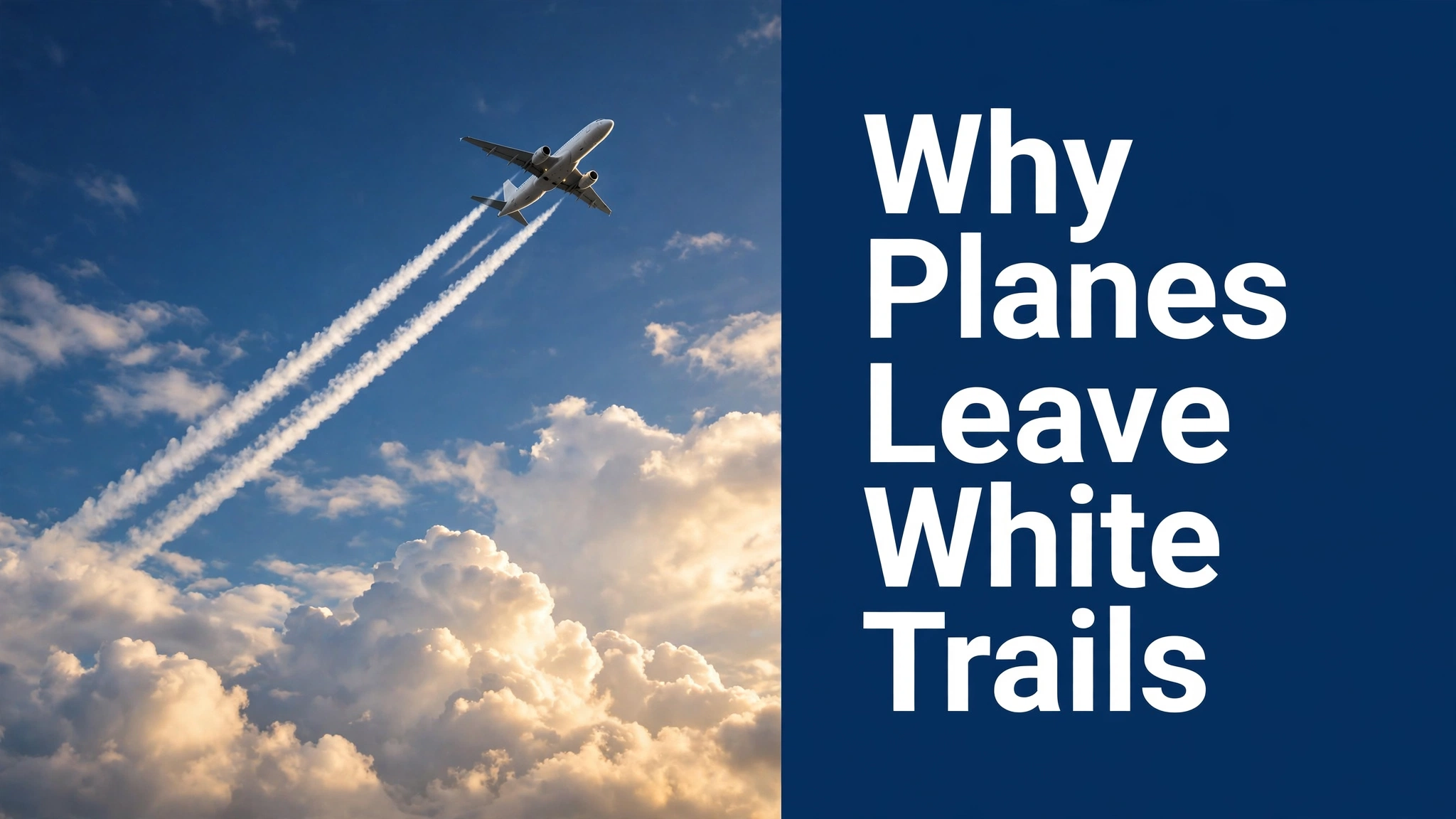
The white trails behind planes are called contrails, short for condensation trails. They are clouds, not smoke, formed when hot, moist exhaust from a jet engine mixes with very cold air high in the atmosphere. At cruising altitude, typically around nine to twelve kilometres, the air temperature is often around minus forty degrees Celsius or colder. When the warm exhaust meets that cold air, the water vapour in the exhaust cools rapidly, condenses into tiny water droplets, and then freezes into tiny ice crystals. Those crystals reflect sunlight, which is why the trail looks bright white against the blue sky.
This process is similar to seeing your breath on a cold morning. Warm, moist air from your lungs meets cold outside air, cools, and becomes visible as a small cloud. A jet engine does the same thing on a much larger scale, because it burns fuel, and burning hydrocarbon fuel produces water vapour and carbon dioxide, among other gases. The water vapour is invisible until it cools and condenses. The trail is therefore a visible sign of an invisible gas becoming a cloud, not a sign of something being sprayed deliberately.
Contrails have been observed since high-altitude flight began, and they were widely photographed during the Second World War, when aircraft flew at high altitude in large formations. Their appearance is not new, and their basic physics is well understood. What varies is not whether contrails can form, but whether they last seconds, minutes, or hours, and whether they spread into wider cloud. That variation depends on the air the plane flies through, not only on the plane itself.
Why Altitude and Cold Air Matter So Much
Altitude matters because temperature falls with height in the lower atmosphere. Near the ground, air is usually too warm for exhaust vapour to condense into a lasting trail, which is why planes taking off rarely leave long white lines. At cruising altitude, the air is cold enough that the exhaust plume cools below its dew point, the temperature at which water vapour condenses, very quickly. The colder the air, the more readily the vapour becomes ice. This is why contrails are a high-altitude phenomenon, seen from the ground as thin lines across the upper sky.
Humidity at altitude matters just as much as temperature. If the upper air is dry, the ice crystals in a fresh contrail evaporate, or sublimate, back into invisible vapour within seconds or minutes, and the trail disappears. If the upper air is already humid, close to saturation with respect to ice, the crystals do not evaporate quickly. Instead, they can persist, grow by taking up surrounding water vapour, and spread sideways as wind moves them. Those long-lasting, spreading trails are sometimes called persistent contrails, and they can evolve into a thin, wispy cirrus-like cloud layer.
That is why two planes on the same day, or even the same plane on different days, can leave very different trails. One day the upper air is dry, and trails vanish quickly. Another day the upper air is humid, and trails linger for hours and widen across the sky. Observers sometimes notice a sky full of trails on one morning and none the next, and conclude that something changed about the planes. In most cases, what changed was the invisible humidity and temperature of the upper atmosphere, which is why weather forecasters and pilots pay close attention to upper-air conditions.
Engine Types, Fuel, and Trail Appearance
All jet engines that burn fuel produce water vapour, but the amount and temperature of the exhaust vary by engine design and power setting. Modern high-bypass turbofan engines, used on most airliners, mix a large amount of bypass air with the hot core exhaust, which affects how quickly the plume cools and how the trail forms. Older, less efficient engines produced hotter, more concentrated exhaust, and their trails could look denser. Engine differences therefore affect trail appearance, but they do not change the basic mechanism: hot moist exhaust plus cold humid air equals ice-crystal cloud.
Altitude, speed, and throttle also shape the trail. A plane climbing at high power produces a different exhaust plume from one cruising steadily, and a plane flying slightly lower, in warmer air, may produce no trail at all while a higher plane nearby leaves a clear line. That explains the common sight of one plane with a trail and another without, in the same patch of sky. The planes are flying through different layers of air, at different temperatures and humidities, even if they look close together from the ground.
Trail shape also reveals wind. A straight trail shows calm upper winds, while a wavy or broken trail shows turbulence or wind shear, where wind speed or direction changes with height. Trails that appear to cross, loop, or form patterns usually reflect the flight paths of several planes over time, moved and stretched by wind, rather than a single plane performing manoeuvres. Time-lapse photography of persistent contrails shows them drifting, widening, and merging, much like natural cirrus clouds, because that is essentially what they become.
Contrails, Cirrus Clouds, and Climate
Persistent contrails matter beyond curiosity, because they affect the Earth’s energy balance. Like natural cirrus clouds, they reflect some sunlight back to space, which has a cooling effect, and they also trap some heat rising from the surface, which has a warming effect. Research indicates that, on balance, the warming effect of persistent contrails and the cirrus they create is the larger one, particularly for night flights, when there is no sunlight to reflect but heat-trapping continues. The size of this effect is still studied, and estimates vary, but it is recognised as a real, if smaller, part of aviation’s climate impact compared with carbon dioxide.
This is why researchers and airlines are studying contrail avoidance. If a plane can fly slightly higher or lower to avoid a humid layer where persistent contrails would form, it can reduce that warming effect without necessarily burning much extra fuel. Trials using weather forecasts to predict contrail-forming regions, and adjusting flight altitude by a small amount, have shown promise. The challenge is operational: air traffic control, fuel, safety, and schedules all constrain how freely a plane can change altitude. Contrail avoidance is therefore a promising area of research, not yet a routine practice on every flight.
It is important to keep scale in perspective. Contrails are one part of aviation’s total climate effect, alongside carbon dioxide, nitrogen oxides, and other emissions. Reducing contrails alone would not make flying climate-neutral, and increasing fuel burn sharply to avoid them could cancel the benefit. The scientific discussion is about finding the balance: small altitude changes, where they cost little extra fuel, that avoid the most persistent trails. That nuanced approach is very different from claiming that trails themselves are the main problem, or that they are harmless.
Contrails Versus Chemtrails: What the Evidence Shows
The claim that white trails are chemicals deliberately sprayed for secret purposes, often called chemtrails, has circulated for decades. Scientists, aviation authorities, and atmospheric researchers have examined this claim and found that the trails behave exactly as condensation physics predicts: they form only in cold, humid upper air, they vary with weather, they contain mainly ice crystals, and they have been observed since the early days of high-altitude flight, before the alleged programmes are said to have begun. No credible evidence of a large-scale secret spraying programme using airliners has been presented, and the logistics of secretly modifying thousands of commercial aircraft, crews, and fuel systems without detection make such a programme implausible.
It is also useful to understand what planes do legitimately release. Besides exhaust gases, planes may release water from other sources, such as wingtip vortices in humid air, which can create brief trails at lower altitudes, and fuel dumping in emergencies, which is a separate, rare, and regulated procedure, not a normal trail. Cloud seeding, where small aircraft release substances to encourage rain, is a real but localised practice, carried out by small planes at lower altitudes over specific areas, and it is not the same as the high-altitude trails of airliners. Confusing these different activities leads to mistaken conclusions about ordinary contrails.
For a curious observer, the best test is weather, not suspicion. Check whether trails last longer on humid days, whether they appear only above a certain height, and whether they spread like cirrus. Notice that military, commercial, and private jets all produce similar trails when conditions are right. That consistency across aircraft types, operators, and countries points to a common physical cause, not a secret programme limited to one fleet. Healthy scepticism means asking for evidence, and in this case the evidence consistently supports condensation physics.
How to Observe and Photograph Trails
Observing contrails is a good introduction to reading the sky. Note the time, the trail’s length, whether it fades quickly or persists, and whether it widens. A short trail that vanishes in under a minute suggests dry upper air. A long trail that lasts and spreads suggests humid upper air and the possible formation of contrail cirrus. Over hours, persistent trails can cover a large part of the sky with a thin veil, which may look like natural high cloud. Learning to distinguish fresh, sharp trails from older, spread-out ones helps you understand how the upper atmosphere changes through the day.
Photography can capture this evolution. A wide-angle view shows the pattern of trails across the sky, while a telephoto view shows the texture of a single trail. Early morning and late afternoon light make trails especially visible, because the sun angle highlights the ice crystals. If you photograph the same sky over several hours, you can create a simple time record of how trails form, drift, and merge. That record is more informative than a single dramatic photo, because it shows change, which is the key feature of a cloud, not a fixed spray.
For children and students, contrails offer a safe, free science lesson. They show that invisible gases become visible under the right conditions, that the atmosphere has layers with different temperatures, and that human activity can create clouds. A teacher or parent can connect a trail in the sky to the breath-on-a-cold-day experiment, to the water cycle, and to the idea that the sky is not empty, but full of moving air, moisture, and temperature changes. That connection turns a casual question into lasting understanding.
When Trails Look Unusual
Trails sometimes look unusual for ordinary reasons. A trail may appear to stop suddenly, because the plane entered a drier layer of air where ice crystals evaporate, or exited a humid layer. A trail may appear coloured at sunrise or sunset, because the ice crystals scatter low-angle sunlight, just as natural clouds turn pink and orange. A trail may appear to fall or rise, because perspective from the ground distorts a three-dimensional path, and wind moves different parts of the trail at different speeds. None of these effects requires an unusual explanation.
Shadows can also surprise observers. A contrail can cast a shadow on a lower cloud layer, creating a dark line that looks like a gap or a second trail. That shadow moves with the sun and the trail, and it disappears when the cloud layer changes. Similarly, a plane flying through a thin natural cloud can punch a hole or create a fallstreak, a narrow gap with falling ice crystals, which looks dramatic but is a known cloud phenomenon. Atmospheric optics and cloud physics produce many striking sights, and contrails are part of that larger family of sky phenomena.
If a trail genuinely worries you, the most useful step is to note the date, time, direction, and duration, and to check upper-air weather information or a flight-tracking app, which often shows the plane’s altitude and route. That information usually explains the observation without needing speculation. The sky rewards careful observation more than quick conclusions, and contrails are a good place to practise that habit, because their physics is clear, their variation is weather-driven, and their beauty is real.
Trails and the Sky You See From Below
From the ground, a contrail’s appearance depends on viewing angle as much as on physics. A trail directly overhead looks thin and sharp, while a trail near the horizon looks wider and longer, because you see it through more atmosphere and at a shallow angle. That perspective effect explains why a single trail can look dramatically different to observers in different towns, and why photographs of the same sky can seem to show different phenomena. It also explains why trails sometimes appear to hang motionless: at cruising altitude, a trail may be moving with the wind, but its distance makes motion hard to perceive, just as a distant plane seems to move slowly even at high speed.
My Take:
My first view on contrails is that they are a perfect example of how everyday science hides in plain sight. Most people look up, see a white line, and either ignore it or invent a story about it. The real story is more interesting: a machine burning fuel at minus forty degrees creates a cloud, and that cloud then behaves like any other cloud, drifting, spreading, and fading with the wind. I find that more satisfying than any secret explanation, because it connects a jet to a breath on a winter morning, and to the water cycle we all learned in school. Science does not make the sky less wonderful; it makes it more connected.
My second view is that the chemtrail idea persists because it feels like an explanation for a sky that sometimes looks crowded. When persistent trails spread and cover the sky, it is natural to feel that something has changed, and to look for a human cause. But the human cause is real and ordinary: more planes flying higher, in air that is sometimes humid enough to keep their trails alive. The sky looks different from fifty years ago because aviation has grown, not because a new secret programme began. Understanding that growth, and its climate effects, is more useful than chasing a hidden plot, because it leads to real questions about fuel, altitude, and flight planning.
My third view is about climate honesty. Contrails do warm the planet on balance, especially persistent ones at night, and that fact should not be hidden to make flying seem harmless. But it should also not be exaggerated into the claim that trails are the main climate problem from aviation. Carbon dioxide lasts far longer and accumulates, while contrails last hours to a day. The honest position is that both matter, and that contrail avoidance is a useful, low-cost step alongside fuel efficiency, sustainable fuels, and fewer unnecessary flights. A science-based view can hold two truths at once: contrails matter, and they are not the whole story.
My fourth view concerns observation. I think everyone should spend one afternoon watching trails change, because it teaches a skill that applies far beyond the sky: distinguishing a pattern from a single image. A single photo of a trail proves little. A sequence over hours, showing formation, persistence, and spreading, proves a great deal. That habit, looking for change over time rather than judging by one moment, protects against many kinds of misinformation, not only about contrails. The sky is a free laboratory, and contrails are one of its easiest experiments.
My fifth view is for parents and teachers. When a child asks why planes leave white trails, answer with the breath experiment first, then with the altitude and cold, then with the ice. Let the child blow warm air onto a cold mirror, watch it fog, and connect that fog to the jet’s exhaust. That chain of small, visible steps builds scientific confidence better than a long lecture. Children who understand contrails will also understand why some days have trails and others do not, and they will be less likely to accept a scary story that ignores weather. Good science teaching starts with a question a child actually asked.
My sixth view is about wonder. Even knowing the physics, I still stop to look at a trail that catches the sunset, or a sky criss-crossed by morning flights. Knowing that it is ice does not remove its beauty; it adds a layer, because I now see the invisible humidity, the wind shear, and the altitude in that line. Knowledge does not spoil wonder. It deepens it, by turning a line into a story about temperature, water, and human flight. That is why I keep looking up, and why I think others should too.
My final view is simple. The next time you see a white trail, ask three questions: how long does it last, does it spread, and what is the weather like up high? Those three questions will tell you more than any rumour. They will tell you whether the upper air is dry or humid, whether the trail will become cirrus, and whether the sky will stay blue or turn veiled by evening. That is a useful, testable way to read the sky, and it comes from understanding, not from fear. The trail is a cloud, made by a plane, shaped by weather, and worth watching with curiosity.
My seventh view is about citizen science. Ordinary observers, with a phone and a notebook, can contribute useful records of contrails: when they form, how long they last, and how they spread. Those records, shared with weather and aviation researchers, help refine models of contrail formation and climate effect. You do not need a laboratory to contribute; you need consistent observation, honest notes, and a willingness to record both trails and no-trails days, because a day with no trails is data too. That participation turns curiosity into contribution.
My eighth view concerns the future of flight. As aviation grows, contrails will become more common in busy airspace, unless avoidance measures improve. That growth is not a reason to panic, but it is a reason to support research into forecasting, altitude optimisation, and cleaner fuels, and to consider, for each trip, whether flying is necessary or whether a train or a video call would serve. Individual choices matter, but system changes matter more, and informed travellers can support both by asking airlines and policymakers about contrail and emissions plans, rather than only about ticket prices.
Finally, I return to wonder with knowledge. A contrail is ice, made by a machine, shaped by wind, and lit by the sun. It is also a reminder that human activity reaches the upper atmosphere, visibly, every day. That visibility is a gift: most human effects on the atmosphere are invisible, but contrails are there to see, to photograph, and to understand. Look up, ask how long it lasts, and notice the weather behind it. That simple habit makes you a better observer of the sky, and a better thinker about the planet.
Frequently Asked Questions
Why do planes leave white trails in the sky?
Planes leave white trails, called contrails, when hot, moist jet exhaust mixes with very cold air at cruising altitude. The water vapour cools, condenses, and freezes into tiny ice crystals, forming a visible cloud behind the plane.
Why do some planes leave trails and others do not?
Trails depend on temperature and humidity at the plane’s altitude. A plane in cold, humid upper air will leave a trail, while another plane in warmer or drier air, even nearby, may leave none. Engine type and altitude also affect trail formation.
How long do contrails last?
Short contrails in dry air may vanish within seconds or minutes. Persistent contrails in humid air can last for hours, spread sideways, and evolve into thin cirrus-like cloud. Duration is mainly determined by upper-air humidity, not by the plane alone.
Are contrails the same as chemtrails?
No. Contrails are condensation clouds explained by well-tested physics and observed since early high-altitude flight. The chemtrail claim of secret large-scale spraying from airliners lacks credible evidence and does not match how trails vary with weather and altitude.
Do contrails affect the climate?
Persistent contrails and the cirrus they create have a net warming effect, especially at night, because they trap heat more than they reflect sunlight. Research is ongoing, and contrail avoidance by small altitude changes is being studied as one way to reduce this effect.
Why do contrails sometimes look pink or orange?
At sunrise and sunset, low-angle sunlight scatters through the ice crystals, colouring trails like natural clouds. The colour comes from sunlight and ice, not from a different substance in the trail.