Why Do We Love Horror Movies? The Psychology Explained
In this post
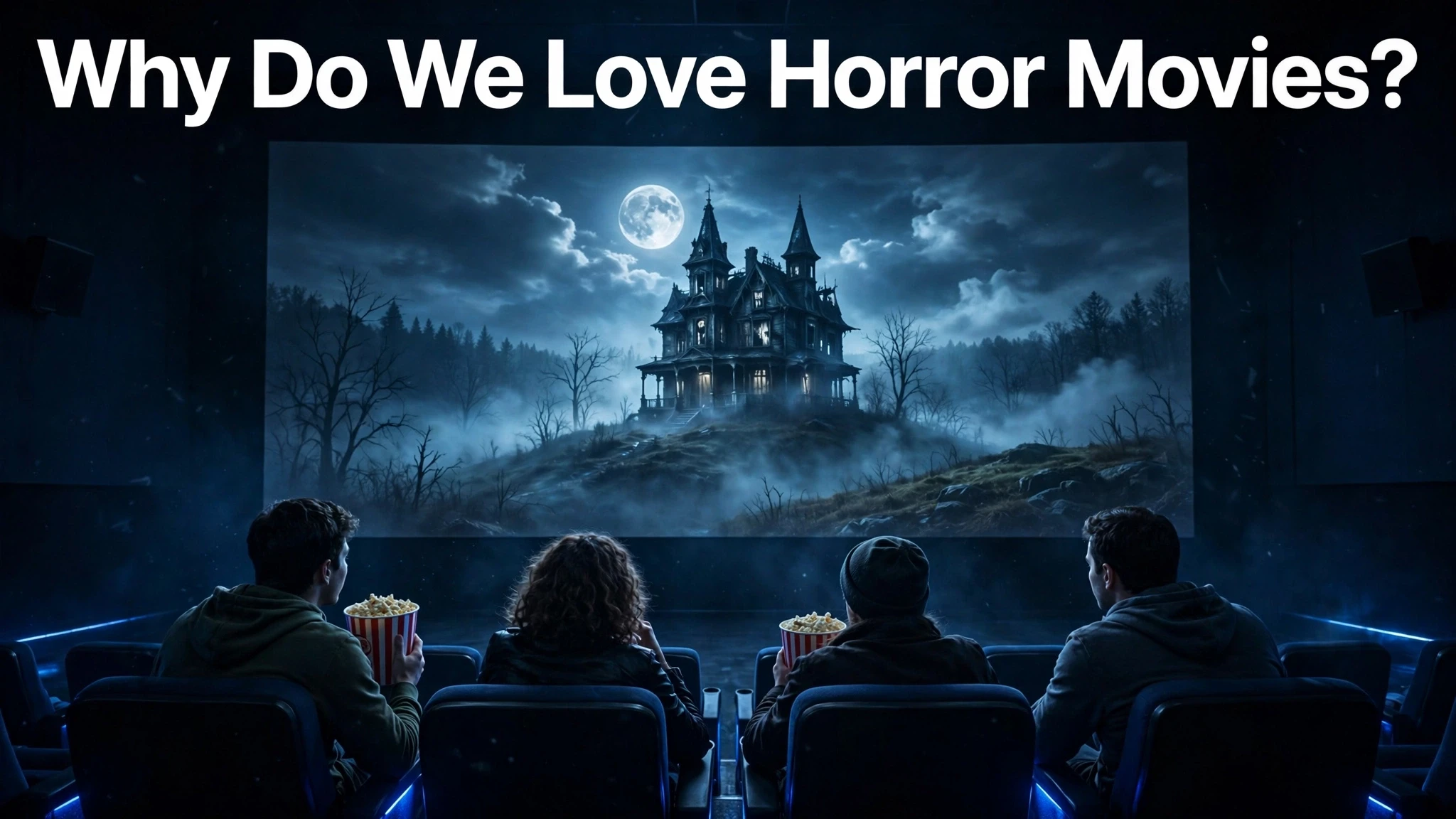
Think about the last time you watched a horror film. Your heart was beating faster, your hands were gripping the seat, and when the scare finally came, you jumped, and then you laughed, partly from relief, and partly from delight. That reaction is strange, when you think about it. Why would anyone pay to feel afraid? Why would millions of people choose, on a Friday night, to sit in the dark and be frightened, when they could watch something pleasant instead?
This guide explains why we love horror movies, using psychology, biology, and a little history. It looks at what fear does to the brain, why some people love horror and others avoid it, how different kinds of fear work, and why horror changes with the times. It is not about defending horror, or attacking it. It is about understanding a pleasure that is older than cinema, and that tells us something important about ourselves.
Fear in a Safe Place
The key to horror is safety. A horror film frightens you, but you know, at some level, that you are safe: you are sitting in a chair, the monster is on a screen, and you can leave whenever you want. That safety is what makes the fear enjoyable, because it lets you experience the rush of danger without any real risk. Psychologists call this the paradox of horror: we enjoy fear when we know it is not real, and when we control it, and we avoid fear when it is real, and out of our control.
That control matters. You choose the film, you choose when to watch it, and you can cover your eyes, or pause it, if it becomes too much. That sense of control turns fear from something threatening into something playful, like a roller coaster, which is frightening precisely because you know it is safe. A person who loves horror is not a person who loves being afraid in real life. They are a person who enjoys the feeling of fear, in a place where it cannot hurt them, and that distinction is important, because it explains why horror is a pleasure, not a problem.
The Thrill of the Jump Scare
The jump scare is the simplest tool in horror, and the most criticised, but it works because it exploits a reflex. When something appears suddenly, with a loud sound, your brain reacts before you can think, releasing adrenaline, raising your heart rate, and preparing your body to run. That reaction is automatic, and it is the same reaction your ancestors had when they heard a rustle in the grass. A jump scare hijacks that ancient system, and it does so in a way that is safe, and brief, and followed by relief.
The relief is the pleasure. After the scare, your brain realises there is no danger, and it releases dopamine, a chemical associated with reward, and you feel a rush of pleasure, and often laughter. That cycle, tension, scare, relief, is addictive, and it is why audiences keep coming back, even when they know the scare is coming. But a jump scare alone is not enough. A film that relies only on jump scares becomes tiring, because the audience learns the pattern, and the relief fades. The best horror films use jump scares sparingly, and build tension slowly, so that when the scare comes, it matters.
Why We Enjoy Being Scared Together
Horror is better with other people, and there is a reason for that. Fear is a social emotion, and sharing it makes it more intense, and more enjoyable. When you watch a horror film with friends, you laugh together, you scream together, and you hold on to each other, and that shared experience creates a bond. Studies have found that people who watch a frightening film together feel closer afterwards, because they have survived something, even if it was only fictional, and that shared survival is a form of connection.
That is why horror films are popular on dates, and at sleepovers, and why horror is a social genre in a way that drama is not. A couple who watch a horror film together will often hold hands, or sit closer, and that closeness is part of the pleasure. A group of friends who watch a horror film will talk about it for days, retelling the scares, and laughing about who screamed loudest. The film is the excuse. The real pleasure is the togetherness, and the feeling of having faced something, together, and come through it safely.
Horror as a Way to Face Real Fears
Horror also lets us face fears that are too difficult to confront directly. A film about a monster can be a way of thinking about death, about loss, or about the things we cannot control, without having to face them head-on. A horror film about a haunted house can be about grief, and a film about a killer can be about the fear of violence, and a film about a plague can be about the fear of illness. The monster is a metaphor, and it allows us to feel the fear, and to process it, at a safe distance.
That is why horror is often most popular in difficult times. During wars, recessions, and pandemics, horror films thrive, because they give people a way to express anxiety, and to feel a sense of control over it. Watching a character survive a terrifying situation can be reassuring, because it suggests that survival is possible, even in the worst circumstances. Horror does not create fear. It gives fear a shape, and a story, and by doing so, it makes it easier to bear. That is a valuable thing, and it is one reason horror has lasted for so long.
The Satisfaction of Surviving the Film
Part of the pleasure of horror is the ending, and the feeling of having survived. When the credits roll, and the lights come up, there is a sense of relief, and of accomplishment, as if you have been through something, and come out the other side. That feeling is similar to finishing a difficult hike, or a hard workout: it is tiring, and it is satisfying, and it makes you feel capable. A horror film that ends well leaves you with that feeling, and it is why audiences return, even to films that frightened them.
That satisfaction is also why horror fans often rewatch films they already know. The second time, you know when the scares are coming, and you can enjoy the craft, the tension, and the performances, without the shock. Rewatching is a way of mastering the fear, of proving to yourself that it cannot hurt you, and that you can face it, and enjoy it. It is a small, safe victory, and it is one that horror offers, again and again, to anyone willing to sit in the dark, and to be scared, for a little while.
Different Kinds of Fear in Horror
Not all horror is the same, and different films frighten us in different ways. A slasher film frightens through violence, and through the threat of a killer who cannot be stopped. A ghost story frightens through atmosphere, and through the sense that something is present, but unseen. A psychological horror frightens through uncertainty, by making you doubt what is real, and who can be trusted. And body horror frightens through disgust, by showing the body changed, or harmed, in ways that disturb us deeply.
Each kind of fear appeals to different people, and each one works differently. Some viewers love the shock of a slasher, and find ghost stories boring. Others love the slow dread of a ghost story, and find slashers crude. Understanding which kind of fear you enjoy will help you choose films you will like, and avoid ones you will not. It will also help you appreciate horror as a genre, because it is not one thing. It is many things, and its variety is part of its strength. Try different kinds, and you may discover a fear you enjoy, that you did not know you had.
When Horror Is Not for You
Horror is not for everyone, and that is fine. Some people find it distressing, rather than enjoyable, and they do not like being scared, even in a safe place. That is a normal difference in temperament, and it is not a sign of weakness, or of a lack of imagination. Fear affects people differently, and a person who avoids horror is simply protecting themselves from an experience they do not enjoy, which is a sensible thing to do.
It is also important to be honest about when horror is harmful. If a film causes nightmares, anxiety, or lasting distress, it is better to stop watching it, and to choose something else. There is no prize for finishing a film that frightens you, and there are many other films to enjoy. And do not pressure someone else to watch horror, or mock them for avoiding it. Let people enjoy what they enjoy, and let horror be a choice, not a test. The best horror fans are the ones who understand that, and who respect the fact that fear is personal, and that not everyone wants to feel it, even for fun.
Horror Through the Decades: How Fear Has Changed
Horror has changed with the times, and each decade has had its own fears, and its own monsters. In the 1930s, horror was gothic: castles, vampires, and monsters, played by actors such as Bela Lugosi and Boris Karloff, in films that were atmospheric, theatrical, and often beautiful. Those films were about the fear of the foreign, the fear of the unknown, and the fear of science, and they reflected a world that was changing rapidly, and that was anxious about what it might become. They are still watched today, because they are elegant, and because their fears, though old-fashioned, are still recognisable.
In the 1950s, horror became science fiction, with films about aliens, mutants, and radiation, which reflected the fears of the Cold War, and of nuclear weapons. The monsters were often metaphors for communism, or for the bomb, and the films were a way of talking about fears that were too frightening to discuss directly. In the 1960s, horror became more psychological, with films such as Psycho, which showed that the monster could be an ordinary person, living next door, and that the most frightening thing was not a creature, but a human mind. That shift changed horror forever, because it made it personal, and it made it harder to dismiss as fantasy.
The 1970s and 1980s were the age of the slasher, with films such as Halloween and Friday the 13th, which featured a killer, a group of young people, and a series of violent deaths. These films were often criticised for their violence, but they were also popular, because they offered a simple, cathartic thrill, and because they reflected anxieties about youth, about sexuality, and about the breakdown of the family. They also established a formula that is still used today, and they created icons, such as Michael Myers and Jason Voorhees, who are still recognised around the world. Whether you love them or hate them, they are part of the history of horror, and they cannot be ignored.
In the 1990s and 2000s, horror became more self-aware, with films such as Scream, which commented on the genre itself, and which played with the audience’s expectations. It also became more international, with Japanese horror, such as Ringu, influencing Western films, and with a new wave of directors who brought fresh ideas. In the 2010s, horror became more thoughtful, with films such as Get Out and A Quiet Place, which used horror to talk about race, about family, and about society, and which were praised by critics as well as audiences. That trend continues today, and it suggests that horror is not only about scaring people. It is about understanding the world, and about using fear to say something important.
The lesson of this history is that horror is a mirror, and it reflects the fears of its time. A horror film from the 1930s tells you what people feared then, just as a horror film from today tells you what people fear now. That is why horror is worth studying, and worth watching, not only for the scares, but for what it reveals. The monsters change, but the fear remains, and it is always about something real, even when it is dressed as fantasy. Watch horror with that in mind, and you will see more than a scary film. You will see a history of fear, and a history of ourselves.
My Take:
The history of horror is what fascinates me most, because it shows that our fears are not random, but that they reflect the world we live in. A film from the 1930s tells you about the fears of that decade, just as a film from today tells you about the fears of now, and that makes horror a kind of history, written in fear. I think we should watch horror with that awareness, and we should ask not only whether a film is scary, but what it is scared of, and why. That question will make you a better viewer, and it will make horror more interesting, because it turns a scary film into a window on the world.
I also think we should be honest about the fact that horror is not for everyone, and that it is fine to avoid it. Some people find horror distressing, and they do not enjoy being scared, and there is nothing wrong with that. Fear is a real emotion, and it affects people differently, and a person who avoids horror is not less brave, or less interesting, than a person who loves it. They simply have a different relationship with fear, and that should be respected. Do not pressure someone to watch horror, and do not mock them for avoiding it. Let people enjoy what they enjoy, and let horror be a choice, not a test.
Another point I would make is about the quality of modern horror, and how it has improved. For a long time, horror was dismissed as a low genre, as cheap, violent, and unworthy of serious attention. But in recent years, horror has produced some of the most thoughtful, original, and acclaimed films, and it has been recognised by critics, and by audiences, as a serious art form. That change is welcome, and it is a sign that horror is maturing, and that it is being taken seriously. I would encourage anyone who dismisses horror to watch a modern horror film, with an open mind, and to see what the genre can do. You may be surprised, and you may discover a new favourite.
And the final thing I would say is to watch horror in moderation, and to take care of yourself. Horror is designed to scare you, and it can affect your sleep, your mood, and your sense of safety, especially if you watch too much, or watch alone, late at night. Take breaks, watch with friends, and choose films that match your tolerance. Horror is a pleasure, but it is a pleasure that should be enjoyed responsibly, and with an awareness of its effects. If a film disturbs you, stop watching it, and do something else. There is no prize for finishing a film that frightens you, and there are many other films to enjoy. Watch well, watch thoughtfully, and let horror be a source of excitement, not of distress. That is the best way to love it.
Horror is also a way of dealing with anxiety, and that is one of its most interesting functions. A person who feels anxious about the world can watch a horror film, feel afraid in a controlled setting, and then walk out of the cinema, or turn off the television, and feel relief. That relief is real, and it can be calming, because the fear had a beginning, a middle, and an end, and the viewer survived it. In a world where real fears are often vague and unending, a horror film offers a fear with a shape, and a shape can be faced.
Horror also differs across cultures in ways that are worth exploring. Japanese horror often uses quiet, atmosphere, and the fear of the ordinary becoming strange, while American horror often uses pace, and shock. Korean horror can be deeply emotional, and European horror can be slow, and unsettling. Trying horror from another country is a good way to discover what kind of fear works on you, and what kind does not. And if horror is not for you, that is fine. Not everyone needs to enjoy being scared, and there is no prize for forcing yourself to watch something that only makes you miserable. The genre is there for those who want it, and it will wait for you if you ever change your mind.
Frequently Asked Questions
Why do people love horror movies?
Horror gives a safe thrill: the brain releases adrenaline and dopamine during a scare, then relief when the danger passes. It also lets people face fears, explore dark ideas, and share an intense experience with others, all from the safety of a cinema seat.
Is it normal to enjoy being scared by films?
Yes, it is normal. Many people enjoy the rush of fear when they know they are safe, in the same way they enjoy roller coasters. Enjoying horror does not mean enjoying real suffering; it means enjoying a controlled, fictional experience of fear.
Why do horror movies feel exciting?
They trigger the body’s fight-or-flight response, raising heart rate and attention, and then reward it with relief when the scare ends. That cycle of tension and release is exciting, and it is why a well-made scare feels satisfying rather than merely unpleasant.
Are horror movies good for you?
They can be, in moderation. Research suggests horror can help people practise coping with fear and anxiety, and it can be a shared social experience. But if horror causes lasting anxiety, nightmares, or distress, it is better to watch less or choose gentler films.
Why do some people hate horror movies?
People differ in how strongly they react to fear, gore, and tension. Some find horror distressing rather than fun, especially if they are sensitive to jump scares or violence. That is a normal difference in temperament, not a lack of courage, and it should be respected.