Wimbledon 2027: Preview, Favourites and What to Watch
In this post
- The Men’s Favourites: Alcaraz, Sinner and the Chasers
- The Women’s Draw: Power, Variety and Surprises
- Why Grass Changes Everything
- The Draw, the Seeds and the Dangerous Floaters
- British Hopes and the Home Crowd
- Tickets, the Queue and the Wimbledon Experience
- What to Watch in the Second Week
- The Grass-Court Season Before Wimbledon
- Novak Djokovic and the Old Guard
- The Doubles, the Juniors and the Other Stories
- Weather, the Roof and the Schedule
- My Take:
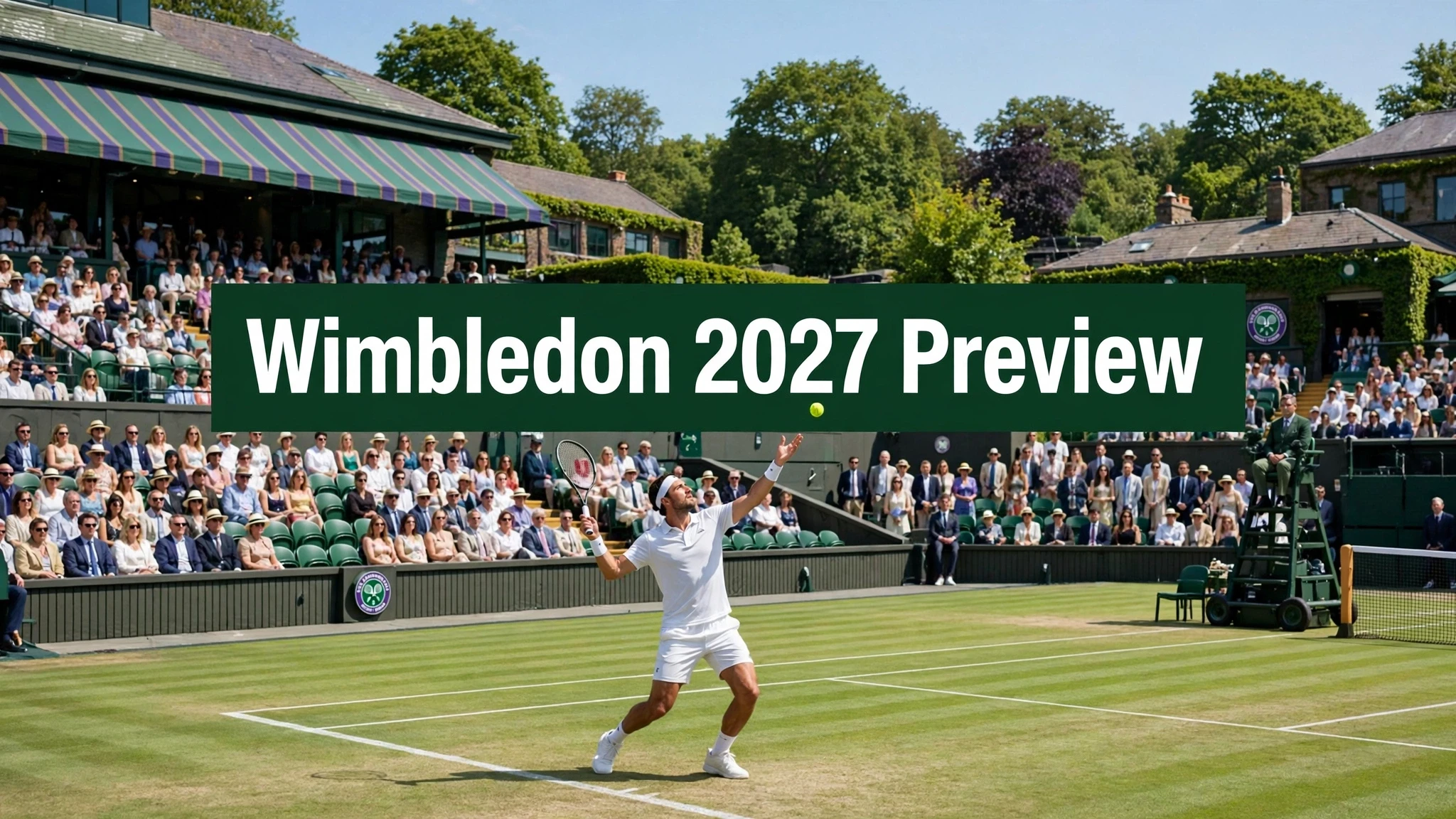
Wimbledon is the oldest tennis tournament in the world, first played in 1877, and it remains the one every player wants to win most, because the grass, the white clothing, the strawberries and the Royal Box carry a history that no other tournament can match. The 2027 edition, expected to run from late June into early July at the All England Club in south-west London, arrives with a men’s draw led by Carlos Alcaraz, who has won the title twice, and Jannik Sinner, the world number one, and a women’s draw where the grass-court specialists and the big servers always have a chance to surprise. Grass is the fastest surface in tennis, the ball stays low, the rallies are short, and a big serve can win points that would be lost on clay. That is why Wimbledon produces different winners from the French Open, and why a player ranked outside the top ten can reach the second week if their game suits the grass. This preview looks at the favourites, the dark horses, the draw, the British hopes, and the small details, from the roof on Centre Court to the queue for tickets, that make Wimbledon unlike any other sporting event.
The Men’s Favourites: Alcaraz, Sinner and the Chasers
Carlos Alcaraz arrives as the player to beat on grass, because he has won Wimbledon twice and his game is built for the surface: a huge forehand, a soft drop shot that dies on grass, and movement that lets him slide into shots other players cannot reach. He is also the most exciting player to watch, because he plays with a freedom that makes the crowd gasp, and he has beaten the best players on the biggest stages before his twenty-fifth birthday. Jannik Sinner, the world number one, is the other favourite, because his flat, powerful groundstrokes stay low on grass, his serve has improved every year, and his calm under pressure has made him the most consistent player in the world. Sinner reached the Wimbledon semi-finals before winning his first Grand Slam titles elsewhere, and his rivalry with Alcaraz, which has already produced some of the best matches of the decade, is the story that defines men’s tennis in 2027.
The Women’s Draw: Power, Variety and Surprises
The women’s tournament at Wimbledon is often the most unpredictable Grand Slam, because grass rewards a big serve and a willingness to come to the net, and several players outside the top ten have the game to win it. Iga Swiatek, the world number one for much of the last three years, is the most consistent player in the world, but grass is her weakest surface, because her heavy topspin sits up on the bounce and gives her opponents time to attack. Aryna Sabalenka, with the biggest serve and the most powerful groundstrokes in the women’s game, is a natural favourite on grass, because her first serve wins free points and her forehand can end rallies in two shots. Coco Gauff, who won the US Open and reached the Wimbledon fourth round as a fifteen-year-old in 2019, has the speed, the fighting spirit and the grass-court experience to win, and her improvement on serve has made her a threat on every surface.
Why Grass Changes Everything
Grass is the fastest surface in tennis, and it changes the game in ways that are invisible on television but obvious to the players. The ball bounces lower than on clay or hard courts, it skids through the court, and it stays low on the return, which means a player who stands far behind the baseline, as many do on clay, will be rushed and will hit the ball late. The rallies are shorter, the serve matters more, and the player who can volley, who can hit a slice that stays low, and who can move forward to finish points will win more often than the player who waits. The grass itself changes through the fortnight: in the first week it is green, firm and fast, while in the second week the baseline areas wear down to bare earth, the bounce becomes uneven, and the player who can adapt to bad bounces wins. That is why Wimbledon rewards experience, because a player who has played the tournament before knows how the court will change and plans for it.
The Draw, the Seeds and the Dangerous Floaters
The draw, which is held a few days before the tournament, decides who plays whom, and a kind draw can carry a player to the second week while a hard draw can end a favourite’s tournament in the first round. The top thirty-two players are seeded, which means they cannot meet each other until the third round, and the top eight cannot meet each other until the quarter-finals, but the unseeded players, called floaters, can be dangerous. A big server ranked outside the top fifty, a grass-court specialist who plays only a few tournaments a year, or a young player with nothing to lose can beat a seed in the first round, and Wimbledon has a long history of such upsets. The draw also matters for the British players, who receive wild cards into the main draw, and for the qualifiers, who have already won three matches in the week before the tournament and arrive in form. Once the draw is made, the paths to the final become clear, and the analysts will argue about which half is harder, which quarter is the group of death, and which favourite has the easiest route.
British Hopes and the Home Crowd
British hopes at Wimbledon always carry a special weight, because the home crowd wants a British champion and the tournament has produced only a handful in the modern era. Andy Murray, who won the title in 2013 and 2016, retired in 2024, and his absence leaves a gap that the next generation must fill. Jack Draper, the British number one, is the best hope, because he is tall, left-handed, has a big serve and a powerful forehand, and he has reached the second week of Grand Slams, but he must stay fit, because injuries have interrupted his progress. Emma Raducanu, who won the US Open in 2021, remains the most famous British women’s player, and her grass-court game, with a flat backhand and a willingness to attack, suits Wimbledon, but she too has struggled with injuries and consistency. The crowd on Centre Court, on Court One, and on Henman Hill, the grass bank where fans watch on a big screen, will support every British player, and that support can lift a player to a win they would not achieve elsewhere.
Tickets, the Queue and the Wimbledon Experience
Wimbledon is famous for the Queue, where fans camp overnight for tickets, and the tradition is part of the tournament’s charm. The Queue opens days before the tournament, fans are given a numbered card, and they wait, often in tents, for the chance to buy a ground pass or a show-court ticket on the day. The ballot, which is held months in advance, is the other way to get tickets, and it is oversubscribed every year, because demand far exceeds supply. A ground pass, which gives access to the outside courts but not to Centre Court, is the best value, because it lets a fan watch several matches in a day, see young players up close, and enjoy the atmosphere of the grounds. Inside, the traditions are strict: players wear white, the Royal Box is reserved for guests, strawberries and cream cost a set price, and the roof on Centre Court, which was added in 2009, means play can continue in the rain. The experience is unlike any other in sport, and it is why Wimbledon sells out every year.
What to Watch in the Second Week
The second week of Wimbledon is when the tournament becomes a test of nerve as much as skill, because the courts are worn, the pressure is highest, and the players who remain are all capable of winning. The quarter-finals, which are played on the middle Tuesday and Wednesday, often produce the best matches, because the favourites meet the dark horses and the styles clash. The semi-finals on Centre Court, played on the Thursday and Friday, are the most atmospheric matches in tennis, with the crowd, the history, and the knowledge that a place in the final is at stake. The finals, the women’s on Saturday and the men’s on Sunday, are watched by millions around the world, and the men’s final, which is best of five sets, can last for five hours, as the 2019 final between Novak Djokovic and Roger Federer did, lasting almost five hours and decided by a tie-break in the fifth set. The player who wins Wimbledon will have survived two weeks of grass, rain, pressure and expectation, and that is why the title means more than any other in tennis.
The Grass-Court Season Before Wimbledon
Wimbledon is not played in isolation, because the grass-court season begins a few weeks earlier, with tournaments at Queen’s Club in London, at Halle in Germany, and at Eastbourne on the south coast, and those events are where players learn to play on grass again. The Queen’s Club tournament, which is played the week after the French Open, is the most important warm-up, because it is played on grass in London, with a strong field, and the winner often does well at Wimbledon. Halle, in Germany, is the other key event, and it has been won by Roger Federer ten times, which shows how much the great grass-court players valued it. Players who do well in these warm-up events arrive at Wimbledon with confidence, with matches on grass in their legs, and with a feel for the low bounce, while players who skip them, or who lose early, arrive cold and often lose early at Wimbledon too. The warm-up season is short, only three weeks, and it is intense, because the change from clay to grass is the hardest change in tennis.
Novak Djokovic and the Old Guard
Novak Djokovic, who has won Wimbledon seven times, remains a threat in 2027, even though he is in his late thirties, because his grass-court game is built on the things that do not fade with age: a great return, a great backhand, and a mental strength that no other player can match. Djokovic has reached the Wimbledon final in his last several appearances, and he has beaten Alcaraz and Sinner on grass before, so no one should write him off. His body is the question, because injuries have interrupted his recent seasons, and a long tournament, with seven best-of-five matches, is a test of fitness as much as skill. If he is fit, he can win, and if he wins, it would be his eighth Wimbledon title, equalling Roger Federer’s record, and that would be one of the great achievements in tennis history. The old guard, including Djokovic and the other veterans, are fighting against time, and Wimbledon is where they have the best chance to turn back the clock.
The Doubles, the Juniors and the Other Stories
Wimbledon is not only about the singles, because the doubles, the mixed doubles, the juniors, and the wheelchair events all have their own stories, and they are worth watching. The doubles is played by specialists who have spent their careers learning to volley, to serve, and to play as a team, and the matches are fast, exciting, and often decided by a single break of serve. The juniors, who play on the outside courts, are the future of the sport, and many of the great champions, from Federer to Alcaraz, played the junior event at Wimbledon before they won the senior title. The wheelchair events, which have grown in prestige, feature some of the best athletes in the world, and their matches are played with the same intensity as the singles. These events do not get the same attention as the singles, but they are part of what makes Wimbledon a complete tournament, and a fan who watches them will see tennis at its best.
Weather, the Roof and the Schedule
The weather is the one thing no one can control at Wimbledon, and it has shaped the tournament for more than a century, because London in late June can be sunny, rainy, or both in the same day. The roof on Centre Court, which was added in 2009, and the roof on Court One, added in 2019, mean that the biggest matches can continue in the rain, but the outside courts still stop, and rain delays can push the schedule back by days. The tournament has a rest day on the middle Sunday, which was abolished in 2022, so play now continues every day, and the schedule is tighter than it used to be. Players must be ready to play on consecutive days, to wait for hours in the locker room, and to adapt to a court that is wet, then dry, then wet again. The weather is part of Wimbledon, and the players who handle it best, who stay patient, who stay warm, and who stay focused, are the ones who win.
My Take:
I think Wimbledon is the greatest tournament in tennis, and I say that without hesitation, because it is the only one that has not changed its soul to chase money or fashion. The players still wear white, the grass is still real, the strawberries are still served, and the Royal Box still matters, and those traditions are not quaint, they are the reason the tournament feels special. Other tournaments have changed their surfaces, their schedules, and their rules to suit television, but Wimbledon has changed slowly, and it has kept the things that make it unique. I respect that, because in a world where everything is for sale, a tournament that says, this is who we are, and we will not change for you, is a rare and valuable thing. I would rather watch a tournament with traditions than a tournament with gimmicks, and Wimbledon is the proof that tradition can be a strength, not a weakness.
My strongest feeling is about Carlos Alcaraz, because he is the most exciting player I have seen since Roger Federer, and I do not say that lightly. He plays with a joy that is infectious, he hits shots that should not be possible, and he smiles when he wins a point that would make other players scream. He is also a fierce competitor, because behind the smile is a player who hates to lose, who fights for every point, and who has beaten the best players in the world on the biggest stages. I think he will win Wimbledon again in 2027, because his game is made for grass, and because he loves the tournament, and love matters in sport. A player who loves a tournament plays better there, and Alcaraz loves Wimbledon, which is why I would bet on him before anyone else, even against the world number one.
I also believe the women’s tournament is more interesting than the men’s, and I believe that because it is more unpredictable. In the men’s draw, you can name the winner with reasonable confidence, because Alcaraz and Sinner are so far ahead of the rest. In the women’s draw, ten players could win, and a player ranked outside the top twenty could reach the final, because grass rewards a big serve and a bold game, and several players have those things. That unpredictability is a gift, because it means every match matters, every upset is possible, and the final could be a match no one predicted. I think tennis needs that unpredictability, because a sport where the winner is known before the first ball is hit is a boring sport, and the women’s draw at Wimbledon is never boring.
Another thing I care about is the Queue, because it is the most democratic thing in elite sport. A fan who cannot afford a hospitality package, who did not win the ballot, and who does not know anyone important can still get into Wimbledon by queuing overnight, with a tent, a sleeping bag, and a willingness to wait. That fan will sit on Centre Court next to a celebrity, a royal, and a sponsor, and they will have earned their seat by waiting, not by paying. I think that is beautiful, and I think it is why Wimbledon feels different from other tournaments, where money buys everything. The Queue says that patience and passion matter, and I would like to see more sporting events keep a place for the fan who is willing to wait, because that fan is the heart of the sport.
Finally, I think grass-court tennis is the purest form of the game, because it rewards the skills that tennis was invented for: the serve, the volley, the slice, and the ability to move forward. On clay, a player can win by standing ten metres behind the baseline and hitting the same shot for an hour, and that is a skill, but it is not the whole game. On grass, a player must come forward, must volley, must adapt to bad bounces, and must think quickly, because the ball is back before you have time to plan. I love that, because it makes the matches shorter, sharper, and more exciting, and it produces points that make the crowd stand up. I hope grass-court tennis never disappears, because if it does, tennis will lose a part of its soul, and Wimbledon is the place that keeps that soul alive.
I also think Novak Djokovic deserves more respect than he gets, because he has won seven Wimbledon titles, he has beaten Federer and Nadal on their best surfaces, and he has done it with a game that is built on resilience rather than beauty. People call him the third man, behind Federer and Nadal, and that is unfair, because his record is as good as theirs, and his mental strength is greater than either of them. I have watched him win matches he should have lost, come back from two sets down, and save match points with a calm that is almost frightening, and that is the mark of a great champion. I think history will judge him kindly, and I think when he retires, people will realise that they watched one of the greatest players of all time, and that they did not appreciate him enough while he was playing.
There is one more thing I care about, and it is the way Wimbledon treats the players, because the tournament is run by a club, not by a corporation, and that shows in the details. The players are given a locker room that is comfortable, the practice courts are excellent, the food is good, and the staff treat them with respect, which is not always the case at other tournaments. I think that matters, because a player who feels welcome plays better, and Wimbledon, more than any other tournament, makes its players feel welcome. I hope that never changes, because the day Wimbledon becomes just another tournament, run for profit and not for the love of the game, will be a sad day for tennis, and I do not think that day will come soon, because the All England Club understands what it has, and it protects it.
Frequently Asked Questions
When is Wimbledon 2027?
Wimbledon 2027 is expected to run from late June into early July at the All England Club in London, with the finals on the second Saturday and Sunday of the fortnight.
Who are the favourites for Wimbledon 2027?
Carlos Alcaraz and Jannik Sinner lead the men’s betting, while Aryna Sabalenka, Iga Swiatek and Coco Gauff are among the leading contenders in the women’s draw.
Why is Wimbledon played on grass?
Wimbledon has been played on grass since the first tournament in 1877, and grass remains the fastest surface, rewarding big serves, volleys and quick points.
How can I get Wimbledon tickets?
Tickets are available through the public ballot held months in advance, and through the Queue, where fans camp overnight for day tickets and ground passes.
What is the Queue at Wimbledon?
The Queue is the famous overnight waiting line for tickets, where fans receive a numbered card and wait, often in tents, for the chance to buy tickets on the day.
Who won Wimbledon last time?
Carlos Alcaraz won the men’s title twice in recent years, and the women’s champions have included Marketa Vondrousova and Barbora Krejcikova, showing how open the women’s draw can be.