Wolf Alice: The Life Story Behind the Don't Delete the Kisses Band
In this post
Wolf Alice are the kind of band that refuses to stay in one place. One song can be loud and wild, the next can be soft and dreamy, and the next can sound like a folk song from another time. That restlessness is not confusion. It is the sound of four musicians who love many kinds of music and who trust their audience to follow them wherever they go. In a world where many bands find one sound and repeat it forever, Wolf Alice keep moving, and that movement has made them one of the most respected British rock bands of their generation.
The band comes from London, and it is made up of Ellie Rowsell, who sings and plays guitar, Joff Oddie on guitar, Theo Ellis on bass, and Joel Amey on drums. They began in 2010 as a small acoustic duo, Rowsell and Oddie, playing folk songs together. Over time they added Ellis and Amey, and the sound grew louder and bigger, until it became the wild, shifting rock music that people know today. Their songs move between noise and beauty, between anger and tenderness, often in the same track.
Their journey has brought them a Mercury Prize, Grammy attention, and three albums that each sound different from the last. Their debut, My Love Is Cool, arrived in 2015. Their second, Visions of a Life, won the Mercury Prize in 2018. Their third, Blue Weekend, arrived in 2021 and was praised as one of the best British albums of its year. A fourth album, The Clearing, followed in 2025. Through all of it, they have kept the same four members, the same curiosity, and the same belief that a band should never stand still.
A Duo in North London
Ellie Rowsell and Joff Oddie met in London and began making music together in 2010. At first they were a folk duo, playing acoustic guitars and singing quiet songs. Rowsell had a voice that could be soft one moment and sharp the next, and Oddie had a way with guitar that made simple songs sound rich. They played small shows, they wrote songs together, and they learned how to work as a pair. The name Wolf Alice came from a short story, and it suited them: a name that sounded both wild and gentle, like their music would later become.
London in the early 2010s was full of young bands, and it was easy to get lost in the crowd. Rowsell and Oddie did not try to shout louder than everyone else. They tried to write songs that felt honest, and they played them wherever they could. They released early recordings online, and people who heard them noticed the quality of the writing. The songs were about love, about growing up, about the strange feeling of being young in a big city, and they were sung in a voice that sounded like a real person, not a pop star.
As the duo played more, they began to want a bigger sound. A folk duo can only do so much on stage, and the songs they were writing wanted drums and bass. They asked Theo Ellis to join on bass, and then Joel Amey joined on drums, and the band became a four-piece. The change was not sudden. It grew out of the songs themselves, which were getting louder and more restless. The folk roots stayed in the quiet parts, but the loud parts became wilder, and the band found a balance between the two that became their signature.
The early years were hard in the ordinary way that young bands find hard. They had little money, they played small venues, and they travelled in cheap ways. But they also had something that money cannot buy: four people who liked each other and who believed in the same music. That belief kept them going through the small shows and the long nights, and it gave them the patience to build their sound slowly instead of rushing into a record they were not ready to make.
My Love Is Cool and the First Roar
Wolf Alice released their first singles in the early 2010s, and songs like Fluffy, Bros and Moaning Lisa Smile began to win them attention. Bros, a song about childhood friendship, showed their softer side, while Fluffy and Moaning Lisa Smile showed their louder side, with guitars that roared and drums that hit hard. The contrast between the two sides made people curious. Here was a band that could be tender and fierce in the same set, and the audience did not know what would come next.
Their debut album, My Love Is Cool, was released in 2015, and it was praised by critics and loved by fans. The album moved from song to song like a journey through different moods. Giant Peach opened with noise and energy, You’re a Germ was sharp and angry, Silk was soft and dreamy, and Bros closed the record with warmth and memory. The album was nominated for the Mercury Prize, one of Britain’s most respected music awards, and Moaning Lisa Smile was nominated for a Grammy Award in the United States. For a young band, that was a remarkable first step.
Touring for the album took them around the world, and their live shows became famous for their energy. Rowsell sang with a power that could fill a large room, Oddie’s guitar screamed and whispered by turns, and Ellis and Amey drove the songs forward with a rhythm that made crowds move. The band learned how to play to big festival crowds without losing the feeling of a small room. They were loud when the song needed to be loud, and quiet when the song needed to be quiet, and the audience followed every change.
The success of the first album also brought pressure. A band that is praised for its first record must then make a second record that is just as good, or better, and that is a hard task. Wolf Alice did not try to copy My Love Is Cool. They went back to writing, they tried new sounds, and they trusted that their audience would follow them into stranger places. That trust became the story of their second album, which took them even further from where they had started.
Visions of a Life and the Mercury Prize
Visions of a Life was released in 2017, and it was a wilder and more daring record than the first. The album opened with Heavenward, a song that built slowly into a wall of noise, and it moved through songs like Yuk Foo, a short burst of anger, and Don’t Delete the Kisses, a long and beautiful song about a love that might be ending. The album showed a band that was not afraid to be strange, to be loud, or to be quiet for a long time before the noise arrived.
Don’t Delete the Kisses became one of their most loved songs. It is a slow, dreamy track about a person who is not sure whether a relationship is over, and Rowsell sings it with a tenderness that makes the words feel like a private thought. The song was used in films and television, and it became a favourite at live shows, where the crowd often sang along in a soft voice. It showed that Wolf Alice could write a love song that was as powerful as any of their loudest tracks, and that their quiet side was just as strong as their wild side.
In 2018, Visions of a Life won the Mercury Prize, the award for the best British album of the year. Winning the Mercury Prize is a big moment for any British band, because it brings attention from people who might never have heard the band before. For Wolf Alice, it was a recognition of their daring and their growth. They had made a record that was harder to love than the first, and the prize said that the risk had been worth it. The band accepted the award with joy, and they used the attention to reach new listeners around the world.
The years after the Mercury Prize were busy. The band toured the world, they played bigger stages, and they became one of the most respected rock bands in Britain. But they also knew that a prize is not a finish line. It is a moment, and after the moment passes, the band must still write the next songs. They took their time, they rested, and they began to think about what the third album should sound like. That patience would pay off in a record that many people consider their best.
Blue Weekend and a Band Grown Up
Blue Weekend was released in 2021, and it was the sound of a band that had grown up. The album was recorded in Brussels, in Belgium, and it had a warmer and more open sound than the records before it. The songs were about love, about friendship, about the feeling of being in your late twenties and trying to understand your life. The Last Man on Earth, the album’s first single, was a slow and beautiful song about feeling alone in a crowded world, and it became one of their most loved tracks.
The album also included Smile, a sharp and funny song about not letting other people decide who you are, and No Hard Feelings, a soft song about a friendship that has ended without anger. How Can I Make It OK? was another highlight, a song about trying to fix something that is broken. The album was praised by critics as one of the best British records of the year, and it reached the top of the charts in Britain. For a band that had started as a folk duo, it was a remarkable achievement.
Making Blue Weekend during the pandemic gave the album a special feeling. The band had spent long months away from the stage, and the songs carried a sense of longing for the people and places they had missed. When live music returned, they took the album on tour, and the shows felt like a reunion. People who had listened to the songs at home during hard times could now hear them in a room full of strangers, and the shared feeling was strong. The band played with a joy that came from being back on stage after so long away.
The album also showed Rowsell writing with more directness than before. She sang about her own life, about her relationships, and about the pressure of being a woman in a rock band. The band supported that honesty, and the music around her voice gave the words room to breathe. Blue Weekend was not just a collection of songs. It was a picture of a band that had grown from young musicians into adults, and who were not afraid to show that growth in their work.
The Clearing and a New Direction
The band’s fourth album, The Clearing, arrived in 2025, and it showed Wolf Alice moving again. The album had a brighter and more open sound, with songs that drew on pop music and classic rock as well as the band’s own noisy roots. Bloom Baby Bloom, one of the album’s best known songs, was bold and joyful, with a chorus that felt made for a large stage. The record showed a band that was still curious, still willing to try new things, and still writing songs that felt personal.
The Clearing was made with a new producer, and the change in sound was clear. The guitars were still there, and the drums were still strong, but the songs had a lighter touch, with melodies that stayed in the mind. Some fans were surprised by the change, and some loved it at once. That is the story of Wolf Alice in miniature: every album surprises someone, and every album finds new listeners who love the new sound. The band have never tried to please everyone at once. They have tried to please themselves, and the audience has followed.
Touring for The Clearing took them to festivals and concert halls around the world, and the shows mixed the new songs with the old favourites. A crowd that had come for Don’t Delete the Kisses could now sing along to Bloom Baby Bloom as well, and the band played both with the same energy. It was a picture of a band with a long history, one that could look back at its early songs with pride and look forward to new songs with excitement at the same time.
The album also showed that the band’s friendship had lasted. After fifteen years, the same four people were still making music together, still arguing about songs, still laughing on stage. That is rare in rock music, where bands often split when the members grow apart. Wolf Alice have grown together, and their music has grown with them. The Clearing was not an ending. It was another step in a journey that is still going.
Noise, Beauty and the Courage to Change
One of the most interesting things about Wolf Alice is how they balance noise and beauty. Their loudest songs are very loud, with guitars that scream and drums that crash, and their quietest songs are very quiet, with a voice and a guitar and almost nothing else. Most bands choose one side or the other. Wolf Alice choose both, and they move between them without warning. That balance is hard to keep, because a band can easily lose its audience when it changes mood so fast. Wolf Alice keep their audience because the changes feel honest, like the changes in a real person’s mood.
The band’s courage to change is also the reason they have lasted. Many bands find one sound that works and then repeat it until people get bored. Wolf Alice have never done that. Each album sounds different from the last, and each album takes a risk. My Love Is Cool was a wild first step. Visions of a Life was stranger and louder. Blue Weekend was warmer and more grown up. The Clearing was brighter and more open. A listener who follows the band through all four albums hears a group that is always learning, always trying, and always willing to be surprised by its own music.
Their live shows are the best place to understand that courage. On stage, the band can go from a whisper to a roar in a single song, and the crowd follows every change. Rowsell is a singer who can be tender one moment and fierce the next, and the band behind her can match her in both moods. That range is rare, and it is the reason their concerts feel like a journey rather than a single mood repeated for an hour.
The band have also stayed true to their roots in London, even as they have travelled the world. They write about the city, about its streets and its people, and their music carries the feeling of a place where many kinds of people live close together. That sense of place gives their songs a home, even when the music itself travels far from London. It is a reminder that a band can be from somewhere and still belong to the whole world.
Still Moving, Still Four Friends
In the years since their first album, Wolf Alice have become one of the most respected bands in Britain, but they still work like a band that is hungry to learn. They take their time between albums, they try new sounds, and they do not let success decide what the next record should sound like. That independence is part of their story. They have won a Mercury Prize, they have been nominated for a Grammy, and they have played to huge crowds, but they still make decisions as four friends who met in London and who love making music together.
Their influence can be heard in younger British bands who learned from them that a rock band does not need to sound the same on every song. Wolf Alice showed that a band can be loud and soft, angry and tender, strange and catchy, all in the same album. That freedom has helped a new generation of musicians to be braver in their own work. The band never set out to be teachers, but their example has taught a lesson anyway: a band should follow its own curiosity, even when the path is uncertain.
Looking back, the story of Wolf Alice is a story of growth. They started as a folk duo in North London, they became a loud rock band, they won a Mercury Prize, they made a warm and grown up third album, and they made a bright fourth album that pointed to a new future. Through all of it, they stayed together, they stayed curious, and they stayed honest. That is a rare achievement in music, and it is why their songs still matter to the people who first heard them more than ten years ago.
The Band on Stage: Loud, Soft and Everything Between
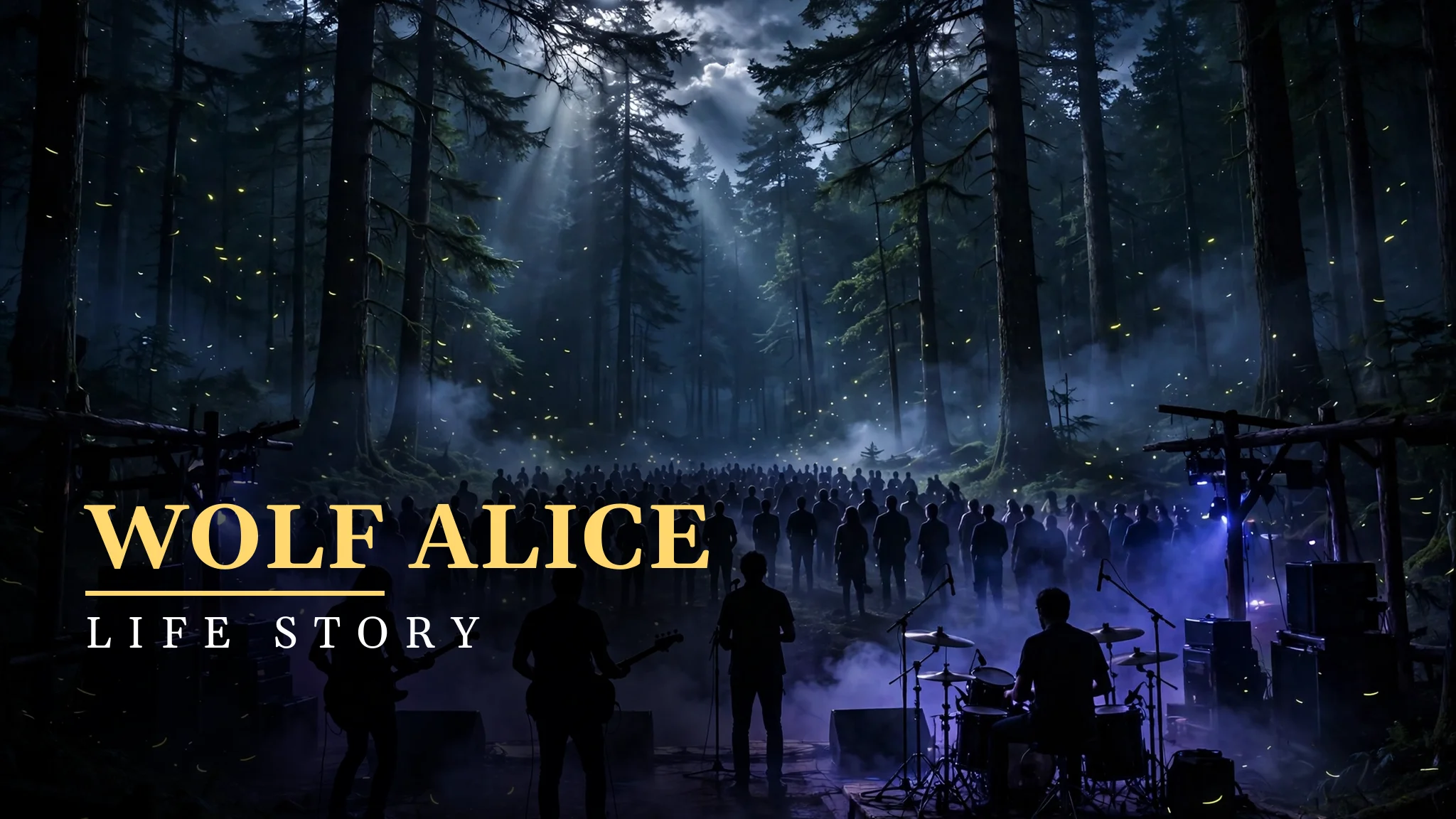
A Wolf Alice concert is a journey, and it is the best way to understand what the band are really about. On stage, they can go from a whisper to a roar in a single song, and the crowd follows every change. Ellie Rowsell sings softly, then she shouts, then she sings softly again, and the band behind her matches her in both moods. That range is rare, and it is the reason their concerts feel like more than just a set of songs. They feel like a story, told in loud and quiet parts, with the audience living through each change.
The band learned how to play live over many years, from small clubs in London to festival fields around the world. In the early days, their sound was loud and wild, and it was easy to make it work on a big stage. The hard part was learning how to play the quiet songs, the ones that need silence and attention, in a large room full of people who want to dance. They solved that problem by trusting the crowd, by playing the quiet songs as if the room were small, and by letting Rowsell’s voice carry the feeling. The audience responded by listening, and that listening became part of the show.
The tours for Blue Weekend and The Clearing showed that lesson even more clearly. By then the band were playing to audiences who had waited through a pandemic, who had listened to the albums at home, and who were glad to be back in a room full of strangers. The shows felt like a reunion, and the band played with a joy that came from being back on stage. When Don’t Delete the Kisses began, the whole room fell quiet, and when Giant Peach began, the whole room jumped. That contrast, quiet and loud in the same night, is the heart of Wolf Alice.
There is also a practical side to their live shows that is easy to miss. A band that changes mood so fast must rehearse carefully, must know each song by heart, and must trust each other on stage. Rowsell, Oddie, Ellis and Amey have played together for fifteen years, and that long friendship shows in the way they move on stage. They watch each other, they listen to each other, and they change together, without a word. That closeness is the reason their shows feel so alive. A concert is not a performance to watch from a distance. It is a conversation between four friends, and the audience is invited to listen.
What I find most interesting about their live shows is how they mix old and new songs. A crowd that came for Bros can now sing along to Bloom Baby Bloom as well, and the band play both with the same energy. That mix shows a band with a long history, one that can look back at its early songs with pride and look forward to new songs with excitement at the same time. It is a picture of a band that has grown up in public, and that is not afraid to show that growth on stage.
The band’s later tours have also shown their sense of humour. They joke on stage, they laugh, they talk to the crowd, and they make the room feel like a small club, even when it is a large hall. That humour is part of why people love them. A band that can laugh on stage is a band that is comfortable with itself, and that comfort makes the audience comfortable too. Wolf Alice have that comfort, and it is the result of fifteen years of playing together, of growing together, and of learning to trust each other.
My Take:
When I listen to Wolf Alice, the first thing I feel is surprise. I never quite know what the next song will sound like, and I like that feeling. Most bands give me a sound and then repeat it until I get bored. Wolf Alice give me a new sound every time, and they trust me to keep up. That trust feels generous. It says that the band believes their audience is clever enough to follow them, and that belief makes me want to listen more carefully. When I hear Don’t Delete the Kisses after hearing Yuk Foo, I do not feel confused. I feel like I am listening to a real band with many moods, the way a real person has many moods.
I think the most admirable part of their story is the way they changed without losing themselves. A folk duo became a rock band, a rock band became a Mercury Prize winner, and a Mercury Prize winner became a band that could write a warm, grown up album like Blue Weekend. Each change could have gone wrong. The folk fans could have left when the guitars got loud. The rock fans could have left when the songs got soft. But the band kept the heart of their music in every change: honest words, a strong voice, and four people playing together with feeling. That is a hard thing to keep, and they kept it.
I also admire Ellie Rowsell as a singer and a writer. She can sing a love song so softly that it feels like a secret, and she can sing a loud song with a power that fills a festival field. That range is rare, and it is the reason the band can move between moods so freely. I think her writing has also grown in a way that matters. On the early albums, she wrote about being young and confused. On Blue Weekend, she wrote about being an adult and trying to understand love, friendship and pressure. That growth feels real, because it is the growth of a person, not just a singer. I respect a writer who lets her audience grow up with her.
There is a sadness in their story, too, and it is the sadness of a band that is sometimes too brave for its own good. Wolf Alice make albums that take risks, and risky albums do not always sell as well as safe ones. Visions of a Life was stranger than My Love Is Cool, and Blue Weekend was softer than Visions of a Life, and each time, some listeners were confused. I think that is unfair, because the band were doing exactly what good artists should do: they were trying something new. But the music world often punishes that bravery, and I worry that a band as good as this one does not always get the attention it deserves. That is not the band’s fault. It is the fault of a world that wants the same song again and again.
Another thing I notice is how much their music depends on the friendship of the four members. Rowsell, Oddie, Ellis and Amey have been together for fifteen years, and that is a long time for any band. Many bands split after a few years because the members want different things, or because fame puts pressure on old friendships. Wolf Alice have stayed together because they still want the same thing: to make music that feels true. I think that friendship is the quiet centre of their story, and it is the reason their music still sounds warm even when it is loud. A band that likes each other plays differently from a band that is only working together for money, and the audience can hear the difference.
I find their Mercury Prize win especially moving, because it was a recognition of risk. Visions of a Life was not an easy album. It was loud, strange, and sometimes difficult to listen to. The prize said that difficulty can be a strength, and that a band should be rewarded for trying something new. I think that message matters for young musicians. It tells them that they do not need to make the safest record to be praised. They can make the record they believe in, and if it is honest, people will notice. Wolf Alice proved that, and I am glad the prize went to a band that had earned it by being brave.
If I have a criticism, it is only that their albums can sometimes feel uneven. Because they try so many different sounds, a single album can have a song I love next to a song I do not understand. That is the price of their curiosity, and I would not want them to lose the curiosity. But I do think a listener who is new to the band can feel lost, because there is no single song that tells you everything about them. You need to listen to a whole album, and then another, before the picture becomes clear. That is not a real fault, though. It is a sign that the band is richer than a single hit, and that richness is worth the effort.
I also think about their live shows, and how exciting they must be. A Wolf Alice concert can go from a whisper to a roar in a single song, and the crowd must feel that change in their bodies. I would love to be in that crowd, to hear the quiet of Don’t Delete the Kisses and then the noise of Giant Peach, and to feel the band move between those two worlds without losing the audience. That is a rare skill, and it is the reason their concerts are talked about with such warmth by the people who have seen them.
When I compare Wolf Alice with other British bands of their generation, what stands out is their refusal to stand still. Many bands from the early 2010s found a sound and stayed with it, and some of them faded when that sound went out of fashion. Wolf Alice kept moving, and that movement kept them fresh. They did not chase fashion, but they were never out of fashion either, because they were always a little ahead of it. That is a clever way to survive in music, and it is also an honest way, because it comes from curiosity rather than calculation.
For a young reader, I think the clearest lesson is about change. Wolf Alice started as a folk duo, and they could have stayed a folk duo forever. Instead, they let their music grow, they added new members, they tried new sounds, and they were not afraid to surprise their own fans. That takes courage, because change can lose you the people who loved the old sound. But it also keeps you alive as an artist. A person who never changes stops growing, and a band that never changes stops mattering. Wolf Alice show that change, done with honesty, is not a betrayal of your past. It is a way of honouring it, by letting it grow into something new.
I also take a personal lesson from their story, and it is about trusting my own taste. Wolf Alice trusted their taste when they made a strange second album, and they trusted it again when they made a soft third album. Each time, the world caught up with them. I think many of us are afraid to trust our own taste, because we worry that other people will not like what we like. Their story says that if the work is honest, the right people will find it. That is a comforting thought, and it is one I will carry with me.
In the end, I think Wolf Alice matter because they prove that a rock band can still surprise us. In a time when so much music sounds the same, they sound like themselves, and themselves keeps changing. Their songs are loud and soft, angry and tender, strange and beautiful, and they hold all of those feelings together without falling apart. That is a rare achievement, and it is why I keep returning to their albums. I never know what I will find, but I know it will be honest, and honesty in music is rarer than it should be.
One more thought stays with me, and it is about the future. I do not know what their fifth album will sound like, and I do not need to know. I trust that it will surprise me, that it will be different from The Clearing, and that it will still sound like four friends from London who love making music together. That trust is something a band earns over many years, and Wolf Alice have earned it. I will keep listening, not because they are the loudest band in the world, but because they are one of the most curious, and curiosity in music is worth more than noise.
I also think about what I would say to a friend who had never heard Wolf Alice. I would not start with their loudest song, because that would hide their soft side. I would start with Bros, a warm song about childhood friendship, and then I would play Don’t Delete the Kisses, and then Giant Peach, and I would let the friend hear how wide the band’s sound is. That is the best way to meet this band: through contrast, through loud and soft, through the full range of what they can do.
There is another lesson in their story that I keep coming back to, and it is about the value of a small and steady team. Wolf Alice have always been four people, with a small group of trusted helpers around them. They have not built a huge machine, they have not hired an army, and they have not let the business of music take over the music itself. That smallness is a choice, and it is a brave one in an industry that rewards size. It tells me that a person does not need a large team to do good work. They need a few people they trust, a clear idea, and the patience to keep going.
I also wonder what their next album will sound like, and I find that I do not mind not knowing. Some bands make me want to guess, to predict, to follow every rumour. Wolf Alice make me want to wait. I trust that when the record comes, it will surprise me, it will be different from The Clearing, and it will sound like them. That trust is a rare thing to feel about a band, and it is the result of fifteen years of good work. A band that has never let me down earns the right to be waited for.
When I think about Ellie Rowsell’s voice, I think about how it has changed over the years. On the first album it sounded young and fierce, as if she were testing the strength of her own voice. On Blue Weekend it sounded warm and sure, as if she knows exactly what her voice can do. That change is not about technique. It is about confidence, and confidence grows slowly, through years of singing, through years of facing a crowd, through years of learning that your voice is worth hearing. I find that growth hopeful, because it shows that a voice, like a person, can become stronger with time.
I also think about the listeners who found this band during hard times. Many people discovered Wolf Alice when they were young, when they were confused, when they needed a band that sounded like their own feelings. Those listeners did not find the band at a party. They found them in a bedroom, with headphones on, and the songs stayed with them when they grew up. That is a special kind of success: not a hit that everyone hears at once, but a song that finds the right person at the right time, and stays.
If I could ask the band one question, I would ask them how they decide when a song is finished, when it is loud enough, when it is soft enough, when it is ready. I suspect the answer would be simple: they listen, they argue, they wait, and they trust each other. That simplicity is the heart of their story, and it is the reason their music still sounds honest. A band that listens to itself will always sound true, and truth is the rarest sound in popular music.
In the end, what I carry from Wolf Alice is a feeling of freedom. Their music does not stay in one place, it does not follow one rule, and it does not try to be everything at once. It is a wild, curious sound, made by four friends who listen to each other, and it reaches people all over the world. That is enough, and it is more than enough. It is a reminder that curious work, done with care, can still be heard, even in the noisiest of times.
Frequently Asked Questions
How did Wolf Alice form?
Wolf Alice began in London in 2010 as an acoustic folk duo of Ellie Rowsell and Joff Oddie. They later added Theo Ellis on bass and Joel Amey on drums, and the sound grew from quiet folk songs into loud, shifting rock music.
What is Wolf Alice’s most famous song?
Don’t Delete the Kisses is one of their most famous songs, a slow and dreamy track from Visions of a Life about a love that might be ending. Bros, Moaning Lisa Smile and The Last Man on Earth are also well known songs from different albums.
Which album won Wolf Alice the Mercury Prize?
Visions of a Life, released in 2017, won the Mercury Prize in 2018. The album was praised for its daring mix of loud noise and soft beauty, and the prize brought the band to a much wider audience.
What albums has Wolf Alice released?
Their studio albums are My Love Is Cool from 2015, Visions of a Life from 2017, Blue Weekend from 2021, and The Clearing from 2025. Each album sounds different from the last, moving from wild rock to warm, grown up songwriting.
Who sings for Wolf Alice?
Ellie Rowsell is the lead singer and also plays guitar. She is known for a voice that can be soft and tender one moment and powerful and fierce the next, and she writes many of the band’s songs with Joff Oddie.
Where does the name Wolf Alice come from?
The name comes from a short story, and the band chose it in their early days as a duo. It suited their music, which mixes wild and gentle feelings, like a wolf that is both fierce and soft.
Is Wolf Alice still together and touring?
Yes, the same four members have stayed together since the band became a four-piece, and they have continued to release albums and tour, including shows for The Clearing in 2025. Their live shows remain known for moving between quiet and loud in a single set.


