Wong Kar-wai: The Life Story Behind the Romantic Dream Director
In this post
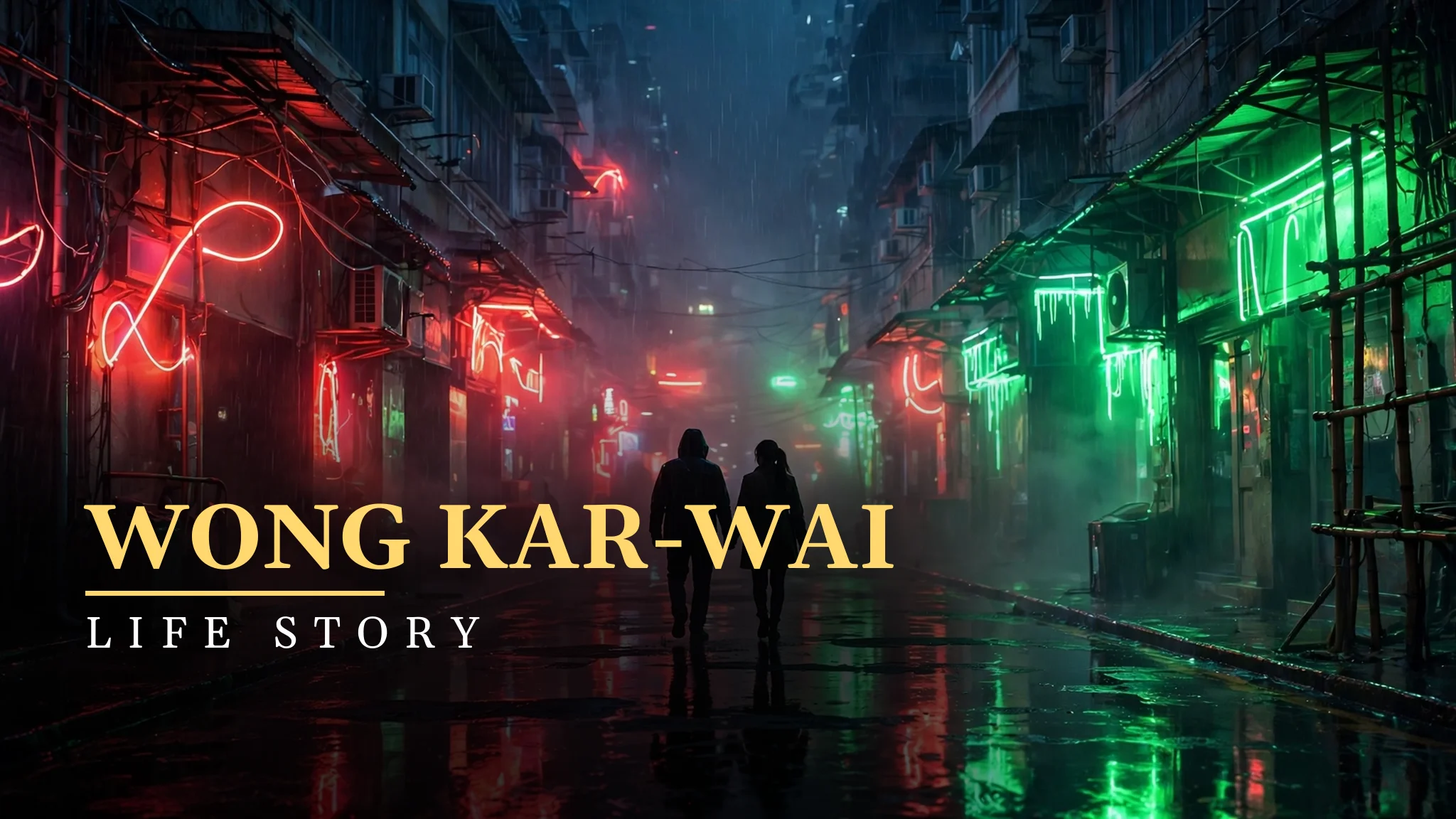
If you have ever walked through a city at night in the rain, past neon signs and closed shops, and felt both lonely and alive at the same time, then you have already felt a Wong Kar-wai film. His films do not rush. They drift, they glow, and they linger on small things, a clock on a wall, a bowl of noodles, a hand almost touching another hand, and somehow those small things carry more feeling than a loud argument or a car chase. Wong is one of the most loved directors in world cinema, and his films about love and time have made him a legend far beyond Hong Kong.
Wong Kar-wai was born on 17 July 1958 in Shanghai, China, and he moved to Hong Kong with his family in 1963, when he was five years old. The move shaped his whole life, because Hong Kong in the 1960s was a crowded, fast, noisy city full of people who had come from somewhere else, and a child who arrived from Shanghai would always feel a little bit like an outsider, even in his own home. His mother took him to the cinema often, and those visits became his first school. He sat in the dark and watched stories from around the world, and he learned that a film could be a place to hide, a place to dream, and a place to feel things that were hard to say out loud.
What makes Wong different from almost every other famous director is that he works without a finished script. He starts with an idea, a mood, or a few pages, and he discovers the film while he is shooting it, letting the actors, the city, and the light change the story as they go. That way of working drives producers mad and makes his films take years, but it also gives them their special feeling, the sense that something real is happening in front of the camera, something that was not planned in an office months before. His films feel like memories, and memories are never neat.
Shanghai, a Move, and a Childhood in the Cinema
Wong was born in Shanghai, a great port city in China, and his early childhood there was brief. In 1963, when he was five, his family moved to Hong Kong, which was then a British colony, and the family settled in Tsim Sha Tsui, a busy district in Kowloon. The move was not easy for a small child. He spoke Shanghainese at home, while Hong Kong spoke Cantonese, and the streets, the schools, and the food were all different. He has said that he felt like a stranger in his new home, and that feeling of being slightly out of place never left him. It became the quiet centre of his films, where characters often live in a city that is home and not home at the same time.
His mother was the person who opened the door to cinema for him. She took him to films often, and they watched all kinds of movies together, from Hollywood films to Chinese opera films to European art films. In those days, Hong Kong cinemas showed films from many countries, and a child who went often could see the whole world from a single seat. Wong learned to love the dark of the cinema, the way the light from the screen fell on the audience, and the way a story could make a room full of strangers feel the same thing at the same time.
At school, Wong was a quiet student who read a great deal, and he was drawn to books and pictures as much as to films. He did not grow up in a film family, and there was no obvious path from his childhood to a career as a director. Hong Kong in the 1960s and 1970s was a city of trade, factories, and hard work, and a boy who wanted to make films had to find his own way. Wong found it slowly, through reading, through watching, and through a growing sense that the stories he loved most were the ones about people who missed each other, who arrived too late, or who loved someone they could not keep.
After school, he studied graphic design at Hong Kong Polytechnic, and that training shaped his eye for colour, shape, and composition. A graphic designer learns to think about how a picture is put together, where the eye goes first, and how a single colour can change a mood. All of that appears in Wong’s films, where the frame is always carefully built, where a red dress or a green wall is never an accident, and where the city itself becomes a kind of design, full of neon, rain, and reflections. He did not study film at university, and in some ways that freed him. He learned cinema by watching it, not by being told how it should be done.
Television Writing and the Road to the Director’s Chair
Wong began his working life in television, writing scripts for TVB, the big Hong Kong television station, in the early 1980s. Television writing taught him how to build a scene, how to write dialogue that sounds natural, and how to work fast under pressure. It also taught him what he did not want to do. Television in those days was made quickly and cheaply, and the stories were often simple. Wong wanted something slower, stranger, and more beautiful, and he began to dream of making films of his own.
He also worked as a scriptwriter for films, and he learned how the Hong Kong film industry worked from the inside. Hong Kong cinema in the 1980s was booming, with action films, comedies, and gangster films filling the cinemas, and a young writer could find work if he was fast and reliable. Wong was both, and he built a reputation as a writer who understood character and mood. But writing for other directors was not enough. He wanted to control the camera, the light, and the rhythm of a film, and he began to look for a chance to direct.
That chance came in 1988, when he directed his first feature film, As Tears Go By. The film was a gangster story, the kind of film Hong Kong audiences loved, but Wong made it his own. It starred Andy Lau as a young gangster torn between loyalty to his friends and love for his cousin, played by Maggie Cheung, and it had a tenderness and a sadness that most gangster films did not have. The film was a success, and it showed that Wong could work inside a popular genre and still make something personal. It also introduced two actors who would become central to his later work, Andy Lau and Maggie Cheung.
As Tears Go By was only the beginning, and Wong knew it. He had proved he could direct, but he had not yet made the film that was truly his. That film would come two years later, and it would be a very different kind of story, a film about young people in Hong Kong who drift through the city looking for love and finding only brief moments of it. The film would not be a commercial hit, but it would change Hong Kong cinema, and it would set Wong on the path that made him famous.
Days of Being Wild and the First True Wong Film
Days of Being Wild, released in 1990, is the film where Wong Kar-wai truly became Wong Kar-wai. The story follows Yuddy, a young man played by Leslie Cheung, who drifts through Hong Kong in 1960, moving from one woman to another, looking for his birth mother and for a place to belong. The film has almost no plot in the usual sense. It is a series of moments, a dance in a flat, a phone call that is never answered, a train journey that goes nowhere, and those moments add up to a portrait of youth, restlessness, and loneliness that feels true in a way a tidy story never could.
The film was a commercial failure, and it was famously difficult to make, with long shoots and a director who kept changing his mind. But it won awards in Hong Kong, and it introduced the team that would define Wong’s career, the cinematographer Christopher Doyle, whose camera moves like a dancer, and the editor and production designer William Chang, who shaped the look and the rhythm of the film. It also introduced Tony Leung, who appears in a brief scene at the end, a scene that was meant to set up a sequel that was never made, and that has become one of the most famous endings in Hong Kong cinema.
Days of Being Wild matters because it shows Wong’s central theme for the first time in full, the idea that people are like birds without legs, always flying and never landing, always looking for a home they cannot find. Yuddy tells a story about a bird that can never land, and the film itself is like that bird, beautiful, restless, and always moving. The film also captures Hong Kong in 1960, a city of crowded flats, dance halls, and neon, and it does so with a warmth and a sadness that make the city feel like a character in its own right.
After Days of Being Wild, Wong was known as a serious artist, but he was also known as a difficult director who took too long and spent too much money. He needed a success, and he needed to prove that his way of working could produce a film that audiences loved. That proof would come in the most unlikely way, from a small, fast film made while he was waiting for another, bigger film to be finished.
Chungking Express and the Film Made in Six Weeks
In 1994, while he was struggling to finish a large martial arts film called Ashes of Time, Wong decided to make a small film quickly, to clear his head and to try something new. That film was Chungking Express, and it was shot in just six weeks, with a small crew and a sense of freedom that his bigger films did not have. The film tells two stories, both about policemen in Hong Kong who have just been left by their girlfriends, and both about the strange, brief connections they make with women they meet by chance.
The first story follows a policeman played by Takeshi Kaneshiro, who falls for a mysterious woman in a blonde wig, played by Brigitte Lin, who is involved in drug smuggling. The second story follows another policeman, played by Tony Leung, who is watched and then loved by Faye, a young woman who works at a snack bar, played by the pop star Faye Wong. The film is funny, sad, and full of life, and it is shot in a way that makes Hong Kong feel like a dream, with blurred lights, fast motion, and moments of stillness that stop the viewer in their tracks.
Chungking Express became a huge success, both in Hong Kong and around the world, and it is now one of the most loved films of the 1990s. It showed that Wong could be playful as well as sad, and that his way of working, fast, improvised, and open to chance, could produce a film that felt alive in a way a carefully planned film never could. The film’s use of the song California Dreamin’, played again and again by Faye Wong’s character, became famous, and the film’s images of Hong Kong at night, full of neon and rain, have been copied by filmmakers ever since.
The film also showed Wong’s gift for working with actors. Faye Wong had never acted in a film like this before, and her performance is natural, funny, and touching, a young woman who is shy and bold at the same time. Tony Leung gives a quiet, gentle performance as a man who is lonely without quite knowing it, and Takeshi Kaneshiro is charming and sad as a man who counts down the days until his heartbreak expires, like a can of pineapple with a date on it. That image, of love with an expiry date, is one of the most famous in Wong’s work, and it captures his whole view of romance in a single picture.
Happy Together, 2046, and the Longest Loves
Wong followed Chungking Express with Fallen Angels in 1995, a film about a hitman who wants to quit and a woman who is obsessed with him, and it was another success, full of the same restless energy and visual beauty. But his next great film was Happy Together, released in 1997, a story about two men from Hong Kong, played by Leslie Cheung and Tony Leung, who travel to Argentina and try to start their relationship again, only to find that love is harder to repair than they thought. The film won Wong the Best Director award at the Cannes Film Festival, and it was a bold, honest film about a gay relationship at a time when such stories were rarely told so openly in Hong Kong cinema.
Happy Together is a film about distance, both the distance between Hong Kong and Buenos Aires and the distance between two people who love each other but cannot live together. The film is shot in a rough, handheld style, and it feels raw and real, like a home movie that has been turned into art. It also carries a quiet sadness about Hong Kong itself, because 1997 was the year Hong Kong was handed back to China, and many people in the city were thinking about what home meant and where they belonged. Wong does not make a political film, but the feeling of a city at a turning point runs through the whole story.
In 2000, Wong released In the Mood for Love, the film that made him a legend. The story is set in Hong Kong in 1962, and it follows two neighbours, a man played by Tony Leung and a woman played by Maggie Cheung, who discover that their spouses are having an affair with each other. The two neighbours spend time together, sharing meals, walking to buy noodles, and slowly falling in love, but they never act on it in the usual way. The film is about what is not said, what is not done, and what is almost touched, and it is one of the most beautiful and most painful films ever made about love.
In the Mood for Love took years to make, and Wong shot it without a finished script, letting the story grow as he filmed. The result is a film of extraordinary beauty, with Maggie Cheung in a series of elegant dresses, Tony Leung in a quiet, restrained performance, and the music of Nat King Cole playing in the background. The film won awards around the world, and it is now regularly named one of the greatest films of all time. It also gave Wong his most famous image, two people standing in a narrow corridor, close enough to touch, and choosing not to.
Wong followed it with 2046 in 2004, a film that continues the story of Tony Leung’s character and imagines a future where people travel to a place called 2046 to recover lost memories. The film is dreamlike and complex, and it was not as widely loved as In the Mood for Love, but it showed Wong’s ambition and his willingness to take risks with time, memory, and science fiction. It also showed that he was still fascinated by the same questions, what we remember, what we lose, and whether love can survive time.
The Grandmaster, Blossoms, and a Slower Later Life
After 2046, Wong took his time, as he always does, and his next film was The Grandmaster, released in 2013, a martial arts film about Ip Man, the teacher of Bruce Lee. The film stars Tony Leung as Ip Man and Zhang Ziyi as a fellow martial artist, and it is a film of great beauty, with fight scenes that move like dances and a story about honour, loss, and the end of an old China. The film was a success in China and around the world, and it showed that Wong could take a popular genre and make it his own, just as he had done with the gangster film in As Tears Go By.
The Grandmaster also showed Wong’s interest in history. The film is set in the 1930s and 1940s, a time when China was changing fast, and its martial arts schools were disappearing. Ip Man is a man who holds on to an old code in a world that no longer values it, and that theme, of a person who belongs to a time that has passed, runs through all of Wong’s films. The film took years to make, and there are several different versions of it, which is typical of Wong, who is never quite finished with a film and who keeps cutting and changing it long after most directors would have stopped.
In 2023, Wong returned to television with Blossoms Shanghai, a long series set in Shanghai in the 1990s, about a young man who rises from nothing to become a wealthy businessman. The series was a huge hit in China, and it showed that Wong’s style, his love of colour, music, and longing, could work on a long television scale as well as in a two-hour film. It also brought him back to Shanghai, the city where he was born, and it felt like a homecoming, a return to the place where his story began.
Wong is now in his late sixties, and he works more slowly than ever, but he remains one of the most respected directors in the world. He is known for his sunglasses, which he wears in public, and for his quiet, thoughtful way of speaking about his work. He lives in Hong Kong, and he continues to plan new films, even if they take years to appear. His influence can be seen in films from many countries, where directors copy his colours, his music, and his way of filming love, but none of them quite capture the feeling of his work, because that feeling comes from his own life, his own sense of being an outsider, and his own belief that the most important moments in love are the ones that almost happen.
Blossoms Shanghai also deserves a longer look, because it showed a side of Wong that film alone had never quite revealed, his ability to build a world over many hours. In a film, he has two hours to make you feel longing. In a series, he has dozens of hours, and he uses them to show a whole city changing, a young man learning how to survive in a world of money and power, and a group of people whose lives cross and separate again and again. The series is set in the Shanghai of the 1990s, a time of fast growth and new wealth, and it is full of the same details that make his films so rich, the clothes, the food, the music, and the way a room can feel warm one minute and lonely the next. Viewers in China loved it, and it reminded the world that Wong’s way of seeing, slow, beautiful, and full of feeling, works on any scale.
My Take:
I think Wong Kar-wai makes films for people who have loved someone and lost them, or loved someone and never quite told them, and that is almost everyone. I have watched In the Mood for Love more times than I can count, and every time I notice something new, a look, a pause, a dress, a song, and every time I feel the same ache. That ache is the heart of his work. He does not make films about love that works out. He makes films about love that almost works out, and that almost is more painful and more beautiful than a happy ending could ever be. I think that is why his films stay with me. They tell the truth about how love actually feels, which is often quiet, unfinished, and full of things left unsaid.
What I admire most is his patience. He takes years to make a film, and he shoots without a finished script, and most directors would be terrified to work that way. I would be terrified. But Wong trusts the process, he trusts his actors, and he trusts the city to give him the film he needs. That trust is a kind of faith, and it produces films that feel alive in a way a tightly planned film never can. When I watch Chungking Express, I can feel the freedom in it, the sense that the camera is discovering the story at the same time as the audience. That feeling is rare, and it is worth the years of waiting.
I also admire his eye. I do not think any living director films a city as beautifully as Wong films Hong Kong. The neon, the rain, the crowded streets, the small flats with their clocks and curtains, all of it glows in his films like a dream. He makes Hong Kong feel both real and magical, a place where a chance meeting in a snack bar can change a life, and where a walk to buy noodles can be the most romantic scene in cinema. I have never lived in Hong Kong, but his films make me feel as if I have, and they make me miss a city I have never visited. That is a strange and wonderful gift.
His theme of time moves me deeply. His characters are always looking at clocks, checking expiry dates, counting down days, and trying to hold on to a moment that is already slipping away. In Chungking Express, a man treats his heartbreak like a can of pineapple with a date on it, as if love could be kept fresh if you are careful enough. In 2046, people travel to a place where memories never change, because the present is too painful to live in. In In the Mood for Love, two people meet at the wrong time, and the film is about the sadness of that wrongness. I think Wong understands something that many of us learn too late, which is that time is the real enemy of love, not another person, not a mistake, but simply the fact that moments pass and cannot be brought back.
I love the way he films almost-touching. In In the Mood for Love, Tony Leung and Maggie Cheung stand close together in a narrow corridor, they share a meal, they walk side by side, and they never kiss, never hold hands, never say the words that are in their hearts. And yet the film is one of the most romantic I have ever seen, because the restraint makes the feeling stronger. A kiss would be easy. Not kissing, and letting the audience feel the weight of that choice, is much harder, and much more honest. I think Wong knows that desire is often strongest when it is held back, and he films that held-back desire with a tenderness that few directors can match.
His collaboration with Christopher Doyle deserves a long thought, because Doyle’s camera is half of what makes a Wong film a Wong film. Doyle moves the camera like a dancer, he lets lights blur and smear, and he finds beauty in a crowded street at night that most people would walk past without noticing. Together, Wong and Doyle created a look that has been copied around the world, but the copies never quite work, because they copy the colours without copying the feeling. The feeling comes from two artists who trust each other and who share a way of seeing the world, and that trust cannot be copied. I am sad that they worked together less in later years, but the films they made together will last forever.
I also think about his background as an outsider, because it explains so much of his work. He was born in Shanghai and moved to Hong Kong as a child, and he has said he felt like a stranger in his new home. His characters are strangers too, people who live in a city but do not quite belong to it, people who speak a different language at home, people who are always looking for a place to land. That feeling of being slightly out of place is one I recognise, and I think many viewers recognise it too, even if they have never moved countries. We have all felt like outsiders at some point, and Wong films that feeling with a kindness that makes it feel less lonely.
If I am honest, his films are not for everyone, and they are not always easy to watch. They are slow, they have little plot, and they can feel confusing if you expect a clear story with a clear ending. I have shown In the Mood for Love to friends who found it boring, and I understand why. If you want action, twists, and a happy ending, Wong will disappoint you. But if you are willing to slow down, to watch faces and listen to music, and to let a film wash over you like a song, then his work opens up in a way few other films do. I think that is a fair trade. He asks for patience, and he rewards it with beauty.
I also wonder sometimes whether his way of working is too slow for its own good. He takes years to make a film, and some of his projects never appear at all. Fans wait and wait, and the waiting can turn into frustration. I understand that frustration, because I have waited for his films too. But I also think the slowness is part of the work. A film like In the Mood for Love could not have been made in six weeks. It needed time, it needed the actors to live with their characters, and it needed Wong to discover the story as he went. The years are not wasted. They are the film.
What I learn from Wong is that a small moment can carry a whole story. A bowl of noodles, a song on a jukebox, a dress, a clock, a hand that almost touches another hand, these are the things his films are made of, and they are enough. He teaches me to pay attention to the small things in my own life, because the small things are often where the feeling lives. A big event can be forgotten, but a small moment, a walk in the rain, a shared meal, a song heard at the wrong time, can stay with you for years. That is a lesson I carry with me, and it makes my own life feel richer.
I think about Happy Together often, because it is a film about two men who love each other and cannot make it work, and it was made at a time when such a story was brave to tell in Hong Kong. Wong did not make a film about being gay. He made a film about being in love and being lonely, and the fact that the lovers are two men is simply part of the story, not a message. That feels right to me. Love is love, and loneliness is loneliness, and a good film does not need to explain that. It just needs to show it honestly, and Happy Together does.
In the end, I think Wong Kar-wai is a director for the night, for the rain, for the moments when you are alone in a city and thinking about someone you miss. His films do not give answers. They give moods, and those moods stay with you long after the film ends. I will keep watching them, and I will keep recommending In the Mood for Love to anyone who has ever loved someone at the wrong time, which is to say, to almost everyone I know. His films remind me that love is often a matter of timing, that timing is often cruel, and that the beauty of a moment is not lessened by the fact that it passes. It is made greater by it.
I keep thinking about the music in his films, because it is not background noise. It is memory itself. When Nat King Cole sings in In the Mood for Love, the song does not just fill a room, it fills a whole era, and it makes the audience feel the 1960s in a way a history book never could. When Faye Wong’s character plays California Dreamin’ again and again in Chungking Express, the repetition is not a joke, it is a picture of a young woman who is stuck on a song the way she is stuck on a feeling. Wong chooses his songs the way other directors choose their actors, with care, and he lets a song carry a scene that words could not carry. I have added his soundtracks to my own listening, and they bring back the films every time I hear them.
His work with Tony Leung also deserves more thought, because Leung is the actor who appears most often in Wong’s world, and their partnership is one of the great ones in cinema. Leung is a quiet actor, a man who can say more with a look than most actors can say with a speech, and Wong gives him room to be quiet. In Chungking Express he is a lonely policeman who talks to the objects in his flat. In In the Mood for Love he is a man who holds back his feelings until it is too late. In 2046 he is a writer who cannot forget a woman he has lost. Each time, Leung plays a man who is waiting, and Wong films that waiting with a tenderness that makes it feel noble rather than sad. I think their partnership works because both men understand that silence can be more powerful than words.
I also think about Maggie Cheung, and how Wong gave her some of the finest roles of her career. In Days of Being Wild she is a young woman who is left behind and who must find a way to go on. In In the Mood for Love she is a woman in beautiful dresses who carries herself with grace even as her heart is breaking. Wong films her with a respect that is rare, never using her as decoration, always letting her intelligence and her pain show through. Her dresses in In the Mood for Love are famous, but the dresses are not the point. The point is the woman inside them, and the way she holds herself together when the world around her is falling apart.
Another idea that stays with me is the way Wong films food. His characters are always eating, buying noodles, sharing a meal, or sitting alone in a snack bar, and those meals are never just meals. They are moments of connection, or moments of loneliness, or moments when two people who cannot say what they feel can at least sit together and eat. In In the Mood for Love, the daily walk to buy noodles is the most romantic thing in the film, because it is the one time the two neighbours are alone together, away from their homes and their spouses. Wong understands that love often lives in small, repeated actions, not in grand gestures, and he films those actions with a care that makes them feel sacred.
I want to be honest about the fact that his films can be hard to follow. The stories jump in time, the same actor plays different roles, and the connections between scenes are not always clear. I have watched 2046 twice and I am still not sure I understand every part of it, and I think that is fine. A Wong film is not a puzzle to be solved. It is a mood to be felt, and if you try to solve it like a mystery, you will miss the point. I have learned to let go of the need to understand everything, and to let the images and the music carry me instead. That is a different way of watching a film, and it took me time to learn it, but it has made his work richer for me.
Finally, I think Wong teaches me that home is not always a place. He was born in one city and grew up in another, and his characters are always searching for a home they cannot find, in a person, in a city, or in a memory. That search is universal. We all want to belong somewhere, and we all know what it feels like to be slightly out of place, even in a room full of people we love. Wong films that feeling without pity, and he shows that the search itself can be beautiful, even when it does not end in arrival. His films are, in the end, about the beauty of searching, and that is why I will keep returning to them, night after night, rain or not.
Frequently Asked Questions
Where was Wong Kar-wai born?
Wong Kar-wai was born on 17 July 1958 in Shanghai, China. He moved to Hong Kong with his family in 1963, when he was five years old, and he grew up in the Tsim Sha Tsui district of Kowloon.
What is Wong Kar-wai’s most famous film?
His most famous film is In the Mood for Love, from 2000, starring Tony Leung and Maggie Cheung as two neighbours in 1960s Hong Kong who slowly fall in love. It is regularly named one of the greatest films ever made.
Why does Wong Kar-wai work without a finished script?
Wong often starts with an idea or a few pages and discovers the film while shooting, letting the actors, the city, and the light change the story. This way of working makes his films take years, but it gives them their improvised, dreamlike feeling.
Who is Christopher Doyle?
Christopher Doyle is the Australian cinematographer who shot many of Wong Kar-wai’s most famous films, including Days of Being Wild, Chungking Express, and In the Mood for Love. His moving, glowing camera work helped create Wong’s signature look.
What is Chungking Express about?
Chungking Express, from 1994, tells two stories about Hong Kong policemen who have just been left by their girlfriends and the brief, strange connections they make with women they meet by chance. It was shot in just six weeks.
What is Blossoms Shanghai?
Blossoms Shanghai is a television series directed by Wong Kar-wai, released in 2023 and set in Shanghai in the 1990s. It follows a young man who rises from nothing to become a wealthy businessman, and it was a huge hit in China.


