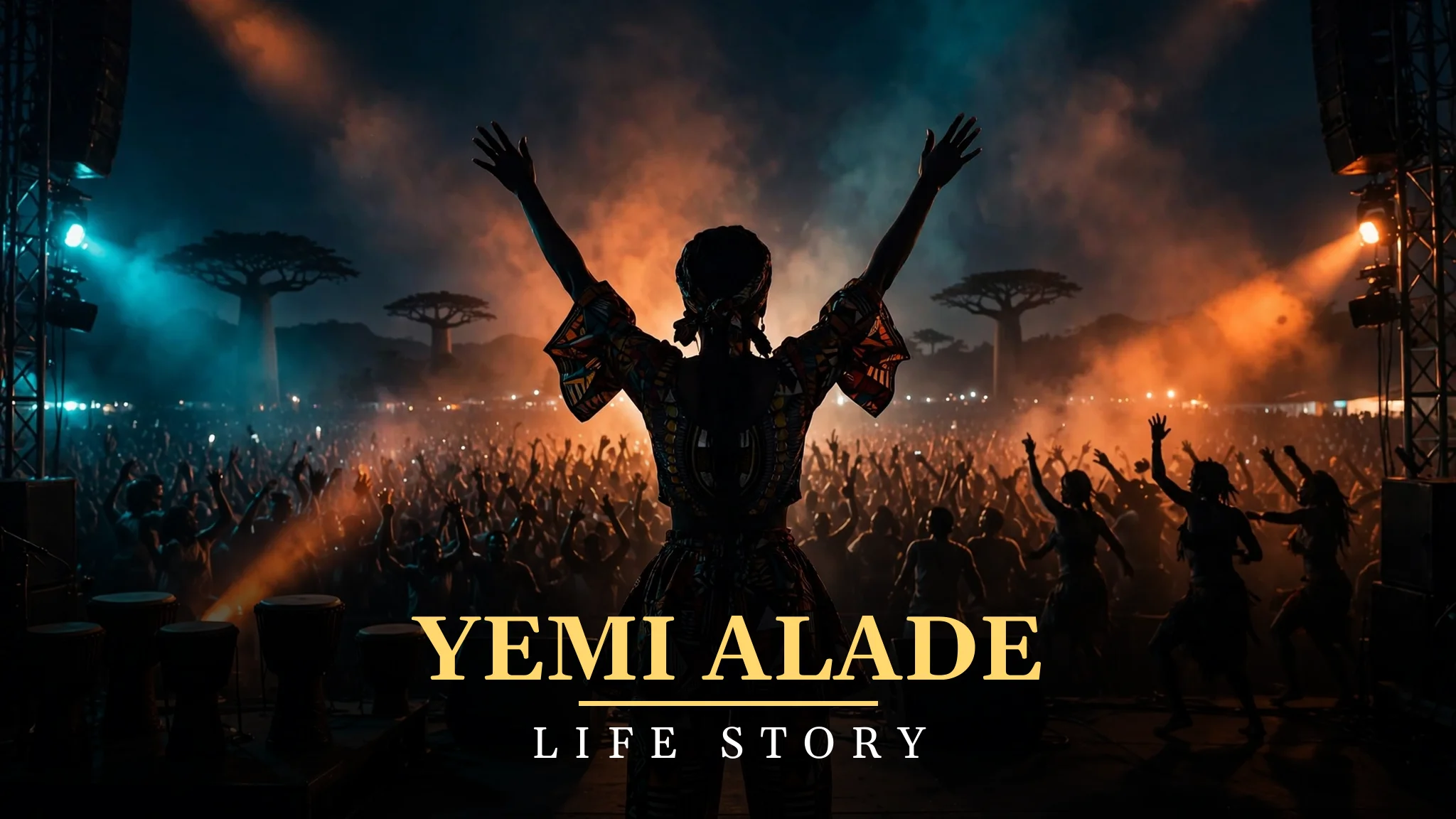
Yemi Alade: The Life Story Behind the Mama Africa Voice
In this post
- A Childhood in Abia and Lagos
- A Girl Group, a Talent Show, and the First Steps
- Johnny and the Song That Crossed Africa
- King of Queens, Mama Africa, and Album After Album
- The Voice, the Dance, and the Style of Mama Africa
- Today, Influence, and What Comes Next
- Singing in Many Languages and Reaching Many Peoples
- The Voice Nigeria and Teaching the Next Generation
- My Take:
Yemi Alade is a singer who fills a stage with colour, with energy, and with a voice that can be heard across a continent. She is known as Mama Africa, a name that fits her, because her music belongs to Africa as a whole, not only to Nigeria. She sings in English, in Yoruba, in Igbo, and in other African languages, and she dances with a joy that makes audiences dance with her. She is not a quiet star. She is a loud, bright, generous performer, and people love her for it.
She became famous with a song called Johnny, a funny, catchy song about a man who cannot be faithful, and the song spread across Africa and beyond, making her one of the most popular Afrobeats singers of her generation. But Johnny was not a lucky accident. It was the result of years of singing, of winning a talent show, of working in a girl group, and of learning how to write songs that people could sing along to after hearing them once.
Her story is also a story about Africa. She has travelled the continent, she has worked with artists from many countries, and she has spoken about the need for Africans to be proud of their music, their languages, and their cultures. She is a singer, a dancer, a fashion figure, and a voice for a continent that is often talked about but rarely heard. This is the story of how a girl from Abia State became Mama Africa, and of how she carried African music to the world.
A Childhood in Abia and Lagos
Yemi Eberechi Alade was born on 13 March 1989 in Abia State, in the south-eastern part of Nigeria, into a family that valued music, education, and hard work. Her father was a police officer, and her mother was a businesswoman, and the family gave their children a home that was both disciplined and full of music. Yemi was the fifth of seven children, and growing up in a large family means learning to share, to sing together, and to find your own voice among many others.
The family later moved to Lagos, where Yemi spent much of her childhood, and Lagos gave her a different kind of education. Lagos is a loud, fast city, full of music, markets, and people chasing their dreams, and a child growing up there learns early how to be heard. Yemi learned that lesson well. She sang at home, she sang in church, and she sang at school, and people began to notice that her voice was special, strong, clear, and full of feeling.
She attended schools in Lagos, including St. Saviour British Primary School and Victory Grammar School, and she later studied geography at the University of Lagos. Education was important to her family, and she took it seriously, even while music was pulling at her. She knew that a degree could give her a future, even if music did not work out, and that balance helped her stay steady when fame arrived so fast.
As a teenager, she was drawn to music and to dance, and she took part in school activities, in church choirs, and in local talent shows. She was not a shy singer. She liked to perform, she liked to dance, and she liked to be on stage, and that confidence would later become one of her greatest strengths. A singer needs more than a voice. She needs the courage to be looked at, to be judged, and to keep going when the judgment is harsh. Yemi learned that courage young, in small rooms, long before big stages.
Her family also gave her a deep love for Nigerian culture. She grew up hearing Igbo and Yoruba music, hearing stories in different languages, and learning that Nigeria is a country of many peoples, many sounds, and many traditions. That love for diversity later showed in her music, which mixes languages, rhythms, and styles from across Africa, and which speaks to people in many countries, not only in Nigeria.
A Girl Group, a Talent Show, and the First Steps
Before she became a solo star, Yemi Alade was part of a girl group called Noty Spices, a group of young women who sang together, performed together, and learned the craft of being on stage. Working in a group is a different skill from singing alone. It means learning to harmonise, to share the spotlight, and to work as a team. Yemi learned those lessons, and she also learned that she had a voice that stood out, even among other talented singers.
The group did not last, as many young groups do not, but it gave her experience, confidence, and a taste of what a music career could be. She learned how to rehearse, how to perform for a crowd, and how to handle the ups and downs of being in a group where not everyone wants the same thing. Those lessons were valuable, because they taught her how the music industry works, and how to survive in it.
In 2009, she took part in the Peak Talent Show, a Nigerian singing competition, and she won. Winning a talent show is a major moment for a young singer, because it means that judges, audiences, and the industry have all noticed you at once. It also brings a prize, a chance to record, and a door into the music world that is hard to open on your own. Yemi won, and she used that win as a stepping stone, not as a finish line.
After the talent show, she began to record her own songs, working with producers in Lagos and learning how to shape a song from a first idea to a finished track. She released singles, she performed at shows, and she built a small but loyal audience who loved her voice, her energy, and her style. It was a slow process, and it took years, but she did not give up. She kept singing, kept writing, and kept performing, even when the big break had not yet come.
During this period, she also learned how to write songs that people could remember. A good song needs a strong chorus, a clear story, and a beat that makes people move, and Yemi learned to write songs that had all three. She wrote about love, about life, and about the everyday experiences of young Nigerians, in words that were simple, direct, and easy to sing along to. That gift for a memorable song would later become one of her greatest strengths.
Johnny and the Song That Crossed Africa
In 2013, Yemi Alade released Johnny, a song that changed her life. Johnny tells the story of a man who is unfaithful, a man who lies to many women, and a woman who is tired of his games. The song is funny, it is catchy, and it is sung in a way that makes people laugh even as they recognise the truth in it. The chorus is simple, the beat is strong, and the song spread quickly across Nigeria, then across West Africa, then across the whole continent.
Johnny became one of the biggest Afrobeats songs of its time, and its music video, which was colourful, joyful, and full of dance, was watched millions of times. People in Kenya, Ghana, South Africa, and many other countries sang along to Johnny, even when they did not speak the same language as Yemi. That is the power of a great song: it does not need translation. It needs a feeling, a beat, and a voice that carries it across borders.
The success of Johnny made Yemi a star, and it opened doors that had been closed before. Radio stations played her songs, promoters wanted her for shows, and other artists wanted to work with her. She was no longer a young singer trying to be heard. She was a leading voice in Afrobeats, and the whole continent was listening to her.
Johnny also showed what made her different. She was not singing a sad song about love. She was singing a funny, strong song about a woman who knows her worth and who will not be fooled. That message, of a woman who is smart, funny, and unafraid to speak, became part of her public image, and it won her many fans, especially women, who saw themselves in her songs.
The song also brought her awards attention, and it established her as one of the most important new voices in African music. It was a breakthrough, but it was also a test: could she follow Johnny with more hits, or would she be a one-song star? She answered that test by working even harder, by recording more music, and by proving that Johnny was only the beginning.
King of Queens, Mama Africa, and Album After Album
In 2014, Yemi Alade released her debut album, King of Queens, a record that built on the success of Johnny and showed that she could make a full album, not only a single hit. The album included Johnny, as well as other songs that showed different sides of her, from love songs to dance songs to songs about life in Nigeria. It was widely praised, and it won awards, including at the Headies, Nigeria’s major music awards, where she was recognised as one of the leading new artists.
She followed it with Mama Africa in 2016, an album whose title said everything about how she saw herself. Mama Africa was a celebration of the continent, with songs in different African languages, collaborations with artists from other countries, and a sound that mixed Afrobeats with highlife, makossa, and other African rhythms. The album was a statement: Yemi was not only a Nigerian singer. She was an African singer, and her music belonged to the whole continent.
In 2017, she released Black Magic, an album that continued her run of hits, with songs that were played across Africa and beyond. She followed it with Woman of Steel in 2019, an album that showed a more mature, more confident artist, with songs about strength, about love, and about the power of women. Each album added new hits, new collaborations, and new proof that she could keep up with the changing sound of African music.
In 2020, she released Empress, an album that came during the difficult year of the pandemic, and that showed her ability to keep working even when the world was in trouble. She also released other projects, including songs for films and collaborations with international artists, and she continued to tour, to perform, and to record, even as the music industry changed around her.
Her albums are not only collections of songs. They are statements about who she is, about where she comes from, and about what Africa means to her. She sings in many languages, she dances in many styles, and she wears clothes that celebrate African fashion, from Ankara prints to bold colours. That celebration of Africa is at the heart of her work, and it is why she is called Mama Africa, a name she has earned, not only given.
The Voice, the Dance, and the Style of Mama Africa
Yemi Alade’s voice is strong, clear, and full of energy, and it is one of the first things people notice about her. She can sing a soft, romantic line, and she can also sing a loud, joyful chorus that makes a whole crowd dance. That range is rare, and it is why her songs work in many settings, from a quiet room to a huge stadium. She does not need to shout to be heard, but she can shout when the song needs it, and she does it with a joy that is infectious.
Her dancing is just as important as her singing. She dances with a freedom and a happiness that makes audiences want to dance with her. Her music videos are full of colour, of movement, and of African dance styles, from traditional dances to modern Afrobeats moves, and she performs them with a skill that comes from years of practice. Dancing is not an extra for her. It is part of the music, part of the story, and part of who she is.
Her style is also a central part of her image. She wears bright Ankara prints, bold colours, and African designs that celebrate the continent’s fashion. She has become a fashion figure, appearing at events and in campaigns that show her sense of style, and she uses fashion to tell a story about Africa: that African fashion is beautiful, modern, and worthy of the world stage. That message matters, because it tells young Africans that their clothes, their colours, and their cultures are something to be proud of.
She has also worked as a coach on The Voice Nigeria, helping young singers to learn, to grow, and to find their own voices. That work as a teacher shows a different side of her, a generous side, a woman who wants to help the next generation, not only to shine herself. She gives advice, she shares her experience, and she encourages young artists to be proud of who they are and where they come from.
Her performances at festivals and shows across Africa and the world have made her one of the most travelled African singers, and she has used those travels to learn, to collaborate, and to build bridges between countries. She has worked with artists from Kenya, Ghana, Tanzania, and many other places, and each collaboration has added a new sound, a new language, and a new story to her music.
Today, Influence, and What Comes Next
Today, Yemi Alade remains one of the most important voices in African music, a singer whose songs are played across the continent, whose videos are watched by millions, and whose name is known in many countries. She continues to record, to perform, and to work with other artists, and her career is still growing, even after more than a decade at the top. She has shown that a singer can be both popular and proud, both modern and traditional, and that African music can reach the world without losing its roots.
Her influence is not only in her songs. It is in the way she carries herself, in the way she speaks about Africa, and in the way she refuses to be small. She has shown young African women that they can be bold, that they can sing, dance, and dress as they like, and that they can be proud of their cultures. That message is powerful, and it is one that many young women need to hear.
She has also been recognised for her work beyond music, including her role as a goodwill ambassador for the United Nations Development Programme, where she has spoken about issues affecting Africa, from poverty to education to the empowerment of women. That work shows that she sees her fame as a responsibility, not only as a reward, and that she wants to use it to help others.
Her story is still being written, and she has many years ahead of her. If she keeps singing honestly, keeps dancing with joy, and keeps celebrating Africa, she has the chance to become one of the defining artists of her generation, not only in Nigeria but in the world. She is Mama Africa, and that name is not only a title. It is a promise, a promise to carry African music to the world, and to do it with pride, with colour, and with love.
Singing in Many Languages and Reaching Many Peoples
Yemi Alade’s gift for languages is one of the most important parts of her music. She sings in English, in Yoruba, in Igbo, in French, in Swahili, and in other African languages, and she does it in a way that feels natural, not forced, and that speaks to people in many countries. A listener in Kenya can hear a word in Swahili, a listener in Ghana can hear a rhythm they know, and a listener in Nigeria can hear a language from home, and all of them feel that the song belongs to them.
That multilingual singing is not an accident. It is a choice, a choice to celebrate Africa’s diversity, to show that African music is not one sound, but many sounds, and that those sounds can come together in a single song. She has worked with artists from Kenya, from Ghana, from Tanzania, and from many other places, and each collaboration has added a new language, a new rhythm, and a new story to her music.
Her work in many languages also shows her respect for her audiences. She does not expect everyone to understand English. She meets them in their own language, even if it is only a few words, and that effort tells them that she sees them, that she values them, and that her music is for them, not only for people who speak her language. That respect is a large part of why she is loved across the continent, and why she is called Mama Africa, a name that means mother to all, not only to one country.
The Voice Nigeria and Teaching the Next Generation
Yemi Alade’s work as a coach on The Voice Nigeria shows a different side of her, a generous side, a woman who wants to help the next generation, not only to shine herself. As a coach, she listens to young singers, she gives them advice, she shares her experience, and she encourages them to be proud of who they are and where they come from. That work is not easy, because it means spending time, energy, and care on people who are not yet stars, and who may never become stars, but Yemi does it with joy, because she believes that music is a community, not a competition.
She tells young singers to sing in their own language, to dance in their own style, and to be proud of their culture, and that advice matters, because many young artists are told to copy American or European singers, to hide their accents, and to forget their roots. Yemi tells them the opposite: your roots are your strength, your language is your gift, and your culture is your beauty. That message is powerful, and it is one that many young Africans need to hear, especially in a world that often tells them their cultures are not good enough.
Her work on The Voice also shows her patience, her kindness, and her ability to listen. A good coach does not only talk. She listens, she understands, and she helps a young singer to find their own voice, not to copy hers. Yemi does that, and the young singers who work with her learn not only how to sing, but how to be an artist, how to handle fame, and how to stay true to themselves.
My Take:
When I listen to Yemi Alade, I do not first think about charts or awards. I think about colour, about joy, and about a voice that sounds like it belongs to a whole continent. She sings with a happiness that is hard to fake, and that happiness is infectious. When she sings Johnny, I want to dance, even if I am sitting down. When she sings a slower song, I want to listen, because her voice carries a warmth that makes the words feel true. That is a rare gift, and it is one that she has used well for more than a decade.
I think about Johnny, and what it meant for African music. Johnny is a funny song, a song about a man who cannot be faithful, and it is sung in a way that makes people laugh. But it is also a song that crossed borders. People in Kenya, in Ghana, in South Africa, and in many other countries sang along to it, even when they did not speak the same language as Yemi. That is the power of a great song. It does not need translation. It needs a feeling, a beat, and a voice that carries it across a continent. Yemi gave African music that power, and she did it with a song that was simple, funny, and true.
What I admire most about her is her pride in Africa. She calls herself Mama Africa, and she lives up to that name. She sings in many African languages, she wears African clothes, she dances African dances, and she works with artists from many African countries. She does not try to sound American or European to be successful. She sounds African, and she is proud of it. That pride matters, because many young Africans are told that their cultures are old-fashioned, that their languages are not important, and that their music is not good enough for the world. Yemi shows them that their cultures are beautiful, their languages are valuable, and their music can reach the world without losing its roots.
I also think about her voice, and how it has grown over the years. When she won the Peak Talent Show in 2009, she was a young singer with a strong voice and a lot of energy. Today, she is a mature artist, with a voice that is stronger, clearer, and more controlled. She can sing a soft line, she can sing a loud chorus, and she can do both with a feeling that comes from experience. That growth is not an accident. It comes from years of singing, of performing, of learning, and of working hard, even when the world was not watching.
Her dancing is another part of her story that I love. She does not dance as an extra, as something to fill a video. She dances as part of the music, as a way of telling the story, and as a celebration of life. Her videos are full of colour, of movement, and of joy, and they make me want to dance with her. In a world where many singers stand still and sing, Yemi moves, and that movement is a gift. It shows that music is not only for the ears. It is for the body, for the heart, and for the whole person.
I think about her work as a coach on The Voice Nigeria, and what it tells us about her. A star who only thinks about herself will not spend time teaching young singers. Yemi does spend that time, and she does it with generosity, sharing her experience, giving advice, and encouraging young artists to be proud of who they are. That generosity is a sign of a real artist, one who knows that music is not a competition, but a community, and that helping the next generation is part of the work.
If I am honest, I do not love every song she has made equally. Some of her later songs feel lighter to me, as if they were made to keep up with the speed of the charts rather than to say something lasting. That is not a harsh judgment. It is the normal pressure of the music world, where a new song is needed every few weeks and the public moves on fast. I would like to hear her take more time with some songs, to write a few more lines that only she could write, and to let her voice breathe a little more. But I also understand why she works fast. She is a popular star, the world is listening, and she wants to use the moment.
I also think about the name Mama Africa, and what it means to carry it. It is a big name, a name that comes with responsibility, and Yemi carries it with pride and with care. She does not only sing about Africa. She speaks about Africa, she works for Africa, and she uses her platform to talk about issues that affect the continent, from poverty to education to the empowerment of women. That work, as a goodwill ambassador for the United Nations, shows that she sees her fame as a duty, not only as a reward. I respect that, because many stars use their fame only for themselves, and Yemi uses hers for others as well.
Her story also reminds me that a singer can be both modern and traditional. She uses modern beats, modern videos, and modern fashion, but she also uses traditional rhythms, traditional languages, and traditional dances. She does not choose between the old and the new. She brings them together, and she makes something that is both fresh and rooted. That is a difficult balance to keep, and she keeps it well. Young artists who want to be modern should learn from her: you do not have to forget your roots to be modern. You can carry your roots with you, and they will make your modern work stronger.
I think about young girls in Africa who watch her videos and see a woman who looks like them, who sings like them, and who dances like them. For those girls, Yemi is proof that an African woman can be a star, that she can be bold, that she can be joyful, and that she can be proud of her culture. That message is worth more than any award, because it gives hope to people who need it most. She is not only a singer. She is a sign that African music, African fashion, and African joy belong on the world stage.
In the end, I think Yemi Alade’s story is about celebration. She celebrates Africa, she celebrates music, she celebrates dance, and she celebrates life, even when life is hard. She does it with a voice that is strong, a smile that is bright, and a heart that is generous. I hope she keeps singing, keeps dancing, and keeps showing the world what Mama Africa means. Her story is not finished, but it is already a joyful one, and it will be remembered for a long time.
I think about the children who watch her videos, who see a woman in bright Ankara, dancing with joy, singing in many languages, and who learn that African culture is beautiful. For those children, Yemi is not only a singer. She is a teacher, a woman who shows them that their clothes, their languages, and their dances are something to be proud of, not something to hide. That lesson is worth more than any hit song, because it shapes how a child sees herself, and how she will see the world when she grows up.
I also think about her work with the United Nations, and what it tells us about her character. She could have used her fame only for herself, for money, for shows, and for attention, but she chose to use it for others, to speak about poverty, about education, and about the empowerment of women. That choice is a sign of a real leader, one who knows that fame is not only a reward, but a responsibility, and who acts on that responsibility with care. I respect that, because many stars talk about helping others, but few do it as consistently as Yemi does.
I think about her dancing, and how it is a language of its own. She does not dance to show off. She dances to celebrate, to tell a story, and to invite the audience to join her. When she dances, the crowd dances with her, and that shared joy is a powerful thing. It breaks down barriers between countries, between languages, and between people, and it reminds us that music and dance are universal, that they belong to everyone, and that they can bring people together even when words cannot.
Her story also reminds me that a singer can be both modern and traditional, both global and local, and that those things do not have to fight each other. She uses modern beats, modern videos, and modern fashion, but she also uses traditional rhythms, traditional languages, and traditional dances, and she brings them together in a way that feels natural, not forced. That balance is difficult to keep, and she keeps it well, showing young artists that they do not have to choose between the old and the new. They can have both, and they can make something beautiful from both.
I think about the children who watch her videos, who see a woman in bright Ankara, dancing with joy, singing in many languages, and who learn that African culture is beautiful. For those children, Yemi is not only a singer. She is a teacher, a woman who shows them that their clothes, their languages, and their dances are something to be proud of, not something to hide. That lesson is worth more than any hit song, because it shapes how a child sees herself, and how she will see the world when she grows up, and it will stay with her long after the song has ended.
I also think about her dancing, and how it is a language of its own. She does not dance to show off. She dances to celebrate, to tell a story, and to invite the audience to join her. When she dances, the crowd dances with her, and that shared joy is a powerful thing. It breaks down barriers between countries, between languages, and between people, and it reminds us that music and dance are universal, that they belong to everyone, and that they can bring people together even when words cannot, and that is a gift that few artists have.
I think about the way Yemi Alade handles the pressure of being called Mama Africa, and how she carries that name with pride and with care. It is a big name, a name that comes with responsibility, and she does not treat it lightly. She sings in many languages, she works with artists from many countries, and she speaks about Africa with a love that is plain to hear. That responsibility is a sign of a real leader, one who knows that a title is not only an honour, but a duty, and who acts on that duty every day, in her music, in her work, and in her public life.
I also think about her fashion, and how it tells a story about Africa. She wears Ankara prints, bright colours, and African designs, not as a costume, but as a celebration, a way of saying that African fashion is beautiful, modern, and worthy of the world stage. That message matters, because many young Africans are told that their clothes are old-fashioned, that their colours are too bright, and that their cultures are not good enough. Yemi shows them the opposite, with every outfit, every video, and every performance, and that is a lesson worth learning.
I think about the young girls in Africa who watch her dance, who see a woman who is bold, joyful, and proud, and who learn that they can be bold too. A girl who sees Yemi on stage, singing, dancing, and smiling, learns that she does not have to be small to be loved, that she does not have to hide her joy, and that she can be proud of who she is. That lesson is worth more than any hit song, because it shapes how a girl sees herself, and how she will see the world when she grows up.
Frequently Asked Questions
When was Yemi Alade born?
Yemi Alade was born on 13 March 1989 in Abia State, Nigeria, and she grew up largely in Lagos, where she studied geography at the University of Lagos.
How did Yemi Alade become famous?
She won the Peak Talent Show in 2009, and she became a star with Johnny, released in 2013, a song that spread across Africa and beyond.
What does Mama Africa mean?
Mama Africa is the name Yemi Alade is known by, because her music celebrates the whole continent, singing in many African languages and working with artists from many countries.
What albums has Yemi Alade released?
Her albums include King of Queens in 2014, Mama Africa in 2016, Black Magic in 2017, Woman of Steel in 2019, and Empress in 2020.
Has Yemi Alade worked on television?
Yes, she has worked as a coach on The Voice Nigeria, helping young singers to learn and to find their own voices.
What is Yemi Alade’s role with the United Nations?
She has served as a goodwill ambassador for the United Nations Development Programme, speaking about issues affecting Africa, including poverty, education, and women’s empowerment.


