Yotuel Romero: The Life Story Behind Cuba's Music Star
In this post
There are singers who sing about love, and there are singers who sing about home, about freedom, and about a country they love, and Yotuel Romero belongs to the second kind. He is a Cuban singer, actor, and songwriter, best known as a member of Orishas, the group that mixed Cuban music with hip hop, and as one of the voices behind “Patria y Vida”, a song that became an anthem for Cubans who dream of a different future. His music is a mix of rap, of son, of rumba, and of the streets of Havana, and it is sung with a voice that is both proud and sad.
Yotuel Romero was born on 6 October 1976, in Havana, Cuba. He grew up in a city where music is everywhere, where children learn to dance before they learn to read, and where a young man with a talent for words can become a rapper, a singer, and a star. He left Cuba as a young man, he lived in Paris, he formed Orishas there, and he became a voice for Cubans at home and abroad, singing about the island he left, and the island he still loves.
What makes his story worth telling is how his music became a voice for a people, and how a song, “Patria y Vida”, became more than a song. It became a slogan, a hope, and a cry for change, sung by Cubans on the island and in exile, and heard around the world. Yotuel did not set out to be a political figure. He set out to be a musician, but his music, because it was honest about Cuba, became political, and he accepted that role with courage. This is the story of how a young man from Havana became a voice for his country, through music, through rap, and through a song that changed everything.
His work is about Cuba, about its music, its people, and its future, and it is sung with a love that is clear, even when the words are hard.
Havana, a City of Music, and a Young Rapper
Havana is a city where music is a part of daily life, where a child hears a drum on the street, a song on the radio, and a voice in the market, all in the same day. Yotuel Romero was born there in 1976, and he grew up in that world, learning to love music early, and learning to love words, to rhyme, and to tell a story in a rap. He was a young man with a talent for language, and with a ear for the rhythms of Cuba, from the son of the countryside to the rumba of the streets, and he began to mix those rhythms with hip hop, a new sound that was arriving from the United States.
As a teenager, he was drawn to rap, and to the culture of hip hop, which was growing in Cuba in the 1990s, with young people rapping about their lives, about their neighbourhoods, and about their hopes. Yotuel was one of those young people, and he learned to write lyrics that were honest, direct, and full of Cuban pride. He did not rap in English. He rapped in Spanish, about Cuba, about Havana, and about the life he knew, and that made his rap different, and made it his own.
He also studied acting, and he worked as an actor in Cuba, appearing in films and in television, and learning how to perform, how to hold a stage, and how to speak to an audience. Acting taught him discipline, and it taught him how to be a performer, not only a singer, and that skill stayed with him when he became a musician. He was not only a rapper. He was an entertainer, with a presence that made people look, and listen.
Havana in the 1990s was a hard place, with shortages, with a special period of economic crisis after the fall of the Soviet Union, and with many young people dreaming of leaving. Yotuel was one of them, and he dreamed of a life where he could make music freely, and where he could be heard. That dream would take him to Paris, to a new life, and to a group that would make him famous, but it would also keep him tied to Havana, in his songs, in his heart, and in his voice.
The name Orishas also mattered, because it told the world that the group’s music was rooted in the Yoruba gods, in African culture, and in the spiritual life of Cuba. That root, African and Cuban at once, is a central part of Cuban identity, and Orishas wore it proudly, in its name, in its music, and in its stage presence. It was a statement that Cuban music is African music, and that its history is a history of survival, of joy, and of faith.
Paris, Orishas, and a New Sound
In the late 1990s, Yotuel Romero moved to Paris, France, where he met other Cuban musicians, and together they formed Orishas, in 1999. The group was made up of Yotuel, Ruzzo, and Roldan, three Cuban musicians living in Paris, who wanted to mix Cuban music with hip hop, to make a sound that was both Cuban and modern, both traditional and new. They called themselves Orishas, after the gods of the Yoruba religion, which is a central part of Cuban culture, and that name told the world that their music was rooted in Africa, in Cuba, and in the spiritual life of the island.
Orishas’s first album, A Lo Cubano, released in 1999, was a success, and it introduced the group to Europe and to Latin America. Its songs mixed rap with son, with rumba, and with the rhythms of Cuba, and they were sung in Spanish, with a pride in being Cuban, and with a love for Havana. The group toured Europe, it played in large venues, and it became a name in world music, a group that could make a crowd dance, and make it think, at the same time. It was a new sound, and it was a Cuban sound, and it was loved.
The group’s songs, such as “Represent, Cuba”, “537 C.U.B.A.”, and “A Lo Cubano”, became hits, and they were played on the radio, in clubs, and at festivals, across Europe and Latin America. Orishas was not only a rap group. It was a Cuban group, and it carried Cuba with it, in its music, in its words, and in its stage presence. It showed the world that Cuban music could be modern, that it could mix with hip hop, and that it could speak to a new generation, in Havana and in Paris, and in many other cities.
Yotuel was a central part of Orishas, as a rapper, as a singer, and as a songwriter, and his voice became one of the group’s trademarks. He wrote lyrics about Cuba, about exile, about pride, and about the life of a Cuban far from home, and he sang them with a passion that made audiences feel his love for the island. He was not only a musician. He was a storyteller, and his stories were about a country he loved, and a home he missed.
Orishas became one of the most successful Cuban groups of its time, and it toured the world for many years, with Yotuel at its heart. It was a remarkable journey, from Havana to Paris, and from Paris to the world, and it was built on a simple idea: that Cuban music, mixed with hip hop, could be a voice for a people, and a bridge between cultures.
The group’s tours also took it to festivals, where it played for audiences who had never heard Cuban hip hop, and who were surprised by its energy. A festival crowd, hearing Orishas for the first time, would dance, would sing along, and would leave with a new love for Cuba. That is the power of live music, and Orishas used it well, turning strangers into fans, one concert at a time.
Orishas, World Tours, and Cuban Pride
As the 2000s went on, Orishas became a major act in world music, touring Europe, Latin America, and the United States, and recording albums that mixed Cuban rhythms with rap, with funk, and with pop. The group’s concerts were joyful, with dancing, with singing, and with a celebration of Cuban culture, and its fans came from many countries, drawn by a sound that was both familiar and new. Yotuel, as one of the group’s leaders, was at the centre of those concerts, rapping, singing, and talking to the audience about Cuba, about music, and about pride.
The group’s success was built on its live shows, which were energetic, and on its records, which were played on the radio and in clubs. It won awards, including a Latin Grammy Award, and it was praised by critics who saw in it a new kind of Latin music, one that was not only romantic, but also political, and that spoke about the real life of Cubans, at home and abroad. Orishas was not afraid to talk about Cuba, about its problems, and about its hopes, and that honesty made its music more powerful.
Yotuel also worked as a solo artist, and as an actor, appearing in films and in television, and building a career that was his own, as well as a part of Orishas. He was a versatile performer, able to rap, to sing, to act, and to write, and that versatility made him a valuable artist, in Cuba and beyond. He did not rest on the success of Orishas. He kept working, kept writing, and kept looking for new ways to tell his story.
The group had its ups and downs, as all groups do, with members leaving and returning, and with pauses in its work, but it kept coming back, because its music was loved, and because its message, of Cuban pride, was still needed. Yotuel stayed with the group through those changes, and he kept its spirit alive, even when the road was hard. That loyalty is part of his story, and it is part of why Orishas is still loved today.
He also learned to work in different languages, and in different cultures, and to adapt his music to new audiences, without losing his Cuban voice. That adaptability is a skill, and it is one that Yotuel has used throughout his career, moving between Paris, Madrid, and Miami, and making music that speaks to people in each place, while staying true to Havana.
Solo Work, Acting, and a Voice of His Own
Beyond Orishas, Yotuel Romero built a solo career, as a singer, as a songwriter, and as an actor, and he showed that he could stand on his own, as well as in a group. He recorded solo songs, he worked with other artists, and he appeared in films and in television series, where he played roles that drew on his Cuban identity, and on his experience as an immigrant. He was a performer who could do many things, and who did them with a passion that made him stand out.
His solo work allowed him to explore themes that were personal to him, about Cuba, about exile, about family, and about the future of his country. He wrote lyrics that were more direct, more political, and more personal than the songs of Orishas, and he sang them with a voice that was his own, not only the voice of a group. That solo voice would become important in the next chapter of his story, when he would write a song that would change everything.
He also worked in Spain, where many Cubans live, and where his music found a large audience, and he became a figure in the Spanish music world, as well as in the Cuban and Latin American worlds. He moved between countries, between languages, and between cultures, and he carried Cuba with him, in his music, and in his heart, wherever he went. That movement, between Havana, Paris, Madrid, and Miami, is a part of his life, and a part of his art.
Yotuel’s acting work also mattered, because it showed a different side of him, as a man who could play a character, and who could tell a story without music. He appeared in Spanish television and in films, and he brought his Cuban charm, and his experience as a performer, to those roles. He was not only a rapper. He was an artist, in the full sense of the word, and he was building a career that spanned music, film, and television.
By the late 2010s, Yotuel was a respected artist, with a long career, and with a voice that was known across the Spanish-speaking world. He was ready for a new chapter, and that chapter would come in 2021, with a song that would make him a symbol, not only of Cuban music, but of a Cuban hope for change.
Patria y Vida and a Song That Became an Anthem
In 2021, Yotuel Romero, together with Gente de Zona, Descemer Bueno, and other Cuban artists, released “Patria y Vida”, which means “Homeland and Life”, a song that became an anthem for Cubans who dream of freedom, and of a better life. The song was a response to the Cuban government’s slogan “Patria o Muerte”, homeland or death, and it offered a different idea: homeland and life, a future where Cubans could live, could be free, and could be happy, without having to choose death. It was a simple idea, and it was a powerful one, and it spread quickly, in Cuba and abroad.
The song won the Latin Grammy Award for Song of the Year in 2021, a major honour, and it was played at protests in Cuba, in July 2021, when thousands of Cubans took to the streets to demand change. The song became the soundtrack of those protests, and its title became a slogan, shouted by crowds, written on walls, and shared online. Yotuel, who had written the song with his collaborators, became a symbol of that movement, and his name became known to people who had never heard his music before.
“Patria y Vida” was not only a song. It was a political act, and it was a brave one, because to criticise the Cuban government, even from abroad, is to take a risk, and to become a target. Yotuel accepted that risk, and he spoke openly about Cuba, about its problems, and about his hope for its future. He did it in interviews, in concerts, and in his music, and he did it with a courage that many admired, and that some criticised. He did not hide. He sang, and he spoke, and he stood by his words.
The song’s success changed Yotuel’s life, and it changed his place in Cuban music. He was no longer only a member of Orishas, or a solo artist. He was a voice for a generation of Cubans, at home and in exile, who wanted a different future. That is a heavy responsibility, and it is one that Yotuel has carried with seriousness, and with a love for Cuba that is clear in every word he sings. He did not ask to be a political figure, but his music made him one, and he accepted it.
He also continues to support young Cuban musicians, giving them advice, giving them a stage, and giving them a chance to be heard. A musician who helps the next generation is building a future, not only a career, and Yotuel has done that, with generosity, and with a love for Cuban music that goes beyond his own work.
Today, Exile, and a Hope for Cuba
Today Yotuel Romero lives outside Cuba, and he continues to make music, to act, and to speak about his country. He is a Cuban in exile, like many others, and he carries Cuba with him, in his songs, in his voice, and in his heart. He has not returned to the island, and he has not forgotten it, and his work is a reminder that exile does not end love, and that a song can keep a home alive, even when the singer is far away.
He continues to work with Orishas, and as a solo artist, and he continues to collaborate with other Cuban musicians, in Miami, in Madrid, and in many other cities where Cubans live. His music is still a mix of rap and Cuban rhythms, and it is still about Cuba, about its people, and about its future. He has not changed his message, and he has not softened it, even when it has been hard. That steadiness is part of his strength, and it is part of why his fans trust him.
His hope for Cuba is a central part of his story, and it is a hope that he shares with many Cubans, at home and abroad. He hopes for a Cuba where people can live freely, where they can speak, where they can work, and where they can be happy, without fear. That hope is in his songs, in his interviews, and in his life, and it is a hope that has made him a symbol, not only of music, but of a dream. Whether that dream comes true is not in his hands alone, but he has given it a voice, and that voice will not be silenced.
Yotuel Romero is still working, still singing, and still a voice for Cuba. His place in Latin music is secure, as a member of Orishas, as a solo artist, and as the voice of “Patria y Vida”. His story is a reminder that music can be more than entertainment. It can be a hope, a cry, and a home, for a people who have lost theirs, and who dream of finding it again.
His music will be sung for many years, in Havana and far from it, by Cubans who love their home, and who dream of a future where homeland means life, and where a song can be a hope.
That hope, sung in a clear voice, is Yotuel Romero’s gift to Cuba, and to the world.
My Take:
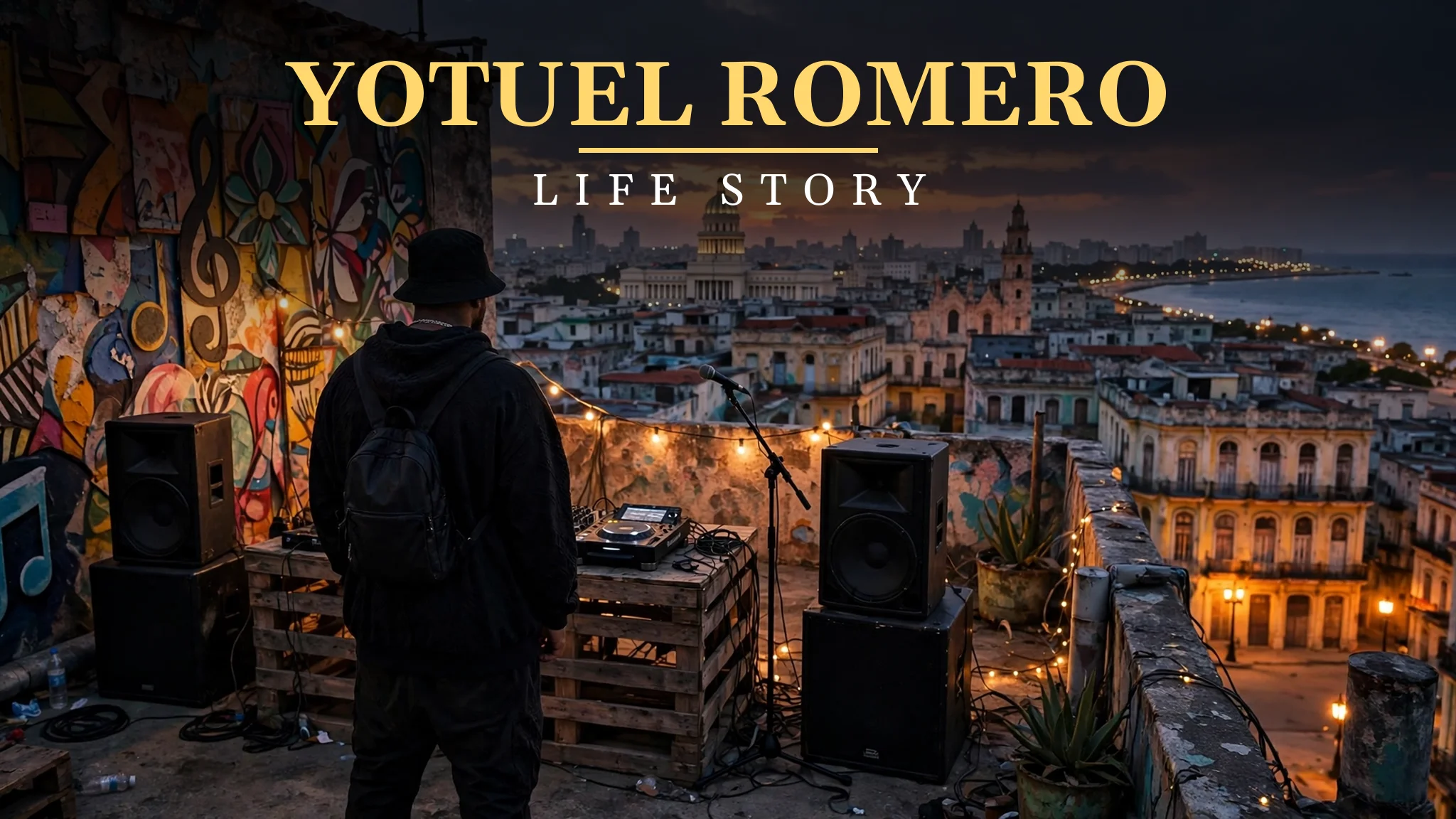
When I think about Yotuel Romero, I think about a rooftop in Havana at sunset, with a mural on the wall, with speakers, and with a man looking out at a city he loves. That image stays with me, because Yotuel’s music is about that city, about its beauty, and about its pain, and about a man who left it, but who never left it in his heart. I admire that, because it takes a special kind of love to carry a home with you, in a song, when you cannot go back to it.
I admire his courage more than anything else in this story. To write “Patria y Vida”, to sing it, and to stand by it, took courage, because it was a direct challenge to a powerful government, and it made Yotuel a target. He could have stayed quiet, and he could have kept making music about love, and no one would have blamed him. He did not stay quiet. He sang, and he spoke, and he accepted the risk, because he believed that his country deserved a better future. That is a brave thing, and it is one that I respect deeply.
What moves me most is the way his music mixes joy and sadness, rap and Cuban rhythms, and a love for home with a hope for change. Orishas’s music is joyful, it makes people dance, and it celebrates Cuban culture, but it is also sad, because it is sung by men who are far from home, and who miss the island they love. That mix, of joy and sadness, is the heart of Cuban music, and Yotuel carries it in his voice. I think about that mix, and I feel that it is true to life, because life is both joyful and sad, and music should be both as well.
I also think about his time in Paris, and about how a young Cuban in Paris must have felt, far from home, in a cold city, with a new language, and with a dream of making music. That is a hard life, and it is a brave one, and Yotuel lived it, with his friends in Orishas, and he made a new sound out of that exile. I think that is a hopeful lesson: that exile, which is a painful thing, can also be a creative thing, and that a musician far from home can make music that is even more Cuban, because he misses home so much.
There is a sadness in this story too, and it is the sadness of a man who cannot go home. Yotuel has not returned to Cuba, and he may not return for a long time, and that separation is a deep wound. I feel sympathy for him, and for all Cubans in exile, who love a country they cannot visit, and who sing about a home they cannot touch. That sadness is in his music, underneath the joy, and it is part of why his songs feel so real. He is not singing about an idea. He is singing about a loss, and about a hope that the loss will one day end.
I have a particular respect for the way he has used his fame to speak for others. He is a famous musician, and he could have used that fame only for himself, but he has used it to speak for Cubans on the island, who cannot speak freely, and for Cubans in exile, who need a voice. That is a generous use of fame, and it is a brave one, because it has made him a target, and it has cost him. I think that generosity is part of his legacy, and it is part of why his name is respected, not only as a musician, but as a man.
I have a criticism as well, and I will say it plainly. “Patria y Vida” is a powerful song, but a song alone cannot change a country, and I worry that some people put too much hope in a single song, and too little in the hard work of building a better future. Yotuel himself knows this, and he has said that music is only a part of the change, but I think it is worth remembering, because a song can inspire, but it cannot govern, and it cannot feed a hungry family. That is not a criticism of Yotuel. It is a reminder that music is a beginning, not an end.
What I learn from Yotuel is that music can be a home, and a hope, and a voice, all at once. His music is a home for Cubans far from Cuba, a hope for a better future, and a voice for people who cannot speak. That is a lot for a song to do, and Yotuel’s songs do it, night after night, in concerts, on the radio, and in the streets. I think that is a lesson for any musician: your music can be more than entertainment, if you are honest, and if you sing about what matters to you.
I think about the future, and about what comes next for Yotuel, and for Cuba. I do not know what will happen, and I do not want to pretend that I do. But I hope that Yotuel’s dream, of a Cuba where people can live freely, and where life is more important than death, comes true, and I hope that he can one day return to Havana, and sing “Patria y Vida” there, in the city where he was born. That would be a beautiful moment, and I think it is a moment that many Cubans dream of, as Yotuel does.
If I had to choose one song to explain Yotuel to a stranger, I would choose “Patria y Vida”. It is not his earliest song, and it is not his most joyful, but it is the most important, and the most honest. It says that a homeland should be about life, not about death, and that a people deserve to live, to be free, and to be happy. I think that song tells you everything you need to know about Yotuel Romero, and about why his music still matters. It is a song about a country, and it is a song for a country.
I will end by saying that Yotuel Romero’s story is a story about a young man from Havana, a group in Paris, and a song that became an anthem. He made music that mixed rap with Cuban rhythms, he carried Cuba with him wherever he went, and he gave a voice to a hope for change. That is a remarkable achievement, and it is one that deserves to be remembered. I am glad to have learned his story, and I will remember it, every time I hear “Patria y Vida”, and every time I think about Cuba, and about the music that keeps its hope alive.
I think about Havana again, and about the music that is heard there, on every street, in every home. That music is a part of Yotuel, and it is a part of every Cuban, and it is a gift that Cuba has given to the world. I think about the drums, the son, the rumba, and the rap, and about how they all live together in Yotuel’s songs. That mix is a beautiful thing, and it is a sign that Cuban music is alive, and that it will keep growing, even far from home.
I also think about the Yoruba gods, the Orishas, and about how they are a part of Cuban life, in religion, in music, and in daily speech. Yotuel’s group took that name, and it carried that spiritual heritage with it, to Paris, and to the world. I think that is a powerful choice, because it says that Cuban music is not only entertainment. It is a spiritual thing, a connection to ancestors, and a source of strength. That depth is in Orishas’s music, and it is part of why it is loved.
There is something I find hopeful about the way hip hop and Cuban music came together in Orishas. Hip hop was born in the United States, in Black communities, and Cuban music was born in Cuba, in Black communities as well, and both are music of people who have faced hardship, and who have turned that hardship into art. When Yotuel mixed them, he was joining two traditions that share a history, and a spirit, and that joining made a new sound, that was both old and new at once.
I wonder what Yotuel felt when he first heard Patria y Vida on the streets of Cuba, during the protests of July 2021, sung by people he had never met, in a country he could not visit. It must have been a powerful moment, and also a sad one, because the song was being sung by people who were risking their freedom, and who were hoping for change. I think about that moment, and I feel respect for Yotuel, and for the Cubans who sang his song, because they were brave, and they were hopeful, and they were singing for a better life.
I also reflect on the risk Yotuel took, and on how it has affected his life. To criticise a government is to become a target, and Yotuel has been criticised, and threatened, for his song. He has accepted that, and he has kept singing, and that takes a kind of courage that is rare. I think many artists would stay quiet, to protect their careers, but Yotuel did not stay quiet. He spoke, and he sang, and he stood by his words, and that is a brave thing to do.
I think about the other artists on Patria y Vida, Gente de Zona, Descemer Bueno, and the others, and about how they worked together, as Cubans, to make a song that was bigger than any one of them. That collaboration is a sign of unity, and it is a sign that Cuban musicians, at home and abroad, can work together for a common hope. I think that unity is a beautiful thing, and it is a part of why the song was so powerful. It was not one voice. It was many voices, singing together.
I have another thought about exile, and about how it shapes a musician. Exile is a painful thing, but it can also make a musician more honest, because he sees his home more clearly from far away, and he feels its loss more deeply. Yotuel’s music is more Cuban because he is far from Cuba, and that paradox is a part of his story. He left home, and he became more Cuban, not less, and his songs are proof of that.
I also think about the future, and about what will happen to Cuba, and to Yotuel. I do not know, and I do not want to pretend that I do. But I hope that Yotuel’s dream comes true, and that he can return to Havana, and sing there, in the city where he was born, to an audience that loves him. That would be a beautiful homecoming, and I think it is a homecoming that many Cubans dream of, as Yotuel does.
I want to say something about the word Patria, homeland, and about how Yotuel changed it, from Patria o Muerte to Patria y Vida. That change, from death to life, is a simple one, and it is a profound one. It says that a homeland should be about living, not about dying, and that a people deserve life, and joy, and freedom. I think that is a message worth remembering, not only for Cuba, but for any country, and for any people who dream of a better future.
Finally, I want to say that Yotuel Romero’s story gives me hope about the power of a song. A song cannot change a government, and it cannot feed a hungry family, but it can give people hope, it can give them a voice, and it can give them a reason to keep going. Patria y Vida did that, for many Cubans, and Yotuel gave them that song. I will remember that, and I will carry it with me, every time I hear his music, and every time I think about Cuba.
Frequently Asked Questions
Who is Yotuel Romero and what is he best known for?
Yotuel Romero is a Cuban singer, actor, and songwriter, born in 1976 in Havana, best known as a member of Orishas and as a co-writer of “Patria y Vida”.
What is Orishas and when was it formed?
Orishas is a Cuban hip hop group formed in Paris in 1999 by Yotuel Romero, Ruzzo, and Roldan, mixing Cuban music with hip hop, and known for songs such as “A Lo Cubano” and “Represent, Cuba”.
What is Patria y Vida about?
“Patria y Vida”, released in 2021, is a song by Yotuel Romero, Gente de Zona, Descemer Bueno, and others, offering “Homeland and Life” as an alternative to the slogan “Homeland or Death”, and it became an anthem for Cubans seeking change.
Did Patria y Vida win a Latin Grammy Award?
“Patria y Vida” won the Latin Grammy Award for Song of the Year in 2021, and it became widely known during the protests in Cuba in July 2021.
Where was Yotuel Romero born and where does he live now?
Yotuel Romero was born on 6 October 1976 in Havana, Cuba, and he has lived in Paris, Spain, and the United States, working as a musician and actor outside Cuba.
Is Yotuel Romero still making music today?
Yotuel Romero is still making music, as a solo artist and with Orishas, and he continues to speak about Cuba and to collaborate with other Cuban musicians.


