Youssou N'Dour: The Life Story Behind Senegal's Global Voice
In this post
Youssou N’Dour is one of the most famous African singers in the world. His voice is high, clear, and full of energy, and it can be heard in songs that have been played on radio stations from Dakar to London to New York. He is best known for “7 Seconds”, the song he recorded with Neneh Cherry in 1994, a song about the short time it takes for a child to learn about the world. But his career is much bigger than one song. He has been singing for more than fifty years, he has led one of the great bands of Africa, he has won a Grammy Award, and he has served as a minister in the government of Senegal.
He was born in Dakar, the capital of Senegal, in 1959, into a family of griots, the traditional storytellers and musicians of West Africa. In his family, music was not a hobby. It was a calling, a duty, and a way of life. He grew up hearing the old songs, and he began to sing as a boy. By the time he was a teenager, he was already performing, and by the time he was twenty, he was a star in Senegal. His rise was fast, but it was built on a deep foundation of tradition and hard work.
His story is the story of a singer who took the music of Senegal, a style called mbalax, and carried it to the world. He did not change his music to please foreign listeners. He kept singing in Wolof, he kept the drums and the rhythms of Senegal, and the world came to him. He also became a businessman, a media owner, and a politician, and he used his fame to speak about Africa, about its people, and about its future. This is the story of that voice, that journey, and that life.
Born Into a Griot Family in Dakar
Youssou N’Dour was born on 1 October 1959 in Dakar, Senegal, in the Medina district of the city. The Medina is a lively, crowded part of Dakar, full of markets, mosques, and music. Youssou grew up there, in a family of griots. Griots are the traditional musicians and storytellers of West Africa, and their role is an old and honoured one. They sing the history of a family, they praise great people, and they carry the memory of a community. In a griot family, a child learns to sing almost as soon as he learns to speak, and Youssou was no different.
His mother was a griot singer, and she was a great influence on him. She sang at ceremonies and celebrations, and young Youssou listened to her and learned. He heard the old songs, the praise songs, and the stories that griots tell, and he took them in. He also heard the music of the street, the drums, the dance, and the songs of everyday life in Dakar. That combination, the old tradition and the living city, shaped his voice and his style from the very beginning.
As a boy, he began to sing in public, first at small gatherings and then at larger events. People noticed his voice. It was high, clear, and strong, and it had a quality that made listeners stop and pay attention. He was not a shy singer. He sang with confidence, even when he was young, and he seemed to know that music was what he was meant to do. His family supported him, and they understood that a griot’s son would become a singer, just as his mother had been before him.
He went to school in Dakar, but music was always his first love. He listened to the radio, and he heard singers from Senegal, from Mali, from Guinea, and from America. He loved the soul music of America, and he loved the traditional music of West Africa, and he began to imagine a sound that could hold both. That imagination would become the heart of his career. He was a griot’s son, but he was also a modern singer, and he would find a way to be both at once.
The Medina, the Clubs, and a Young Star
As a teenager, Youssou N’Dour began to perform in the clubs of Dakar, and he quickly became known as a young singer with a remarkable voice. Dakar in the 1970s had a lively music scene, with bands playing in clubs and at parties, and with audiences who loved to dance. Youssou sang with several bands, learning his craft night after night. He learned how to hold a crowd, how to pace a performance, and how to make a song feel alive. Those nights in the clubs were his training, and they turned a talented boy into a professional singer.
He joined the band that would make him famous, the Super Étoile de Dakar, which he formed in the early 1980s. The name means the Super Star of Dakar, and it fitted the band’s ambition. The Super Étoile played mbalax, the popular music of Senegal, which mixes traditional Wolof drumming with modern instruments like electric guitar, keyboards, and saxophone. Youssou was the lead singer, and his voice was the centre of the sound. The band became hugely popular in Senegal, and its concerts were events that people talked about for days.
Mbalax is a music of rhythm and dance, and it is also a music of words. The songs tell stories, they praise people, and they speak about life in Senegal. Youssou’s voice suited mbalax perfectly. He could sing a fast, danceable song, and he could also sing a slow, emotional one. He sang in Wolof, the language of most Senegalese, and his lyrics spoke directly to his audience. He was not singing for foreigners. He was singing for his own people, and they loved him for it.
By the early 1980s, Youssou N’Dour was a star in Senegal, and his fame was spreading to other parts of West Africa. His records sold well, his concerts drew large crowds, and his name was known across the region. He had achieved in a few years what many singers work for a lifetime to achieve. But he was not satisfied. He wanted the world to hear Senegalese music, and he began to think about how to take mbalax beyond Africa. That ambition would lead him to Europe, to America, and to the biggest stages in the world.
Super Étoile and the Sound of Mbalax
The Super Étoile de Dakar was more than a band. It was a school, a family, and a force in Senegalese music. Youssou led it with a clear vision: to make mbalax the best it could be, and to make it known far beyond Senegal. The band’s musicians were among the finest in West Africa, and they played with a precision and an energy that made every concert feel like a celebration. The drums, especially the sabar drums of Senegal, gave the music its heartbeat, and Youssou’s voice soared above them.
The band recorded many albums in the 1980s, and songs like “Immigrés”, from the album of the same name released in 1984, became classics. “Immigrés” spoke about the experience of Africans living in Paris, about the hardship of exile and the longing for home. It was a song that many listeners recognised, because they had lived it themselves. Youssou sang it with a feeling that was both personal and universal, and it became one of his most loved songs. It showed that mbalax could speak about serious subjects, not just about dance and celebration.
He also worked with musicians from other countries, and he began to build bridges between Senegalese music and the wider world. He performed at festivals in Europe, he recorded with Western musicians, and he showed that mbalax could stand beside any music in the world. He did not change his sound to please foreign audiences. He kept the Wolof language, the sabar drums, and the rhythms of Senegal, and he trusted that listeners would come to him. They did, and they kept coming.
The Super Étoile remained his band for decades, and it became one of the most respected groups in African music. Musicians who played in it learned from Youssou, and many of them went on to have their own careers. He was a leader, a teacher, and a star, all at once. The band was his home, and it was the foundation of everything he would achieve. Even when he became famous around the world, he never left the Super Étoile behind. It was, and it remains, the heart of his music.
7 Seconds and a Song Heard Around the World
In 1994, Youssou N’Dour recorded a song that would change his life. It was called “7 Seconds”, and he sang it with the Swedish singer Neneh Cherry. The song was about a child, and about how in the first seven seconds of life, a child does not know about race, about war, or about the divisions of the world. It was a song of hope, a plea for a better world, and it was sung in English, French, and Wolof. It became a huge hit in Europe, reaching the top of the charts in many countries, and it introduced Youssou to millions of listeners who had never heard Senegalese music before.
The success of “7 Seconds” was a turning point. Youssou was no longer just a star in Africa. He was a world star, with a song that was played on radio stations everywhere. He toured the world, he performed on television, and he was invited to sing at major events. He handled that fame with a calm that came from years of performing. He knew who he was, he knew where he came from, and he did not let the fame change him. He kept singing in Wolof, he kept leading the Super Étoile, and he kept his roots in Dakar.
The song also showed what Youssou could do as a collaborator. He had worked with many Western musicians before, but “7 Seconds” was different. It was a true partnership, with two voices, from two worlds, singing together about a shared hope. Neneh Cherry’s voice and Youssou’s voice fitted together beautifully, and the song’s message was simple and powerful. It remains one of the most loved songs of the 1990s, and it is still played today. For many listeners, it is the first Youssou N’Dour song they ever heard, and it is the song that made them want to hear more.
After “7 Seconds”, Youssou’s career reached a new level. He recorded more albums for international audiences, he performed at festivals around the world, and he became known as one of the great voices of Africa. He did not forget Senegal. He kept his home in Dakar, he kept his band, and he kept singing for his own people. The world had come to him, but he had not left home to meet it. That balance, between the world and Dakar, became the pattern of his life.
A Grammy, Egypt, and Music With a Message
In 2005, Youssou N’Dour won a Grammy Award for his album Egypt, and it was a historic moment. The album was a tribute to the Islamic music of Senegal, to the Sufi traditions that are part of the country’s spiritual life. It was a quiet, beautiful album, very different from the dance music of mbalax, and it showed a side of Youssou that many listeners had not heard before. He sang with an orchestra, he sang in a style that honoured the religious music of his home, and he did so with a deep respect for the tradition. The Grammy, for Best Contemporary World Music Album, was a recognition of that work, and it made him the first Senegalese artist to win a Grammy.
The Egypt album was also a statement. After the attacks of 2001 in America, many people in the West had a narrow view of Islam, and Youssou wanted to show a different side of it. He wanted listeners to hear the beauty, the peace, and the spirituality of the Islamic music he had grown up with in Senegal. He recorded the album in Cairo, with Egyptian musicians, and he sang with a devotion that was clear in every note. It was a brave album, because it asked listeners to hear a religion through music rather than through the news. It succeeded, and it remains one of his most respected works.
He continued to make albums that spoke about Africa, about its people, and about its future. He sang about the environment, about the need for Africans to take charge of their own destiny, and about the hope that the continent could grow and prosper. His songs were not just entertainment. They were messages, and he delivered them with the authority of a man who had lived the life he sang about. He was not a singer who talked about Africa from far away. He lived in Dakar, he saw the problems every day, and he sang about them with knowledge and with love.
His work as a musician also brought him into contact with leaders, with activists, and with organisations that worked for Africa. He used his fame to support causes he believed in, from children’s health to the fight against poverty. He did not just sing about a better world. He tried to help build one, with his voice, his money, and his time. That commitment is an important part of his story, and it is one of the reasons he is respected far beyond music.
Business, Media, and a Minister’s Chair
Youssou N’Dour is not only a singer. He is also a businessman, and he has built a media empire in Senegal. He founded a newspaper, a radio station, and a television station, and he used them to give Senegalese people a voice. His media group, which includes the newspaper L’Observateur and the television channel TFM, became one of the most important in the country. He believed that Senegal needed independent media, and he was willing to invest his money and his reputation to build it. That work brought him into conflict with politicians, but he did not back down.
His media work also showed a different side of his character. He was not content to be only a singer. He wanted to shape the public life of his country, to give people information, and to hold power to account. That is a difficult and sometimes dangerous job, and he did it with courage. His newspapers and television stations reported on politics, on corruption, and on the lives of ordinary Senegalese, and they became trusted sources for many people. He was proud of that work, and he saw it as part of his duty as a public figure.
In 2012, he took that public role even further when he was appointed as Minister of Tourism and Culture in the government of Senegal, and later as Minister of Culture. It was a remarkable step for a singer to take, and it showed how much he was trusted in his country. As a minister, he worked to promote Senegalese culture, to support artists, and to bring tourists to Senegal. He served in the government for a time, and he learned how politics worked from the inside. He later stepped down, but the experience changed him, and it gave him a new understanding of how a country is run.
He has also been involved in politics in other ways, speaking out on issues he cares about and supporting candidates he believes in. He once considered running for president himself, and that idea showed how seriously he takes his role in Senegalese life. He did not run in the end, but the fact that people took the idea seriously tells you how much he is respected. He is not just a singer. He is a national figure, a man whose voice matters in music, in media, and in politics.
What His Voice Carries Today
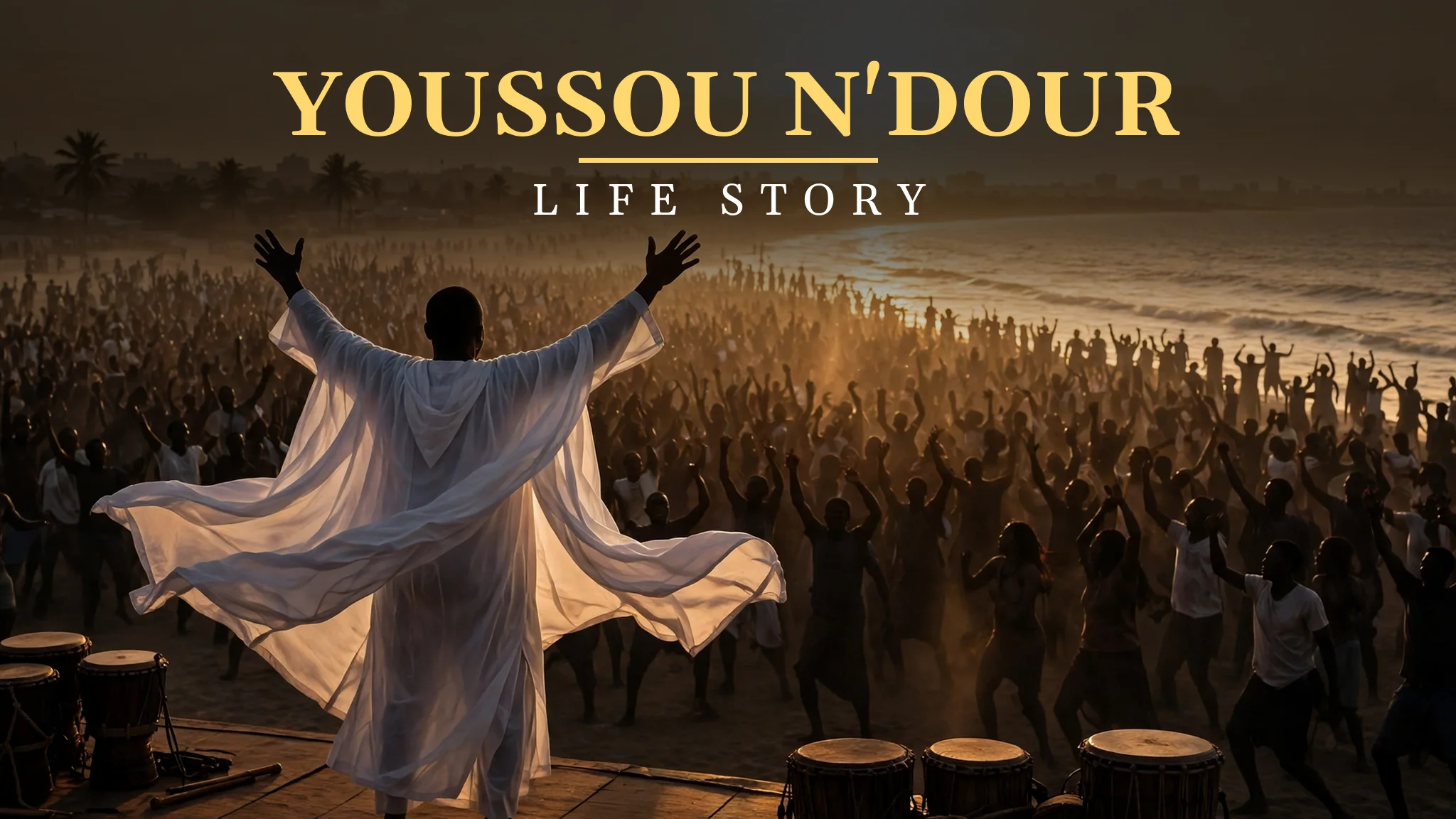
Today, Youssou N’Dour is still performing, still leading the Super Étoile, and still singing for audiences in Senegal and around the world. His concerts in Dakar are legendary, with crowds dancing to mbalax late into the night. He sings the old songs, and the audience sings with him. He sings new songs, and the audience listens with care. He is now in his sixties, and his voice is still strong, still clear, and still full of energy. He has not slowed down, and he does not seem to want to.
His legacy is already secure. He is regarded as one of the greatest African singers of all time, a man who took the music of Senegal to the world and who never forgot where he came from. He won a Grammy, he had a world hit with “7 Seconds”, he built a media group, and he served as a minister. Few singers have done so much, in so many fields, and done it so well. His story is not just the story of a singer. It is the story of a man who used his voice to shape the life of his country.
Younger Senegalese singers look to him as a model, not only for his music but for his life. He shows that a singer can be a businessman, a media owner, and a politician, and still be true to his art. He shows that a griot’s son from the Medina can become a world star, and that a world star can still sing in Wolof for his own people. Those are powerful lessons, and they are lessons that go beyond music. They are lessons about what a person can do with talent, with hard work, and with a deep love for home.
His voice will be heard for many years to come, in the songs he has recorded, in the band he leads, and in the singers he has inspired. Youssou N’Dour is a global voice, but he is also a Senegalese voice, and he is proud of both. That pride, that balance, is the heart of his story, and it is why his name will be remembered long after the last note of his last concert has faded.
The Voice of Dakar at Home
For all his world fame, Youssou N’Dour’s home is still Dakar, and his concerts there are the heart of his career. In Dakar, he is not a foreign star. He is a son of the Medina, a griot’s son who grew up in the city and who still lives there. His concerts in Dakar draw crowds who know every word, who dance to every song, and who feel that he belongs to them. Those concerts are different from his shows in Paris or London, because the audience is his own people, and the feeling is one of homecoming, every time.
He has built a life in Dakar, with his family, his band, and his media group, and he has invested in his city. He believes that Senegalese artists should live in Senegal, should work there, and should build their country’s culture from home. That belief is a large part of who he is. He could have moved to Paris or New York, as many African stars do, but he stayed. He stayed because Dakar is his home, because his music belongs there, and because he wants to be part of its future. That staying is a kind of loyalty, and it is one that his fans respect deeply.
His home concerts also show a different side of his music. In Dakar, he sings the songs that his audience knows best, the mbalax songs that have been part of their lives for decades. He sings them with a joy that comes from being home, from singing for people who understand every word. That joy is infectious, and it is why his Dakar concerts are legendary. They are not just shows. They are celebrations of a city, a people, and a voice that has carried them to the world and back home again.
My Take:
When I hear Youssou N’Dour sing, the first thing I notice is the height of his voice. It is high, clear, and it seems to float above the drums and the guitars, like a bird over a city. I have never heard a voice quite like it. It is not a soft voice. It is a strong voice, a voice that can fill a stadium, and it carries a feeling of joy and energy that is hard to resist. I think that is the first thing anyone should know about him. He does not sing quietly. He sings with a power that makes you want to dance, and that power has carried him around the world.
What I admire most about him is that he never gave up his own language. He sings in Wolof, the language of Senegal, and he has sung in Wolof for more than fifty years, even when he was performing in London, in Paris, or in New York. It would have been easy for him to switch to English or French, to make his songs easier for foreign listeners. He did not do that. He trusted that the music itself would speak, that the drums and the melody and the feeling in his voice would be enough. He was right. The world came to him, and it learned to love Wolof singing because of him. That is a brave and important choice, and it is one that I respect deeply.
I think his story teaches a lesson about tradition. He was born into a griot family, and he learned the old songs from his mother. He could have left that tradition behind when he became famous. Instead, he carried it with him, and he made it the foundation of his modern music. Mbalax is a modern sound, with electric guitars and keyboards, but it is built on the old drumming and the old singing of Senegal. Youssou understood that, and he never forgot it. He shows that tradition and modern life can live together, and that a singer can be both old and new at once. That is a hopeful message for any culture that is trying to hold on to its roots while living in the modern world.
The song “7 Seconds” moves me every time I hear it, because it is a song about a child, and about how quickly a child learns the divisions of the world. It is a simple idea, and it is a powerful one. In seven seconds, a child does not know about race or war. In seven seconds, a child is just a child. Youssou sang that idea with Neneh Cherry, and the world listened. I think that song is one of the best things he ever did, not because it was a hit, but because it said something true in a way that millions of people could understand. A hit fades. A true idea lasts, and “7 Seconds” is still true today.
I also admire his Egypt album, and the courage it took to make it. After 2001, it would have been easy for a Muslim singer from Africa to keep quiet about his faith, or to make an album that avoided the subject. Youssou did the opposite. He made an album that celebrated the Islamic music of Senegal, and he sang it with devotion and with beauty. He wanted the world to hear a different side of Islam, a side of peace and spirituality. That took courage, and it took faith. The Grammy he won for it was well deserved, but the real achievement was the album itself, a work of art that asked listeners to hear with an open heart.
If I am honest, I sometimes wonder whether his political and business work has taken time away from his music. He has built a media empire, he has served as a minister, and he has been involved in politics. Those are important jobs, and I respect him for doing them. But I also think that his greatest gift is his voice, and I hope that he keeps singing as long as he can. A singer who can fill a stadium with joy is a rare thing, and the world needs that joy. I hope he never stops, because his concerts are a reminder of what music can do when it is played with heart and with skill.
What I learn from his life is that a singer can be more than a singer. Youssou is a singer, a businessman, a media owner, and a former minister. He has used his fame to build things that last, from a newspaper to a television station to a band that has trained generations of musicians. That is a different kind of success from simply having a hit song. It is the success of a man who thinks about his country, about its people, and about its future. I think young artists should learn from that. Fame is not just about yourself. It is about what you do with it, and Youssou has done a great deal with his.
I also think about the Super Étoile, and how important a band can be. Youssou did not become famous alone. He became famous with a group of musicians who played together for decades, who knew each other’s sound, and who built mbalax together. That loyalty, that willingness to stay with a band for a lifetime, is rare in modern music, where singers change their backing musicians every year. Youssou kept his band, and the band kept him. That is a beautiful partnership, and it is one of the reasons his music sounds so strong. It is the sound of people who have played together for a very long time, and who trust each other completely.
When I think about Senegal, I think about Youssou’s voice. It is the sound of Dakar, of the Medina, of the drums and the dance, and of a people who love music deeply. He has carried that sound to the world, and he has done it with pride and with joy. I am grateful for that, because it means that listeners like me, who have never been to Senegal, can hear a little of what Dakar sounds like, and can feel a little of its energy. That is a gift, and it is one that Youssou has given generously for more than fifty years.
In the end, I come back to the image of a boy in the Medina, singing the songs his mother taught him, and growing up to sing them for the world. That image tells me everything I need to know about Youssou N’Dour. He started with tradition, he built on it with hard work, and he shared it with a generosity that has never faded. His voice is a global voice, but it is also a home voice, a voice that belongs to Dakar and to Senegal. I hope he keeps singing it for many years to come, because the world is better when his voice is in it.
I also want to say something about the way he handles fame, because it is different from many stars. He does not seem to chase attention. He works, he sings, he builds, and he lets the work speak. He is famous, but he is not a celebrity in the usual sense. He is a public figure who takes his responsibilities seriously, and that seriousness comes through in his music and in his life. I respect that. In a world where many famous people use their fame only for themselves, Youssou has used his for his country, for his music, and for the people who listen to him. That is a legacy to be proud of.
I also think about the griot tradition, and how important it is to his story. A griot is not just a singer. A griot is a keeper of history, a person who remembers the stories of a family and a community and who passes them on. Youssou was born into that tradition, and he has carried it into the modern world. His songs are not just entertainment. They are history, they are memory, and they are a record of Senegalese life. That is a serious responsibility, and he has carried it with grace for more than fifty years. I think that is why his music feels so deep. It is not just a pop song. It is a story, and it is told by a man who knows that stories matter.
Another thought that stays with me is about his voice itself, and how it has stayed strong for so long. He is in his sixties now, and his voice is still high, still clear, and still full of energy. That is remarkable for a singer who has performed for more than fifty years. It shows that he has taken care of his voice, that he has practised, and that he has treated his gift with respect. A voice is a fragile thing, and many singers lose theirs. Youssou has kept his, and that is a testament to his discipline and to his love for his art. I hope he keeps singing for many years, because the world needs his voice.
I also admire the way he has used his fame to build things that last, from his media group to his band to his work as a minister. He did not just sing and spend his money. He invested it, he built a newspaper, a radio station, and a television channel, and he gave Senegalese people a voice. That is a different kind of success from having a hit song. It is the success of a man who thinks about his country, about its people, and about its future. I think young artists should learn from that. Fame is not just about yourself. It is about what you do with it, and Youssou has done a great deal with his.
When I think about his future, I hope he keeps leading the Super Étoile, because that band is a treasure. It is a group of musicians who have played together for decades, who know each other’s sound, and who make mbalax at its best. As long as Youssou leads them, mbalax will have a home, and young musicians will have a school to learn from. I also hope he keeps recording, because his voice still has much to say. He has sung about love, about Africa, about faith, and about hope, and there are still more songs to sing. I will be listening, and I think millions of others will be listening too.
In the end, I think Youssou N’Dour matters because he proved that a singer from the Medina can become a world star without leaving home. He proved that Wolof can be sung on the world’s biggest stages, that mbalax can fill a concert hall in Paris, and that a griot’s son can become a minister. That is a remarkable journey, and it is one that gives hope to young Africans everywhere. His voice is a global voice, but it is also a home voice, and he is proud of both. That pride, that balance, is the heart of his story, and it is why his name will be remembered for a long time.
I also want to say something about the way he handles criticism, because it is part of his character. He has been praised and he has been criticised, as any public figure is, and he has continued to work through both. He does not stop when people praise him, and he does not stop when people criticise him. He keeps singing, keeps building, and keeps serving his country. That steadiness is a kind of strength, and it is one that I respect. In a world where many people are swayed by the latest opinion, Youssou stays true to his path, and that is a rare and valuable thing.
When I listen to him now, I hear a voice that has travelled the world and come home again, a voice that carries the Medina, the drums, and the joy of Dakar in every note. That is a gift, and it is a gift that he has given generously for more than fifty years. I am grateful for it, and I think anyone who hears his voice will be grateful too.
Frequently Asked Questions
When and where was Youssou N’Dour born?
Youssou N’Dour was born on 1 October 1959 in the Medina district of Dakar, Senegal. He was born into a griot family, and his mother was a griot singer who taught him the traditional songs of West Africa.
What is mbalax and what is Youssou N’Dour’s role in it?
Mbalax is the popular music of Senegal, mixing traditional Wolof drumming with modern instruments like guitar and keyboards. Youssou N’Dour is its most famous singer, and he led the Super Étoile de Dakar, one of its great bands.
What is Youssou N’Dour’s most famous song?
His most famous song is “7 Seconds”, recorded with Neneh Cherry in 1994. It became a huge hit in Europe and is about a child learning about the world in the first seven seconds of life.
Did Youssou N’Dour win a Grammy Award?
Yes, he won a Grammy Award in 2005 for his album Egypt, which was named Best Contemporary World Music Album. It was a tribute to the Islamic music of Senegal and he recorded it in Cairo.
What is the Super Étoile de Dakar?
The Super Étoile de Dakar is the band Youssou N’Dour formed in the early 1980s, and it has been his band for decades. It plays mbalax and is one of the most respected groups in African music.
Has Youssou N’Dour worked in politics?
Yes, he served as Minister of Tourism and Culture and later as Minister of Culture in the government of Senegal from 2012. He also built a media group in Senegal with a newspaper, radio, and television.
Is Youssou N’Dour still performing today?
Yes, he is still performing with the Super Étoile de Dakar, singing in Dakar and at festivals around the world. His concerts in Senegal remain hugely popular and his voice is still strong.


