Zaz: The Life Story Behind France's Street Voice Turned Star
In this post
Some voices sound polished before they ever reach a stage, and some voices sound like they were shaped by the street itself. Zaz belongs to the second kind. When she sings, you can hear the open air in her voice, the sound of a woman who learned her craft in front of strangers, not behind closed doors. She does not sing like a person who is trying to impress a jury. She sings like a person who is talking to you, plainly and warmly, and that is why so many people across the world have fallen in love with her music even when they do not speak a word of French.
Her real name is Isabelle Geffroy, and she was born in Tours, a city in the Loire Valley in central France. The name Zaz came later, a short and bright stage name that suited a singer who wanted to be close to her audience. Her biggest song, “Je veux”, arrived in 2010 and travelled further than anyone expected. It was played on radios from Paris to Berlin, from Montreal to Tokyo, and it turned a street singer into an international star almost overnight. Yet the woman behind the song stayed simple. She kept her love of live music, her love of travel, and her habit of speaking her mind.
This is the story of how a girl from Tours became one of the most recognisable French voices of her time. It is a story of patience, because her success did not come quickly. It is also a story of staying true to yourself, because when the whole world suddenly wanted a piece of her, she chose her own path. She sang in bars and on pavements, she travelled with musicians, she slept in modest places, and she built her career one concert at a time. The fame, when it came, was the reward for years of hard and honest work.
A Childhood in Tours
Isabelle Geffroy was born on 1 May 1980 in Tours, a calm and pretty city on the River Loire. Her mother worked as a teacher, and her father worked for the electricity company, and the family lived an ordinary life in a part of France known more for its gardens and chateaux than for pop music. Isabelle was the youngest of the family, and from an early age she showed a love of music. She sang at home, she listened to the songs her family played, and she found that music gave her a way to express feelings that were hard to put into ordinary words.
As a child she was curious and full of energy, and she tried many things. She learned to play instruments, she joined a choir, and she began to understand that her voice had a special quality. It was not a soft and perfect voice. It had a rough edge, a warmth, and a power that made people listen. Teachers and friends noticed it, and they encouraged her to keep singing. She was not a child who dreamed of red carpets and television cameras. She dreamed of singing, of travelling, and of living a free life.
School gave her a normal education, but music kept pulling her away from the ordinary path. When she was still a teenager, she began to think seriously about making music her life. She knew that the road would not be easy, because few singers from a small French city ever reach a wide audience. But she also knew that she had something real to offer. She had a voice, she had energy, and she had a stubborn belief that music could be a way of life rather than just a hobby.
The years in Tours shaped her in ways that stayed with her. She grew up in a France of small towns and quiet streets, far from the noise of Paris, and that gave her a grounded view of life. She learned to value simple things: a good song, a shared meal, a long walk, an honest conversation. Later, when she travelled the world and sang in front of thousands of people, she carried that simple view with her, and it became part of her appeal.
Learning Music Far From Paris
When Isabelle was old enough, she left Tours to study music more seriously. She went to Bordeaux, in the south-west of France, where she studied at a music school and began to play with other young musicians. Bordeaux was a bigger city with a lively music scene, and it gave her the chance to try different styles. She sang jazz, she sang soul, she tried rock, and she learned how to hold a stage. These were important years, because they taught her that a singer must be able to adapt, to listen to the musicians around her, and to find her own sound among many influences.
During this time she joined a group and began to perform in bars and small venues. The pay was small, the crowds were small, and the hours were long. She sang late at night, she travelled in old cars with the band, and she learned the hard parts of a musician’s life. She also learned something else: that a small audience can teach you more than a big one. When only twenty people are listening, you cannot hide. You must sing with your whole heart, or they will turn away.
She also spent time in other parts of France and abroad, playing with different groups and learning from different traditions. She was drawn to the music of Latin America, to jazz, to gypsy music, and to the songs of the street. She did not want to be locked into one style. She wanted her music to be open, like the world itself. This open mind would later become one of the marks of her albums, where French chanson sits happily next to jazz, pop, and Latin rhythms.
Money was tight in those years, and life was not always comfortable. She lived simply, she shared flats with other musicians, and she took work where she could find it. But she never stopped singing. For her, music was not a job that she did for money. It was the way she lived, and the way she understood the world. That attitude kept her going through the lean years, and it prepared her for the moment when her chance finally came.
The Streets of Montmartre
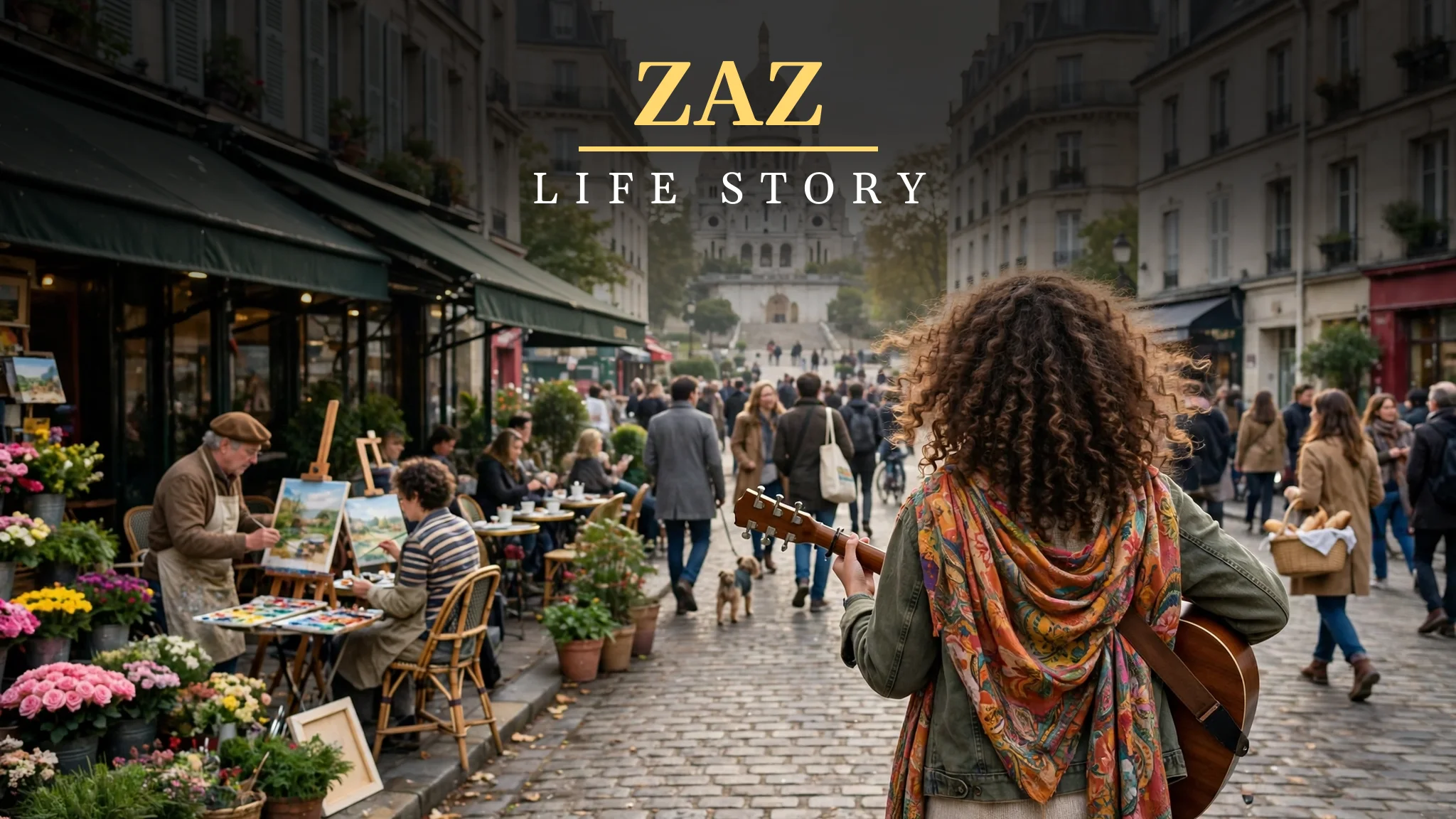
After her years of study and travel, Isabelle came to Paris, and it was there that her story took its most famous turn. Paris is a city where music lives on the street, and Montmartre, the old hilltop quarter with its painters and cafes, was the perfect place for her. She began to sing in the streets and squares of Montmartre, with a guitar and a small group of musicians, and the people passing by stopped to listen. She sang French songs, she sang her own songs, and she sang with a joy that was hard to ignore.
Street singing is one of the hardest schools a musician can attend. There is no stage, no lighting, no sound system to hide behind. The audience is free to walk away at any moment, and they will only stay if the music is real. Zaz learned to win people over in the first few notes. She learned to sing loudly enough to be heard over the noise of the city, and softly enough to make people come closer. She learned to read a crowd, to change a song when the mood changed, and to keep going even when the weather was cold or the coins in the hat were few.
Montmartre also gave her a community. She met other street musicians, painters, and artists, and she became part of a world that valued freedom over money. The people of Montmartre loved her voice, and word began to spread. Musicians in Paris started to talk about the young woman with the big voice who sang on the hill. It was not fame in the usual sense. It was something better: a real reputation, built one song at a time, among people who knew music.
Those years on the street also shaped the singer she would become. She learned to sing without fear, to be direct, and to treat every listener as a person rather than a number. When she later stood on big stages in front of thousands, she sang in the same way she had sung on the pavement: as if she were singing to each person one by one. That is a rare gift, and it came from Montmartre.
Je veux and the First Album
In 2010, everything changed. Zaz released her first single, “Je veux”, and it became a hit in France and then across Europe. The song was simple and joyful, a list of the things she did not want — money, luxury, big houses — and the things she did want: love, joy, freedom, and a good mood. It was the opposite of the usual pop song. It did not promise glamour. It promised a simple and honest life, and millions of people recognised their own feelings in it.
The song was written with the help of the songwriter Kerredine Soltani, and it was produced with a small team who understood her sound. It was not a loud or complicated song. It had a bouncing rhythm, a clear voice, and a chorus that people could sing along to after hearing it once. Radio stations played it again and again, and it climbed the charts in France, Belgium, Switzerland, Germany, and beyond. For a singer who had spent years on the street, it was a strange and wonderful feeling to hear her own voice coming from car radios and shop speakers.
Her first album, called simply “Zaz”, followed in the same year, and it was also a great success. It mixed French chanson, jazz, pop, and Latin sounds, and it showed that she was far more than a one-song singer. Songs like “Éblouie par la nuit” showed a softer and more tender side, while other tracks showed her playful energy. The album sold hundreds of thousands of copies, and it won her awards and invitations to sing in many countries. She was no longer a street singer. She was a star, and the world wanted to hear her.
The success brought new pressures. She had to learn to live with interviews, photographers, and long tours. She had to sing the same song night after night without losing its freshness. She did it by remembering where she came from. She kept her band close, she kept her sense of humour, and she kept the habit of talking to her audience as if they were friends. The girl from Montmartre had not disappeared. She had simply found a bigger street.
The World Discovers Her Voice
After the first album, Zaz travelled the world. She sang in Germany, where her music was especially loved, in Canada, in Japan, in South America, and in many other places. She discovered that her songs crossed borders even when people did not understand the French words. The melody, the rhythm, and the feeling in her voice were enough. People danced, they sang along, and they came to her concerts again and again. She became one of the best-known French singers of her generation outside France, a rare thing for a singer who sings mainly in French.
Her second album, “Recto Verso”, came in 2013, and it showed a singer who was growing. The songs were more varied, the lyrics more personal, and the production richer. It included the song “On ira”, which became another favourite with her fans, a joyful song about leaving and travelling. The album was a success in France and abroad, and it proved that her first album had not been a lucky accident. She was a real artist with a real career, and she was building it carefully.
In 2014 she released “Paris”, an album of songs about the French capital, recorded with a big orchestra and a trio of musicians. It was a love letter to the city that had given her so much, and it showed her respect for the great French singers of the past. The album included classic songs about Paris, sung in her own warm style, and it was praised by critics who saw that she was not just a pop singer but a keeper of a tradition. She could honour the past without being trapped by it.
Touring became a central part of her life. She spent months on the road, singing in concert halls, festivals, and theatres. She learned to live out of a suitcase, to sleep on buses and in hotels, and to find energy for a concert even when she was tired. She loved meeting her fans after the shows, and she often stayed to talk and sign autographs. For her, the concert was not a performance to be watched from a distance. It was a meeting between people, and that is why her audiences stayed loyal.
New Albums, New Roads
In the years that followed, Zaz continued to record and to tour. Her album “Effet miroir” came in 2018, and it showed a more modern and polished sound, with songs that spoke about the world around her. She sang about the pressure of modern life, about the need to slow down, and about the search for truth in a noisy world. The album was well received, and it took her on another long tour, including concerts in big halls across Europe and beyond.
She also took time to think about her life and her career. Fame had given her many things, but it had also taken things away, such as privacy and quiet time. She began to speak more openly about the need to protect the planet, about the importance of kindness, and about her own wish to live simply. She was not a singer who hid behind her songs. She used her voice to say what she believed, and her fans respected her for it.
In 2021 she released “Isa”, an album named after her real first name, Isabelle. It was a more personal record, with songs about love, family, and the passing of time. The album showed a woman who was no longer a young newcomer but a mature artist with a long story behind her. Critics noted the warmth and honesty of the record, and her fans found in it a singer who was growing with them, sharing their joys and their worries.
She also worked with other artists, sang on charity records, and appeared at festivals that brought musicians together from many countries. She never stopped travelling, and she never stopped learning from the music of other places. Her career became a long road rather than a short burst of fame, and that is a rare achievement in pop music, where many stars shine brightly for a year and then fade away.
Hard Years and Honest Songs
No long career is without hard times, and Zaz has faced her share. The music industry changed greatly during her career, with streaming taking over from CDs and with the pressure on artists to be always visible on social media. She had to adapt to a world where a singer is expected to post every day, to share every moment, and to compete for attention with thousands of others. She did it in her own way, staying true to her belief that music matters more than noise.
The pandemic years were especially hard for a singer who lives for live concerts. When concert halls closed, she could not meet her audience, and like many musicians she had to find new ways to keep singing. She played online, she recorded at home, and she waited for the day when she could stand on a stage again. The experience reminded her, and her fans, of how much live music means. A song on a screen is not the same as a song sung in a room full of people.
She has also spoken about the personal cost of a life on the road. Travelling for months at a time is tiring, and it is hard to keep a normal life when you are always moving. She has been honest about the need to rest, to look after her health, and to protect her private life. She does not pretend that fame is easy. She talks about it plainly, and that honesty has made her fans trust her even more.
Through all of this, she kept writing and singing. Her later songs are calmer and more thoughtful than her early hits, but they carry the same warmth. She sings about love, about the world, about growing older, and about the small things that make life worth living. She has shown that a singer can change and grow without losing the thing that made people love her in the first place: a true voice, sung with an open heart.
What Zaz Means Today
Today, Zaz stands as one of the most loved French singers of her time. She is known in France, of course, but also in Germany, in Canada, in Japan, and in many other countries where people have learned her songs by heart. She has sold millions of records, she has won major French music awards, and she has sung in some of the most famous halls in the world. Yet she is still, at heart, the singer from Montmartre who sang for whoever stopped to listen.
Her influence can be seen in the young singers who followed her, especially young French women who saw that it was possible to sing in French and still reach the world. She showed that you do not need to sing in English to be heard, and you do not need to follow fashion to be loved. You need a real voice, real songs, and the courage to be yourself. That lesson has travelled further than any single song.
She continues to tour and to record, and her concerts still have the warmth of a street performance. She talks to the audience, she laughs, she sings with her whole body, and she makes a big hall feel like a small room. People come to her shows not just to hear the hits but to feel that warmth, to spend an evening with a singer who seems like a friend. That is a rare and precious thing in modern music.
The story of Zaz is, in the end, a story about patience and honesty. She did not become famous at eighteen. She worked for years in bars and on streets, she learned her craft the hard way, and when success came, she was ready for it. She did not let it change her. She kept her values, she kept her love of simple things, and she kept singing the songs she believed in. For anyone who dreams of a life in music, her story is a reminder that the slow road, walked with honesty, can lead further than the fast road.
My Take:
When I think about Zaz, the first thing that comes to me is not a chart position or an award. It is the picture of a woman singing on a Paris street, with people walking past, and a few of them stopping because something in her voice makes them turn around. I love that picture, because it tells me everything about why her music works. She did not start in a television studio with perfect lighting and a team of people telling her how to stand. She started where real music starts, in front of real people, with nothing to hide behind. That is a brave way to begin, and I think it is the reason her songs still feel honest today.
I admire her patience more than anything else. She was not a child star, and she was not discovered at sixteen by a record company that made her famous overnight. She spent years singing in bars, in small venues, and on the streets of Montmartre, earning a little money and learning her craft. Most people would have given up. The pay was small, the nights were long, and the future was uncertain. She kept going, not because she was sure of success, but because singing was the thing she loved. I think there is a deep lesson in that. If you only do something when success is certain, you will never do anything brave. She did it because it mattered to her, and success came later as a kind of reward for her stubbornness.
What I like most about “Je veux” is that it says the opposite of what pop music usually says. Most pop songs tell you to want more money, more luxury, more fame, and more things. “Je veux” says the opposite: I do not want your money, I do not want a big house, I want love, I want joy, I want to be free. That is a simple message, but it is a radical one in a world that keeps telling us to buy more and want more. When millions of people sang along to that song, they were not just enjoying a catchy tune. They were agreeing with an idea, and that idea was that a good life is not measured by what you own. I find that beautiful, and I think it explains why the song travelled so far. People in Germany, in Japan, in Canada, people who did not speak French, still felt the meaning of it, because the feeling was in the music itself.
I also think about her voice, because it is not a perfect voice in the technical sense, and that is exactly why I love it. It has a rough edge, a warmth, and a power that sounds human. When she sings a soft song, you can hear the tenderness in it. When she sings a joyful song, you can hear the smile in it. She does not hide behind tricks or effects. She stands in front of the microphone and sings like a person, and that directness is rare. Many modern singers sound like they have been polished until every human edge is gone. Zaz sounds like a person, and I would always rather listen to a person than to a machine.
There is something I find sad in her story, and it is the price of the life she chose. A life on the road is not a romantic life when you live it every day. It means long nights, tired mornings, hotel rooms that all look the same, and months away from home. It means singing the same songs night after night and trying to make them fresh, even when your throat is tired and your body is asking for rest. I do not think she complains about it, but I can see the cost of it in the way she talks about needing time to rest and time to be quiet. Fame gives you a stage, but it takes away your privacy, and it takes away the simple pleasure of walking down a street without being recognised. I respect the way she has handled that trade, but I do not pretend that it is easy.
I admire the way she has stayed true to French music while still being open to the world. She could have switched to English to sell more records, as many singers do. She did not. She kept singing in French, and she proved that a French song can travel the world on its own strength. At the same time, she opened her music to the sounds of other countries: Latin rhythms, jazz, gypsy music, the music of the street. That balance is hard to achieve. Some singers become so traditional that they sound old-fashioned, and others become so international that they lose their roots. She managed to keep both: she sounds French, and she sounds like the world. That is a real achievement.
I also think about what her story teaches a young person who wants to make music. The lesson is not to wait for a lucky break. The lesson is to sing wherever you can, to anyone who will listen, and to get better every time. She sang in bars, she sang on the street, she sang in small halls, and each time she learned something. By the time the record companies came to her, she already knew who she was as a singer. Nobody had to invent her. That is why her success lasted. A singer who is invented by a company can be replaced by the next invention. A singer who knows herself cannot be replaced, because there is only one of her.
Another thing I notice is her honesty about the world. She sings about the planet, about kindness, about the pressure of modern life, and she does not pretend that these things are simple. She is not a singer who only sings love songs and avoids hard subjects. She uses her platform to say what she believes, and she does it in a gentle way, without shouting or preaching. I like that. I think artists have a responsibility to say something real, and she does it without losing her warmth. She reminds me that a pop singer can also be a thoughtful person, and that the two things do not have to be separate.
If I have a criticism, it is a small one, and it is really a wish. I wish more people outside France knew her later albums as well as they know “Je veux”. Her later songs are calmer and deeper, and they show a mature artist with a lot to say. But the world often remembers only the first big hit, and that is unfair. An artist grows, and the later work deserves the same attention as the early work. I hope her fans take the time to listen to the whole journey, from the street songs to the quiet songs of her later albums, because the whole journey is the real story.
I think about the pandemic years, too, and what they must have meant for her. For a singer who lives for live concerts, the silence of empty halls must have been painful. She could not meet her audience, she could not feel the energy of a room, and she had to wait. But I think that time also showed her what matters most. When the concerts came back, the joy was even greater, because everyone had learned what it feels like to lose live music. I hope she felt that joy, and I hope her audiences told her how much they had missed her. A singer like her is not just an entertainer. She is a person who brings people together in a room, and that is a precious thing in a world that often keeps people apart.
In the end, what I take from the story of Zaz is a simple idea: be yourself, be patient, and sing what you believe. She did not try to be anyone else. She did not chase fashion. She sang in French, she sang on the street, she sang about simple things, and the world came to her. That is the opposite of what most advice tells young artists, which is to follow the trend and to please the market. She pleased herself first, and the market followed. I think that is the bravest and the wisest way to build a career, and I think it is a lesson that works far beyond music. In any job, in any life, the people who last are the people who know who they are and who refuse to pretend otherwise.
I will keep listening to her music, and I will keep thinking about that street in Montmartre. Every time I hear “Je veux”, I hear a woman who chose freedom over luxury, and joy over money, and I think that is a choice worth remembering. She reminds me that a good life is not about having more. It is about loving what you have, singing what you feel, and sharing it with whoever stops to listen. That is a small idea, and it is a big one, and Zaz has spent her whole career singing it.
I also think about the women who came before her, and the women who came after her. French music has a long line of great female singers, from Édith Piaf to the stars of today, and each one of them carried the tradition in her own way. Zaz belongs in that line, not because she copies anyone, but because she understands what the tradition is really about. It is not about sounding old-fashioned. It is about singing with your whole heart, about telling the truth in a song, and about standing in front of people and giving them something real. She does that, and she does it in a way that is entirely her own. I think Piaf would have understood her, and I think the young singers of today understand her too, because honesty never goes out of fashion.
Another thing that stays with me is her love of travel, and the way it shows in her music. She did not stay in one place. She went to South America, she went to Asia, she went to Canada and Germany, and she let the music of those places touch her own songs. That is a generous way to be an artist. Some singers travel and take nothing in, and their music stays the same wherever they go. She travels and listens, and her music grows because of it. I think that is why her concerts feel different in different countries. She is not just bringing a French show to a foreign audience. She is meeting people, and she is letting the meeting change her. That takes humility, and humility is not a quality you often find in a famous singer.
I also want to say something about her sense of humour, because it is easy to forget when we talk about serious artists. Zaz is funny. She laughs on stage, she jokes with her band, she does not take herself too seriously, and that lightness is part of her charm. A singer who can laugh at herself is a singer who is comfortable in her own skin, and an audience can feel that comfort. It makes the room relax. It makes people feel that they are among friends. I think humour is an underrated gift in music, and she has it in full measure. She can sing a sad song and then smile, and the smile does not take away from the sadness. It makes the sadness feel human, because that is how life works: we are sad and we laugh, sometimes in the same hour.
There is one more lesson I take from her, and it is about the value of starting small. We live in a time when everyone wants to be famous quickly, when a single video can make a person a star overnight, and when the slow road looks like a waste of time. Her story says the opposite. The slow road taught her everything she needed to know. The bars taught her to hold a room. The street taught her to win a stranger’s attention. The small tours taught her to survive on the road. By the time fame arrived, she was not a beginner who could be pushed around. She was a professional who knew her craft. I think that is worth remembering for anyone who feels impatient with their own slow start. The slow start is not a delay. It is the training, and the training is what makes the success last.
Frequently Asked Questions
Where was Zaz born and what is her real name?
Zaz was born Isabelle Geffroy on 1 May 1980 in Tours, France, a city in the Loire Valley. She took the short stage name Zaz when she began performing, and she is now known by that name around the world.
What is Zaz’s most famous song?
Her most famous song is “Je veux”, released in 2010 as the first single from her debut album. The song became a hit in France and across Europe, and it remains the song most people think of first when they hear her name.
Did Zaz really sing on the streets of Paris?
Yes, she sang for years in the streets and squares of Montmartre in Paris, with a guitar and a small group of musicians. That time on the street shaped her direct and warm singing style, and she still sings with the same closeness to her audience today.
What albums has Zaz released?
Her albums include “Zaz” from 2010, “Recto Verso” from 2013, “Paris” from 2014, “Effet miroir” from 2018, and “Isa” from 2021. Each album shows a different side of her music, from joyful pop to quiet and personal songs.
Why is Zaz popular outside France?
Her songs cross borders because the feeling in her voice and the melody carry the meaning even when listeners do not speak French. She is especially loved in Germany, Canada, and Japan, and she has toured in many countries around the world.
What is Zaz doing now?
She continues to record new music and to tour, singing in concert halls and at festivals in France and abroad. Her later work is calmer and more personal than her early hits, and she still performs with the warmth of a singer who loves meeting her audience.


