Zedd: The Life Story Behind the German DJ and Producer
In this post
Zedd is the German producer who turned years of classical piano lessons into some of the biggest dance songs in the world. His music is bright, polished, and full of energy, built on big melodies, powerful drops, and voices that soar over the beat. He has worked with some of the biggest pop stars on the planet, he has won a Grammy, and he has played on the largest festival stages in the world. Yet his story starts in a quiet, ordinary way: a boy in Kaiserslautern, Germany, sitting at a piano, learning to play the notes that his parents taught him.
Zedd’s real name is Anton Zaslavski. He was born in Saratov, Russia, in 1989, and he grew up in Kaiserslautern, in western Germany, after his family moved there when he was a small child. His parents were both musicians, and music was part of his life from the start. He learned the piano as a child, he learned the drums as a teenager, and he played in a metal band before he ever made electronic music. That mix of classical training, rock energy, and electronic curiosity became the foundation of his sound, and it is why his songs feel both musical and powerful at the same time.
What makes his story special is how completely he changed direction, and how well he did it. He went from playing drums in a metal band to making electronic dance music, from a small German town to the top of the American charts, and from a young producer posting tracks online to a Grammy winner working with Ariana Grande, Selena Gomez, and Alessia Cara. His hits include “Clarity” with Foxes, “Stay the Night” with Hayley Williams, “Stay” with Alessia Cara, and “The Middle” with Maren Morris and Grey. This is the story of how a classically trained boy from Kaiserslautern became one of the most successful producers in the world.
Saratov to Kaiserslautern: A Musical Childhood
Anton Zaslavski was born on 2 September 1989 in Saratov, a city in Russia on the Volga River. His parents were musicians, and music was part of everyday life in his home. When Anton was three years old, his family moved to Germany, and they settled in Kaiserslautern, a city in the state of Rhineland-Palatinate. Growing up in Germany gave him a new home, a new language, and a new set of opportunities, but music stayed at the centre of his life.
His parents taught him the piano when he was very young, and he practised for years. Classical piano is a hard discipline. It means sitting alone for hours, learning scales, learning pieces by Bach, Beethoven, and Chopin, and learning how to make a piano sing. Anton learned those lessons well, and they gave him a deep understanding of melody, harmony, and structure. That understanding would later make his electronic music richer and more musical than the work of many other producers who had never learned an instrument.
As a teenager, he also learned the drums, and he joined a metal band called Dioramic, playing drums and writing songs with his friends. Metal is a loud, fast, and aggressive style of music, and it taught him about energy, about rhythm, and about performing live. Playing in a band also taught him how to work with other musicians, how to rehearse, and how to build a song from a simple idea into something complete. The mix of classical piano and metal drums may sound strange, but it gave him a wide range of musical tools, and he would use all of them in his later work.
Kaiserslautern was a quiet place to grow up, and it gave him time and space to practise. He was not surrounded by the music industry, and he did not have famous connections. He had a piano, a drum kit, a computer, and a love of music, and that was enough. He spent his teenage years learning, playing, and experimenting, and he slowly began to think about making electronic music, a style that would let him combine everything he had learned into one sound.
From Metal Drums to Electronic Beats
In his late teens, Zaslavski began to explore electronic dance music. He had heard DJs and producers making tracks on computers, and he was drawn to the freedom of that world. In electronic music, one person can be the composer, the performer, and the producer all at once, and that appealed to a young musician who had spent years learning different instruments. He began to make tracks under the name Zedd, a short version of his surname, and he posted them on the internet.
His early tracks were in the style of electro house, a loud and energetic form of dance music with big bass lines and sharp melodies. He won remix competitions, including a well-known contest for the French DJ Justice, and his work began to attract attention from other producers. In 2010, he released his first singles, and he began to tour as a DJ, playing in clubs in Europe and America. He was still young, but he was learning fast, and his classical training gave him an advantage. His tracks had melodies that stuck in your head, and structures that felt like real songs, not just loops.
He also began to work with other artists. In 2011, he produced tracks for the American singer Lady Gaga, and he toured with the Australian DJ duo Nervo. Those experiences taught him how the professional music world worked, and they gave him confidence. He was no longer a teenager in Kaiserslautern making tracks in his bedroom. He was a producer working with world-famous artists, and his name was becoming known in the dance music world.
The move from metal to electronic music was not a rejection of his past. It was a way of bringing everything he had learned together into a new form. The piano gave him melody, the drums gave him rhythm, and the metal band gave him energy. Electronic music gave him a way to combine all three, and to reach a much larger audience. That combination became the Zedd sound, and it would soon take him to the top of the charts.
Clarity and the Grammy
In 2012, Zedd released his first album, “Clarity”, and it contained the song that would make him a star. “Clarity”, featuring the British singer Foxes, is a powerful dance song about a relationship that is falling apart, with a soaring vocal and a huge, emotional drop. The song became a hit in America and around the world, reaching the top ten in the United States and winning the Grammy Award for Best Dance Recording in 2014. For a young producer from Germany, winning a Grammy was an extraordinary achievement, and it confirmed that he was one of the leading artists in dance music.
The album “Clarity” also contained other strong songs, including “Spectrum” with Matthew Koma and “Stay the Night” with Hayley Williams of Paramore. Each song showed a different side of Zedd’s production: big melodies, clean sounds, and vocals that were given room to shine. The album was a success, and it established Zedd as a producer who could make dance music that worked on the radio as well as in a club. His songs were not just for dancing. They were for listening, for singing along, and for feeling.
The Grammy win changed his life. He was now a recognised name in America, and he was invited to work with more pop stars, to play at bigger festivals, and to produce music for films and television. He handled the success with calm, and he kept working in the same careful way he always had: by writing melodies, by practising, and by trusting his musical training. He did not let the award change his sound. He let it give him more freedom to make the music he wanted to make.
“Clarity” remains his most important song, because it proved that a classically trained producer from Germany could make a dance song that would win America’s highest music award. It also showed that electronic music could be emotional, melodic, and human, not just loud and mechanical. That message has stayed with Zedd throughout his career, and it is why his music continues to reach people who do not normally listen to dance music.
True Colors, Break Free, and the Pop Years
After “Clarity”, Zedd released his second album, “True Colors”, in 2015, which contained the songs “I Want You to Know” with Selena Gomez and “Beautiful Now” with Jon Bellion. The album was a success, and it showed a producer who was growing more confident. The songs were bigger, the melodies were stronger, and the production was cleaner. Zedd was now working at the highest level of pop music, and he was doing it on his own terms.
In 2014, he had also produced “Break Free” for Ariana Grande, a song that became a worldwide hit and one of the biggest songs of that year. Working with Grande was a major moment, because she was one of the biggest pop stars in the world, and the song’s success showed that Zedd could write a pop hit for another artist as well as for himself. The song’s bright, energetic sound fitted both artists perfectly, and it became a favourite in clubs and on the radio.
During this period, Zedd also toured the world as a DJ, playing at major festivals including Ultra Music Festival in Miami and Electric Daisy Carnival in Las Vegas. His sets were known for their energy, their big melodies, and their clean, powerful sound. He played for crowds of tens of thousands of people, and he became one of the most in-demand DJs in the world. He also continued to produce music for other artists, and he became known as a producer who could bring a pop song to life with a dance beat.
The pop years were busy, but Zedd kept his focus on quality. He did not release music just for the sake of it. He worked on each song until it was right, and he chose his collaborations carefully. That patience is part of why his hits have lasted. A song like “Clarity” or “Break Free” still sounds fresh years after it was released, because it was made with care and with a strong melody at its heart.
Stay, The Middle, and a New Sound
In 2017, Zedd released “Stay” with Alessia Cara, a song that became a worldwide hit and one of his most successful singles. “Stay” is a soft, emotional song about wanting someone to stay with you, and it showed a gentler side of Zedd’s production. The song was played on radio stations everywhere, it was streamed billions of times, and it became a favourite for weddings and for quiet moments. It proved that Zedd could make a hit that was not loud or aggressive, but tender and human.
In 2018, he released “The Middle” with Maren Morris and Grey, a song that became an even bigger hit. “The Middle” is a catchy, upbeat song about a couple trying to meet in the middle, and it reached the top of the charts in many countries. The song was nominated for Grammy Awards, and it became one of the most played songs of the year. It showed that Zedd could work with country singers, pop singers, and electronic producers all at once, and make a song that brought their different worlds together.
These songs marked a new phase in Zedd’s career. He was no longer just a dance producer. He was a pop producer who could work in many styles, and who could make hits that reached people who had never been to a dance festival. His music had become more melodic, more emotional, and more accessible, and that change brought him a larger audience. He was now one of the most successful producers in the world, with hits in many different genres.
He also continued to tour and to play at festivals, and he remained a popular DJ. His sets mixed his own hits with music by other artists, and they were known for their energy and their polish. He was now a global star, but he kept his working style simple: write good melodies, produce with care, and choose collaborations that felt right.
Telos and the Later Years
In 2024, Zedd released his third album, “Telos”, after a long break from albums. The album was a return to his electronic roots, with longer tracks, more complex production, and collaborations with artists including John Mayer and the band Muse. It showed a producer who was still curious and still willing to try new ideas, even after many years at the top. The album was well received, and it proved that Zedd had not lost his love of electronic music, even as he had become a pop star.
The later years of his career have been about balance. He tours less than he did in his busiest years, and he spends more time in the studio, writing and producing. He has also worked on music for films and for other artists, and he has become a mentor to younger producers. He is now a respected figure in the music world, known not only for his hits but for his musicianship and his professionalism.
Zedd has also stayed close to his family and to his roots in Germany, even though he now lives in the United States. He speaks about his childhood in Kaiserslautern with warmth, and he credits his parents with giving him the musical education that made his career possible. That gratitude is part of his story, and it shows in the care he takes with his music. He knows that his success was built on years of practice, and he does not take it for granted.
His story is still going on, and he continues to release new music and play shows around the world. He is no longer the young producer from Kaiserslautern who was trying to get noticed. He is a Grammy winner with a long list of hits, but he still works with the same careful, musical approach that he learned as a child at the piano. That is the heart of his story: a classically trained boy who became a dance music star by trusting his training and his ear.
What Zedd Leaves Behind
Today, Zedd is one of the most successful producers in the world, with billions of streams, a Grammy Award, and a list of hits that includes “Clarity”, “Stay”, “The Middle”, and “Break Free”. He has worked with some of the biggest pop stars on the planet, he has played at the biggest festivals, and he is known far beyond Germany. Yet he is still, in many ways, the same musician who started at the piano in Kaiserslautern: a person who loves melody, who works hard, and who cares about making music that lasts.
His legacy is not only in his hits. It is in the example he set for young producers around the world. He showed that classical training can make electronic music better, not worse, and that a producer who understands melody and harmony has an advantage. He showed that a young person from a small German city can become a global star, and that hard work and patience matter more than connections. Many young producers who came after him learned from that example.
For new listeners, the best place to start is simple: listen to “Clarity” for the song that won the Grammy, listen to “Stay” for his gentle side, listen to “The Middle” for his biggest pop hit, and listen to “Break Free” for his work with Ariana Grande. Then go and see him live, if you can, because that is where Zedd truly lives. On stage, in front of thousands of people dancing to a big melody, Zedd is not a star from the past. He is an artist who is still happening, still musical, and still making songs that make people feel alive, and that is a rare and wonderful thing.
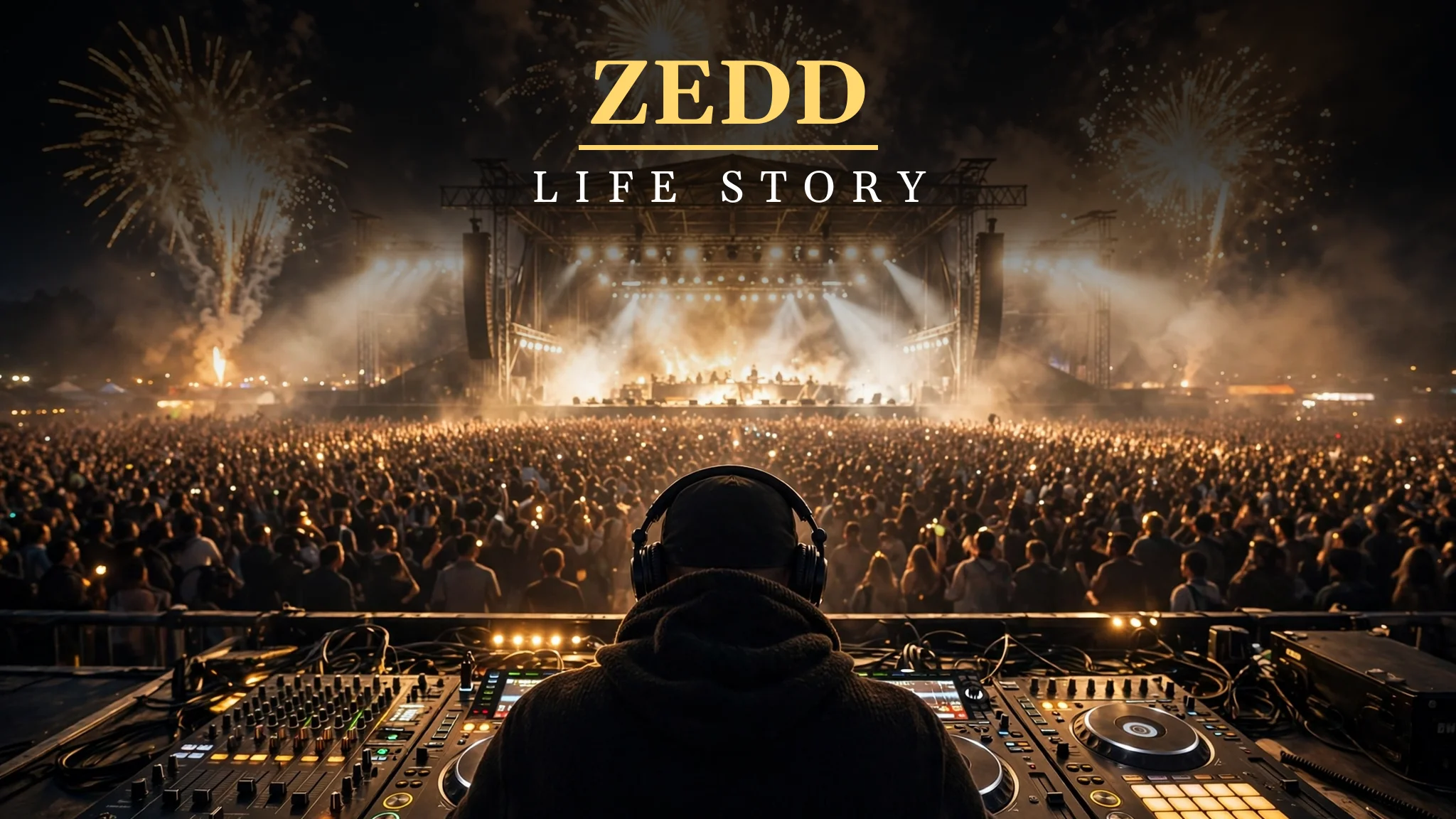
Festival Stages and the Big Room Sound
Zedd’s music was made for large stages, for festivals, and for crowds of tens of thousands of people, and his live career took him to all of those places. After the success of “Clarity”, he began to play at major festivals around the world, including Ultra Music Festival in Miami and Electric Daisy Carnival in Las Vegas, two of the biggest dance festivals on the planet. Playing at those festivals is a dream for many DJs, and Zedd played there many times, in front of huge crowds who knew his songs by heart. His sets were energetic, melodic, and polished, and they stood out because they combined the power of dance music with the musicality of a trained pianist.
His live shows also have a special relationship with the audience. Fans come to a Zedd set to dance, to sing along, and to feel the drop, that moment when the music builds and then explodes. Zedd is a master of that moment, because he understands melody and structure, and he knows how to build tension and release it at exactly the right time. That skill comes from his classical training, and it is why his sets feel more musical than those of many other DJs. He does not just play tracks. He builds a journey, from a quiet start to a powerful peak, and the crowd travels with him.
He also learned how to adapt his sets to different cultures and different venues. A crowd in Tokyo is different from a crowd in Berlin, and a crowd in Miami is different from a crowd in London, but Zedd’s music worked in all of those places, because it was built on big melodies and strong emotions that are universal. He did not change his sound for each country. He trusted his sound, and his sound travelled well. That global reach is part of why he has lasted so long at the top of dance music.
The festival years also taught him about the business of being a global star. He had to manage a busy schedule, work with a team, and take care of his health while travelling constantly. He learned to balance touring with time in the studio, and to rest when he needed to. That balance is part of why he has lasted so long. Many DJs burn out after a few years of heavy touring, but Zedd paced himself, and he is still playing and producing more than a decade after his breakthrough.
For his fans, a Zedd set is a moment of joy, of energy, and of shared excitement. People come to his stage to dance, to cheer, and to feel alive, and they leave with a memory of a big melody and a huge crowd moving together. That is a different kind of festival experience, but it is a real one, and it is why his name remains on festival line-ups around the world.
My Take:
When I think about Zedd, the first thing I feel is admiration for his training. He spent years learning the piano, learning the drums, and playing in a metal band, and all of that work shows in his music. His songs have melodies that feel real, structures that feel like songs, and a polish that comes from understanding music deeply. I admire that, because many dance producers never learn an instrument, and their music can sound thin and empty. Zedd’s music sounds full, because it was made by a musician who knows how music works from the inside. That is a lesson for any young person who wants to make music: learn your instrument, practise every day, and the work will pay off in ways you cannot yet see.
I admire “Clarity” most of all, because it is a song that changed his life and changed dance music at the same time. It is a song about a relationship falling apart, and it is full of feeling, but it is also a huge dance track with a drop that makes a crowd jump. That combination of emotion and energy is hard to achieve, and Zedd achieved it when he was only twenty-three years old. When I listen to “Clarity”, I hear a young producer who understood something important: that dance music can be emotional, that a song can make you dance and make you feel at the same time, and that is a powerful thing. The Grammy Award was a fitting recognition for that achievement.
What I love about his music is its brightness. A Zedd song feels like sunlight, like a clear sky, like a moment of joy. The melodies are big, the production is clean, and the voices soar. I think many dance producers try to make music that is dark and heavy, because they think that is what a club wants. Zedd proved that a crowd also wants light, and melody, and a song they can sing along to. His music is not for a dark, underground club. It is for a festival stage, a summer day, a moment of happiness, and that is a different kind of energy, and I think it is a better kind.
I also think about his journey from Russia to Germany to America, and I find it inspiring. He was born in Saratov, he grew up in Kaiserslautern, and he became famous in America, and each of those places shaped his music. His Russian roots gave him a classical tradition, his German home gave him discipline and a love of electronic music, and America gave him the pop world and the biggest stages. That mix of cultures is part of why his music feels universal. It is not tied to one country or one style. It is music that belongs to the whole world, and that is a beautiful thing.
There is something else I admire, and it is his ability to work with other artists. He has worked with Ariana Grande, Selena Gomez, Alessia Cara, Maren Morris, and many others, and each collaboration sounds like Zedd and like the other artist at the same time. That is a rare skill. Many producers either take over a song completely, or they disappear into the background. Zedd finds a balance, bringing his sound to the song while letting the singer shine. I think that takes generosity, and a real respect for other musicians, and I admire that quality in him.
If I have a criticism, it is a small one, and it is about how polished some of his music can sound. His production is so clean, so perfect, that it can sometimes feel a little too smooth, a little too safe. I do not think that is a serious flaw, because the polish is part of what makes his songs so listenable, and his fans love that sound. But I do think a new listener should also listen to his earlier, rougher tracks, and to his album “Telos”, where he tried more complex and experimental ideas, because that is where you hear the musician behind the polish. The best Zedd is the Zedd who takes risks, and I hope he keeps taking them.
Another thing I notice is how calm Zedd is about fame. He is a global star, but he does not act like one. He is quiet, he is focused, and he lets his music speak for him. I respect that, because fame can change people, and it can make them loud, arrogant, or distant. Zedd stayed close to his work, stayed close to his family, and stayed close to the music that made him. That steadiness is the foundation of his long career, and it is why he is still relevant after more than a decade at the top.
For a young reader, I think the lesson of Zedd is to learn your craft, practise every day, and be open to change. Learn an instrument, learn how music works, and then use that knowledge to make something new. Do not be afraid to change direction, as Zedd did when he moved from metal to electronic music. Do not be afraid to work with people who are different from you. If you do those things, and you keep working, you may not become famous overnight, but you will build something real, and something real lasts longer than fame.
I think about the future of his career, and I hope he keeps making music for many more years. He has already given the world some of its most loved dance and pop songs, and he has shown that a classically trained musician can become a dance star. When I listen to his music, I feel happy, I feel energised, and I feel like I am at a festival on a sunny day, with good music and good friends. That feeling is rare, and it is precious. I am glad this artist exists, and I am glad he trusted his training, because without him, dance music would be less musical, less bright, and less joyful.
One more thought stays with me. Zedd’s story is a story about a piano in Kaiserslautern, about a boy who practised for hours, and about a young man who believed that melody matters. That idea has carried him across the world, across many years, and across many changes in the music business. It is a reminder that the basics matter: learn your instrument, write a good melody, and work hard. I will keep listening to Zedd, and I will keep smiling when I hear “Clarity”, because that song means the music is still alive, and the music is a good place to be.
I also think about the value of musical training, and how Zedd proves it matters. He spent years learning the piano, learning the drums, and playing in a band, and all of that work shows in his music. His songs have melodies that feel real, structures that feel like songs, and a polish that comes from understanding music deeply. I think many young producers skip that training, and their music can sound thin because of it. Zedd shows that learning an instrument is not a waste of time. It is an investment, and it pays off in ways you cannot yet see. That is a lesson for any young person who wants to make music.
Another thing that stays with me is his ability to collaborate. He has worked with Ariana Grande, Selena Gomez, Alessia Cara, Maren Morris, and many others, and each time he finds a balance between his sound and the singer’s voice. That takes generosity, and a real respect for other musicians. Many producers either take over a song completely, or they disappear into the background. Zedd finds a middle path, bringing his production to the song while letting the singer shine. I admire that, because collaboration is a skill, and it is one that makes music better for everyone.
I think about the future, and I wonder what Zedd will do next. He has already won a Grammy, made many hits, and played the biggest festivals, but he does not seem tired. His album “Telos” showed that he is still curious, still willing to try new ideas, and still in love with electronic music. I hope he keeps going, because dance music needs him. It needs a producer who is musical, bright, and ambitious, all at the same time. It needs a producer who can fill a festival stage and still make a song that feels personal. That is a rare combination, and I am glad it exists.
When I listen to his music now, I hear something different from what I heard at first. At first, I heard a big beat and a catchy melody. Now I hear years of piano practice, of drum lessons, of playing in a metal band, and of learning how music works from the inside. That depth is what makes his later songs so moving, and it is what makes his story worth telling. A producer can be famous for a year, but to be loved for more than a decade, you need something more than hits. You need trust, and this artist has earned it.
I also want to say something about his journey across cultures, which is part of what makes his music universal. He was born in Russia, grew up in Germany, and became famous in America, and each of those places shaped his sound. His Russian roots gave him a classical tradition, his German home gave him discipline, and America gave him the pop world. That mix is why his music feels like it belongs to everyone, not to one country. In a world that is often divided, a musician who brings cultures together is doing something important, and Zedd does that with every song.
In the end, my feeling about this artist is simple: I am grateful. I am grateful for the songs, for the melodies, for the Grammy-winning “Clarity”, and for the example he set. He showed me that training matters, that melody matters, and that a classically trained boy from Kaiserslautern can become a global star. Those are lessons that go beyond music, and they are lessons I will carry with me. When I hear “Clarity” again, I will think of a piano in a small German town, of a boy practising for hours, and of a producer who made that practice into something the whole world could dance to.
One last thought: the best producers do not just make beats. They make melodies, they make feelings, and they make a place where people can belong, where they can dance together, sing together, and feel less alone. Zedd makes such a place, at festivals, on the radio, and in the hearts of millions of listeners. That place is still open, still bright, and still welcoming, and I hope it stays open for many more years. If you have never heard his music, listen with good headphones, and pay attention to the melody. You may find, as I did, that a producer from Kaiserslautern has something important to say to you, too.
I keep returning to the idea of melody, because it is what sets Zedd apart. Many dance producers build tracks around a beat, and the melody is an afterthought. Zedd builds his songs around a melody, and the beat serves the melody. That is a direct result of his piano training, and it is why his songs stay in your head long after they end. A good melody is a simple thing to describe and a hard thing to create, and Zedd creates them again and again. I think that is his greatest gift, and it is why his music reaches people who do not normally listen to dance music. A melody speaks a language everyone understands, and Zedd speaks it fluently.
I also think about his move from metal to electronic music, and what it teaches about change. He could have stayed in his metal band, playing drums for a small audience, and been happy. Instead, he tried something new, learned a new style, and became a global star. That willingness to change direction, to leave something comfortable for something unknown, takes courage. Many people stay in a safe place because they are afraid of failing. Zedd left the safe place, and he succeeded, not because he was lucky, but because he brought everything he had learned with him. His piano, his drums, and his metal energy all became part of his electronic sound, and that is why it is so rich.
Frequently Asked Questions
When was Zedd born and where is he from?
Zedd, whose real name is Anton Zaslavski, was born on 2 September 1989 in Saratov, Russia. He grew up in Kaiserslautern, Germany, after his family moved there when he was three years old.
What is Zedd’s most famous song?
“Clarity” with Foxes from 2012 is his most famous song, winning the Grammy Award for Best Dance Recording in 2014. “Stay” with Alessia Cara and “The Middle” with Maren Morris and Grey are also among his biggest hits.
Did Zedd win a Grammy?
Yes, Zedd won the Grammy Award for Best Dance Recording in 2014 for “Clarity” featuring Foxes. It was his first Grammy win and a major moment in his career.
What instruments did Zedd learn as a child?
Zedd learned classical piano from a young age, taught by his musician parents, and he also learned the drums as a teenager. He played drums in a metal band called Dioramic before turning to electronic music.
What songs did Zedd make with Ariana Grande and Selena Gomez?
Zedd produced “Break Free” for Ariana Grande in 2014, which became a worldwide hit, and he released “I Want You to Know” with Selena Gomez in 2015. Both songs showed his skill as a pop producer.
What is Zedd’s latest album?
Zedd released his third album, “Telos”, in 2024, after a long break from albums. It marked a return to his electronic roots, with longer tracks and collaborations with artists including John Mayer.
Is Zedd still active today?
Yes, Zedd is still active, releasing new music and playing at major festivals around the world. He continues to be one of the most successful German producers in dance and pop music.


