Zhu Yawen: The Life Story Behind China's Strong Star
In this post
- Growing Up in Yancheng on the East Coast
- Early Television Work and Learning the Job
- Red Sorghum and the Role of Yu Zhanao
- The Battle at Lake Changjin and the Big Screen
- A Husband and Father First
- The Work Keeps Coming, the Standard Stays High
- What Strength Really Means in His Story
- Training the Body for War Films and Hard Roles
- My Take:
Zhu Yawen is the kind of actor who looks like he could carry a heavy load and still keep walking. He is tall, strong, and direct, and when he plays a soldier or a farmer or a man fighting for his family, you believe him at once. Chinese audiences know him from Red Sorghum, the great television drama where he played a rough and passionate man in the countryside, and from The Battle at Lake Changjin, one of the biggest war films ever made in China. He has become one of the most trusted leading men in the country, and he did it by playing men who are strong on the outside and soft on the inside.
He was born in 1984 in Yancheng, a city in Jiangsu province on the east coast of China. Yancheng is a flat, open place, known for its wetlands and its wide skies. Zhu Yawen grew up there, and he studied at the Beijing Film Academy, the most famous film school in China. He was a young actor with a strong body and a strong presence, and directors noticed him early. But his career was not a straight line to the top. He worked in television for years, playing many kinds of men, before Red Sorghum gave him the role that would define him.
His story is about strength, but not the simple kind of strength that comes from muscles. It is about the strength to keep working when the parts are small, the strength to play a rough man with a kind heart, and the strength to stay humble when fame arrives. It is also a story about family, because Zhu Yawen is known as a devoted husband and father, a man who takes his work seriously and his home life even more seriously.
Growing Up in Yancheng on the East Coast
Yancheng is a city in Jiangsu province, on the flat coastal plain of eastern China. It is known for its wetlands, for the rare birds that visit them, and for its wide, open skies. Zhu Yawen was born there on 21 April 1984. His childhood was the childhood of a boy in a medium-sized Chinese city in the 1980s and 1990s: school, friends, sport, and a growing love of stories on television and in films. He was a tall boy, and a strong one, and he had a natural energy that made people notice him.
He was not a quiet child in the way some actors are. He was active, direct, and full of life. He liked to move, to play, and to be outside. That physical energy would later become one of his greatest strengths as an actor. He could run, fight, and work in a scene in a way that looked real, because it was real. He had the body of a man who had grown up moving, and he had the confidence of a man who was not afraid of hard work.
As a teenager, he began to think about acting. The Beijing Film Academy was the dream of many young people who wanted to work in film, and Zhu Yawen set his eyes on it. The entrance exams were hard. Thousands of young people applied every year, and only a small number were taken. He prepared himself, and he was accepted. The move from Yancheng to Beijing was a big step, from a flat coastal city to a huge capital, from a quieter life to a faster one. He took the step with the same directness that marked everything else in his life. He did not look back. He went forward.
At the Beijing Film Academy, he studied acting with students from all over China. The school is known for its strong training in both film and stage, and for the many famous actors who have studied there. Zhu Yawen was a good student, and he was known for his strong presence. He was the kind of young actor who could play a soldier, a worker, or a farmer, and make the audience believe it. He did not need to pretend to be strong. He was strong, and the camera could see it.
Early Television Work and Learning the Job
After graduation, Zhu Yawen went into television, as many young Chinese actors do. Television dramas in China reach huge audiences, and they give young actors a chance to learn their craft in front of millions of people. He played a wide range of parts in those early years: young men in love, soldiers, policemen, and men from history. He did the work well, but he was not yet a star. He was a working actor, building his name one drama at a time.
Those early years taught him how to work on a set. Television in China moves fast. A drama can have dozens of episodes, and the actors must learn their lines quickly, shoot many scenes in a day, and keep their energy up for months. Zhu Yawen learned to do that without losing the quality of his performance. He learned to arrive prepared, to listen to the director, and to give his best even when he was tired. That discipline would serve him well for the rest of his career.
He also learned something important about his own type. He was not the pretty young leading man that some dramas wanted. He was a rougher, stronger kind of leading man, the kind who could play a man from the countryside, a man who worked with his hands, a man who fought for what he believed in. That type is not always the first choice for a romantic drama, but it is the right choice for a serious drama about real life. Zhu Yawen began to find the parts that suited him, and he began to build a reputation as an actor who could be trusted with a strong, serious role.
During these years, he also met the woman who would become his wife. Shen Jiani, also an actress, became his partner, and their relationship became one of the most admired in Chinese entertainment. They married, and they had two daughters. Zhu Yawen has spoken about his family with warmth and pride, and he has said that being a father changed the way he thinks about his work. He wanted to be the kind of man his daughters could be proud of, both on screen and at home.
Red Sorghum and the Role of Yu Zhanao
The turning point in Zhu Yawen’s career came in 2014, with the television drama Red Sorghum. The series was based on the famous novel by Mo Yan, China’s Nobel Prize-winning writer, and it told the story of a woman and a man in the countryside of Shandong province in the 1930s, a time of war, hardship, and passion. Zhu Yawen played Yu Zhanao, a rough and wild man who becomes a hero of the resistance against the Japanese invasion. It was a big, demanding role, and it needed an actor who could be both brutal and tender.
He played Yu Zhanao with a force that audiences had not seen from him before. Yu Zhanao is a man who drinks, who fights, who loves fiercely, and who is not afraid of death. Zhu Yawen brought all of that to the screen, and he also brought something else: a sense of humour, a warmth, and a loyalty that made the character easy to love, even when he was doing wild things. The drama was a huge success. It was watched by millions, and it was talked about everywhere. Zhu Yawen became a star.
The role was important for another reason. It showed that Zhu Yawen could carry a major drama as the leading man, and that he could do it in a way that felt real. He was not playing a polished hero from a poster. He was playing a man from the earth, a man with dirt on his hands and fire in his heart. That kind of hero is rare in television, and audiences loved him for it. They saw in Yu Zhanao a man who was strong, but also human, a man who made mistakes and kept going anyway.
Red Sorghum also won Zhu Yawen praise from critics. He was nominated for awards, and he was recognised as one of the best television actors of his generation. More importantly, it changed the kinds of roles he was offered. Directors now saw him as a leading man for serious, large-scale dramas, not only as a supporting actor. The years of hard work in television had paid off, and he was ready for the bigger stage that was waiting for him.
The Battle at Lake Changjin and the Big Screen
After Red Sorghum, Zhu Yawen moved more and more into film, and his biggest film role came in 2021, in The Battle at Lake Changjin. The film told the story of a famous battle in the Korean War, when Chinese soldiers fought in terrible cold against a much better-equipped enemy. It was one of the most expensive films ever made in China, and it became one of the highest-earning films in Chinese history. Zhu Yawen played Mei Sheng, a soldier who is also a father, a man who fights not for glory, but for his family and his country.
The role was physically demanding. The film was shot in cold weather, with long days on set, and with battle scenes that needed the actors to run, fall, and fight in snow and mud. Zhu Yawen did the work without complaint. He had the body for it, and he had the discipline for it. He played Mei Sheng as a man who is tired, who is afraid, and who keeps fighting anyway. That is the kind of hero that audiences believe, because it is the kind of hero that real life produces.
The Battle at Lake Changjin was a huge success, and it made Zhu Yawen known to an even wider audience. People who had never watched a television drama knew him from the film. He had become a film star as well as a television star, and he had done it by playing a soldier with the same honesty he had brought to Yu Zhanao. He did not play a superhero. He played a man, and the man was enough.
He also appeared in the sequel and in other large war and history films, playing soldiers and officers with the same steady strength. These films are important in China, and they are watched by huge numbers of people. Zhu Yawen’s presence in them is a sign of trust. The makers of these films know that he will take the work seriously, that he will not show off, and that he will make the story feel real. That trust is hard to earn, and he has earned it over many years of careful work.
A Husband and Father First
One of the things people love most about Zhu Yawen is not his acting. It is his family life. He is married to Shen Jiani, and they have two daughters. He talks about his wife and his daughters with a warmth that is rare among famous actors. He has said that his family is the most important thing in his life, and that his work comes second. He has also said that he tries to be at home as much as he can, even when he is busy with a film or a drama.
He is known for being a hands-on father. He plays with his daughters, he takes them to school, and he shares small moments of family life with the public in a way that feels honest, not staged. Chinese audiences love that. They see a strong man on screen, a man who can fight in a war film, and they also see a gentle father at home, a man who is not afraid to show love for his children. That combination is powerful, because it shows that strength and tenderness can live in the same person.
His marriage is also admired because it has lasted in an industry where many marriages do not. He and Shen Jiani have been together for many years, and they have supported each other through the ups and downs of acting careers. She has stepped back from acting to focus on the family, and he has spoken about her sacrifice with gratitude. That gratitude matters. It shows that he understands what his family has given him, and that he does not take it for granted.
In a world where famous people often seem to care only about themselves, Zhu Yawen’s focus on his family is refreshing. It does not make him less of a star. It makes him more of one, because people trust a man who takes care of his own home. They believe that a man who is good to his family will also be good in his work. Zhu Yawen has proved that belief right, again and again, both on screen and at home.
The Work Keeps Coming, the Standard Stays High
In recent years, Zhu Yawen has remained one of the busiest leading men in Chinese film and television. He has played in historical dramas, in modern dramas, and in films about war and about ordinary life. He has worked with many of the best directors in the country, and he has continued to choose roles that ask him to be strong, honest, and real. He has not chased easy fame. He has chased good work, and the fame has followed.
He has also faced the usual pressures of a famous actor. There are always new young stars arriving, and there are always people who say that a leading man in his forties is too old. Zhu Yawen has answered that pressure in the only way that works: by doing good work. He has shown that a man in his forties can still be a leading man, and that experience can make a performance deeper, not weaker. His roles have grown with him, from young men in love to fathers, soldiers, and leaders. Each stage has suited him, because he has let his acting grow with his life.
He has also become a model for younger actors. They watch how he prepares, how he treats the crew, and how he balances his work with his family. They see a man who is strong without being arrogant, and famous without being careless. That example matters, because the film world needs more actors like him, actors who take the work seriously and who remember that fame is a result, not a goal.
His story is still being written. He is in his early forties, and he has many good years ahead of him. If he continues as he has begun, he will be remembered as one of the great leading men of his generation, a man who played strong characters with a soft heart, and who showed that a real hero is not a perfect man, but a man who keeps going when life is hard. That is a legacy worth having, and it is one that Zhu Yawen is building, one role at a time.
What Strength Really Means in His Story
Zhu Yawen’s story is about strength, but it is worth asking what strength really means in his case. It is not only the strength of his body, although that is real. It is the strength of his character. It is the strength to work for years without fame, the strength to play a rough man with kindness, and the strength to put his family first in an industry that rewards selfishness. Those are harder kinds of strength than lifting a heavy weight, and they are the kinds that last.
He also shows that strength and tenderness are not opposites. Yu Zhanao is a wild man, but he loves fiercely. Mei Sheng is a soldier, but he is also a father who misses his daughter. Zhu Yawen himself is a strong man on screen, and a gentle father at home. The world often tells men that they must choose between being strong and being tender. Zhu Yawen’s life says that a man can be both, and that being both makes him stronger, not weaker.
For audiences, he remains a familiar and welcome face. When he appears in a drama or a film, people know what to expect: a serious performance, a real character, and a story that will be told with care. That trust is the most valuable thing an actor can have, and Zhu Yawen has earned it. He earned it in Yancheng, in Beijing, in the long years of television, and in the great roles that made him a star. It is a trust that he will carry with him for the rest of his career, and it is a trust that he has never betrayed.
Training the Body for War Films and Hard Roles
Zhu Yawen’s body is a large part of his acting, and he works hard to keep it ready for the roles he plays. War films, in particular, ask a great deal of an actor’s body. They ask him to run in heavy clothes, to carry equipment, to fall in mud and snow, and to keep going for long days on set. Zhu Yawen trains for those demands, with exercise, with running, and with a discipline that comes from his years as an athlete in spirit, if not in name. He does not train to look good in a photograph. He trains to be able to do the work, take after take, without breaking down.
That physical preparation matters, because audiences can tell when an actor is truly tired, and when they are only pretending to be tired. In The Battle at Lake Changjin, the cold, the snow, and the long days were real, and Zhu Yawen’s tiredness was real too. He did not need to act tired. He was tired, and the camera caught it. That reality is what makes the film feel true. A war film that is acted by people who are comfortable, warm, and rested will never feel like war. A war film acted by people who are cold, tired, and sore will feel like war, because it is, in a small way, war. Zhu Yawen understands that, and he prepares his body accordingly.
He also uses his body to tell a story in quieter roles. The way a man stands, the way he walks, and the way he holds his shoulders can say a great deal about who he is. A soldier stands differently from a farmer. A father stands differently from a young man in love. Zhu Yawen thinks about those differences, and he builds them into his performances. He does not only learn his lines. He learns how his character moves, how he breathes, and how he carries himself. That attention to the body is one of the reasons his performances feel so complete. He is not only acting with his face. He is acting with his whole self, from head to toe.
That physical approach to acting also has a cost. It is hard on the body, and it can lead to injuries, to exhaustion, and to long recoveries. Zhu Yawen has accepted that cost, because he believes that the work demands it. He would rather be sore and real than comfortable and false. That choice is a brave one, and it is one that few actors make. Most actors want to be comfortable. Zhu Yawen wants to be true, and he is willing to pay for that truth with his body. I think that is worth respecting, because it shows a level of commitment that goes beyond words. It is a commitment written in muscle, in sweat, and in tiredness, and it shows on screen, in every role he plays.
My Take:
When I think about Zhu Yawen, I think about a man who proves that strength is not only about muscles. Yes, he is tall and strong, and yes, he looks convincing when he plays a soldier. But the strength that matters most in his story is quieter than that. It is the strength to keep working when nobody is watching. It is the strength to be a good husband and a good father when the whole world is telling you to care only about yourself. It is the strength to play a rough man and still show his kind heart. I think those are the hardest kinds of strength, and I think they are the ones we need most in real life.
I admire the way he plays men who are rough on the outside and tender on the inside. Yu Zhanao in Red Sorghum is a wild man. He drinks, he fights, and he does not follow the rules. But he loves with his whole heart, and he is loyal to the people he cares about. Mei Sheng in The Battle at Lake Changjin is a soldier in a terrible war, but he is also a father who thinks about his daughter. I think those characters matter because they show a truth about men that we do not talk about enough. Men are often told that they must be either strong or soft, either tough or kind. Zhu Yawen’s characters are both, and they are better for it. A man who is strong but not kind can be frightening. A man who is kind but not strong can be helpless. A man who is both can protect the people he loves and also comfort them. That is the kind of man I would want to be, and the kind of man I would want my friends to be.
I also think about his family, and I want to be honest about why it moves me. In the world of famous people, family is often treated as a problem. A star is supposed to be free, available, and focused only on work. Zhu Yawen has gone the other way. He talks about his wife and his daughters. He says his family comes first. He is not embarrassed to be a father who plays with his children. I find that refreshing, and I find it brave, because it goes against the idea that a successful man must sacrifice his home for his career. He has not sacrificed his home. He has built his career around it, and his career is stronger for it. I think many men, famous or not, struggle with the same choice. They think they must choose between work and family. Zhu Yawen shows that the choice is not always necessary. You can work hard and still go home. You can be a star and still be a father. It takes effort, and it takes saying no to some things, but it can be done.
There is a part of his story that makes me a little sad, and I want to name it. The sad part is that actors like Zhu Yawen are often put in a box. Because he is strong and looks like a soldier, directors keep offering him soldier roles. Because he played Yu Zhanao so well, people want him to play Yu Zhanao again and again, in different clothes. That box can become a prison. An actor who is good at one thing can find that nobody lets him try anything else. I hope Zhu Yawen gets the chance to surprise us, to play a weak man, or a funny man, or a quiet man who never lifts a weapon. I think he could do it. I think the same honesty that makes him great as a soldier would make him great as a completely different kind of person. I do not say this to criticise his choices. I say it because I think his talent is bigger than the box, and I want to see all of it before his career is over.
I also think about where he came from, and what Yancheng gave him. Yancheng is not Beijing. It is not Shanghai. It is a flat, open city on the coast, known for wetlands and wide skies. A boy from Yancheng has to travel to Beijing to become an actor, and he has to prove himself to people who grew up in the capital. Zhu Yawen did that, and he did it without pretending to be someone else. He kept his directness, his energy, and his physical strength. I think that is a lesson for anyone who comes from a smaller place. You do not need to hide where you are from. You need to bring it with you, and let it make you different in a good way. The film world has enough polished actors from big cities. It needs actors who grew up in real places, with real weather, real work, and real people around them. Zhu Yawen is one of those actors, and his work is better because of it.
The lesson I take from him, more than anything, is about what a hero looks like. In films, a hero is often a perfect man, a man who never makes a mistake, a man who always wins. Zhu Yawen’s heroes are not like that. Yu Zhanao makes mistakes. Mei Sheng is tired and afraid. They are not perfect. They are real. And because they are real, we believe in them, and we care about them. I think that is a better kind of hero, and I think it is a better kind of person to admire. A perfect hero is easy to admire and impossible to copy. A real hero is harder to admire, because you can see his flaws, but he is possible to copy, because his flaws are the same as yours. He keeps going in spite of them. That is the kind of heroism I can use in my own life. I cannot be perfect. I can keep going. Zhu Yawen’s characters keep going, and so can I.
Finally, I want to say that his story gives me hope about the future of Chinese acting. There are many young actors who are famous for their looks, and who will fade when their looks fade. Zhu Yawen is famous for his work, and work does not fade in the same way. He is building a career that will last, because it is built on skill, on discipline, and on a kind of strength that does not depend on youth. He is in his early forties, and he has many good years ahead of him. I look forward to watching those years, and I look forward to seeing what he does next. I hope he keeps choosing the hard roles, the honest roles, and the roles that show a strong man with a soft heart. That is the Zhu Yawen I admire, and that is the Zhu Yawen I think the world needs more of.
I also think about the way Zhu Yawen’s smile works, because it is such a contrast to his usual seriousness. On screen, he is often stern, tough, and unsmiling. At home, with his daughters, he smiles, he laughs, and he plays. That contrast is important, because it shows that strength and softness can live in the same person. A man who is strong on a battlefield can be gentle at home. A man who fights in a film can be kind to his children. The world often tells men that they must choose: be strong, or be soft. Zhu Yawen shows that you can be both, and that being both makes you a better man, not a weaker one. I think that is a message that many men need to hear, especially young men who are learning what it means to be a man. You do not need to hide your softness to be strong. You need to let both live inside you, and to use each one when it is needed. Zhu Yawen does that, and his life is better for it, and his acting is better for it too.
I want to think, too, about what it means to be a leading man in your forties. In the film world, leading men are often young, in their twenties and thirties. A man in his forties is often pushed to the side, given supporting roles, or told that his time has passed. Zhu Yawen has refused that story. He is in his early forties, and he is still a leading man, still playing soldiers, still carrying films, and still winning audiences. He has done that by taking care of his body, by choosing good roles, and by letting his experience show in his performances. A man in his forties knows things that a man in his twenties does not know. He knows what it feels like to be a father, to be tired, to have lost something, and to keep going anyway. Those feelings make his performances deeper, and audiences can feel the depth. I think that is a hopeful message for anyone who is growing older and wondering if their best years are behind them. They may not be. They may be ahead of you, waiting for you to grow into them, as Zhu Yawen has grown into his.
There is another part of his story that I find important, and it is the way he treats his wife’s sacrifice. Shen Jiani stepped back from acting to focus on their family, and Zhu Yawen has spoken about that with gratitude. He has said, in effect, that his career is possible because of what she gave up, and that he does not take that for granted. I think that gratitude matters, because it is easy for a successful person to forget the people who helped them succeed. It is easy to think that you did it all yourself. Zhu Yawen does not think that. He knows that his family made his career possible, and he says so, openly, and with thanks. That honesty is rare, and it is admirable. It shows that he understands that success is never a solo achievement. It is always shared, with the people who love you, who support you, and who give up things so that you can do what you love. I hope more successful people would say that, and mean it, as Zhu Yawen does.
I want to be honest about something else as well. Zhu Yawen is often cast as a soldier, or as a strong man, because that is what he looks like, and what he does well. But that can become a trap. If a director only sees you as a soldier, they will only offer you soldier roles, and you will never get to play anything else. I hope Zhu Yawen gets the chance to play a man who is weak, or funny, or afraid, or ordinary, a man who never picks up a weapon, and who never fights a battle. I think he could do it, and I think it would surprise a lot of people. The same honesty that makes him great as a soldier would make him great as a completely different kind of person. I do not say this to criticise his choices. I say it because I think his talent is bigger than the roles he usually takes, and I want to see all of it, before his career is over. I hope he takes that risk, and I hope a director gives him the chance.
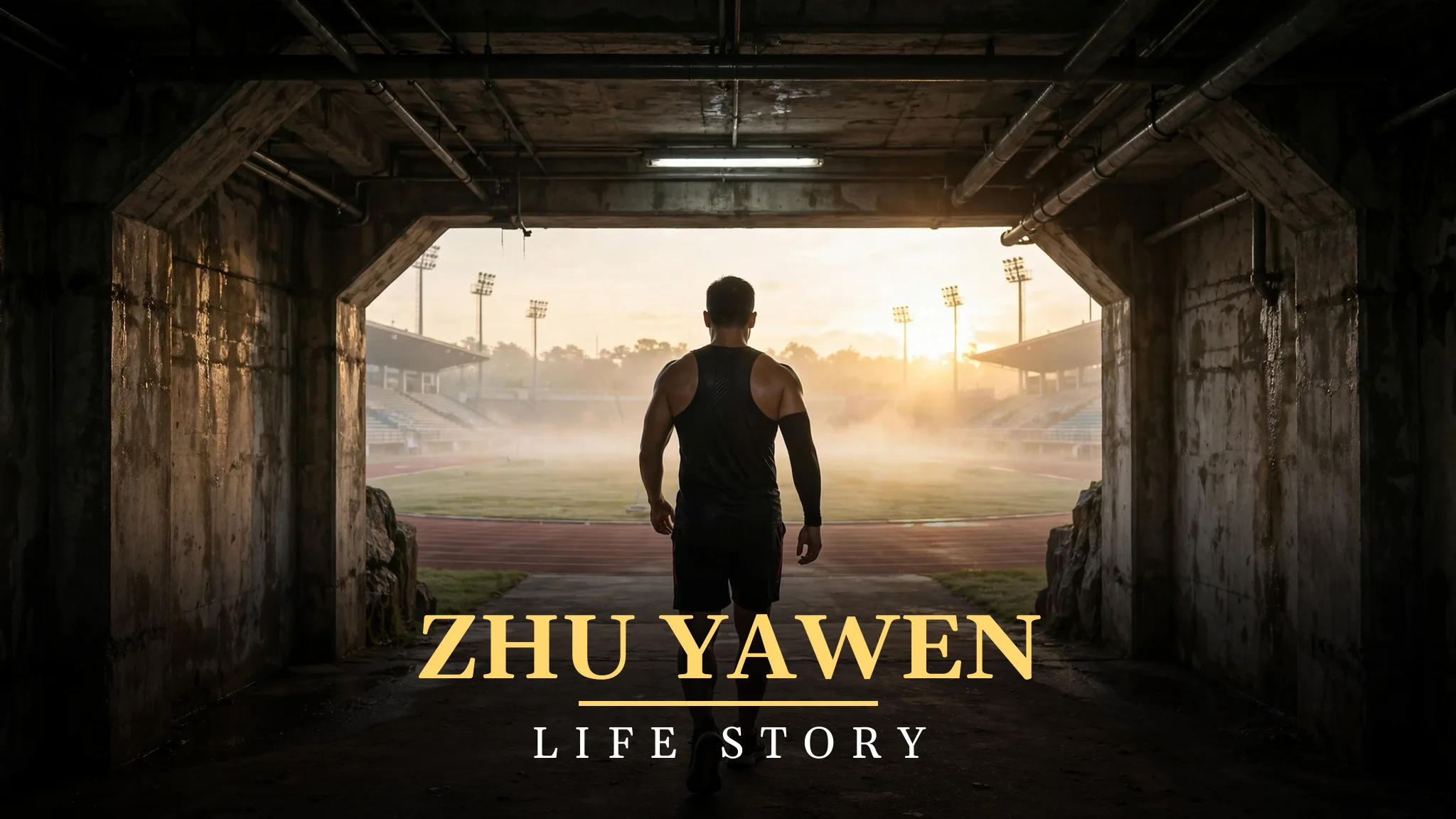
Finally, I want to return to the image of the man walking from a dark tunnel toward a sunlit stadium, which is the image on his cover. That image fits Zhu Yawen well, because it shows a man coming out of darkness into light, walking alone, with his head up, toward a bright, open place. That is the story of his career, in a way. He came from a small city, through years of hard work in television, through the darkness of waiting, and into the light of fame, as a leading man. He walked that tunnel alone, step by step, and he came out into the sun. I think that is a beautiful image, and it is a hopeful one. It says that the tunnel does not last for ever, that the light is ahead, and that if you keep walking, you will reach it. Zhu Yawen kept walking, and he reached the light, and he is still walking, toward whatever comes next. That is why I admire him, and why I think his story is worth telling.
I also want to say something about the way Zhu Yawen’s daughters will remember him, because that is a legacy that matters more than any award. They will not remember the box office numbers, or the prizes, or the reviews. They will remember a father who came home, who played with them, who listened to them, and who was there. That memory is the most important thing an actor can leave behind, more important than any film, because films fade, but a child’s memory of a loving father lasts a lifetime. Zhu Yawen seems to understand that, and he lives his life accordingly, putting his family first, even when his career demands his time. I respect that choice, and I think it is the wisest choice he has made, in a career full of wise choices.
Frequently Asked Questions
Who is Zhu Yawen and what is he best known for?
Zhu Yawen is a Chinese actor born in 1984 in Yancheng, Jiangsu. He is best known for playing Yu Zhanao in the television drama Red Sorghum in 2014, and Mei Sheng in the war film The Battle at Lake Changjin in 2021.
Where did Zhu Yawen study acting?
He studied at the Beijing Film Academy, China’s most famous film school. He moved there from Yancheng as a young man and trained in acting before beginning his long career in television and film.
What is Red Sorghum about?
Red Sorghum is a television drama based on the novel by Mo Yan, set in Shandong province in the 1930s. Zhu Yawen plays Yu Zhanao, a rough and passionate man who becomes a hero of the resistance, in a story of love, war, and hardship in the countryside.
Who does Zhu Yawen play in The Battle at Lake Changjin?
He plays Mei Sheng, a soldier and father who fights in the famous Korean War battle. The film was one of the biggest in Chinese history, and his performance was praised for showing a tired, afraid, yet determined man rather than a simple superhero.
Is Zhu Yawen married and does he have children?
He is married to actress Shen Jiani, and they have two daughters. He is known as a devoted husband and father, and he often speaks about his family as the most important part of his life.
How old is Zhu Yawen?
Zhu Yawen was born on 21 April 1984, so he was forty-two years old in 2026. He became widely famous in his early thirties with Red Sorghum and has worked steadily as a leading man ever since.
What makes Zhu Yawen different from other Chinese leading men?
He is known for playing strong, rough men with a kind heart, such as soldiers and farmers, rather than polished romantic heroes. His physical strength, direct manner, and honest performances make his characters feel real and believable.


