Agent Tesla Spies On Keyboards
In this post
Picture an office worker at her desk on an ordinary morning. She opens her email, clicks the attachment on a message that looks like a routine order form, and carries on with her day. Nothing crashes. Nothing flashes red. Her screen looks exactly the same as it did a moment ago. But from that morning onward, every single key she presses is being copied and quietly posted to a stranger. Her bank password. Her private messages. The login for the company accounts system. She types them all in good faith, and someone she will never meet reads every word over her shoulder, without ever standing behind her chair.
The tool doing this is called Agent Tesla. It is not some rare weapon built in a secret laboratory. It has been sold since about 2014, packaged and priced like ordinary software that anyone can buy. That is the truly shocking part of this story: complete spying power, available for pocket money, simple enough that a criminal with almost no technical skill can run it like a shopkeeper runs a till.
What Agent Tesla is, and exactly what it does
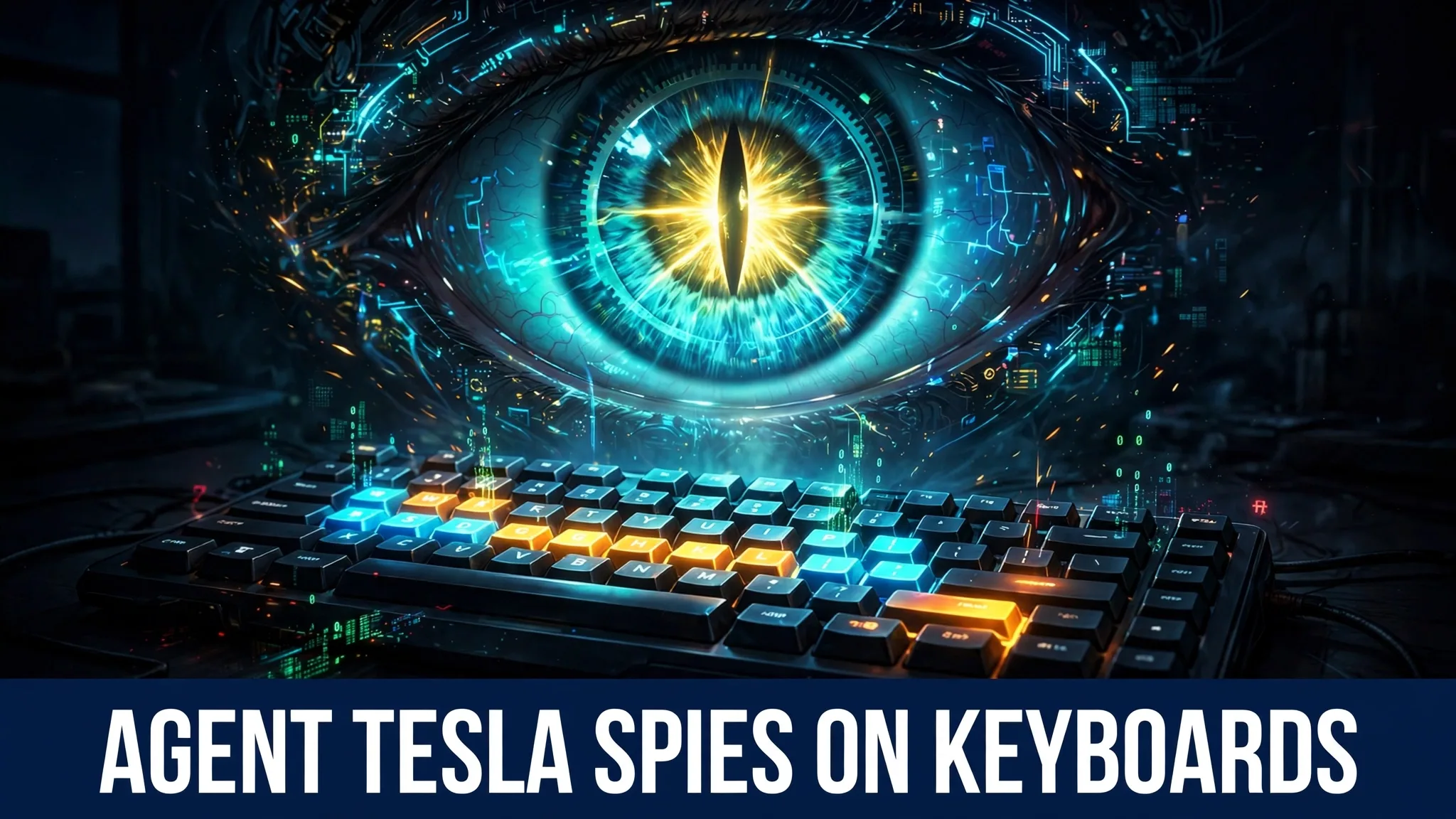
Agent Tesla is two kinds of malware joined into one product. The first is a remote-access trojan. A trojan is a harmful program that pretends to be something harmless so that you let it in yourself, and “remote access” means the criminal can reach into your computer from far away, as if sitting at your desk while sitting in another country. The second is a keylogger, which is exactly what the name says: a program that logs — records — your keys. Every letter, number and symbol you type is written down into a secret file.
Once Agent Tesla settles into a computer, it gets busy in several ways at once:
- It records every keystroke. Passwords, chat messages, emails being written, search terms, card numbers typed into shopping sites — all of it is captured as you type, before any encryption on a website can protect it.
- It takes screenshots. At intervals, it photographs your screen, so the criminal can see what you see: open documents, account pages, private conversations.
- It raids saved passwords. Most browsers politely offer to remember your logins, and email programs store them too. Agent Tesla knows where these are kept and digs them out in bulk, harvesting accounts you may not have typed in months.
- It sends everything home. The stolen material is quietly passed to the criminal through an email inbox, a web control panel, or even a Telegram bot — the same chat app millions of people use to talk to their families.
Security firms document that Agent Tesla was marketed as ordinary “monitoring” software, the kind a company might claim to use for watching its own staff computers. But the firms are clear that in the real world it has been used overwhelmingly as a criminal spying tool. The shop window said one thing; the customers came for another.
Agent Tesla spreads through your inbox
This spy almost never breaks down a door. It is invited in. Agent Tesla reaches victims almost entirely through phishing emails — fake messages dressed up to look like real business or everyday mail, carrying booby-trapped attachments. The trap usually hides inside a Word document, a spreadsheet, or an archive file such as a zipped folder. The email might pretend to be an invoice, a delivery note, a purchase order, or a document you were supposedly expecting. Open the attachment, and in many cases that is all it takes: the spy unpacks itself in the background while you stare at a document that may look blank, broken, or perfectly ordinary.
The lures change with the news. During 2020, security firms documented Agent Tesla surging behind coronavirus-themed tricks: fake business surveys and fake orders for protective equipment, the masks and gloves every company was suddenly desperate to buy. A frightened manager hunting for supplies is a person in a hurry, and a person in a hurry is exactly who these emails are written for.
Once inside a machine, the danger grows quietly. The criminal now holds real passwords, possibly including the login for the victim’s own email account. That mailbox is a master key: from it, the thief can reset other passwords, read business conversations, and even send fresh poisoned emails onward to colleagues and customers, now coming from a genuine, trusted address.
What the damage actually looks like
Agent Tesla rarely announces itself with locked screens or ransom demands. Its damage is slower, quieter and, for many victims, worse. Security firms’ detection charts have repeatedly placed it among the most commonly seen malware families in the world, which tells you this is not an occasional problem — it is an industry running at full speed, every single day.
For an ordinary person, the loss might begin with a social media account hijacked, or a bank account emptied after its password was watched being typed. For a business, the firms link Agent Tesla heavily to two of the most costly frauds of the internet age. The first is business email compromise: swindlers who, armed with real passwords and real message history, step into genuine company email threads and persuade staff that payment details for a supplier have changed. The second is advance-fee fraud, where victims are tricked into sending money to the wrong bank account for goods or deals that do not exist. In both cases the money, once sent, is extremely hard to recover, because the victim technically pressed “send” themselves.
Think about why the stolen keys matter so much. A burglar who steals your house key can return whenever he likes. A keylogger hands the criminal copies of every key you own, including keys you have not used in years and have forgotten exist. And the cruelty of the design is that the victim often feels nothing at all. The computer runs fine. The spy’s whole business depends on you never noticing.
In my view, Agent Tesla is more frightening than the loud ransomware gangs, because silence is the whole weapon — you cannot fight an enemy you never knew moved in.
How to protect yourself from Agent Tesla
The good news is that this spy’s road into your life is narrow, and ordinary habits block most of it.
Treat attachments like strangers knocking. The single biggest defence is suspicion of files that arrive by email, even from names you know. Before opening a document, spreadsheet or archive, ask: was I expecting this? Does the message sound like the person who supposedly sent it? If money, urgency or secrecy is involved, confirm through a different channel — a phone call or a separate message — before you click. A real sender will never mind being checked.
Remember that a watched password is a stolen password. A keylogger defeats even the longest, cleverest password because it sees the password as you type it. This is why the second factor matters so much. Turn on two-factor sign-in — the extra code from your phone or an authenticator app — on your email, banking and social accounts. Then, even if a criminal steals your password perfectly, it is a key without the door: on its own, it cannot get them in.
Use a different password for every account. If one password is captured, unique passwords stop the thief from marching straight through your whole life with it. A password manager app can remember them all for you, so “unique” does not have to mean “impossible to recall.”
Keep everything updated. Agent Tesla’s booby-trapped documents rely on weaknesses in everyday software. Updates for your operating system, browser, office programs and antivirus close those holes. An update you postpone for a month is a door left open for a month.
Turn on the antivirus you already have, and let it scan. Modern built-in security tools detect well-known families like this one. They are not perfect, but a spy that is found is a spy that stops reporting.
If you think you were hit, act from a clean device. If a computer may be infected, do not change your passwords on that same machine — the spy would simply watch the new ones being typed. Use a different, trusted device to change passwords, starting with your email, and switch on two-factor sign-in as you go.
Common questions
What is Agent Tesla in simple words?
It is a spying program that criminals buy cheaply and sneak onto computers, usually through fake email attachments. Once inside, it records everything you type, takes pictures of your screen, steals passwords saved in your browser and email apps, and sends all of it to the criminal.
How does Agent Tesla get onto a computer?
Almost always through phishing email. The message carries a trapped document, spreadsheet or archive file, and opening that file installs the spy quietly in the background. It thrives on hurried clicks — fake invoices, fake orders and urgent-looking business mail are its favourite costumes.
Can a strong password stop Agent Tesla?
No, not on its own. A keylogger watches the password as you type it, so even a brilliant password is handed over in full. The protection that truly helps is two-factor sign-in, because the thief ends up with the password but not the second code from your phone.
Why is Agent Tesla linked to money-transfer fraud?
Security firms connect it heavily to business email compromise and advance-fee fraud. With stolen passwords, criminals enter real company mailboxes, watch how payments are normally made, then slip in fake bank details at the perfect moment. Staff send real money to the wrong account, believing they are following genuine instructions.
What should I do if I suspect my computer has a keylogger?
Stop typing sensitive information on that machine. From a separate, clean device, change your important passwords — email first — and turn on two-factor sign-in. Then run a full antivirus scan on the suspect computer, keep it updated, and watch your bank statements closely for anything you do not recognise.
Sources
- Wikipedia — Agent Tesla: https://en.wikipedia.org/wiki/Agent_Tesla