Alan Jackson: The Life Story Behind Country's Traditional Star
In this post
- Newnan, Georgia, and a Working-Class Childhood
- Moving to Nashville and Working in the Mailroom
- Here in the Real World and the Early Hits
- Gone Country, Good Time, and the Peak Years
- Where Were You, Remember When, and a National Voice
- Denise, Daughters, and a Family Man
- Health, Farewell Tour, and the Hall of Fame
- Good Time, Freight Train, and Keeping the Tradition Alive
- My Take:
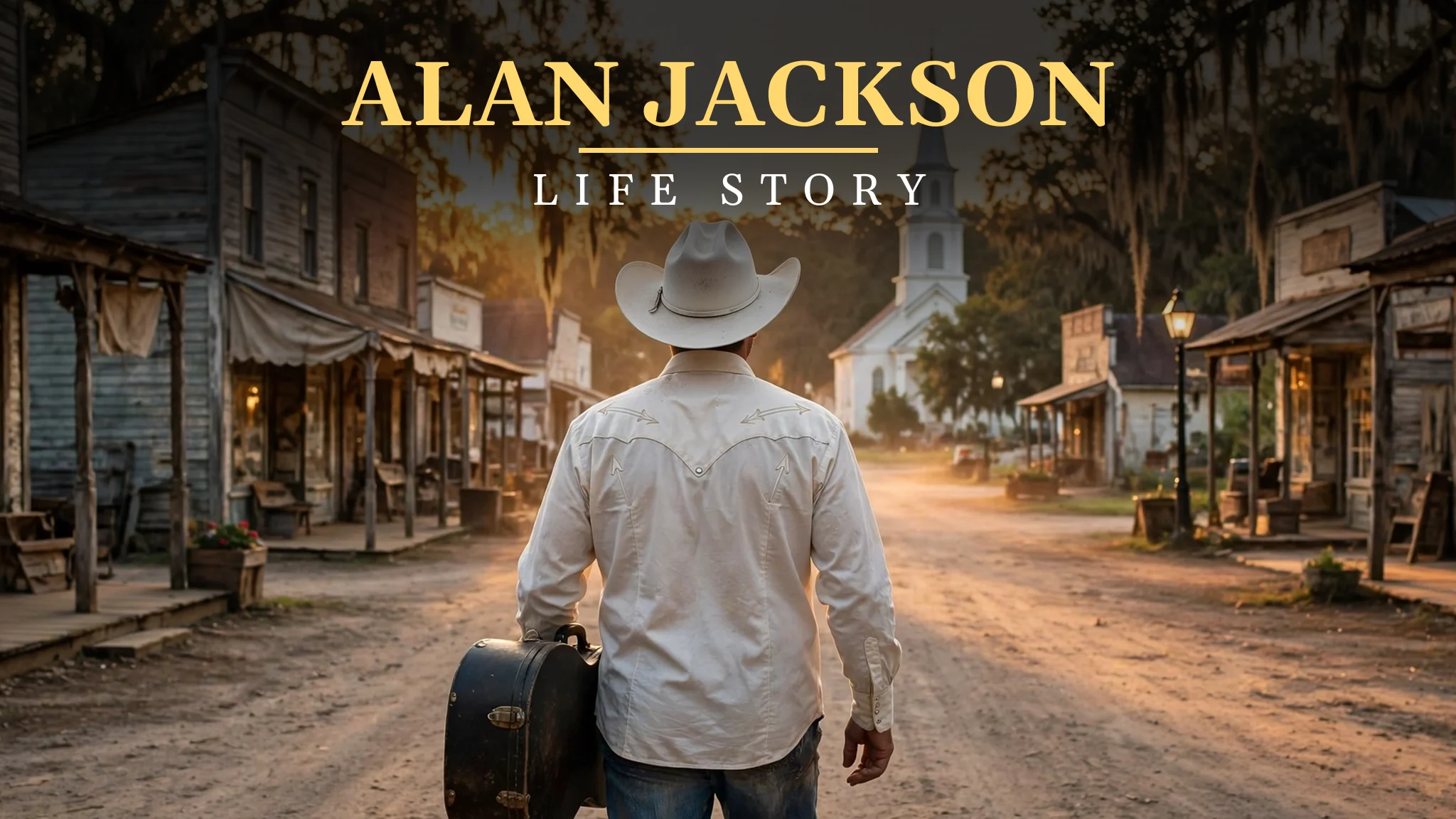
Alan Jackson is a country singer who has never changed his sound to follow a trend, and that is why his fans trust him. For more than thirty years, he has sung traditional country music about small towns, about love, about family, and about America, with a clear voice and a simple, honest style. He wears a white cowboy hat, he plays a guitar, and he sings songs that sound like they come from the Georgia town where he grew up. He has sold millions of records, he has won major awards, and he has been inducted into the Country Music Hall of Fame, all without ever pretending to be someone else.
He was born in Newnan, Georgia, and he grew up in a working-class family. He married his high school sweetheart, Denise, and they moved to Nashville together to follow his dream. He worked in the mailroom at a television network, he sang in bars, and he wrote songs, while success seemed far away. Then a song called “Here in the Real World” changed everything, and he became one of the most loved country singers of his generation.
What makes his story worth telling is the consistency of it. He has made album after album of traditional country music, he has written songs about 9/11, about his father, about his wife, and about the small town he loves, and he has never lost his way. This is the story of a boy from Newnan who became a traditional country star, and who stayed true to the music he first loved.
Newnan, Georgia, and a Working-Class Childhood
Alan Eugene Jackson was born on 17 October 1958 in Newnan, Georgia, a small city southwest of Atlanta. He grew up in a working-class family, in a house that his grandfather had built. His father worked in a factory, and his mother worked in a home. The family was not rich, but they were close, and they valued hard work, faith, and family. He was the youngest of five children, and he grew up with four older sisters who looked after him.
As a boy, he listened to country music on the radio, and he loved the songs of Hank Williams, George Jones, and Merle Haggard. He sang in church, and he began to play the guitar as a teenager. He was not a child star. He was a normal boy from Georgia who loved to sing, and who was trying to find his place. He went to school in Newnan, and he worked at a young age, learning what hard work meant.
He met Denise Jackson, his future wife, when they were in high school. They fell in love, and they married in 1979, when he was twenty-one. Denise believed in his talent, and she encouraged him to follow his dream. She gave him a guitar as a gift, and she told him to move to Nashville and to try to become a singer. That encouragement was a turning point in his life, and it showed how much she believed in him.
He worked at various jobs in Newnan, including in a warehouse and in a factory, and he played in a band at night. He was a young husband, and he was trying to make a living while also following his dream. It was a hard time, but it gave him the experience that would later make his songs so honest. He knew what it was like to work hard, to love a woman, and to dream of a better life.
Moving to Nashville and Working in the Mailroom
In 1985, Alan Jackson and his wife Denise moved to Nashville, Tennessee, to try to build a career in country music. He arrived with a guitar, a few songs, and a strong voice, but he did not have a record deal. He worked in the mailroom at The Nashville Network, a television channel that showed country music. It was a humble job, and it gave him a view of the music business from the inside. He delivered mail to the offices of producers and executives, and he learned how the industry worked.
He also began to perform at bars and clubs around Nashville, and he wrote songs every day. He was a young singer with a clear voice and a gift for writing about real life. He wrote about small towns, about love, about work, and about the people he knew. He was patient, and he was determined, and he believed that his time would come. He kept writing, he kept singing, and he kept working in the mailroom, waiting for his break.
His break came when he was discovered by Glen Campbell, a famous country singer, who heard him perform and recommended him to a record label. He signed a deal with Arista Records Nashville, and he began to work on his first album. It was a remarkable moment, because he had waited for years, and he had worked a humble job, and now his chance had come. He was ready, because he had already learned how to write, how to sing, and how to work.
His first album, Here in the Real World, was released in 1990. The title track was a song about a man who learns that real love is not like the movies, and it became a hit. The album also included “Chasin’ That Neon Rainbow”, a song about a young man who dreams of becoming a country star, and “Wanted”, a song about a man who is wanted by the law and by a woman. The album was a success, and it introduced him to country fans across America.
Here in the Real World and the Early Hits
The success of Here in the Real World changed Alan Jackson’s life. He went from working in a mailroom to having hit songs on country radio, and he began to tour with bigger artists. He learned how to perform for large crowds, and he learned how to keep a show moving. His second album, Don’t Rock the Jukebox, released in 1991, included the title track, a fun song about a man who wants to hear country music, not rock, and “Someday”, a song about a man who promises to change. The album was a huge success, and it showed that he was not a one-hit wonder.
His third album, A Lot About Livin’ (And a Little ‘Bout Love), released in 1992, included “Chattahoochee”, a joyful song about growing up near a river in Georgia, and “She’s Got the Rhythm (And I Got the Blues)”, a song about a man who has lost a woman. “Chattahoochee” became one of his most famous songs, and its video, which showed him waterskiing, was widely shared. The song was about the fun of youth, and it became a summer favourite. It also won awards, and it showed his gift for writing about the place he came from.
He won the Country Music Association Award for Album of the Year, and he was named the association’s Entertainer of the Year in 1995. He was a star, and he was known for his traditional sound, his white cowboy hat, and his honest songs. He was not trying to be a pop star. He was trying to be a country singer, and his fans loved him for it. He was building a career that would last for decades, because it was built on good songs and on respect for the tradition.
During these years, he also built a reputation as a songwriter. He wrote most of his own songs, and he wrote them with care. His lyrics were simple, but they were also deep, and they spoke about real life in a way that listeners understood. He was a singer who wrote about what he knew, and that honesty made his music feel true.
Gone Country, Good Time, and the Peak Years
The years that followed brought Alan Jackson many more hits. His album Who I Am, released in 1994, included “Gone Country”, a song about people who move to Nashville to become country singers, and “Livin’ on Love”, a song about a couple who live on love alone. His album Everything I Love, released in 1996, included “Little Bitty”, a song about the small things in life, and “There Goes”, a song about a man who cannot forget a woman. These albums kept his run of hits going, and they showed that he could still write songs that sounded fresh.
His album Under the Influence, released in 1999, was a tribute to the country singers who had influenced him, including Hank Williams, George Jones, and Merle Haggard. It was a brave choice, because tribute albums do not always sell well, but it showed how much he cared about the tradition. He sang the old songs with respect, and he introduced them to a new generation of listeners. It was a reminder that country music has deep roots, and that those roots are worth keeping alive.
His album When Somebody Loves You, released in 2000, included “Where I Come From”, a song about a man who is proud of his small-town roots, and “www.memory”, a song about the internet and love. The album showed that he could write about modern life without losing his traditional sound. He was a singer who respected the past, but who was not stuck in it. He was growing, and his music was growing with him.
His album Drive, released in 2002, included “Drive (For Daddy Gene)”, a song about his father teaching him to drive, and “Where Were You (When the World Stopped Turning)”, a song about the September 11 attacks. The second song became one of his most famous works, and it was praised for its thoughtful and gentle response to a national tragedy. It was a song that helped many Americans to grieve, and it showed the power of country music to speak about hard times.
Where Were You, Remember When, and a National Voice
“Where Were You (When the World Stopped Turning)” was written by Alan Jackson in the weeks after the September 11, 2001 attacks. The song asked simple questions about where people were when they heard the news, and about how they responded. It was not angry, and it was not political. It was gentle, it was thoughtful, and it was honest. The song became a number one hit, and it won awards. It was performed at the Country Music Association Awards, and it moved many people in the audience to tears. It showed that a country singer could speak to a nation in a time of grief, and that music could help people to heal.
His album Drive also included “Remember When”, a song about his marriage to Denise, looking back on their life together from their youth to their old age. The song became one of his most loved tracks, and it is often played at weddings and anniversaries. It was a song about a love that lasts, and it was written with great tenderness. It showed his gift for writing about his own life in a way that felt universal.
He also released “It’s Five O’Clock Somewhere”, a duet with Jimmy Buffett in 2003, which became a number one hit and a summer favourite. The song was about taking a break from work and enjoying a drink, and it was fun and light. It showed that he could still write a party song, even as he was writing serious songs about love and loss. He was a singer who could do both, and he did both well.
During these years, he was at the height of his fame. He had won many awards, he had sold millions of records, and he was seen as one of the leading voices in country music. He was a traditionalist, but he was also a star, and he had proven that traditional country music could still be popular. His concerts drew large crowds, and his songs were played on the radio across America.
Denise, Daughters, and a Family Man
Alan Jackson has been married to Denise Jackson since 1979. They have three daughters: Mattie, Ali, and Dani. He has spoken about his family with love, and about how Denise has supported his career from the beginning. She believed in him when he was working in a mailroom, and she has stayed with him through fame, through hard times, and through success. Their marriage has lasted for more than forty-five years, and it is one of the longest in country music.
He has written songs about his wife and his daughters, including “Remember When”, which looks back on their life together, and “Drive (For Daddy Gene)”, which is about his father. He has also written about his daughters growing up, and about the joy and the worry of being a father. His songs about family are among his most personal work, and they are loved by fans who see their own families in them.
He has also faced hard times in his marriage. He and Denise separated for a time in the late 1990s, but they reconciled, and they have stayed together since. He has spoken about that difficult period with honesty, and about how it taught him the value of his marriage. He did not hide the pain. He worked through it, and he and Denise rebuilt their life together. That honesty is a central part of who he is, and it is why his fans trust him.
He lives in Tennessee with his family, and he tries to keep his home life private, even though he is a famous singer. He has said that his family is the most important part of his life, and that music is second. That is a healthy way to see fame, and it is one of the reasons he has stayed grounded. He does not let fame rule his life. He lets his family rule it, and music follows.
Health, Farewell Tour, and the Hall of Fame
In 2021, Alan Jackson revealed that he had been diagnosed with Charcot-Marie-Tooth disease, a condition that affects the nerves and muscles, and that makes it harder to walk and to balance. He spoke about the diagnosis with honesty, and he said that it had affected his ability to perform. He continued to tour, but he had to make changes to his shows, and he had to take care of his health. It was a difficult time, but he handled it with grace, and he kept performing for his fans.
He was inducted into the Country Music Hall of Fame in 2017, one of the highest honours in country music. The induction was a recognition of his long career, his many hits, and his commitment to traditional country music. He accepted the honour with humility, and he spoke about the singers who had influenced him, and about how much the Hall of Fame meant to him. It was a proud moment, and it was a reward for decades of hard work.
He has also announced farewell tours, saying that he wants to say goodbye to his fans in person, while he can still perform. Those tours have drawn large crowds, and fans have come to thank him for his music. He has said that he is grateful for his career, and for the fans who have supported him for so many years. He is a singer who is winding down his touring, but who is not winding down his love for music.
Today, he is seen as one of the greatest traditional country singers of his generation. His songs are still played on the radio, his albums are still bought and streamed, and his concerts still draw large crowds. He is a husband, a father, a grandfather, and a singer who has stayed true to the music he first loved. A boy from Newnan, Georgia, picked up a guitar, married his high school sweetheart, and became a country star. That simple story, told over more than thirty years, is why people love Alan Jackson, and why his music still matters.
Good Time, Freight Train, and Keeping the Tradition Alive
Alan Jackson’s album Good Time, released in 2008, was a reminder that traditional country music could still be fun. The album included the title track, a song about taking time off work to enjoy life, and “Country Boy”, a song about a man who is proud of his rural roots. It also included “Sissy’s Song”, a gentle ballad written in memory of a woman who had worked for his family. The album was a success, and it showed that he could still write songs that connected with listeners, even after nearly twenty years in the business.
His album Freight Train, released in 2010, continued that run. It included “Hard Hat and a Hammer”, a song about working people, and “It’s Just That Way”, a song about love that cannot be explained. The album was praised for its honest lyrics and for his strong voice. It showed that he was still writing with care, and that he was still finding new things to say about the life he knew. He was not repeating himself. He was finding new angles on familiar themes, and his fans appreciated it.
He has also recorded albums that pay tribute to the music he loves. His album The Bluegrass Album, released in 2013, was a collection of bluegrass songs, recorded with acoustic instruments and with harmonies that recalled the old days. It was a brave choice, because bluegrass albums do not always sell well, but it showed how much he cared about the roots of his music. He sang the songs with respect, and he introduced them to a new generation of listeners. It was a reminder that country music has deep roots, and that those roots are worth keeping alive.
His album Angels and Alcohol, released in 2015, included songs about love, about drinking, and about the small moments of life. It was a quieter album, and it showed a singer who was thinking about getting older, about family, and about the things that matter. He was growing up in public, and he was doing it with grace. His fans grew with him, and they found themselves in those songs too. That is why his career has lasted: he writes about life as it is lived, and his listeners hear their own lives in his words.
My Take:
When I think about Alan Jackson, I think about a man who never changed to please others. I have seen many singers who change their sound every few years to follow the latest trend, and I have seen many who lose themselves in the process. He did the opposite. He sang traditional country music for more than thirty years, he wore his white cowboy hat, and he wrote songs about small towns, about love, and about family. That consistency is rare, and I admire it. It tells me that he trusts his own taste, and that he trusts his fans to love him as he is.
I admire his song “Where Were You (When the World Stopped Turning)” most of all. It was written after the September 11 attacks, and it is a gentle, thoughtful song about a national tragedy. It does not shout, it does not blame, and it does not pretend to have all the answers. It asks simple questions, and it lets the listener think. I think that is a gift. In a time of grief, a song that is quiet and honest can help more than a song that is loud and angry. He wrote that song, and he sang it with care, and it helped many Americans to grieve. That is a powerful thing, and it is one of the reasons I respect him.
I also admire his song “Remember When”. It is a song about his marriage to Denise, looking back on their life together from youth to old age. It is tender, it is honest, and it is sung with great feeling. I think about the couple who have been married for more than forty-five years, and about the love that has lasted through hard times, and I feel that it is a beautiful thing. He wrote that song for his wife, and he shared it with the world, and it has become a favourite at weddings and anniversaries. That is a gift to many couples, and it is a gift that comes from a real love.
What moves me most about him is his marriage. He has been married to Denise since 1979, and they have three daughters. They separated for a time, but they reconciled, and they have stayed together. I do not pretend that their marriage is perfect, because no marriage is perfect, and I do not know the private details of their life. But I do see a man who writes songs about his wife with real tenderness, and who speaks about his family with pride. I think that staying with one person, raising children together, and building a life together is a real achievement, and it is one that does not get a trophy. It gets a home, and a family, and a sense of peace, and those things are worth more than a trophy.
I also think about his health. He revealed in 2021 that he has Charcot-Marie-Tooth disease, a condition that makes it harder to walk and to balance. I think it is brave to speak openly about a health problem, especially when you are a public figure. Many people hide their health problems, because they are afraid of looking weak. He did not hide his. He spoke about it, he asked for understanding, and he kept performing while taking care of himself. That honesty helps other people who are dealing with health problems, and it shows that a star can be a real person with real struggles.
I think about his early years in Nashville, too. He worked in the mailroom at The Nashville Network, delivering mail to producers and executives, while he tried to get his music heard. That is a humble start, and it is a useful one, because it teaches a young artist how the business works. I think many young people want fame quickly, and they do not want to do the quiet work first. He did the quiet work, and it made him stronger. When his chance came, he was ready, because he had already learned how to write a song, how to play in a band, and how to work with other people.
If I have a criticism, it is not really a criticism of him. It is a sadness that traditional country music does not get more attention on the radio today. His songs are some of the best being written in the genre, and I wish more people heard them. But I also understand that radio follows what is popular, and that a singer cannot force people to listen. He did the right thing. He made the music he loved, and he let the people who wanted to hear it find it. That is enough, and it is more than many artists do.
I also learn from his Hall of Fame induction. He was inducted in 2017, after more than twenty-five years of hits, and it was a fitting honour. It showed that the industry recognised his commitment to traditional country music, and his long career. I am glad that he was honoured while he was still performing, and that he could enjoy the moment with his family. That is a beautiful thing, and it is a reminder that hard work over many years is eventually recognised.
When I listen to his songs now, I hear a man who has grown up in public and who has grown up well. His early songs were about young love and small towns. His later songs are about marriage, about fatherhood, about loss, and about America. That growth feels honest to me. He did not try to stay young forever. He let his songs grow with him, and his fans grew with him too. That is why his audience has stayed loyal. They did not only love the young man who sang “Chattahoochee”. They loved the man he became.
In the end, I think Alan Jackson teaches us that staying true to yourself is enough. He teaches us that traditional music can still be popular, and that a simple song about a small town can touch millions of people. He teaches us that a marriage can last, even through hard times, and that family matters more than fame. He teaches us that a song can help a nation to grieve, and that a singer can be a voice for his country. I will keep listening to his music, and I will keep thinking about the white cowboy hat and the clear voice, because they remind me that honesty is the most important thing in music.
One more thought stays with me. I think about the boy from Newnan who worked in a mailroom, and I think about the man who now stands in the Hall of Fame. The distance between those two points is long, and it was not easy to travel. He travelled it by working hard, by staying honest, and by loving the music. That is the lesson I take from Alan Jackson. Start with the music you love, work at it every day, stay true to it, and do not change who you are to please others. The rest will follow in time.
I also think about his bluegrass album, The Bluegrass Album, and about what it says about him. He made a record of bluegrass songs in 2013, even though bluegrass albums do not always sell well, because he loved the music and wanted to honour it. That is a brave choice, and it is one that shows his respect for tradition. Many stars would not take that risk, because they want every album to be a big seller. He took it, because the music mattered more than the sales. I respect that. A singer who follows his love for the music, even when it is not the easy path, is a singer who can be trusted.
I keep thinking about his song “Sissy’s Song”, from Good Time, which he wrote in memory of a woman who had worked for his family. It is a gentle ballad, and it is sung with great tenderness. I think about the singer who writes a song for a person who is not famous, who is not a star, but who mattered to his family. That is a kind thing to do, and it shows that he values ordinary people. His songs are often about ordinary people, about workers, about mothers, about fathers, and about the small moments of life. That is why his fans love him. They hear themselves in his songs, and they feel seen.
There is another thing I notice about him, and it is the way he treats his band and his crew. He has worked with many of the same musicians for years, and he speaks about them with respect. He does not act as if he is the only person on stage. He acts as if he is part of a team, and that team includes the people who play, who set up the stage, and who drive the trucks. That humility is rare in a star, and I think it is important. A singer who respects his team is a singer who understands that music is made by many hands, not only by one voice. He understands that, and it shows in the way he performs.
I also think about his daughters, Mattie, Ali, and Dani, and about the way he writes about them. He has watched them grow up, marry, and build their own lives, and he has written songs about that journey. I think about the father who sings about his daughters with love, and about the pride he feels in them. That is a beautiful thing, and it is a reminder that a career is not only about hits. It is also about the family you build, and the love you share. He has built a family, and he has shared that love in his songs.
Finally, I think about what his story means for a young singer who loves traditional music. He stayed true to traditional country for more than thirty years, even as radio changed, even as trends came and went, and he became a Hall of Fame singer by doing so. That is a powerful message. You do not have to change who you are to succeed. You have to be yourself, work hard, and trust your audience. That is the lesson I will carry with me from his story, and it is a lesson I hope others will carry too.
I also think about his grandchildren, and about the way his family has grown. He has watched his daughters marry and build their own lives, and he has become a grandfather. I think about the man who sang about his own father teaching him to drive, and who now watches his grandchildren grow, and I feel that it is a full circle. A life that begins with a father teaching a son to drive, and ends with a grandfather watching his grandchildren, is a life well lived. He has lived it with grace, and his songs capture that journey.
I keep thinking about his farewell tours, and about what it means to say goodbye to fans. He has announced farewell tours, saying that he wants to thank his fans in person while he can still perform. That is a generous thing to do. Many stars simply stop touring, without a goodbye. He wants to say thank you, face to face, to the people who have supported him for more than thirty years. I think that is a beautiful gesture, and it shows how much he values his fans. They have given him a career, and he wants to give them a proper farewell.
There is another thing I notice about him, and it is the way he has handled his health with dignity. He revealed his diagnosis of Charcot-Marie-Tooth disease in 2021, and he continued to perform while taking care of himself. He did not hide his condition, and he did not let it define him. He spoke about it, he asked for understanding, and he kept singing. That honesty helps other people who are dealing with health problems, and it shows that a star can be a real person with real struggles. I respect that, and I admire the way he has faced a hard time with grace.
Finally, I think about his place in the Hall of Fame, and about what it means to be honoured while you are still alive to enjoy it. He was inducted in 2017, after more than twenty-five years of hits, and it was a fitting honour. I am glad that he was there to accept it, with his family beside him, and that he could hear the applause. That is a beautiful moment, and it is a reminder that hard work over many years is eventually recognised. That is the lesson I will carry with me from his story, and it is a lesson I hope others will carry too.
Frequently Asked Questions
Where did Alan Jackson grow up, and how did he start singing?
He was born in Newnan, Georgia, grew up in a working-class family in a house his grandfather built, and sang in church and listened to Hank Williams and George Jones as a boy. He began playing guitar as a teenager and married his high school sweetheart Denise in 1979.
What job did Alan Jackson do in Nashville before he became famous?
After moving to Nashville in 1985, he worked in the mailroom at The Nashville Network, delivering mail to producers and executives while performing in bars and writing songs. He was discovered after Glen Campbell heard him and recommended him to a record label.
What is the song Chattahoochee by Alan Jackson about?
“Chattahoochee” is a joyful song from 1992 about growing up near the Chattahoochee River in Georgia, about youth, swimming, and first love. It became one of his most famous songs, won awards, and its video showing him waterskiing was widely shared.
How did Alan Jackson respond to the September 11 attacks in song?
He wrote “Where Were You (When the World Stopped Turning)” in the weeks after the attacks, a gentle song asking where people were when they heard the news. It became a number one hit, won awards, and helped many Americans grieve with its thoughtful, honest words.
Is Alan Jackson married, and how long has his marriage lasted?
Yes, he has been married to Denise Jackson since 1979, for more than forty-five years, and they have three daughters, Mattie, Ali, and Dani. He wrote the song “Remember When” looking back on their life together from youth to old age.
What health condition did Alan Jackson reveal in 2021?
In 2021 he revealed he had been diagnosed with Charcot-Marie-Tooth disease, a condition affecting nerves and muscles that makes walking and balance harder. He spoke openly about it, continued to tour with changes to his shows, and was inducted into the Country Music Hall of Fame in 2017.


