Merle Haggard: The Life Story Behind Country's Working Man
In this post
Merle Haggard sang about the people that country music was made for: working men, prisoners, mothers, truck drivers, and families who had lost everything and kept going anyway. He knew those people because he had been one of them. He was born in a boxcar in California, he lost his father when he was nine, he ran away from home, he went to prison, and he came out of prison to become one of the greatest country singers of all time. His songs were not made up. They were taken from his own life, and that is why they still sound true today.
He recorded thirty-eight number one country hits, he wrote “Mama Tried” and “Okie from Muskogee” and “Sing Me Back Home,” and he became a member of the Country Music Hall of Fame. He sang about prison, about his mother, about trains, and about the working men of America, and he did it in a voice that was plain, warm, and honest. He died on his seventy-ninth birthday, in 2016, after a life that had taken him from a boxcar to the top of country music, and his songs are still sung by everyone who loves real country music.
Born in a Boxcar in Oildale
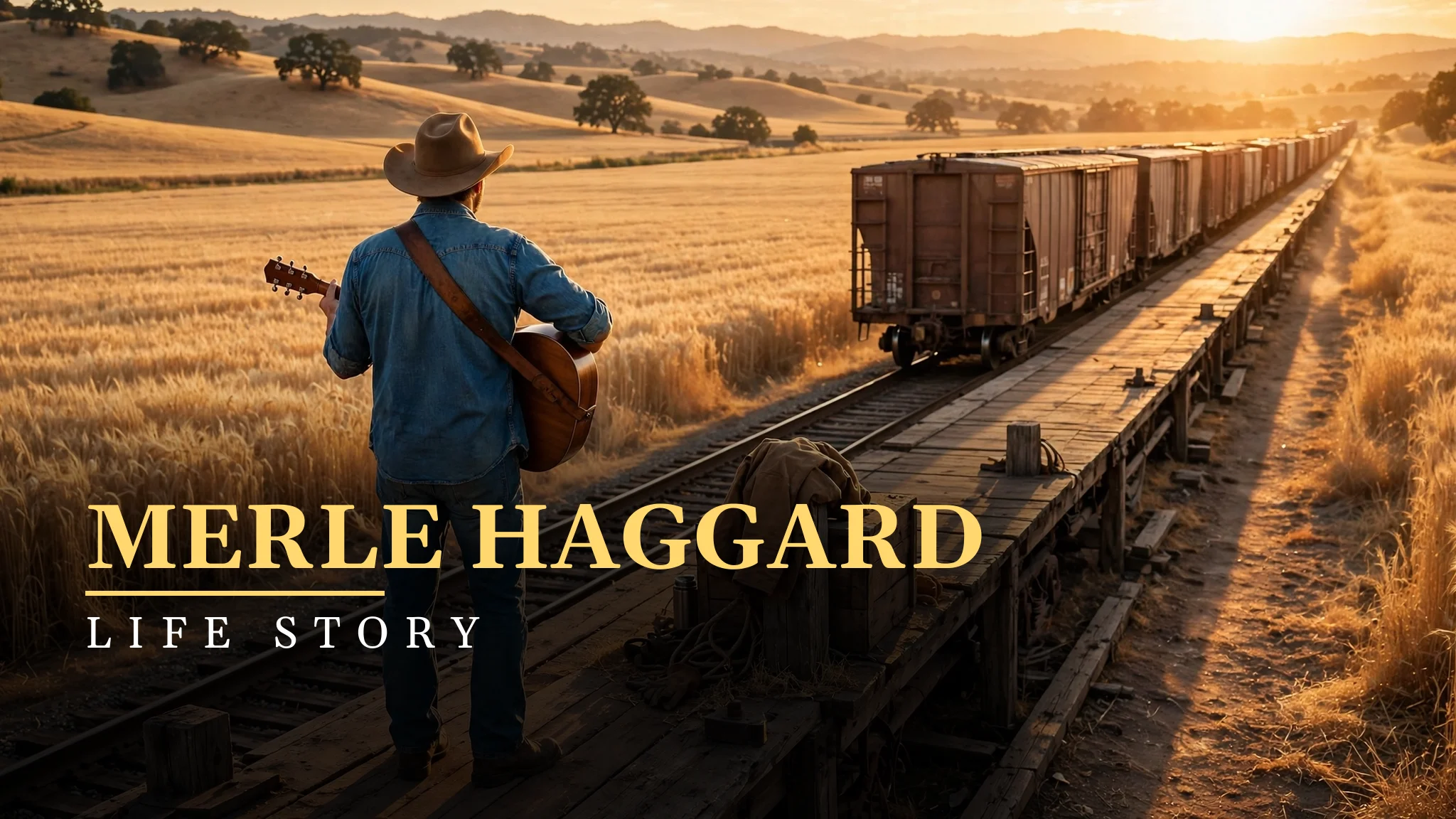
Merle Haggard was born on 6 April 1937, in Oildale, California, a small town near Bakersfield. His parents, James and Flossie Haggard, had come to California from Oklahoma during the Dust Bowl, when drought and dust storms drove thousands of farming families west in search of work. The family lived in a converted boxcar, a railway freight car that had been made into a home, and Merle was born there. It was a hard start, but it was also a fitting one, because trains and travel would be part of his life and his music forever.
His father worked as a carpenter and a railroad man, and his mother kept the house. The family later moved into a small house, and Merle grew up in Oildale, a rough, working-class town. He was a restless boy, and he loved music. He learned to play the guitar, and he listened to the country stars of the time on the radio. He also loved to run away. He ran away from home many times as a boy, hopping freight trains and travelling around California, learning the life of a drifter.
When Merle was nine years old, his father died of a brain haemorrhage. It was a terrible loss, and it changed Merle completely. He had been close to his father, and after his death he became angry and rebellious. He stopped going to school, he got into trouble, and he began to steal. His mother tried to keep him on the right path, but Merle was a wild boy, and he did not want to listen. The loss of his father left a hole in his life that he would sing about for the rest of his career.
He was sent to a juvenile detention home, and he ran away from it. He was arrested again and again for small crimes, and he spent time in and out of reform schools. He was a teenager with no father, no direction, and a growing love of music, and he was heading for serious trouble. He did not know it yet, but the trouble would lead him to prison, and prison would lead him to music.
San Quentin and a New Direction
In 1957, Merle Haggard was arrested for burglary and sent to San Quentin Prison in California. He was twenty years old, and he was facing a long sentence. San Quentin was a hard, frightening place, and Merle spent three years there. He worked in the prison, he played in the prison band, and he thought about his life. He also saw Johnny Cash perform at San Quentin in 1958, and that concert changed him. Cash sang about prison, about freedom, and about redemption, and Merle listened and thought, I can do this. I can sing about my life, and I can make something of it.
He was released from San Quentin in 1960, a changed man. He was still wild, but he had a plan. He wanted to make music, and he wanted to stay out of prison. He went back to Bakersfield, and he began to play in clubs and bars, singing in the Bakersfield sound, a loud, twanging style of country music that was very different from the smooth Nashville sound. The Bakersfield sound was made for honky-tonks and dance halls, and it fit Merle perfectly. He played guitar, he sang, and he wrote songs about his life.
He formed a band called the Strangers, and he began to record. His early records did not make him a star, but they got him noticed. He had a voice that was clear and strong, and he had songs that were real. He wrote about prison, about his mother, about trains, and about the working men he had grown up with. He was not singing about a life he had imagined. He was singing about a life he had lived, and listeners could tell the difference.
In 1963, he married Bonnie Owens, a singer who had been married to Buck Owens, another Bakersfield star. Bonnie became his harmony singer, and she helped him in the studio and on the road. She was a steady, talented woman, and she was an important part of his early success. Their marriage lasted until 1965, but they kept working together, and Bonnie remained a close friend and musical partner for many years.
Mama Tried and Sing Me Back Home
In 1968, Merle Haggard recorded “Mama Tried,” a song about a boy who turned to a life of crime despite his mother’s love and prayers. The song was based on his own life, and it became one of his most famous records. It was a number one hit, and it is still regarded as one of the greatest country songs ever written. The words are simple, the melody is strong, and the feeling is deep. It is a song about a mother’s love, and about a son who knows he has let her down, and it has moved listeners for more than fifty years.
The same year, he recorded “Sing Me Back Home,” a song about a prisoner on death row who asks a fellow inmate to sing him a song that will take him home. The song was also based on his time in prison, and it showed a side of Merle that was tender and thoughtful. He was not just a wild singer. He was a man who thought about death, about home, and about redemption, and he could put those thoughts into a song that anyone could understand.
In 1969, he recorded “Okie from Muskogee,” a song about a small town in Oklahoma where people were proud, patriotic, and traditional. The song became a huge hit, and it became a kind of anthem for people who felt that the country was changing too fast. It was also a controversial song, because some people felt it was making fun of young people and of the counterculture of the time. Merle later said that the song was meant to be a portrait of a place and its people, not an attack, but the argument about it has never really ended. What is certain is that the record made him a star across America, and it became his best-known song.
These three songs, made within two years, made Merle Haggard one of the biggest names in country music. He was a star, and he was in demand everywhere. He had come from a boxcar in Oildale, through juvenile detention and San Quentin, to the top of the music world, and he had done it by singing about his own life.
The Working Man’s Voice
In the 1970s, Merle Haggard became the voice of the American working man. He recorded songs about truck drivers, about farmers, about men who worked with their hands and who were proud of it. His song “Workin’ Man Blues” became an anthem for people who got up early, worked hard, and came home tired. He sang about the dignity of work, and about the pride of a man who provides for his family, and his fans loved him for it.
He recorded thirty-eight number one country hits in total, a remarkable number, and he won many awards, including Grammy Awards and Country Music Association awards. He was named Entertainer of the Year, Male Vocalist of the Year, and he was honoured again and again. But he did not become a smooth Nashville star. He stayed true to the Bakersfield sound, and he stayed true to his own life. He recorded albums about trains, about his mother, about prison, and about the American West, and he did it in his own way.
He also recorded with Willie Nelson, and their album Pancho and Lefty, released in 1983, became a classic. The two men were friends, and they shared a love of honest, plain country music. Their duet on the title song, “Pancho and Lefty,” is still one of the most loved country records ever made. Merle also recorded with other singers, and he was respected by musicians of every kind, from country to rock to folk, because his songs were true and his voice was honest.
His personal life remained difficult. He married five times, and he had six children. He drank, he used drugs at times, and he struggled with the same demons that had troubled him since he was a boy. But he kept working, and he kept writing songs, and his music never lost its honesty. He was a man who had lived a hard life, and he sang about it without apology.
Later Years and a Quiet Goodbye
Merle Haggard kept recording and performing into the 2000s and 2010s, even as his health began to fail. He recorded albums of new songs, he toured, and he played for audiences who had loved him for fifty years. His voice aged, but it kept its warmth, and his songs still sounded true. He was a beloved figure, and he was treated with respect by everyone in country music.
In 1994, he was elected to the Country Music Hall of Fame, a long-awaited honour. He was also given a Grammy Lifetime Achievement Award, and he received the Kennedy Center Honor in 2010, one of the highest honours in American arts. He was proud of those honours, but he was prouder of his songs, and of the fans who had followed him for so many years. He was a working man’s singer, and he never forgot it.
He faced health problems in his later years, including lung cancer, which was treated, and pneumonia, which kept coming back. He cancelled shows when he was too ill to perform, and he told his fans honestly that he was not well. He died on 6 April 2016, on his seventy-ninth birthday, at his home in Palo Cedro, California. He had lived a long, hard, remarkable life, and he had left behind a body of work that few singers have ever matched.
His funeral was attended by family, friends, and fellow musicians, and his songs were played on the radio for days. He was buried in California, and his music lives on. His son, Ben Haggard, plays guitar in his father’s band, and his songs are still sung by country singers of every generation. Merle Haggard did not just make records. He made a life in music, and he made it from the hardest materials: a boxcar, a prison cell, and a mother’s love.
The Strangers and the Sound of Bakersfield
Merle Haggard’s band, the Strangers, was one of the best bands in country music, and it was central to his sound. The band featured some of the finest musicians in California, including the guitar player Roy Nichols, whose clean, twanging solos became a signature of Merle’s records, and the steel guitar player Norman Hamlet, whose crying steel gave the songs their lonely, lonesome feeling. Together, they created the Bakersfield sound: loud, clear, and made for dancing, with a beat that was strong and a sound that was honest.
Merle was a bandleader as well as a singer, and he treated his musicians with respect. He paid them well, he kept the same band together for many years, and he gave them room to play. He was not a singer who used a different band on every record. He had his band, and he trusted them, and they trusted him. That loyalty was part of why his records sounded so good. The band knew his songs, they knew his voice, and they knew how to make a record that sounded like Merle Haggard.
The Bakersfield sound was very different from the Nashville sound of the time. Nashville records were smooth, polished, and full of strings. Bakersfield records were rough, loud, and full of twanging guitars and crying steel. Merle and Buck Owens kept that sound alive, and they proved that country music did not have to be smooth to be great. It could be rough, it could be loud, and it could be honest, and it could still sell millions of records. That is a lesson for any artist: you do not have to follow the fashion. You can make your own sound, and if it is true, people will find it.
A Poet of the Working Man
Merle Haggard was not only a singer. He was a songwriter of remarkable depth, and his songs have been studied by writers and musicians for decades. He wrote about trains, about prison, about his mother, about work, and about America, and he wrote in plain words that anyone could understand. His song “If We Make It Through December” is about a man who has lost his job and who is worried about Christmas for his daughter, and it is one of the saddest and most beautiful songs ever written about poverty. His song “Today I Started Loving You Again” is about a man who realises he still loves a woman he thought he had forgotten, and it is a classic of country songwriting.
He wrote quickly, often in a single sitting, and he wrote from his own life. He did not need to invent stories, because his life had given him enough material for a hundred songs. He had been poor, he had been in prison, he had lost his father, and he had worked hard. He took those experiences and turned them into songs that spoke to millions of people who had lived similar lives. That is the mark of a great songwriter: to take a personal story and make it universal, so that anyone who hears it feels that it is about them.
His songs have been recorded by many other artists, and they have been studied in schools and in songwriting classes. He is regarded as one of the greatest songwriters in American music, in any style, and his influence can be heard in the work of singers from country to rock to folk. He was a poet of the working man, and his poems were set to music, and they will be sung for a long time.
If We Make It Through December
One of Merle Haggard’s most loved songs is “If We Make It Through December,” recorded in 1973, about a man who has lost his job and who is worried about Christmas for his young daughter. The song is simple, sad, and beautiful, and it is one of the finest songs ever written about poverty. Merle sings it in a plain, gentle voice, and you can hear the worry in it, and the love. It is a song about a father who wants to give his daughter a good Christmas, and who does not know how he will do it. It is a song that has moved listeners for more than fifty years, and it is played every December on country radio.
The song shows a side of Merle that is tender and thoughtful. He was not only a singer of tough, rowdy songs. He could also sing a quiet, sad song about a family’s struggle, and he could do it with an honesty that made it feel real. He knew what it was like to be poor, because he had grown up poor, and he knew what it was like to worry about money, because he had worried about it for most of his life. That lived experience is what makes the song so powerful. It is not a song about poverty written by someone who has never been poor. It is a song written by a man who knew.
The Hag in His Final Years
In his final years, Merle Haggard was known to his fans as the Hag, a nickname that he wore with pride. He was an elder statesman of country music, a man who had been singing for more than fifty years, and who was respected by everyone. He recorded albums of new songs, he toured, and he played for audiences who had loved him for decades. His voice aged, but it kept its warmth, and his songs still sounded true. He was a beloved figure, and he was treated with the respect due to a legend.
He recorded a final album with Willie Nelson, Django and Jimmie, released in 2015, a tribute to the jazz guitarists Django Reinhardt and Jimmie Rodgers. The album was warm, playful, and full of great music, and it showed that Merle, even in his late seventies, still loved to make music with his friends. He died the next year, on his seventy-ninth birthday, and the album became a fitting final record: two old friends, making music together, for the joy of it. That is a beautiful ending to a long career, and it is a reminder that Merle Haggard loved music until the very end.
The Fightin’ Side of Me
In 1970, Merle Haggard recorded “The Fightin’ Side of Me,” a song about a man who loves his country and who is tired of people who criticise it. The song became a number one hit, and it became an anthem for people who felt that America was being attacked from within. It was a controversial song, like “Okie from Muskogee” before it, and it divided listeners. Some heard it as a patriotic song about loving your country. Others heard it as a song that told people to leave if they did not agree. Merle later said that the song was about his own feelings, and about the America he knew, and that he did not intend it as an attack on anyone.
The song shows a side of Merle that was proud, patriotic, and traditional, and it is part of why he was loved by working-class audiences. He sang about the America he knew: small towns, working men, and families who loved their country. He did not sing about a perfect America. He sang about a real one, with real people, and real problems, and he did it with honesty. Whether listeners agreed with the song or not, they could not deny that it was sung with conviction, and that it came from a man who believed what he was singing.
My Take:
I think Merle Haggard is the most honest singer in country music, and I say that because his songs are not about a life he imagined. They are about a life he lived. He was born in a boxcar, he lost his father at nine, he went to reform school, he went to San Quentin, and he came out and became a star. When he sings “Mama Tried,” he is not acting. He is remembering his mother, and he is remembering the boy he was, and he is telling the truth about both of them. That honesty is rare, and it is the reason his songs still matter.
What I admire most is that he turned a prison sentence into a career. Most people who go to San Quentin do not come out and become stars. They come out and struggle, and many of them go back. Merle came out, he picked up a guitar, and he made music about what he had seen. He saw Johnny Cash sing at San Quentin, and he thought, I can do that. That is a remarkable thing to think in a prison. It takes a kind of hope that is hard to find in a hard place, and Merle had it. He believed that his life could be more than a prison record, and he was right.
I also think about his father, and about how the loss of his father shaped his whole life. He was nine years old when his father died, and he never really got over it. He became angry, he ran away, he got into trouble, and he spent years trying to find his way without a father to guide him. “Mama Tried” is really a song about that loss, and about a mother who tried to do the work of two parents and could not quite do it. I find that song deeply moving, because it is not a song about a bad boy. It is a song about a boy who lost his father and did not know how to live without him, and who is sorry for the pain he caused his mother. That is a human story, and it is one that many people know from their own lives.
The song “Okie from Muskogee” is the part of his story that I find most difficult, because it is a song that has been argued about for more than fifty years. Some people hear it as a proud, patriotic song about a small town. Others hear it as a song that makes fun of young people and of change. Merle said it was a portrait, not an attack, and I believe him, but I also understand why people were hurt by it. A song that becomes an anthem for one group can feel like an attack to another group, and that is a hard thing for a singer to control. I think the song is best understood as a picture of a place and a time, and as a song that Merle wrote from his own feelings, not as a political statement. But I also think it is honest to say that it divided people, and that it still does.
What I respect about Merle is that he never pretended to be something he was not. He was a working man’s singer, and he stayed a working man’s singer. He sang about truck drivers, about farmers, about prisoners, and about mothers, and he did it in a plain voice that anyone could understand. He did not try to be a pop star. He did not try to be fashionable. He tried to be true, and he was true for fifty years. That is a long time to stay true to yourself, and it is a rare achievement.
I also admire the Bakersfield sound, and the way Merle kept it alive. Nashville country in the 1960s and 1970s was smooth, polished, and full of strings. Bakersfield country was loud, twanging, and made for dancing. Merle and Buck Owens kept that sound alive, and they proved that country music did not have to be smooth to be great. It could be rough, it could be loud, and it could be honest, and it could still sell millions of records. That is a lesson for any artist: you do not have to follow the fashion. You can make your own sound, and if it is true, people will find it.
There is a sadness in his story, too, and it is the sadness of a man who never quite escaped his past. He went to prison, he came out, and he became a star, but the anger and the restlessness never fully left him. He married five times, he drank, he struggled, and he kept working until his body gave out. I wish he had had more peace in his life, and more rest. But I also know that the restlessness was part of what made his music so powerful. He sang about running, about trains, about prison, and about home, because those were the things he knew, and he knew them because he had lived them.
For a young reader, I think Merle’s life teaches a powerful lesson: your past does not have to be your future. He was born in a boxcar, he went to prison, and he could have stayed a criminal for the rest of his life. Instead, he picked up a guitar, he wrote songs about what he had seen, and he became one of the greatest singers in American music. That is not a fairy tale. It is a hard, true story about a man who changed his life, and it is a story that gives hope to anyone who has made mistakes and wants to do better.
In the end, I think of Merle Haggard as a man who sang the truth about working people, about prison, about mothers, and about home, and who did it in a voice that was plain, warm, and honest. He died on his seventy-ninth birthday, after a long life, and he left behind thirty-eight number one hits and a body of work that will be sung for a long time. When I hear “Mama Tried” today, I do not just hear a record from 1968. I hear a boy from Oildale who lost his father, who went to prison, who came home, and who sang his way to the top of the world, and I think that is a story worth remembering.
I also think about his mother, Flossie, and about the role she played in his life. She raised him after his father died, she tried to keep him on the right path, and she prayed for him when he was in prison. She was a strong, loving woman, and she never gave up on her son, even when he gave her every reason to. “Mama Tried” is a song about her, and it is a song about a mother’s love that does not give up, even when the son does not deserve it. That love is at the heart of Merle’s music, and it is one of the reasons his songs are so moving.
There is another thing I notice, and it is the way he wrote about trains. Trains appear in many of his songs, and they are not just a background detail. They are a symbol of freedom, of travel, and of escape. Merle grew up in a boxcar, he hopped freight trains as a boy, and he rode them across California. Trains meant freedom to him, and they meant a way out. When he sings about a train, he is singing about a life on the move, about a man who cannot stay still, and about the longing for a place that feels like home. That is a powerful image, and it runs through his whole career.
I think about his friendship with Willie Nelson, too, because it shows a different side of Merle. He and Willie were friends for many years, they recorded together, and they toured together. They were two very different men, but they shared a love of honest music, and they respected each other deeply. Their album Pancho and Lefty is a classic, and their duet on the title song is one of the most loved records in country music. It is a song about two outlaws, one who dies young and one who lives to tell the story, and it is a fitting song for two men who had lived hard lives and survived them.
The fact that he died on his seventy-ninth birthday is a detail that stays with me. He was born on 6 April 1937, and he died on 6 April 2016, on the same day, seventy-nine years later. It is a strange and fitting end for a man whose life was so full of symmetry and of story. He lived a long life, he made a great deal of music, and he died on the day he was born, at home, with his family around him. There is a quiet dignity in that, and it is a reminder that his life, for all its trouble, had a shape to it, and a meaning.
In the end, I come back to the boxcar in Oildale, and to the boy who was born there, who lost his father, who went to prison, and who became one of the greatest singers in American music. He did not have an easy start, and he did not have an easy life, but he had a gift, and he used it. He sang about working men, about prisoners, about mothers, and about trains, and he sang about them honestly. When I hear “Mama Tried” today, I hear a man who turned a hard life into great art, and I think that is one of the most inspiring stories in country music.
I also think about his son Ben Haggard, who plays guitar in his father’s band, and who carries on the family tradition. Ben learned to play from his father, and he has become a fine musician in his own right. That is a beautiful thing: a father teaching his son, and a son carrying on his father’s music. It is a reminder that Merle’s legacy is not only his records. It is his family, and the music they continue to make together.
There is another thing I notice, and it is the way his songs are used by other artists. Many singers have recorded Merle’s songs, and they have done so because the songs are so well written and so true. They work for many different voices, and they still sound fresh. That is the mark of a great songwriter: the songs outlive the writer, and they find new life in the hands of others. Merle’s songs do that, and they will continue to do so for a long time.
I think about his place in history, too, and about how he will be remembered. He is a member of the Country Music Hall of Fame, he has won Grammy Awards, and he is regarded as one of the greatest songwriters in American music. But his real legacy is his honesty, and the fact that he sang about working people, about prison, and about mothers, in a way that no one else could. When I hear “Mama Tried” today, I hear a man who turned a hard life into great art, and I am grateful for it.
His songs are still played on the radio, his concerts are still packed, and his voice is still loved by fans who have followed him for decades. That is a legacy built on honesty, on hard work, and on a refusal to be anyone other than himself, and it is one that Merle Haggard earned with every song he wrote, from a boxcar in Oildale to the top of country music, and through a life that was hard, true, and unforgettable.
Frequently Asked Questions
Where was Merle Haggard born?
Merle Haggard was born on 6 April 1937 in Oildale, California, near Bakersfield. His parents had come from Oklahoma during the Dust Bowl, and the family lived in a converted boxcar, where Merle was born.
Was Merle Haggard really in prison?
Yes, he spent three years in San Quentin Prison in California, from 1957 to 1960, for burglary. He saw Johnny Cash perform there in 1958, an experience that helped turn him toward a career in music.
What is Merle Haggard’s most famous song?
His most famous songs are “Mama Tried,” “Okie from Muskogee,” and “Sing Me Back Home.” “Mama Tried,” recorded in 1968, is often called one of the greatest country songs ever written.
How many number one hits did Merle Haggard have?
He had thirty-eight number one hits on the country charts, one of the highest totals in country music history, along with many Grammy and Country Music Association awards.
What is the Bakersfield sound?
The Bakersfield sound is a loud, twanging style of country music from Bakersfield, California, made famous by Merle Haggard and Buck Owens. It was rougher and more electric than the smooth Nashville sound of the time.
Did Merle Haggard record with Willie Nelson?
Yes, they recorded the album Pancho and Lefty together in 1983, and the title song became one of the most loved country duets ever made. The two men were close friends.
When did Merle Haggard die?
He died on 6 April 2016, on his seventy-ninth birthday, at his home in Palo Cedro, California, after years of health problems including lung cancer and pneumonia.


