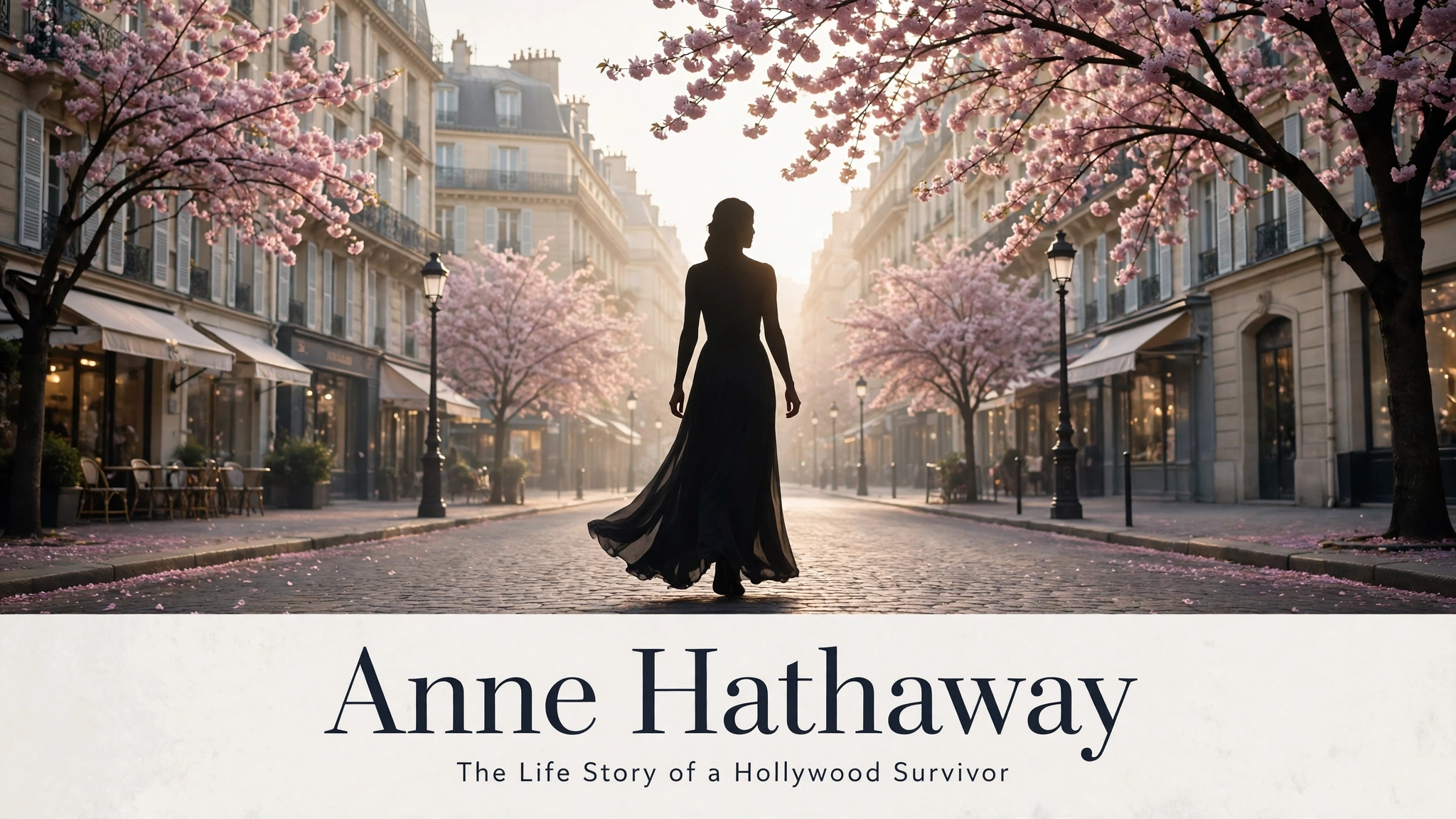
Anne Hathaway: The Life Story of a Hollywood Survivor
In this post
- Brooklyn, New Jersey and a Theatre Childhood
- The Princess Diaries and Overnight Fame
- The Devil Wears Prada and the Fashion Assistant
- Rachel Getting Married, Les Miserables and the Oscar
- The Backlash and Hathahate
- Interstellar, The Intern and the Working Actor
- The Comeback and the New Chapter
- What Survival Looks Like
- The Stage, Shakespeare and the Actor’s First Love
- My Take:
Anne Hathaway has been famous for more than twenty years, and she has survived things that would have ended most careers, a meteoric rise, an Oscar, a backlash so intense it had a name, and a comeback that proved she was never going anywhere. Born in Brooklyn, New York, in 1982, she grew up in New Jersey, trained as an actor, and became a star at eighteen as Mia Thermopolis in The Princess Diaries, the awkward teenager who discovers she is a princess. Since then she has played a fashion assistant, a recovering addict, a singing revolutionary, a cat burglar, and a scientist in space, and she has won an Academy Award, been hated by the internet, and come back stronger, with a career that is now more interesting than it has ever been. This is the life story of a survivor, and of an actor who refused to disappear.
Brooklyn, New Jersey and a Theatre Childhood
Anne Hathaway grew up in New Jersey, in a family where theatre was a normal part of life, because her mother was an actor and her father was a lawyer, and she was a child who loved to perform, who sang, who acted in school plays, and who knew, from a young age, that she wanted to be an actor. She was not a child star, she was a theatre kid, and that training, in school, in community theatre, in the discipline of the stage, gave her a foundation that has lasted her whole career.
Hathaway was born in Brooklyn, New York, in 1982, and grew up in Millburn, New Jersey, the middle of three children, in a family where her mother, Kate McCauley Hathaway, was an actor who had played Fantine in Les Miserables on stage. She began acting in school plays and in community theatre, and she has described herself as a serious, studious child who loved reading, singing and performing, and who was determined, from a young age, to become an actor. She attended Vassar College, where she studied English and political science, and she also studied at the American Academy of Dramatic Arts, training that gave her a classical foundation in acting. That theatre background matters, because Hathaway has always been a stage actor at heart, and she has returned to the stage throughout her career, in Shakespeare, in musicals, and in plays that challenge her in ways film does not.
The Princess Diaries and Overnight Fame
The Princess Diaries made Anne Hathaway a star when she was eighteen, and the role of Mia Thermopolis, the awkward, frizzy-haired teenager who discovers she is the princess of a small European country, became one of the defining performances of early-2000s family film. The film was a hit, it made Hathaway a household name, and it also typecast her, because for years afterwards, audiences saw her as the sweet, wholesome princess, and it took a decade of hard, strange roles to break that image.
In 2001 she starred as Mia Thermopolis in The Princess Diaries, directed by Garry Marshall, playing a shy San Francisco teenager who learns she is the heir to the throne of Genovia, and who must learn to be a princess. The film was a major commercial success, and Hathaway’s performance, which was funny, awkward and charming, made her an instant star, and she returned for the sequel, The Princess Diaries 2: Royal Engagement, in 2004. The role made her famous, but it also created an image, of the sweet, innocent, slightly clumsy heroine, and Hathaway has spoken about the difficulty of escaping that image, and about the roles she took to prove she was more than a princess. Looking back, the debut is remarkable for its naturalness, because Hathaway, at eighteen, carried a film with warmth and humour, and she did it without ever seeming to be acting, which is a gift that very few young actors possess.
The Devil Wears Prada and the Fashion Assistant
The Devil Wears Prada was the film that proved Anne Hathaway could be more than a princess, because she played Andy Sachs, a young journalist who becomes the assistant to Miranda Priestly, the terrifying editor of a fashion magazine, and she held her own opposite Meryl Streep, in a performance that was funny, sympathetic and real. The film was a hit, it made fashion a part of popular culture, and it showed that Hathaway could play a modern, ambitious young woman, not just a fairy-tale heroine.
In 2006 she starred in The Devil Wears Prada, playing Andy Sachs, a recent graduate who takes a job as the assistant to Miranda Priestly, played by Meryl Streep, the editor of a powerful fashion magazine. The film was a huge commercial success, and Hathaway’s performance, as a woman who is slowly seduced by the glamour of fashion and then realises what it is costing her, was widely praised. Working opposite Streep, one of the greatest actors in history, was a test, and Hathaway passed it, holding her own in scenes with a performer who could easily have overwhelmed her, and showing a maturity that surprised critics. The Devil Wears Prada mattered because it moved her from family films to adult films, and because it proved she could carry a major studio film, and it opened the door to the dramatic roles that would define the next decade of her career.
Rachel Getting Married, Les Miserables and the Oscar
The turning point in Anne Hathaway’s career was Rachel Getting Married, a small, raw film in which she played a recovering addict who comes home for her sister’s wedding, and the performance, which was angry, funny and heartbreaking, earned her an Oscar nomination and proved she was a serious dramatic actor. Then came Les Miserables, in which she played Fantine, singing I Dreamed a Dream in a single, devastating take, and the performance won her the Academy Award for Best Supporting Actress, and made her, for a moment, the most acclaimed actor in Hollywood.
In 2008 she starred in Rachel Getting Married, directed by Jonathan Demme, playing Kym, a young woman in recovery from addiction who returns home for her sister’s wedding, a role that required her to be unlikable, funny and vulnerable, often in the same scene. The performance earned her an Academy Award nomination for Best Actress, her first, and it changed the way the industry saw her, from a princess to a dramatic actor of real depth. In 2012 she played Fantine in Les Miserables, the film adaptation of the stage musical, singing I Dreamed a Dream in a single, unbroken take that became one of the most famous scenes in the film, and that showed her gifts as a singer as well as an actor. She won the Academy Award for Best Supporting Actress for Les Miserables, as well as the BAFTA and the Golden Globe, a clean sweep that confirmed her as one of the finest actors of her generation.
The Backlash and Hathahate
No life story of Anne Hathaway is complete without the backlash, because after she won the Oscar, the internet turned on her, with a ferocity that had a name, Hathahate, and that became a case study in how fame can curdle into cruelty. She was called annoying, try-hard, inauthentic, and the criticism, which was often about her personality rather than her work, was painful, public, and, for a time, overwhelming, and she has spoken about it with a honesty that is rare for a star of her size.
After her Oscar win in 2013, Hathaway became the target of intense online criticism, with commentators and social media users describing her as annoying, overly earnest and inauthentic, a backlash that was widely discussed in the press. The criticism was often personal rather than professional, focused on her acceptance speeches, her interviews and her public persona, rather than on her performances, which remained acclaimed. She has spoken about the experience with candour, describing it as painful and confusing, and saying that she did not understand why the public had turned on her, and that it took her time to process it and to move past it. The backlash is now seen as an early example of the way social media can turn on a public figure, and Hathaway’s survival of it, without retreating or becoming bitter, is part of why her comeback has been so widely admired.
Interstellar, The Intern and the Working Actor
After the backlash, Anne Hathaway did what she has always done, she worked, taking roles in big films and small films, in science fiction and in comedy, and proving, one performance at a time, that she was still one of the best actors in Hollywood. She played a scientist in Interstellar, a young CEO in The Intern, a cat burglar in The Dark Knight Rises, and each role was different, and each one showed a different side of her, and the work, slowly, spoke louder than the noise.
In 2012 she played Selina Kyle, Catwoman, in The Dark Knight Rises, Christopher Nolan’s final Batman film, a role that required her to be sexy, funny and dangerous, and that showed a physicality and a wit that audiences had not seen from her before. In 2014 she starred in Interstellar, also directed by Nolan, playing Dr. Amelia Brand, a scientist on a mission to save humanity, a role that required her to play grief, hope and determination in the vastness of space. In 2015 she starred in The Intern, opposite Robert De Niro, playing Jules Ostin, the founder of a fashion website, a warm, funny performance that showed her gift for comedy and for playing a modern, ambitious woman. These roles, taken together, show a versatility that is rare, because Hathaway can do action, science fiction, comedy and drama, and she can do them all well, which is why directors keep casting her, even when the public conversation is about something else.
The Comeback and the New Chapter
In recent years, Anne Hathaway has had a comeback, not because she disappeared, but because the conversation changed, and audiences and critics began to appreciate her again, for the work, for the talent, and for the resilience. Films like The Idea of You, in which she played a woman who falls in love with a younger pop star, showed a new side of her, funny, sexy and confident, and the film became a hit, and Hathaway, in her forties, became a romantic lead again, on her own terms.
In 2024 she starred in The Idea of You, playing Solene, a forty-year-old single mother who begins a romance with a twenty-four-year-old pop star, a role that was funny, romantic and surprisingly honest about age, desire and motherhood. The film was a major success on streaming, and Hathaway’s performance was widely praised, with critics noting her charm, her comic timing and her willingness to play a romantic lead at forty, a rarity in Hollywood. She has also taken on producing roles, and she has spoken about wanting to tell stories about women, about age, and about the experiences that Hollywood usually ignores, a mission that reflects her own journey. This new chapter is the most interesting of her career, because she is no longer the princess, or the Oscar winner, or the target of a backlash, she is an actor in her forties, doing the best work of her life, and doing it on her own terms.
What Survival Looks Like
Anne Hathaway’s story is, in the end, a story about survival, not just of a backlash, but of a career that has lasted more than twenty years, through fame, through criticism, through changing fashions in Hollywood, and through the simple fact of getting older in an industry that does not value older women. She has survived because she is talented, because she is disciplined, and because she never stopped working, and that is a lesson for anyone who has ever been knocked down in public, that the work is the answer, and the work will outlast the noise.
Her filmography is unusually long and unusually varied, with family films, romantic comedies, dramas, musicals, science fiction and action, a range that very few actors can match. She has won an Oscar, a BAFTA, a Golden Globe and an Emmy, a collection of awards that places her among the most honoured actors of her generation, and she has done it while raising a family and while navigating a public life that has not always been kind. She has returned to the stage, she has produced, she has spoken about the issues she cares about, and she has done it all with a professionalism and a grace that is easy to overlook, because it is quiet, and quiet is not news. Whatever she does next, she has already proved the point that matters most, that a career is not a moment, it is a lifetime, and that the actors who last are the ones who keep working, keep learning, and keep showing up, even when the world is not watching kindly.
The Stage, Shakespeare and the Actor’s First Love
Anne Hathaway has always been a stage actor at heart, and she has returned to the theatre throughout her career, in Shakespeare, in musicals, and in plays that challenge her in ways film does not. She played Viola in Twelfth Night, she appeared in the New York Shakespeare Festival, and she has spoken about the theatre as her first love, as the place where she learned her craft, and as the place she returns to when she wants to remember why she became an actor, which is not for fame, or for money, but for the feeling of being on a stage, in front of a live audience, telling a story.
She performed in Twelfth Night in Central Park as part of the New York Shakespeare Festival, playing Viola, a role that is one of the most beloved in Shakespeare, and that showed her classical training and her gift for comedy. She has also appeared in stage musicals and in plays in New York and London, work that pays little compared to film, but that she describes as essential, because it keeps her honest as an actor. Her mother played Fantine in Les Miserables on stage, and Hathaway later played the same role on film, a connection that makes her stage work feel personal, as if she were following in her mother’s footsteps, and honouring a family tradition.
My Take:
My honest view is that Anne Hathaway is the most resilient actor in Hollywood, and I say resilient because she has been through a backlash that would have destroyed most careers, and she came out the other side stronger, funnier and more interesting than she was before. The Hathahate episode is now seen as a case study in online cruelty, but at the time it was real, it was painful, and it was public, and Hathaway had to live through it while still working, still promoting films, still smiling for cameras, and she did it without becoming bitter, without retreating, and without apologising for being herself. That takes a kind of strength that is easy to underestimate, because it is quiet, and quiet strength is not as visible as loud strength, but it is stronger.
What I admire about her acting is the range, because there are very few actors who can do what she does, play a princess, play a fashion assistant, play a recovering addict, play a singing revolutionary, play a cat burglar, play a scientist in space, and play all of them completely, without a trace of the others. Most actors have a type, Hathaway does not, or rather, her type is that she has no type, she is a character actor in a leading lady’s body, and that is a rare and valuable thing. Watch her in Rachel Getting Married, angry and funny and broken, and then watch her in The Devil Wears Prada, polished and ambitious, and you see two different people, played by the same actor, and that is the definition of talent.
I Dreamed a Dream, sung in a single take with the camera on her face, is one of the most devastating scenes in modern film, and it is the reason the Les Miserables performance will be talked about for decades. Hathaway sings it not as a singer, but as a woman who is dying, remembering a life that did not happen, and the rawness of it, the tears, the imperfection, is what makes it unforgettable. Most musical performances are polished until they shine; hers is not polished, it is real, and the reality is why it won her the Oscar. A single take leaves nowhere to hide, and she did not hide, which is the whole performance in miniature: a woman willing to be seen, fully, at her most broken, and trusting the audience to stay with her.
The backlash said more about the audience than it did about Hathaway, and that is the uncomfortable part. She was hated, for a time, for being earnest, for being enthusiastic, for trying too hard, and those are strange things to hate someone for, because in most contexts they are virtues. I think the real discomfort was different: a woman who is ambitious, successful, and unwilling to hide it makes people uneasy, and Hathaway, by being herself, exposed that unease. She survived it, and the conversation has changed since, which suggests something was learned, even if not enough was learned. The fact that earnestness could be treated as a crime tells you more about the culture of 2013 than about the actor, and the culture, slowly, has had to answer for it.
Work is the answer Hathaway gave to the noise, and it was the smartest answer available. The backlash was loud, but it was temporary, and the work is permanent: Rachel Getting Married, Les Miserables, Interstellar, The Idea of You, all on film, all watchable for decades, all judged on their merits rather than on the mood of the internet in a single year. Most people who are attacked online want to respond, to defend themselves, to win the argument, and the argument is unwinnable, because the internet does not concede. Hathaway did something better, she kept working, and the work became the response, which is a lesson for anyone who has ever been knocked down in public: the response that lasts is not a statement, it is a body of work.
Her forties look like the brightest chapter yet, and that is a sentence worth pausing on, because Hollywood has spent decades telling women the opposite. She is doing the best work of her life, playing romantic leads, producing, choosing stories about women and about age, and refusing to disappear on schedule. I hope she keeps going, keeps directing one day, keeps making films like The Idea of You, and keeps proving that a woman in her forties can be a star, funny, sexy, and taken seriously, all at once, without apology. Survival is not just about enduring, it is about growing, and Hathaway has grown in public, in full view, turning a career that was supposed to fade into one that is still expanding, which is a rarer achievement than any single award. The record is still being written, and the next chapter looks like the best one yet.
Earnest is the criticism, and I think it is a wonderful thing to be called in a world that rewards irony, detachment, and coolness. Hathaway cares about her work, cares about her performances, cares about the audience, and she shows it, and the showing is brave, because it leaves you open to mockery, to being called try-hard, to being told you care too much. Irony is safe, because it never commits; earnestness commits, and commitment can be hurt. Her performances are so moving precisely because they are earnest, real, and full of a feeling that irony can never provide, and the fact that she has kept caring, through a backlash built on that very caring, is the bravest part of the whole story. That is why the performances land the way they do, and why they will keep landing.
Caring too much is not a flaw in Hathaway’s story, it is the engine that carried her through a backlash, a twenty-year career, and a comeback that is still unfolding. She cared too much, and she won an Oscar; she cared too much, and she survived; she cared too much, and she is still here, doing the best work of her life. The next time someone tells you to care less, to try less, to be cooler, remember that cooler is not better, it is only colder, and cold has never moved an audience the way warmth has. Hathaway has never been cold, not once, and the warmth is the reason the work lasts, because audiences remember how a performance made them feel long after they forget the jokes made about the performer, and the feeling is what endures.
Frequently Asked Questions
Where is Anne Hathaway from?
Anne Hathaway was born in Brooklyn, New York, in 1982, and grew up in Millburn, New Jersey. Her mother was an actor who had played Fantine in Les Miserables on stage, and Hathaway began acting in school plays and community theatre as a child.
What was Anne Hathaway’s first major film?
Her first major film was The Princess Diaries in 2001, in which she played Mia Thermopolis, a shy teenager who discovers she is the princess of Genovia. The film was a major commercial success and made her an instant star at eighteen.
Did Anne Hathaway win an Oscar for Les Miserables?
Yes, Hathaway won the Academy Award for Best Supporting Actress for playing Fantine in Les Miserables in 2012. She sang I Dreamed a Dream in a single, unbroken take, and she also won the BAFTA and the Golden Globe for the role.
What is Hathahate?
Hathahate was the name given to the intense online backlash against Anne Hathaway after her Oscar win in 2013, when commentators and social media users criticised her as annoying and inauthentic. She has spoken about the experience as painful and confusing, and it is now seen as an early example of social media turning on a public figure.
What is Anne Hathaway’s recent comeback film?
In 2024 Hathaway starred in The Idea of You, playing Solene, a forty-year-old single mother who begins a romance with a twenty-four-year-old pop star. The film was a major streaming success and was widely praised, marking a new chapter in her career as a romantic lead in her forties.