Anya Taylor-Joy: The Life Story Behind the Chess Queen
In this post
- Miami, Buenos Aires and Three Cultures
- London, Ballet and Being Discovered
- The Witch and a Terrifying Debut
- Split, Thoroughbreds and the Rise
- The Queen’s Gambit and Global Stardom
- Emma, Last Night in Soho and the Leading Lady
- Furiosa and the Action Star
- Style, Privacy and the Woman Behind the Roles
- Fashion, Image and the Art of Being Seen
- My Take:
Anya Taylor-Joy has one of the most unusual life stories in Hollywood, because she was born in Miami, raised in Argentina, moved to London as a teenager, and became a star in a film about a witch in seventeenth-century New England. Born in 1996, she grew up speaking Spanish, learned English as a second language, and spent her childhood between three cultures, American, Argentine and British, and that in-between feeling is visible in her performances, which are often about outsiders, about people who do not quite belong. The Queen’s Gambit made her a global star, The Witch made her a critical darling, and Furiosa made her an action lead, and through it all she has remained one of the most distinctive faces in film, with eyes that seem to look straight through the camera. This is the life story behind the chess queen.
Miami, Buenos Aires and Three Cultures
Anya Taylor-Joy was born in Miami, Florida, in 1996, but she did not grow up American, she grew up Argentine, because her family moved to Buenos Aires when she was a baby, and Argentina was the country of her childhood. She spoke Spanish first, English second, and she has described the experience of moving to London as a teenager as a kind of culture shock, because she arrived in a country she had never lived in, speaking a language she was still learning.
Taylor-Joy was born in Miami in 1996, the youngest of six children, to a mother who was a psychologist and a father who was a banker, and her family moved to Buenos Aires, Argentina, when she was still a baby. She grew up in Argentina, speaking Spanish as her first language, and she has described her childhood there as happy and warm, full of family, food and a sense of belonging that she has never quite found anywhere else. When she was six, the family moved to London, a move she has described as difficult, because she did not speak English fluently, she missed Argentina, and she felt like an outsider at school, an experience that later helped her play outsiders on screen. That triple identity, American by birth, Argentine by childhood, British by adolescence, has shaped her whole life, and she has spoken about it as both a gift and a burden, because she belongs everywhere and nowhere at the same time.
London, Ballet and Being Discovered
As a teenager in London, Anya Taylor-Joy was a ballet dancer, a student, and a girl who did not quite fit in, and her discovery as an actor was, like so many discoveries, a matter of luck and timing. She was spotted by a modelling scout while walking down a street, and that chance encounter led to modelling, and modelling led to acting, and acting led, within a few years, to a film that changed her life.
After the move to London, Taylor-Joy attended school in the city and trained in ballet, and she has described herself as a serious, disciplined teenager who loved dance and who thought about a career in the arts. She was discovered by a modelling scout while she was out shopping, an encounter that led to modelling work and to her first experience of being in front of a camera professionally. Modelling taught her how to work with photographers and how to present herself, but she was more interested in acting, and she began auditioning for film and television roles while still a teenager. She has been open about the difficulty of those years, about feeling like an outsider, about missing Argentina, and about the loneliness of being a teenager in a new country, and that honesty has made her a figure many young people identify with.
The Witch and a Terrifying Debut
The film that made Anya Taylor-Joy a star was The Witch, a horror film set in seventeenth-century New England, in which she played Thomasin, a teenage girl accused of witchcraft by her own family. The film was slow, strange and terrifying, and Taylor-Joy, who was nineteen when she made it, carried it with a performance that was both fragile and fierce, and critics immediately recognised her as a major talent.
In 2015 she starred in The Witch, directed by Robert Eggers, playing Thomasin, the eldest daughter of a Puritan family banished from their settlement, who is blamed when strange and terrible things begin to happen. The film was shot in a remote location, with dialogue in period-accurate English, and Taylor-Joy had to learn to speak in a seventeenth-century accent while playing a character who is terrified, angry and, possibly, guilty. Critics praised the film and her performance, with many describing her as a revelation, and the film became a cult hit, establishing both Eggers and Taylor-Joy as important new voices in cinema. The Witch mattered because it proved she could carry a film, and because it proved she was willing to take on difficult, strange material, a willingness that has defined her career ever since.
Split, Thoroughbreds and the Rise
After The Witch, Anya Taylor-Joy worked constantly, taking roles in horror, thriller and drama that showed different sides of her talent, and each one added to a reputation for intensity and for choosing interesting material. She played a kidnapped teenager in Split, a cold, calculating rich girl in Thoroughbreds, and a series of characters who were, in different ways, outsiders, and audiences began to recognise her face, even if they could not yet name her.
In 2016 she starred in Split, directed by M. Night Shyamalan, playing Casey Cooke, one of three girls kidnapped by a man with multiple personalities, a role that required her to play fear, resilience and intelligence under extreme pressure. The same year she appeared in Thoroughbreds, playing Lily, a wealthy, emotionally detached teenager who plots a murder with her friend, a dark comedy that showed her gift for playing characters who are cold on the surface and complicated underneath. These roles, along with work in films such as Morgan and Marrowbone, established her as one of the most in-demand young actors in Hollywood, and as someone who chose her projects carefully. What united these performances was a quality that is hard to describe but easy to recognise, a stillness, an intensity, a sense that the character is thinking, and that quality is what made directors want to work with her again and again.
The Queen’s Gambit and Global Stardom
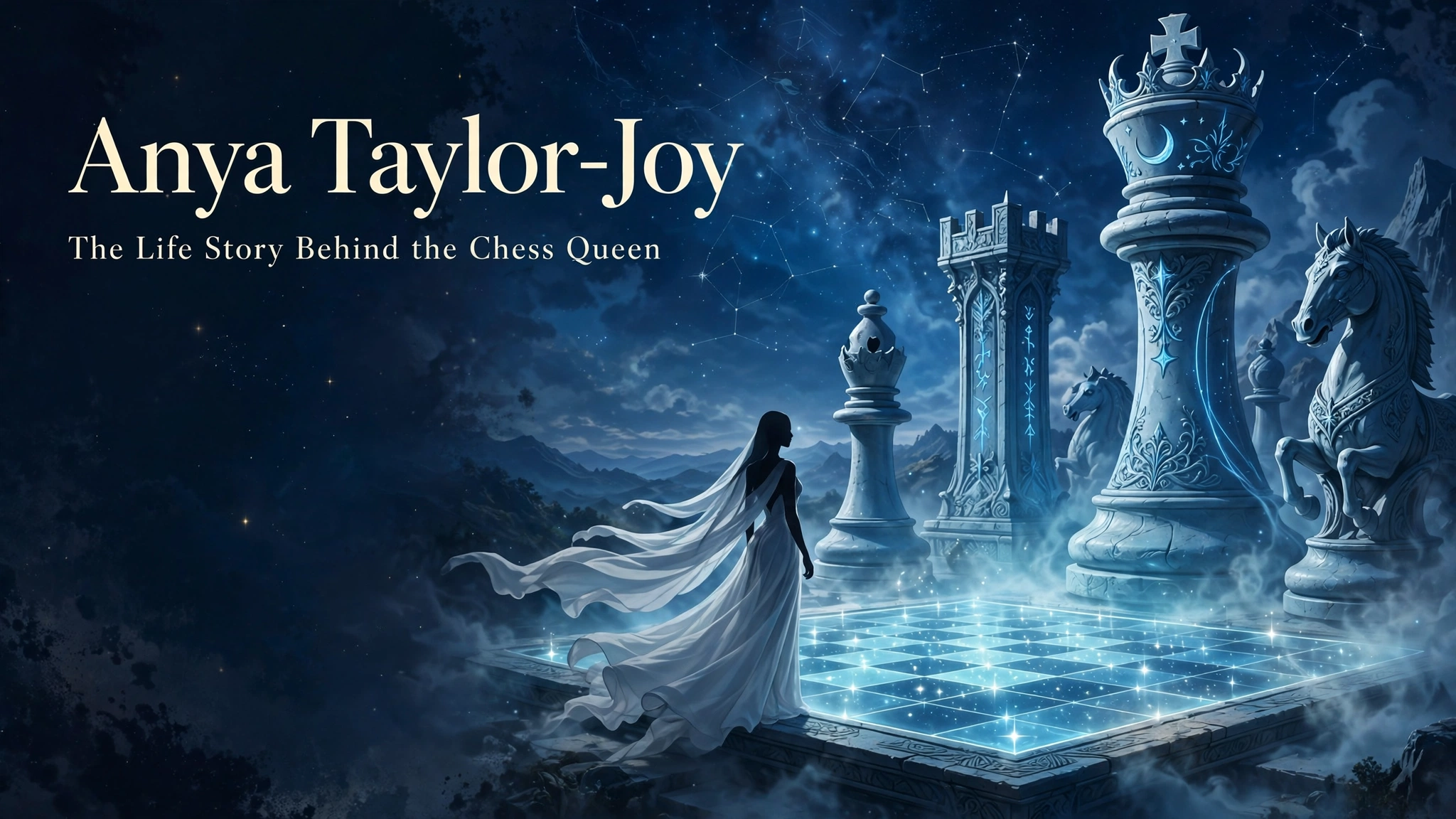
The Queen’s Gambit was the role that turned Anya Taylor-Joy from a critical darling into a global star, and it did so with a story about chess, a subject that should not have been a hit, but became one of the biggest series in Netflix history. As Beth Harmon, a chess prodigy with a troubled past, Taylor-Joy gave a performance that was both glamorous and heartbreaking, and the show made chess fashionable, made her a fashion icon, and made her one of the most famous actors in the world.
In 2020 she starred as Beth Harmon in The Queen’s Gambit, the Netflix limited series based on the novel by Walter Tevis, playing an orphaned girl who becomes a chess prodigy while struggling with addiction and loneliness. The series became a global phenomenon, one of Netflix’s most-watched limited series, and it sparked a surge of interest in chess around the world, with sales of chess sets rising sharply after its release. Taylor-Joy’s performance earned her a Golden Globe for Best Actress in a Limited Series, and it made her a fashion icon, with her red hair, her 1960s wardrobe and her striking features becoming defining images of the year. The role also showed her range, because Beth is glamorous and confident at the chess board and lost and lonely away from it, and Taylor-Joy played both sides of the character without ever making her feel like two different people.
Emma, Last Night in Soho and the Leading Lady
After The Queen’s Gambit, Anya Taylor-Joy became a leading lady, taking the title roles in literary adaptations and in genre films that showed she could carry a film on her name alone. She played Emma Woodhouse in a bright, funny adaptation of Jane Austen, and a singer in a haunted London in Last Night in Soho, and each role was different, and each one proved that her range was wider than anyone had guessed.
In 2020 she played the title role in Emma, a stylish adaptation of Jane Austen’s novel, playing Emma Woodhouse, a wealthy, clever young woman who meddles in the love lives of everyone around her, a performance that was funny, charming and precise. In 2021 she starred in Last Night in Soho, directed by Edgar Wright, playing Sandie, a singer in 1960s London whose story haunts the film’s modern heroine, a role that required her to sing and to play a character who is both glamorous and tragic. These roles showed that she could do comedy, romance and horror, and that she was not limited to the intense, haunted characters of her early films, but could play lightness and wit as well. The variety of her work in these years is striking, because she moved between genres without ever seeming to repeat herself, and that variety is one reason her career has lasted while other young stars have faded.
Furiosa and the Action Star
The most recent chapter in Anya Taylor-Joy’s story is Furiosa, the Mad Max prequel in which she took over the role made famous by Charlize Theron, and the film tested her in a completely new way, as an action lead in a huge, physical, demanding production. It was a risk, because the role was iconic and the comparison was inevitable, but Taylor-Joy made Furiosa her own, playing her with a fierceness and a stillness that felt entirely new.
In 2024 she starred as Furiosa in Furiosa: A Mad Max Saga, directed by George Miller, playing the younger version of the character played by Charlize Theron in Mad Max: Fury Road. The film was a huge, physical production, shot in the Australian desert, and Taylor-Joy had to learn to drive, to fight and to perform stunts, a completely different kind of preparation from the chess and the period dramas of her earlier work. Critics praised her performance, noting how much she conveyed without dialogue, because Furiosa speaks very little in the film, and Taylor-Joy had to tell the character’s story through her eyes and her body. The role confirmed her as a star who can lead a blockbuster, and it opened a new chapter in her career, one in which action and scale sit alongside the intimate, character-driven films that made her name.
Style, Privacy and the Woman Behind the Roles
For all her fame, Anya Taylor-Joy is a private person, and she has kept her personal life largely out of the public eye, even as she has become one of the most photographed women in the world. She is known for her fashion, for her striking looks, and for a public image that is elegant and slightly mysterious, and that mystery is deliberate, because she believes an actor should be known for the work, not for the life.
She married the musician Malcolm McRae in 2022, in a private ceremony that was kept out of the press for some time, a decision that reflects her general approach to privacy and to keeping her personal life separate from her work. She is known for her fashion sense, and she has become a favourite of designers and of fashion magazines, with her red carpet appearances regularly described as among the most striking of any young actor. She does not court publicity, and she gives interviews that are thoughtful and articulate, talking about her work, her background and her love of reading and of music, rather than about gossip or controversy. This privacy, combined with her distinctive looks and her unusual background, has made her one of the most intriguing stars of her generation, an actor who is famous for being interesting rather than for being available.
Fashion, Image and the Art of Being Seen
Anya Taylor-Joy is one of the most photographed women in the world, and her fashion, her red carpet appearances, and her striking looks have become part of her public image, but she has always been careful to keep that image separate from her work, to let the clothes be a performance, and the acting be the truth. She works with designers, she attends fashion events, and she is celebrated for her style, but she has also spoken about the strangeness of being known for how she looks, when what she cares about is how she acts, and that tension, between image and craft, is one she navigates with a grace that is rare for someone so young.
She has become a favourite of fashion houses, and her appearances at premieres and at award ceremonies are regularly described as among the most striking of any young actor, with a style that is bold, elegant and slightly otherworldly. She has spoken about fashion as a form of self-expression, about the joy of wearing beautiful clothes, and about the difference between dressing up for a premiere and being herself, a distinction she is careful to maintain. Her image, with its wide eyes, its pale skin and its red hair, has become iconic, and it has made her instantly recognisable, but she has also been clear that her looks are not her work, and that she wants to be judged on her performances, not on her photographs.
My Take:
My honest view is that Anya Taylor-Joy is the most distinctive actor of her generation, and I mean distinctive in the literal sense, because there is nobody else who looks like her, sounds like her, or acts like her. Her face, with its wide eyes and sharp cheekbones, is instantly recognisable, and her performances have a stillness and an intensity that make it impossible to look away, even when she is doing almost nothing. In an industry that rewards sameness, she is gloriously, stubbornly different, and that difference is not a marketing strategy, it is who she is, a woman shaped by three cultures, two languages and a childhood spent feeling like an outsider.
What I love about her performances is the intelligence, because she always seems to be thinking, and you can see the thinking in her eyes. Watch her as Beth Harmon, studying a chess board, and you believe she is seeing ten moves ahead, because Taylor-Joy makes thinking visible, which is an extraordinary skill. Watch her as Thomasin in The Witch, listening to her family accuse her, and you see a girl who is working out, in real time, whether she is guilty or innocent, and that working-out is the performance. Most actors show you an emotion, Taylor-Joy shows you a mind, and that is a rarer and more interesting thing.
I also think The Queen’s Gambit deserves a calmer look than it usually gets, because people talk about the chess boom and the fashion and forget how sad the story actually is. Beth Harmon is an orphan, an addict, a lonely woman who is brilliant at one thing and lost at everything else, and Taylor-Joy played that loneliness without ever asking for pity, which is why the show worked. It would have been easy to make Beth glamorous and triumphant, and the show is glamorous, but Taylor-Joy never let the glamour hide the pain, and that balance, between beauty and sadness, is what made the performance unforgettable.
She spoke Spanish first and learned English second, and I think you can hear that history in every performance. Arriving in London and not being able to say exactly what she meant taught her that words are not natural, they are tools, and she uses them like tools now, carefully, deliberately, choosing each one and placing it where it will do the most work. There is a precision to her delivery that comes from having had to learn a language from the outside, and a willingness to let silence do the job when words cannot, which is a rarer skill than fluency. Actors who were born inside a language often take it for granted; Taylor-Joy knows its weight, because she once felt its absence, and that knowledge is audible in the care she takes with every line.
Outsider is the thread through her whole life, and she has turned it into material. She was an outsider in Argentina, because she was born in Miami; an outsider in London, because she spoke Spanish; and an outsider in Hollywood, because she did not look or sound like anyone else in the room. Each of those displacements gave her something to draw on, and you can see it in the characters she chooses, Beth Harmon, Thomasin, Furiosa, all women who do not fit, who watch the world from its edge and then act on it. Most people spend their lives trying to belong, and spend their energy on the trying. Taylor-Joy built a career on the opposite move, taking the not-belonging and making it the work, which is a more interesting use of the same energy, and a more powerful lesson for anyone who has ever felt on the outside.
Horror, drama, comedy, period, action: there are very few kinds of film left that she has not already proved she can carry, and that range is both the opportunity and the problem. The question now is not whether she can do something, it is what she will choose to do, and the wrong choice is the safe one, the franchise that pays for a decade and asks nothing. I hope she keeps choosing the difficult films, the ones that ask something of her, because that is the path to a career like Cate Blanchett’s or Tilda Swinton’s, built on range and intelligence rather than on a single image. She has given every sign of knowing exactly who she is, and self-knowledge, in an industry that profits from confusion, is the most valuable asset an actor can own.
Strange is the word people reach for with Taylor-Joy, and I have come to think it is a compliment they do not know they are paying. Strange means you do not fit the template, and not fitting is where originality starts, because the template is, by definition, what has already been done. She did not fit in Argentina, she did not fit in London, she did not fit in Hollywood, and each time she did not fit, she made something new instead of sanding herself down to fit the old shape. A performance, a character, a career: those are the things strange people make, because the old things do not fit them, and the making is the point. Call it strange if you like; the work is the answer, and the work is unlike anyone else’s.
Seeing the world differently is the gift, and Taylor-Joy’s gift is that she can show the rest of us what she sees. Through Beth Harmon’s eyes the chessboard becomes a battlefield, through Thomasin’s eyes a farm becomes a nightmare, through Furiosa’s eyes a desert becomes a mission, and each time the audience sees something it had not seen before. That is the work of an artist in the oldest sense, to take a way of seeing that belongs to one person and make it available to everyone else. Strange is not a problem to be solved here, it is an instrument to be played, and she plays it with a precision that makes the unfamiliar feel true, and the familiar feel strange again, which is the double move that separates a star from an artist.
Her eyes do work that other actors need their whole bodies for, and directors have learned to use them as instruments. In The Witch they carry fear, in The Queen’s Gambit calculation, in Furiosa fury, and in each case the feeling arrives without a speech, without a gesture, just a look held a beat longer than comfort allows. That is a gift, and it is also a responsibility, because when a look can do that much, you have to be careful what you show, and Taylor-Joy is careful, showing exactly what the character would show, no more, no less. The precision is what makes her unforgettable, because the audience feels it has seen something true, and has seen it without being told, which is the quietest and most powerful kind of acting there is.
Frequently Asked Questions
Where was Anya Taylor-Joy born?
Anya Taylor-Joy was born in Miami, Florida, in 1996, but she grew up in Buenos Aires, Argentina, where her family moved when she was a baby. She spoke Spanish as her first language and moved to London with her family when she was six years old.
What was Anya Taylor-Joy’s first major film?
Her first major film was The Witch in 2015, directed by Robert Eggers, in which she played Thomasin, a teenage girl accused of witchcraft by her Puritan family. Critics praised the performance, and the film became a cult hit that established her as a major new talent.
Did Anya Taylor-Joy win a Golden Globe for The Queen’s Gambit?
Yes, Taylor-Joy won the Golden Globe for Best Actress in a Limited Series for playing Beth Harmon in The Queen’s Gambit in 2020. The Netflix series became a global phenomenon and sparked a surge of interest in chess around the world.
Who does Anya Taylor-Joy play in Furiosa?
In Furiosa: A Mad Max Saga, released in 2024 and directed by George Miller, Taylor-Joy plays the younger version of Furiosa, the character played by Charlize Theron in Mad Max: Fury Road. The role required extensive physical preparation and very little dialogue.
Does Anya Taylor-Joy speak Spanish?
Yes, Taylor-Joy grew up speaking Spanish as her first language in Buenos Aires, Argentina, and learned English after her family moved to London when she was six. She has spoken about the experience of arriving in London and feeling like an outsider because of the language.