Anouk: The Life Story Behind the Dutch Rock Singer
In this post
Anouk is one of the most powerful voices in Dutch rock music. Her full name is Anouk Teeuwe, and she was born in The Hague, where she grew up with a love of music and a determination to sing on her own terms. Her breakthrough came in 1997 with the song Nobody’s Wife, a rock anthem that became a hit in the Netherlands and in many other countries, and that made her a star. Since then, she has released many albums, she has performed in large concerts, she has represented the Netherlands at Eurovision, and she has become one of the most respected singers in Europe.
She was born on 8 April 1975 in The Hague, and she grew up in a city that was full of music and culture. She sang from an early age, she performed in local bands, and she dreamed of a career on stage. She was not a conventional pop singer. She was a rock singer, with a raw and powerful voice, and she was not afraid to be herself. That honesty became her trademark, and it is the reason her fans have stayed loyal to her for more than twenty-five years.
What makes her story worth telling is the strength of her voice and the independence of her career. She has never followed fashion, and she has never tried to be someone she is not. She has made the music she wanted to make, she has spoken her mind, and she has built a career that is hers alone. Her story is about talent, about courage, and about a woman who refused to be controlled by the music industry.
Growing Up in The Hague
Anouk Teeuwe was born on 8 April 1975 in The Hague, the seat of the Dutch government and a city with a rich cultural life. She grew up in a family that valued music, and she was encouraged to sing and to express herself from an early age. The Hague was a diverse and lively city, and it gave her a view of the world that was open and curious. She was a child who liked to perform, and she found that singing gave her a way to say things she could not say in any other way.
As a young person, she was drawn to rock music. She listened to American and British rock, and she was inspired by singers who had strong voices and who were not afraid to be different. She sang in school, she sang at home, and she began to perform with local bands while she was still a teenager. She was not a shy singer. She was bold, direct, and full of energy, and audiences noticed her immediately.
Her school years were not always easy. She had trouble at school, and she left without the kind of qualifications that lead to a safe job. That experience shaped her music, because her songs often talk about a young person who has no easy path and who must make her own way. She did not go to university, and she did not have a plan B. Music was her plan, and she threw herself into it with everything she had.
The Hague gave her a sense of independence. It was a city where people were encouraged to think for themselves, and Anouk absorbed that spirit. She learned early that she would have to fight for her place in the music business, and that she would have to do it on her own terms. That independence stayed with her for the rest of her life, and it became one of the most important parts of her story.
Singing in Bands and First Steps
As a teenager, Anouk began to sing in bands in The Hague. She performed in small venues, in clubs, and at local events, and she learned how to work with other musicians, how to perform in front of an audience, and how to handle the pressure of a live show. These early performances were not glamorous, but they were valuable, because they taught her the craft of singing and the discipline of being a performer.
She also began to write her own songs. She wrote about her life, about love, about anger, and about the world around her, and she did it in a direct and honest way. Her lyrics were not polished or clever for the sake of being clever. They were real, and they came from her own experience. That honesty would later become one of the things her fans loved most about her music.
During this period, she met musicians and producers who recognised her talent and who wanted to work with her. She was young, she was talented, and she had a voice that stood out from the crowd. She began to record demos, and she started to build a reputation in the Dutch music scene as a singer to watch. It was a slow process, but it was an important one, because it gave her time to develop her voice and her style.
The early years were not easy. The music business is full of young singers who want to be stars, and only a few of them succeed. Anouk had to work hard, to travel to auditions, and to keep believing in herself when things did not go as planned. She also had to learn how to handle disappointment, because not every song becomes a hit, and not every performance leads to a contract. That experience made her stronger, and it prepared her for the success that was about to come.
Nobody’s Wife and a Breakthrough
In 1997, Anouk released Nobody’s Wife, a rock song that became a huge hit in the Netherlands and in many other countries. The song was powerful, direct, and full of attitude, and it announced Anouk as a major new voice in Dutch rock. It reached the top of the charts, it was played on the radio constantly, and it made her a star almost overnight. The song’s success was not an accident. It was the result of a strong melody, a powerful vocal performance, and a lyric that spoke to many young women who wanted to be independent.
Nobody’s Wife was followed by her debut album, Together Alone, which was also a success. The album showed that Anouk was not a one hit singer. She could write and sing a whole album of strong rock songs, and she could do it with a consistency that few new artists manage. She toured, she performed on television, and she became one of the best known singers in the Netherlands.
The breakthrough changed her life. She was suddenly famous, and she had to learn quickly how to handle fame, how to perform night after night, and how to live a life that was very different from the one she had known in The Hague. She handled it in her own way, by staying true to herself and by refusing to change her style to please others. That independence earned her respect, and it also made her a role model for young women who wanted to be themselves.
The song remains her signature, and it is still played on the radio and sung by fans at her concerts. It is a song about independence, about refusing to be owned by anyone, and about being true to yourself. Those are themes that run through all of Anouk’s work, and they are the reason her music has lasted for so long.
Albums, Hits, and a Rock Career
After Nobody’s Wife, Anouk released a series of successful albums, including Urban Solitude, Graduated Fool, and Hotel New York. Each album showed a different side of her music, but they all shared the same core: strong rock songs, honest lyrics, and a powerful voice. She had hits with songs such as R U Kiddin’ Me, Girl, Lost, and Michel, and she became known as one of the most consistent rock singers in Europe.
Her concerts were loud, energetic, and full of passion, and her fans were loyal and enthusiastic. She performed in large venues in the Netherlands and in other countries, and she built a reputation as a live performer who gave everything on stage. She did not hold back. She sang with her whole body, and she connected with her audience in a way that few singers can. That live energy became one of the hallmarks of her career.
She also worked with other musicians, and she wrote songs for other artists. She was not just a singer. She was a songwriter, a performer, and a creative force in Dutch music. Her albums were praised by critics, and they sold well in the Netherlands and in Belgium, where she also had a large following. She was a star, but she was also a working musician who took her craft seriously.
The years after her breakthrough were busy, but they were also demanding. She had to produce new albums, tour constantly, and live up to the expectations of her fans and her record company. She handled that pressure by staying focused on her music, and by refusing to compromise her style. She made the albums she wanted to make, and she trusted that her fans would follow her. That trust was rewarded, because her fans did follow her, album after album.
Eurovision and Birds
In 2013, Anouk represented the Netherlands at the Eurovision Song Contest in Malmö, Sweden, with the song Birds. It was a surprising choice, because Anouk was a rock singer, and Eurovision was often associated with pop. But she brought her own style to the contest, singing a quiet and emotional song that stood out from the other entries. She finished in ninth place, which was the best result for the Netherlands in many years, and she helped to restore Dutch confidence in Eurovision.
Birds was a different kind of song for Anouk. It was slow, gentle, and full of feeling, and it showed a softer side of her voice that many people had not heard before. The performance was praised, and it brought her to the attention of a wider European audience. It also showed that she was not limited to rock. She could sing a ballad with the same power and honesty as a rock anthem, and that versatility made her an even more respected singer.
The Eurovision experience was important for the Netherlands as well as for Anouk. Dutch entries had struggled in Eurovision for many years, and Anouk’s success showed that a serious artist could do well in the contest. The following year, The Common Linnets, featuring Ilse DeLange, finished second, and Dutch Eurovision success continued. Anouk’s participation is often credited with helping to start that new era, and it is a proud part of her story.
After Eurovision, she continued to make albums and to perform, and she remained a major figure in Dutch music. She had proven that she could succeed in a new arena, and she had done it on her own terms, with a song she believed in and a performance that was true to herself. That is a rare achievement, and it is one that her fans remember with pride.
Later Years, The Voice, and Today
In later years, Anouk has continued to record and to perform, releasing new albums that show her voice is still strong and her songwriting is still honest. She has also worked as a coach on The Voice of Holland, the Dutch version of the television singing competition, where she helped young singers to develop their talent. Her work on the show showed a different side of her: a mentor who was direct, honest, and supportive, and who wanted her singers to be themselves rather than to copy others.
She has also built a life away from the stage. She lives in the Netherlands, and she has a family. She has spoken in interviews about the importance of her children, and about how motherhood has changed her view of life and of music. She is known as a person who works hard, but also as a person who values her private life and who tries to balance the two.
Today, Anouk is seen as one of the most important Dutch singers of her generation. She has sold millions of records, she has performed in front of huge audiences, and she has built a career that has lasted for more than twenty-five years. She is respected by other musicians for her voice and her songwriting, and she is loved by her fans for her honesty and her independence.
Her story is still being written. She is still recording, still performing, and still choosing new projects that interest her. She has come a long way from The Hague, from small clubs to the biggest stages in Europe, and she has done it by working hard, by singing with power, and by staying true to herself. That is a story worth telling, and it is one that will continue for many years to come.
A Voice That Refuses to Be Tamed
Anouk’s voice is one of the most distinctive in European music, and it is worth listening to closely to understand why. It is not a polished pop voice, trained to sound perfect on every note. It is a raw voice, with a roughness that comes from feeling, and it carries a power that cannot be faked. When she sings Nobody’s Wife, her voice is angry, defiant, and full of energy, and the listener can feel that anger as if it were their own. When she sings Birds, her voice is soft, gentle, and full of sadness, and the listener can feel that sadness too. That range, from loud to quiet, from anger to tenderness, is what makes her voice so special.
She developed that voice by singing live, night after night, in small clubs and in large venues, learning how to control it, how to protect it, and how to use it to tell a story. A singer who only records in a studio will never learn the lessons that a live performer learns, because a live audience gives immediate feedback. If a song works, the audience cheers. If it does not, the audience is silent. Anouk learned from that feedback, and she built a voice that could fill a large hall and also whisper in a small room. That versatility is rare, and it is the result of years of hard work on stage.
Her songwriting is just as distinctive as her voice. She writes in English, even though Dutch is her first language, because rock music is sung in English, and she has learned to write lyrics that are simple, direct, and honest. Her songs are about love, about independence, about anger, and about being yourself, and they are written in words that anyone can understand. That simplicity is a strength, because it means that her songs can be understood by listeners in many different countries, even if English is not their first language. A song that is easy to understand is a song that can travel, and Anouk’s songs have travelled far.
She has also been willing to change her sound over the years, moving from hard rock to softer ballads, from loud anthems to quiet reflections, without losing her identity. That willingness to change is a sign of an artist who is still growing, still learning, and still curious about music. Many singers find one sound and stay with it for their whole career. Anouk has explored many sounds, and each one has shown a different side of her talent. That exploration is part of why her fans have stayed with her for so long, because they never know quite what she will do next, but they trust that it will be honest.
Live Performance and the Rock Stage
Anouk’s reputation as a live performer is one of the most important parts of her career, and it is worth understanding what makes her concerts so special. A studio recording can be perfected, note by note, until it sounds exactly as the producer wants it to. A live concert cannot be perfected in that way. It is raw, it is unpredictable, and it depends on the energy between the singer and the audience. Anouk thrives in that environment, because she is a singer who feeds off the crowd, who gives everything on stage, and who makes each concert feel like a unique event that will never happen in exactly the same way again.
Her concerts are known for their energy. She moves across the stage, she talks to the audience, she sings with her whole body, and she creates a feeling of closeness even in a large venue. Fans who have seen her live often say that it was one of the best concerts they have ever attended, not because of lights or special effects, but because of the power of her voice and the honesty of her performance. That is a rare achievement, and it is one that comes from years of performing live, from small clubs in The Hague to large arenas across Europe.
She has also learned how to build a concert, how to choose the order of songs, how to balance loud rock anthems with quiet ballads, and how to give the audience a journey rather than just a list of hits. That skill is part of what makes her a great live performer, because a concert is not just a collection of songs. It is a story, told in music, and Anouk tells that story well. Her fans leave her concerts feeling that they have been part of something special, and that feeling is why they come back again and again.
Rock Music and the Dutch Charts
Anouk’s success changed Dutch rock music, because she proved that a Dutch rock singer could top the charts and fill large venues without giving up her own style. Before Nobody’s Wife, Dutch pop was often dominated by softer sounds, and rock was seen as a niche for a small audience. Anouk showed that rock could be mainstream in the Netherlands, and that a powerful female voice could lead the way. Her success opened doors for other Dutch rock artists, and it helped to create a rock scene that was confident, loud, and proud of its own identity. That is a lasting contribution, and it is one that goes beyond her own records and concerts.
Her chart success also showed the power of a single song. Nobody’s Wife was not just a hit. It was an anthem, a song that people sang along to, that they played at parties, and that they remembered for years. A song like that does not happen by accident. It happens when a talented singer, a good melody, and an honest lyric come together at the right moment, and Anouk was ready for that moment because she had spent years singing in small clubs and learning her craft.
My Take:
When I think about Anouk, I think about a voice that does not ask for permission. From the first time I heard Nobody’s Wife, I knew that this was a singer who was not going to be polite or careful. She was going to sing what she felt, and she was going to sing it loudly. That is a rare quality, and it is the reason her music has lasted for so long. Many singers try to please everyone, and they end up pleasing no one. Anouk pleased herself first, and her fans followed her because they recognised that honesty. I admire that, because it takes courage to be yourself in a business that wants you to be someone else.
I admire her voice, because it is one of the strongest in European rock. It is raw, it is powerful, and it is full of feeling. She can sing a loud rock song, and she can sing a quiet ballad like Birds, and she does both with the same conviction. That range is not easy to achieve, and it is a sign of a talented singer who has worked hard to develop her voice. She did not rely only on talent. She practised, she performed, and she learned how to use her voice in different ways. That work shows in every song she sings.
What I find most interesting about her is her independence. She has never followed fashion, and she has never tried to be a pop star. She has made rock music, she has spoken her mind, and she has refused to be controlled by record companies or by the press. That independence has cost her at times, because the music business does not always reward people who refuse to compromise. But it has also earned her respect, and it has allowed her to build a career that is truly hers. I think that is a valuable lesson for any young artist: do not give up who you are in order to be successful. Be yourself, and let success come to you on your own terms.
I also think about her Eurovision performance, and I find it very moving. She went to Eurovision as a rock singer, with a quiet song, and she finished in ninth place, which was a great result for the Netherlands. She did not try to make a typical Eurovision song. She sang a song she believed in, and she performed it in her own way. That is a brave choice, because Eurovision is a contest where many singers try to be as flashy as possible. Anouk was quiet, and she stood out because of it. I respect that, because it shows a person who trusts her own judgement more than the fashion of the moment.
If I have a sadness about her story, it is that she is not as well known outside the Netherlands and Belgium as she should be. Her voice is world class, and her songs deserve a wider audience. But she has always been a Dutch singer first, and she has not chased international fame in the way that some other artists have. That is her choice, and I respect it, but I also think it is a shame, because people in other countries would love her music if they heard it. I hope that more people will discover her in the years to come.
I also respect the way she has worked as a coach on The Voice of Holland. She could have been a harsh judge, or she could have been a distant star. Instead, she was direct, honest, and supportive, and she helped young singers to find their own voices. That is generous work, and it shows that she cares about the next generation of Dutch singers. A star who helps others is a better star than one who only thinks about herself, and Anouk has shown that she is willing to help.
Another thing I notice is her longevity. She has been famous for more than twenty-five years, and she is still recording and performing. That is not an accident. It is the result of hard work, of a strong voice, and of a decision to keep going even when the music business changed. She did not give up when rock became less popular, or when the charts moved on. She kept making the music she believed in, and her fans kept listening. That is a lesson for anyone who wants a long career: do not depend on one moment of success. Build something that lasts, and keep working at it.
When I compare Anouk with other singers of her generation, what stands out is her honesty. She does not pretend to be perfect, and she does not hide her feelings. Her songs are about real life, about love, about anger, about being yourself, and they are sung with a directness that is rare. That honesty is what makes her music feel real, and it is what makes her fans trust her. A singer who is honest will always have an audience, because people can tell when someone is telling the truth.
For a young singer reading this, I think the lesson is to find your own voice and to protect it. Anouk found her voice early, and she refused to let anyone change it. She sang rock when others wanted pop, she sang quietly when others wanted noise, and she stayed true to herself. That is not an easy path, but it is a path that leads to a lasting career. A young singer who follows her example will not become famous overnight, but they will become a better singer, and they will build a career that is truly theirs.
In the end, I think Anouk teaches us that a strong voice is not just about volume. It is about honesty, about courage, and about the willingness to say what you feel, even when it is not popular. She has sung that way for more than twenty-five years, and her voice is still strong. I admire her for it, and I look forward to hearing what she sings next, because I believe that her best work may still be ahead of her.
One more thought stays with me, and it is about the title Nobody’s Wife. It is a declaration of independence, a statement that a woman belongs to herself and to no one else. That is a powerful idea, and it is one that many people, not just women, can understand. Anouk sang it when she was young, and she has lived it ever since. That is why her story matters, and why her music will be remembered for a long time to come.
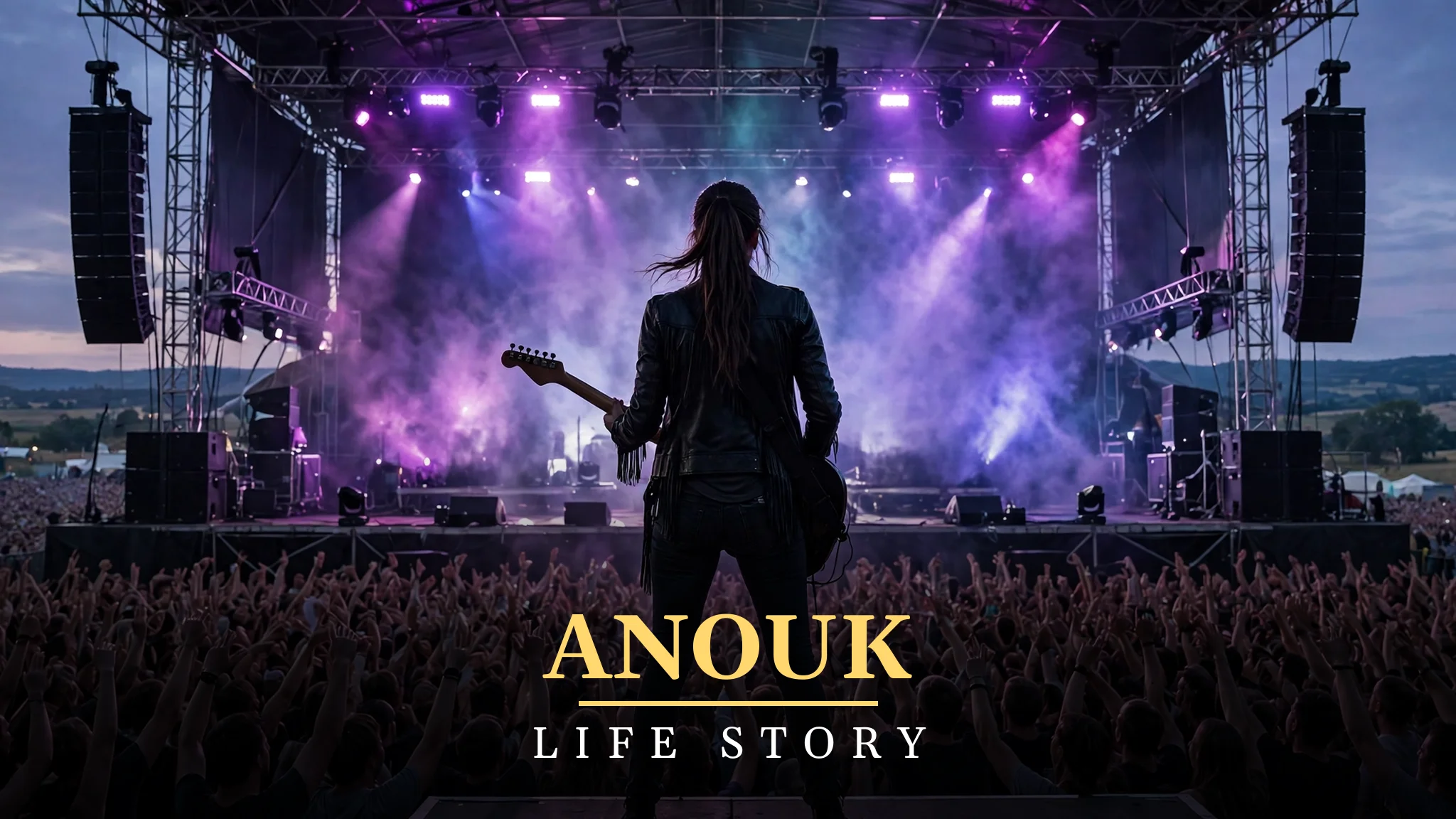
I also think about the festival stage in her image, and about what it says about her career. A festival stage is a big, open place, with thousands of people, with lights and smoke, and with a singer who must fill that space with her voice alone. Anouk has done that many times, and she has done it with a confidence that comes from years of performing. She stands on a large stage, she holds a guitar, and she sings, and the crowd sings along. That is a powerful image, and it is one that captures the essence of her career: a single voice, strong enough to reach thousands of people, and honest enough to make them feel that she is singing directly to them.
Another thing I admire is her attitude towards the music industry. She has often spoken about how the industry tries to control artists, to tell them what to wear, what to sing, and how to behave, and she has refused to accept that control. She has fought for her independence, and she has paid a price for it at times, but she has kept her freedom. That is a brave stance, because many artists give in to pressure in order to be successful. Anouk did not give in, and she built a successful career on her own terms. I think that is an inspiring example for any young artist who feels pressured to change who they are.
I also think about her role as a mother, and about how it has changed her music. A singer who becomes a parent sees the world differently, and that change often appears in their songs. Anouk has spoken about her children, and about how they have made her think about what kind of world they will grow up in, and what kind of music she wants to leave for them. That is a beautiful thought, and it shows a person who is thinking not just about her own career, but about the next generation. Her music will be part of what her children inherit, and that is a legacy worth building.
There is also a lesson here about the Netherlands and rock music, because Anouk helped to prove that Dutch rock could be successful on an international scale. Before her, Dutch pop was often seen as less important than British or American pop. After Nobody’s Wife, the world knew that a Dutch singer could make a rock song that was as powerful as any from London or New York. That is a lasting achievement, and it opened doors for other Dutch rock singers who came after her. She did not just build her own career. She helped to build Dutch rock.
I think about her future too, and about what she might sing next. She is in her fifties, and her voice is still strong. She could sing rock, she could sing ballads, she could write new songs about getting older, about family, and about the world as she sees it now. Those are rich subjects, and Anouk has the experience and the honesty to sing about them well. I hope that she will keep recording, because her voice is still needed, and because her fans are still listening.
Finally, I want to say something about the word Nobody’s Wife once more, because it is more than a song title. It is a statement about freedom, about a woman who belongs to herself, and about a person who refuses to be defined by someone else. That idea is as relevant today as it was in 1997, and it is one that many people, not just women, can understand. Anouk sang it when she was young, and she has lived it ever since. That consistency between her music and her life is rare, and it is why I admire her as much as I do.
I also think about the guitar in her image, and about what it represents. A guitar is an instrument that a singer can carry with her, that she can play on her own, and that she can use to write songs wherever she is. Anouk’s guitar is part of her identity as a rock singer, a sign that she is not just a voice, but a musician who understands her craft from the inside. She writes, she plays, and she performs, and that completeness is part of what makes her so respected by other musicians. She is not a singer who depends on others to make her music. She makes it herself.
Another thing I admire is her honesty about the difficulties of fame. She has spoken in interviews about how hard it can be to be in the public eye, about the pressure to look a certain way, and about the criticism that comes with being a well known woman in rock. She has not hidden those difficulties. She has talked about them openly, and that openness has helped other young women who face the same pressures. A star who is honest about the hard parts of fame is doing a service to her fans, because she is telling them the truth rather than pretending that everything is perfect.
There is also a thought about the Dutch rock scene, and about Anouk’s place in it. Dutch rock has produced many talented artists, but few have achieved the longevity and the impact that Anouk has. She has been at the top for more than twenty-five years, and she is still there, still recording, still performing, and still inspiring new generations of Dutch rock singers. That is a remarkable legacy, and it is one that will last long after her own career has ended, because the singers she inspired will carry her influence forward.
Frequently Asked Questions
Where was Anouk born and what is her full name?
Anouk was born Anouk Teeuwe on 8 April 1975 in The Hague, Netherlands, and she grew up singing in local bands before becoming a professional rock singer.
What was Anouk’s breakthrough song?
Her breakthrough was Nobody’s Wife from 1997, a rock anthem that became a huge hit in the Netherlands and in many other countries and made her a star.
Did Anouk represent the Netherlands at Eurovision?
Yes, she represented the Netherlands at Eurovision in 2013 in Malmö, Sweden, with the song Birds, finishing ninth and helping to restore Dutch confidence in the contest.
What albums is Anouk known for?
She is known for albums including Together Alone, Urban Solitude, Graduated Fool, and Hotel New York, with hits such as R U Kiddin’ Me, Girl, Lost, and Michel.
Was Anouk a coach on The Voice of Holland?
Yes, she worked as a coach on The Voice of Holland, helping young singers to develop their talent and encouraging them to be themselves rather than to copy others.
Is Anouk still performing today?
Yes, she continues to record and perform, releasing new albums and playing concerts, and she remains one of the most respected rock singers in the Netherlands.
What kind of music does Anouk sing?
She sings rock music with a powerful and raw voice, but she can also sing quiet ballads such as Birds, showing a range that goes from loud rock anthems to gentle and emotional songs.


