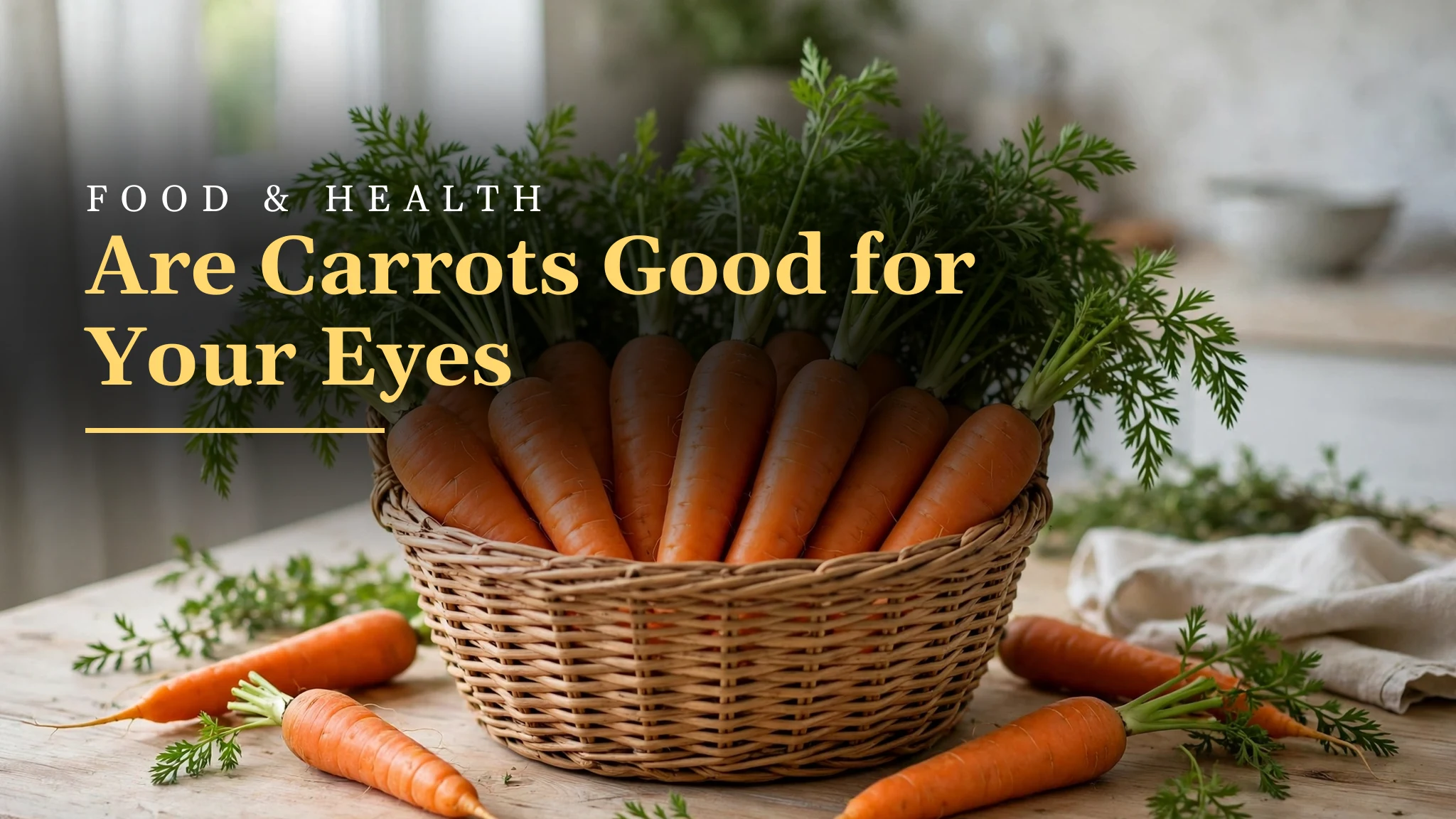
Are Carrots Good for Your Eyes
In this post
- How Vitamin A Works in Your Eyes
- What Carrots Contain, and What Your Body Does With It
- The Myth: Will Carrots Give You Perfect Eyesight
- Carrots and Other Parts of Eye Health
- How to Eat Carrots So Your Eyes Get the Benefit
- Carrots, Colour and the Rest of Your Plate
- Carrots in a Daily Diet, and When to Be Careful
- My Take:
Almost everyone has heard that carrots are good for your eyes. Parents tell children to eat carrots so they can see better, and the saying has been repeated for so long that many people accept it without ever asking why. The short answer is that the saying is based on a real fact, but it is often exaggerated. Carrots are good for your eyes because they are rich in beta-carotene, a plant pigment your body turns into vitamin A, and vitamin A is a nutrient your eyes need to work normally. That is true and important. What is not true is that eating a lot of carrots will give you perfect eyesight, cure a vision problem, or let you see in the dark like an animal. This article explains the real link in plain words, so you can see what carrots can do, what they cannot do, and how to use them sensibly as part of a diet that supports your eyes.
To understand the link, it helps to know what vitamin A does in the eye. Inside the back of your eye is a layer called the retina, and the retina contains cells that respond to light. One of the key substances those cells use is made from vitamin A. When light hits your eye, that substance changes shape, and that change sends a signal to your brain, which your brain reads as vision. Without enough vitamin A, that process does not work properly, and the first sign is often trouble seeing in dim light. In a severe, long shortage of vitamin A, the surface of the eye can also become dry and damaged. That is why vitamin A is called an essential nutrient for vision. Your body cannot make it from nothing. It must come from food, and carrots are one of the easiest and cheapest sources.
Beta-carotene is the form of vitamin A that comes from plants. Carrots get their orange colour from beta-carotene, and your body turns it into vitamin A as needed. That is a useful safety feature: your body converts only as much as it needs, so eating carrots does not give you a dangerous overdose of vitamin A the way taking large amounts of vitamin A pills can. A medium carrot gives you more than enough beta-carotene to cover a large share of your daily vitamin A need, along with fibre, water, vitamin K, vitamin B6 and potassium, for only about twenty-five calories. That is a good return for a small, cheap vegetable, and it is the reason carrots earned their reputation.
How Vitamin A Works in Your Eyes
The retina, the light-sensitive layer at the back of the eye, is where vitamin A does its most important work. Two kinds of cells in the retina, called rods and cones, handle different parts of vision. Rods help you see in low light, and cones help you see colour and fine detail in bright light. Both kinds of cells need a substance called rhodopsin and its related pigments, and those pigments are built from vitamin A. When you walk from bright sunlight into a dim room, your eyes need time to adjust, and that adjustment depends on your retina rebuilding those pigments. If you are low in vitamin A, that adjustment is slower, and you may find it harder to see in dim light or at dusk.
This is why night blindness is the classic early sign of vitamin A shortage. It does not mean you are blind at night. It means your eyes take longer than normal to adjust when the light drops, and you may struggle to see clearly in a dark room or on a poorly lit road. In most countries where food is plentiful, a severe shortage is uncommon, because vitamin A comes from many foods: carrots, sweet potatoes, leafy greens, eggs, milk and liver all supply it in different forms. But a diet with almost no vegetables and very little variety over a long time can still leave a person low, and children are more at risk than adults, because they are growing quickly and need a steady supply. Eating carrots regularly is a simple way to keep that supply steady.
It is also worth knowing that vitamin A does more than help you see in dim light. It helps keep the surface of the eye, the cornea and the clear layer that covers the front of the eye, healthy and moist. Your eyes need a smooth, wet surface to focus light properly, and vitamin A supports the cells that keep that surface in good condition. When that surface becomes dry and rough, vision becomes uncomfortable and less clear. Again, this does not mean a carrot will fix a dry eye caused by staring at a screen for hours, or by a medical condition. It means that a body with enough vitamin A has one less reason for the surface of the eye to suffer.
What Carrots Contain, and What Your Body Does With It
A carrot is mostly water and carbohydrate, with a useful amount of fibre. One medium carrot, about sixty grams, gives you roughly twenty-five calories, about two grams of fibre, and a large amount of beta-carotene. It also gives you vitamin K, which helps blood clot normally, vitamin B6, which helps your body turn food into energy, and potassium, which supports normal blood pressure. The fibre in carrots slows digestion a little, so the natural sugars in the carrot enter your blood gently, and it helps you feel full after a snack. That is why a raw carrot is a better snack than a packet of crisps: it takes time to chew, it gives you nutrients, and it does not leave you hungry again within minutes.
Your body does not use beta-carotene directly. It must first turn it into vitamin A, and that conversion is not perfect. Only part of the beta-carotene in a carrot becomes vitamin A, and the amount varies from person to person. Eating carrots with a little fat helps, because vitamin A is fat-soluble, which means your body absorbs it better when fat is present. A carrot eaten with a meal that contains a little oil, butter, yoghurt or nuts will give you more usable vitamin A than a carrot eaten completely on its own. Cooking carrots also helps in one way and hurts in another. Light cooking breaks down the tough plant walls in the carrot, so your body can reach more of the beta-carotene, but long boiling can reduce some of the vitamin C. A good middle way is to steam carrots briefly, or to cook them in a dish with a little oil, rather than boiling them for a long time in a lot of water.
It is also honest to say that carrots are not the only food that gives you vitamin A. Sweet potatoes give you even more beta-carotene than carrots, and leafy greens such as spinach and kale give you a large amount too, though their green colour hides the orange pigment. Eggs and milk give you vitamin A in its ready-made form, which your body can use directly. That variety matters, because no single food should carry the whole job. A diet that includes carrots, leafy greens and other colourful vegetables gives your eyes a steadier supply than a diet that relies on carrots alone.
The Myth: Will Carrots Give You Perfect Eyesight
The most common exaggeration about carrots is that eating them will improve your eyesight, sharpen your vision, or cure the need for glasses. That is not how it works. Your eyesight depends on the shape of your eyeball, the health of your retina, the clarity of the lens inside your eye, and the way your brain processes what your eyes send it. Vitamin A keeps the retina working normally, but it cannot change the shape of your eyeball. If you are short-sighted, your eyeball is slightly too long, so light focuses in front of the retina instead of on it. No amount of carrots will shorten it. If you are long-sighted, the opposite is true. Glasses, contact lenses or surgery correct the focus. Food cannot.
The story that carrots help you see in the dark comes from the Second World War, when British propaganda claimed that their pilots could see enemy planes at night because they ate a lot of carrots. The real reason was a secret radar system, and the carrot story was invented to hide it. The story stuck, because it was based on a half-truth: vitamin A does help with low-light vision, so the claim sounded plausible. But the gap between helping your eyes work normally in dim light and giving you superhuman night vision is very large, and carrots do not cross it. Eating carrots will keep your low-light vision normal if you were low in vitamin A. It will not make it better than normal.
That distinction matters, because it protects you from disappointment and from wasting money. If your vision is getting worse, if you struggle to read, if straight lines look wavy, or if you have sudden changes in vision, the right step is to see an eye doctor, not to eat more carrots. Carrots are a food, not a treatment. They support normal eye health as part of a varied diet, and that is a real and useful role, but it is not a cure, and anyone who tells you otherwise is selling you something.
Carrots and Other Parts of Eye Health
Vitamin A is the main link between carrots and eyes, but carrots also contain two other pigments, lutein and zeaxanthin, in smaller amounts. These pigments collect in the retina, especially in the central part called the macula, which you use for sharp, detailed vision, such as reading. They act like a natural filter, absorbing some of the blue light that reaches the eye and protecting the retina from damage over time. Leafy greens are richer in lutein and zeaxanthin than carrots, but carrots still contribute a useful amount, especially when eaten as part of a diet with greens, eggs and other colourful foods.
Age is a real factor in eye health. As people get older, the lens inside the eye can become cloudy, which is called a cataract, and the macula can wear down, which is called age-related macular degeneration. A diet rich in vegetables, including carrots and leafy greens, is linked with a lower risk of these problems over a lifetime, but the link is about the whole diet, not about one food. People who eat plenty of vegetables also tend to smoke less, move more, and eat less processed food, and all of those things affect eye health too. The honest way to put it is that carrots are one piece of a larger pattern that supports your eyes as you age, not a shield on their own.
Screen time is another modern worry, and it is worth separating fact from fear. Staring at a phone or computer for hours can make your eyes feel dry, tired and sore, because you blink less often when you look at a screen, and your eyes stay focused at one distance for too long. Carrots will not fix that. The useful steps are simple: blink more often, look away from the screen every twenty minutes and focus on something far away, keep the screen at a comfortable distance, and make sure the room is not too dark compared with the screen. Eating carrots helps your eyes have the nutrients they need, but it does not replace rest, blinking and good screen habits.
How to Eat Carrots So Your Eyes Get the Benefit
The best way to eat carrots is the way you will actually keep doing, and for most people that means a mix of raw and cooked. Raw carrots are a perfect snack. They are cheap, they need no cooking, they travel well in a bag, and they take time to chew, which helps you feel full. A child can eat a raw carrot on the way to school, a worker can eat one during a break, and an older person can eat one without any preparation. The drawback is that raw carrots are harder to digest in large amounts, and your body absorbs less beta-carotene from them than from cooked carrots, because the tough plant walls are still intact.
Cooked carrots are easier to digest, and your body absorbs more beta-carotene from them, especially if you cook them with a little oil. Stirring sliced carrots into a curry, soup or rice dish for the last ten minutes, or steaming them briefly and adding a little butter or oil, is a good way to get more from them. The drawback is that long boiling in a lot of water can lose some nutrients into the water, so it is better to steam, roast or cook carrots in the dish itself rather than boiling them separately and throwing the water away.
Juice is the least useful way to eat carrots for eye health, even though it sounds healthy. Carrot juice gives you a large amount of beta-carotene quickly, but it removes the fibre, and it is easy to drink the sugar from many carrots in a few minutes without feeling full. Eating whole carrots, raw or cooked, gives you the fibre, the chewing, and the feeling of fullness that juice does not. If you enjoy carrot juice, drink a small glass with a meal, but do not let it replace eating real vegetables. The whole carrot is the better food.
Carrots, Colour and the Rest of Your Plate
Colour is a useful guide when you are choosing vegetables, and carrots show why. The orange colour is beta-carotene itself, and the deeper the orange, the more of that pigment the carrot usually holds. Purple carrots get their colour from a different pigment, and yellow carrots hold less beta-carotene than orange ones, though they still give you fibre and other nutrients. That does not mean you should only buy the darkest orange carrot you can find. It means that a plate with several colours on it, orange carrots, dark green leaves, red tomatoes, and yellow or white vegetables, is likely to give you a wider range of nutrients than a plate of one colour alone. Each colour is a clue to a different nutrient, and eating across the colours is one of the simplest rules in healthy eating.
The rest of your plate matters for your eyes too, because vitamin A is only one of the nutrients your eyes use. Your eyes also need vitamin C, which helps keep the small blood vessels in the eye healthy, and vitamin E, which helps protect cells from damage over time. They need zinc, a mineral your body uses to move vitamin A from the liver to the retina, where it is needed. They need omega-3 fats, which are found in fish, nuts and seeds, and which support the normal working of the retina. A diet that gives you all of those things is a diet that supports your eyes far better than carrots alone ever could. That is why the best advice is not to eat more carrots and ignore everything else. It is to eat carrots as one part of a colourful, varied plate.
Water and sleep matter for your eyes as well, and they are easy to forget when the conversation is only about food. Your eyes need moisture to stay comfortable, and drinking enough water through the day helps your whole body stay hydrated, including the tissues around your eyes. Sleep gives your eyes a rest from focusing, and it gives your body time to repair the small wear of the day. A person who eats carrots every day but sleeps very little and drinks almost no water may still have tired, dry eyes, and that is not because the carrots failed. It is because eyes need rest and water as well as nutrients, and no food can replace either one. The honest picture is always wider than one vegetable.
Buying and storing carrots well is a small skill worth learning. Choose carrots that are firm, smooth and bright orange, with no soft spots, cracks or green tops that look wilted. A carrot that bends easily or feels soft has lost water and will taste less sweet. Keep carrots in a cool place, in the fridge if you have one, and they will stay fresh for a week or two. If the green tops are still attached, cut them off before storing, because the tops draw water out of the root. Wash carrots before eating, and peel them if the skin is rough or dirty, though the skin itself is fine to eat when it is clean. Baby carrots, the small ones sold in bags, are simply young carrots or carrots cut into small pieces. They are convenient, but they cost more per kilogram than full-size carrots, and they are no more nutritious.
Carrots in a Daily Diet, and When to Be Careful
For most people, one or two medium carrots a day is a sensible amount. That gives you a good share of your daily vitamin A need, plus fibre and other nutrients, without crowding out other foods. Children can eat carrots daily too, and they are one of the best first vegetables for young children, because they are sweet, soft when cooked, and easy to hold. Older people also do well with carrots, because they are soft when cooked, easy to chew, and a reliable source of vitamin A at an age when appetite is often smaller. The same rule applies as with any food: a carrot is part of a varied diet, not a replacement for it.
There is one harmless but surprising effect of eating a very large amount of carrots every day for weeks: your skin, especially on the palms and the soles of the feet, can turn slightly orange-yellow. This is called carotenemia, and it happens because your body stores the extra beta-carotene in the skin. It is not dangerous, and it goes away when you eat fewer carrots, but it is a sign that you are eating far more than you need. It is not a sign that your eyes are getting extra benefit. Once your vitamin A need is met, extra beta-carotene does not improve your vision further. Your body simply stores the extra pigment, and your skin shows it.
A more serious caution applies to vitamin A supplements, not to carrots. Taking large doses of vitamin A in pill form can be harmful, especially for pregnant women, because too much ready-made vitamin A can damage an unborn baby. Carrots do not carry that risk, because your body only turns beta-carotene into vitamin A as needed. But it is still wise not to take high-dose vitamin A supplements without medical advice, and to get your vitamin A from food instead. If you are pregnant, or planning to be, eating carrots and other vegetables is a safe way to meet your need, while high-dose supplements are not a decision to make on your own.
My Take:
If you ask me what I think about carrots and eyes, my answer is that the old saying is half right, and the half that is right is worth knowing. Carrots are good for your eyes because they give you beta-carotene, which your body turns into vitamin A, and vitamin A is a nutrient your eyes genuinely need. I think that is a good, honest reason to eat carrots regularly. But I also think we should be clear about the half that is wrong: carrots will not give you perfect eyesight, they will not cure the need for glasses, and they will not let you see in the dark. When we repeat the saying without that limit, we turn a useful food into a false promise, and false promises help nobody.
I think the reason the carrot story has lasted so long is that it is simple, and simple stories are easy to remember. Eat carrots, see better. It fits on a poster, and it is easy to tell a child. But the real story is a little longer, and I think it is worth telling properly. Your eyes need vitamin A to rebuild the pigments that respond to light. Carrots give you the raw material for that vitamin. Leafy greens, sweet potatoes, eggs and milk give it to you too. A diet with those foods in it keeps your eyes supplied. A diet without them, over a long time, can leave you short. That is the whole truth, and it is enough. It does not need a wartime myth to make it interesting.
I also think we should be honest about what good eyesight really depends on. It depends on the shape of your eye, the health of your retina, the clarity of your lens, and the way your brain reads the signals your eyes send. Food supports the retina, but it cannot reshape the eyeball. That is why a person who eats carrots every day can still need glasses, and why a person who never eats carrots can still have sharp vision if the rest of their diet is varied. I say this not to dismiss carrots, but to put them in their proper place. They are a supporting food for your eyes, not a treatment for a vision problem, and knowing that difference will save you from disappointment.
There is another reason I like carrots, and it is about how easy they are. A carrot needs no cooking, no special storage, and no money to speak of. You can carry one in a bag, eat it raw during a break, or cook it into the meal you are already making. That ease matters, because the foods that help us most are the ones we actually eat. Many healthy foods fail in real life because they need time, money or skill to prepare. A carrot needs none of those, which is why it works for a labourer, a student, a mother and an older person alike. I would rather recommend a food people will eat every day than a perfect food they will eat once and forget.
I also want to say something about children, because I think carrots are one of the best vegetables to give a child every day. Children need vitamin A for growth and for normal vision, and they need food that is sweet, easy to hold and easy to eat. A raw carrot is fun to chew, a cooked carrot is soft and sweet, and both give a child nutrients without any fuss. If a child grows up eating carrots and other vegetables as a normal part of meals, that habit will stay with them, and it will protect their eyes and their general health far more than any single piece of advice I could give. Do not make a big speech about it. Just put carrots on the plate, eat them yourself, and let the habit form quietly.
The question of raw or cooked is one I hear often, and my view is simple: eat both, and do not worry about which is perfect. Raw carrots are a better snack, cooked carrots give you more usable beta-carotene, and both are good. The perfect method is the one you will use tomorrow and next week. If you like raw carrots, keep a few in the fridge and eat one when you are hungry. If you prefer them cooked, stir them into your evening meal. If you enjoy juice, drink a small glass with food, but do not let it replace the whole vegetable. Health is not built on one perfect choice. It is built on many ordinary choices, repeated without fuss, and carrots fit that pattern well.
I think the most important thing I can say about carrots is this: eat them for the right reason. Eat them because they are cheap, tasty, easy, and a reliable source of vitamin A and fibre, not because you expect them to fix your eyesight. When people expect a miracle from a food and do not get one, they stop trusting good advice altogether. I would rather give you an honest answer: carrots support normal eye health as part of a varied diet, and that is enough. It is a real benefit, and it is worth having, without pretending it is something more.
I also think it is worth stepping back and asking why a simple question like this gets asked so often. I believe it is because food advice has become confusing, and people no longer know whom to trust. One week a food is praised, the next week it is blamed. Carrots have been through this themselves: they have been called a perfect eye food and a sugary vegetable to avoid, sometimes in the same year. No wonder people are unsure. My answer to that confusion is to look at the whole picture instead of one number. A carrot has natural sugar, yes, but it also has fibre, water, beta-carotene and other nutrients, and it comes in a natural package that your body knows how to handle. If you compare whole foods with whole foods, the answer is usually clear, and a carrot compares well with almost anything you could eat as a snack.
So here is my final view, in plain words. Eat one or two carrots a day if you like them, raw as a snack or cooked in your meal, with a little oil or fat so your body can use the beta-carotene properly. Eat leafy greens and other colourful vegetables too, because they give your eyes lutein and other nutrients that carrots alone do not supply in large amounts. Do not expect carrots to cure a vision problem or replace glasses, and if your vision changes suddenly, see an eye doctor. And do not feel guilty if you miss a day. A missed day changes nothing. What matters is the pattern over weeks and months, and a pattern that includes carrots is a better pattern than one that does not.
If a friend asked me whether they should start eating carrots every day, I would say yes, and I would tell them to keep it simple. Buy a bag of carrots once a week, keep them in the fridge, and eat one when you feel hungry between meals. Do not buy a powder, do not download an app, and do not follow a complicated plan. The carrot is the plan. If you get bored of eating it plain, cook it into soup, roast it with a little oil, or eat it with yoghurt or nuts. If you have children, put a carrot in their school bag instead of a packet of crisps, and do not make a big speech about it. Children copy what they see, and if they see you eating a carrot every day, they will think it is normal, which is exactly what you want.
I want to add one more thought about colour, because I think it is the easiest rule a person can remember. When your plate has several colours on it, orange carrots, green leaves, red tomatoes, and something yellow or white, you are probably eating a wider range of nutrients than when your plate is all one colour. I like that rule because it needs no chart and no counting. You can see it with your own eyes, in the market and on the plate. A carrot is the orange part of that picture, and it does its job well, but it is not the whole picture. The green leaves bring lutein, the tomatoes bring vitamin C, the eggs bring zinc, and the fish or nuts bring healthy fats. Together, they support your eyes far better than any one of them could alone, and together they make a meal that is more interesting to eat.
I also think about the people who cook for a whole family, because they are the ones who decide what ends up on the plate. If you cook for your family, you do not need to make a separate carrot dish that nobody wants. You need to put carrots into the food everyone already eats. Add them to soup, to rice, to lentils, or to the evening vegetables, and cook them with a little oil so your body can use the beta-carotene properly. When carrots are part of the shared meal, nobody has to be convinced, nobody has to be forced, and nobody feels singled out. The family simply eats a meal that happens to contain carrots, and over time that becomes normal. That is how food habits really change: not through lectures, but through the quiet repetition of a normal meal.
There is a point about tired eyes that I think is worth naming honestly, because so many people now spend their whole day looking at a screen. A carrot will not rest your eyes. Only rest will do that. If your eyes feel dry, sore or tired after hours on a phone or a computer, the useful step is to look away, blink, and focus on something far away for a minute or two. Do that every twenty minutes, and your eyes will feel better by the end of the day. Eat your carrot as well, because your eyes still need vitamin A, but do not expect the carrot to do the job of rest. I say this plainly because I have seen people buy expensive eye vitamins and special foods while ignoring the simple habit of looking away from the screen, and the simple habit is the one that helps most.
I also want to be clear about what I would not do. I would not buy expensive eye supplements, special carrot powders, or high-dose vitamin A pills and call that looking after my eyes. Those products are costly, and high-dose vitamin A in pill form can be harmful, especially for pregnant women. A fresh carrot, eaten with a meal, gives you beta-carotene in a form your body controls, along with fibre, water and other nutrients, for a fraction of the price. I understand why supplements appeal to busy people, because they promise the benefit without the cooking, but the cooking is only a few minutes, and the real food is better. Save your money, buy the carrot, and eat it. That is my honest advice, and I would give it to my own family.
One last thought, and it is about patience. The benefits of carrots do not arrive in a day. You will not eat a carrot on Monday and see better on Tuesday. The benefit is the steady supply of vitamin A over weeks and months, keeping your retina supplied with the material it needs to work normally. That slowness is not a weakness. It is how food works. The same is true of most good habits: they feel small on any one day, and they add up over months into something real. So do not judge carrots by one meal. Judge them by three months of eating them most days, as part of a varied, colourful diet, with enough sleep, enough water, and sensible rest from screens. If your eyes feel comfortable, if you can see clearly in dim light, and if your meals have colour and variety, the carrots are doing their job, quietly, in the background, exactly as they should.
I also think it is worth remembering that carrots connect us to the way people have always eaten. Long before there were vitamin charts and health articles, families ate carrots because they grew nearby, because they were cheap, because they kept well through the winter, and because a meal felt incomplete without a root vegetable on the plate. That old habit was not based on science, but science has since confirmed what those families knew from experience: a diet with orange vegetables in it gives your eyes one of the nutrients they need. I find that reassuring. It means you do not need a new diet or a new idea to look after your eyes. You need to keep an old, simple habit that has served families for generations, and to pass it on to your own children in the same quiet way it was passed to you.
Frequently Asked Questions
What does “Are Carrots Good for Your Eyes” really mean?
It means asking whether eating carrots actually helps your eyes, and if so, how. The answer is yes, in a specific way: carrots are rich in beta-carotene, which your body turns into vitamin A, and vitamin A is needed by the retina to respond to light, especially in dim conditions. Carrots support normal eye health as part of a varied diet, but they do not cure vision problems, change the shape of your eye, or remove the need for glasses.
Why do so many people search for “Are Carrots Good for Your Eyes”?
People search for it because the saying that carrots improve eyesight is so widely repeated, and many people want to know whether it is true. Parents want to know if carrots help their children see better, older people wonder if carrots can protect their eyes as they age, and people who spend long hours on screens wonder if a food can help tired eyes. It is also a food almost everyone knows, so the question feels personal and practical.
How long does the feeling behind “Are Carrots Good for Your Eyes” usually last?
Carrots do not give an instant feeling in your eyes the way a drop of water might soothe dryness, so there is no fixed length to describe. The benefit is not something you feel hour by hour. It is the steady supply of vitamin A over weeks and months that keeps the retina working normally. If you were low in vitamin A, eating carrots regularly over time helps restore normal low-light vision, but a single carrot does not change how your eyes feel that day.
What makes “Are Carrots Good for Your Eyes” feel stronger on some days?
The benefit feels clearer when the rest of your eye care is also in place. Eating carrots with a meal that contains a little oil helps your body absorb more beta-carotene, and eating a varied diet with leafy greens gives your eyes lutein as well as vitamin A. On days when you rest your eyes, blink often and look away from screens, your eyes feel more comfortable, which can make the whole picture feel better. On a tired day after long screen time, the same carrots will not feel like they have done anything, because screen tiredness needs rest, not food.
Can daily habits change anything about “Are Carrots Good for Your Eyes”?
Yes, small habits make a real difference. Eating one or two carrots a day, raw as a snack or cooked with a little oil, keeps your vitamin A supply steady. Eating leafy greens and other colourful vegetables alongside carrots gives your eyes a wider range of nutrients. Resting your eyes from screens, blinking often, and looking at something far away every twenty minutes also helps, because those habits reduce eye strain in a way food alone cannot.
When should I pay closer attention to “Are Carrots Good for Your Eyes”?
Pay closer attention if your vision changes suddenly, if straight lines look wavy, if you struggle to see in dim light for a long time, or if you notice a sudden loss of vision in one eye. Those are signs to see an eye doctor promptly, not signs to eat more carrots. Also be careful with high-dose vitamin A supplements, especially if you are pregnant, and get your vitamin A from food instead unless a doctor advises otherwise. This is general information only, not personal advice.