Ava DuVernay: The Life Story Behind the Trailblazing Director
In this post
- A Girl from Long Beach Who Loved Black History
- Hip-Hop, Publicity, and Learning How Stories Are Sold
- I Will Follow, Middle of Nowhere, and the First Features
- Selma and the Bridge That Changed America
- 13th, When They See Us, and the Documentaries That Accused
- A Wrinkle in Time, Origin, and Building ARRAY
- What Ava DuVernay Changed for Filmmakers
- Queen Sugar, Television, and Telling Stories Week After Week
- Colin in Black and White and the Stories She Keeps Telling
- Cherish the Day and the Work of Producing for Others
- My Take:
Ava DuVernay did not go to film school. She did not make short films as a teenager. She did not dream of being a director when she was a child. She worked in hip-hop, she ran a publicity company, and she was in her thirties before she picked up a camera. Then, in less than a decade, she made Selma, 13th, and When They See Us, three works that changed the way America talks about race, justice, and history. She became the first Black woman to direct a film nominated for Best Picture, and the first woman of colour to direct a live-action film with a budget of more than one hundred million dollars. She did it without the usual path, and that is what makes her story remarkable.
She grew up in California, in a family that loved Black history and Black culture, and she learned early that stories matter, and that who tells them matters too. She spent years helping other people tell their stories, as a publicist for musicians and filmmakers, and then she decided to tell her own. She made small films with small budgets, she learned by doing, and she built a career that was entirely her own, without waiting for Hollywood to invite her in.
Her story is about a late start, and about the power of starting late. It is about a woman who did not follow the rules, who did not go to the right school or know the right people, and who made films anyway, because she had something to say. It is also about the responsibility of telling stories that matter, about the past, about the present, and about the people who have been left out of the official story. This is the story of Ava DuVernay, a director who started late and changed film.
A Girl from Long Beach Who Loved Black History
Ava Marie DuVernay was born on 24 August 1972 in Long Beach, California, and she grew up in the nearby town of Lynwood, in a family that was close, loving, and proud of its Black heritage. Her mother, Darlene, worked as a teacher, and her stepfather, Murray Maye, worked in the aerospace industry. Ava was raised by her mother and her stepfather, whom she regards as her father, and she grew up in a home where education, faith, and Black culture were valued. She was a bright girl, and she loved to read, to write, and to learn about history.
As a child, Ava spent summers with her stepfather’s family in Alabama, in the town of Selma, where her stepfather had grown up. Selma was a place of great importance in American history, because it was there, in 1965, that civil rights marchers had crossed the Edmund Pettus Bridge, and had been beaten by police, in an event known as Bloody Sunday. Ava visited Selma as a girl, she walked across the bridge, and she heard stories about the march, about Martin Luther King Jr., and about the struggle for voting rights. Those summers stayed with her, and they would shape her work decades later, when she made a film about Selma.
She went to school in California, and she was a good student, but she was not a student who dreamed of making films. She went to the University of California, Los Angeles, known as UCLA, where she studied English and African-American studies, and she graduated in 1990. At UCLA, she learned about Black literature, Black history, and the power of storytelling, and she began to think about the stories that were not being told, and about the people whose voices were not being heard. She did not know, then, that she would one day tell those stories herself, with a camera.
Hip-Hop, Publicity, and Learning How Stories Are Sold
After university, Ava went to work in the music industry, in hip-hop, a world that was young, energetic, and full of stories. She worked as a journalist, writing about hip-hop for magazines, and then she started her own publicity company, called The DuVernay Agency, later renamed DV Vay Entertainment, which represented musicians and filmmakers. She worked with hip-hop artists, she organised press campaigns, and she learned how the entertainment industry worked from the inside: how a story is sold, how an audience is reached, and how a public image is built.
The work was not glamorous. It was long hours, phone calls, and press releases, and it taught Ava something important: that a story is only as good as the people who hear it, and that reaching an audience is a skill in itself. She worked with directors, she watched them on set, and she began to think that she could do what they were doing. She was in her early thirties, and she had never directed a film, but she had spent years watching films being made, and she had spent years thinking about stories. She decided to try.
Her first step was to make short films, small projects that she could finance herself, and that she could learn from. She made a short film called Saturday Night Life, and then she made a documentary about hip-hop, called This Is the Life, in 2008, about the Good Life Cafe, a health food store in Los Angeles where rappers and poets performed in the 1990s. The documentary was a labour of love, and it showed that Ava could tell a story about a community, about a place, and about a culture, with care and with respect. It was a small film, but it was a beginning.
I Will Follow, Middle of Nowhere, and the First Features
In 2010, Ava made her first feature film, I Will Follow, a drama about a woman named Maye, played by Salli Richardson, who spends a day packing up her aunt’s home after her aunt has died of cancer, and who thinks about her life, her loves, and her grief. The film was shot in fifteen days, with a budget of fifty thousand dollars, which Ava raised herself, and it was a quiet, intimate film, about a Black woman’s inner life, a subject that Hollywood rarely showed. The film was praised for its honesty, its performances, and its direction, and it showed that Ava could make a feature film, on a small budget, with a small crew, and tell a story that mattered.
In 2012, she made her second feature, Middle of Nowhere, a film about a woman named Ruby, played by Emayatzy Corinealdi, whose husband is sent to prison, and who has to rebuild her life while he is away. The film was about the impact of mass incarceration on Black families, a subject that Ava would return to in her later work, and it was praised for its performances and its direction. Ava won the award for Best Director at the Sundance Film Festival, becoming the first Black woman to win that award. It was a major achievement, and it put her on the map as a director to watch.
Middle of Nowhere was important for another reason: it showed that Ava was interested in stories about ordinary Black people, about women, about families, and about the systems that shape their lives. She was not making films about heroes or about historical figures. She was making films about people like her, about women who had to make hard choices, and about the strength it takes to keep going. That focus on ordinary people, and on the systems that affect them, would become the centre of her work.
Selma and the Bridge That Changed America
In 2014, Ava DuVernay made the film that would make her famous: Selma, a historical drama about the civil rights marches in Selma, Alabama, in 1965, and about Martin Luther King Jr., played by David Oyelowo, and his struggle to secure voting rights for Black Americans. The film focused on a specific moment in history, the three months from the death of a young protester named Jimmie Lee Jackson to the march from Selma to Montgomery, and it showed King not as a saint, but as a man, with doubts, fears, and disagreements with his colleagues. The film was a critical success, and it was nominated for the Academy Award for Best Picture, making Ava the first Black woman to direct a film nominated for that award.
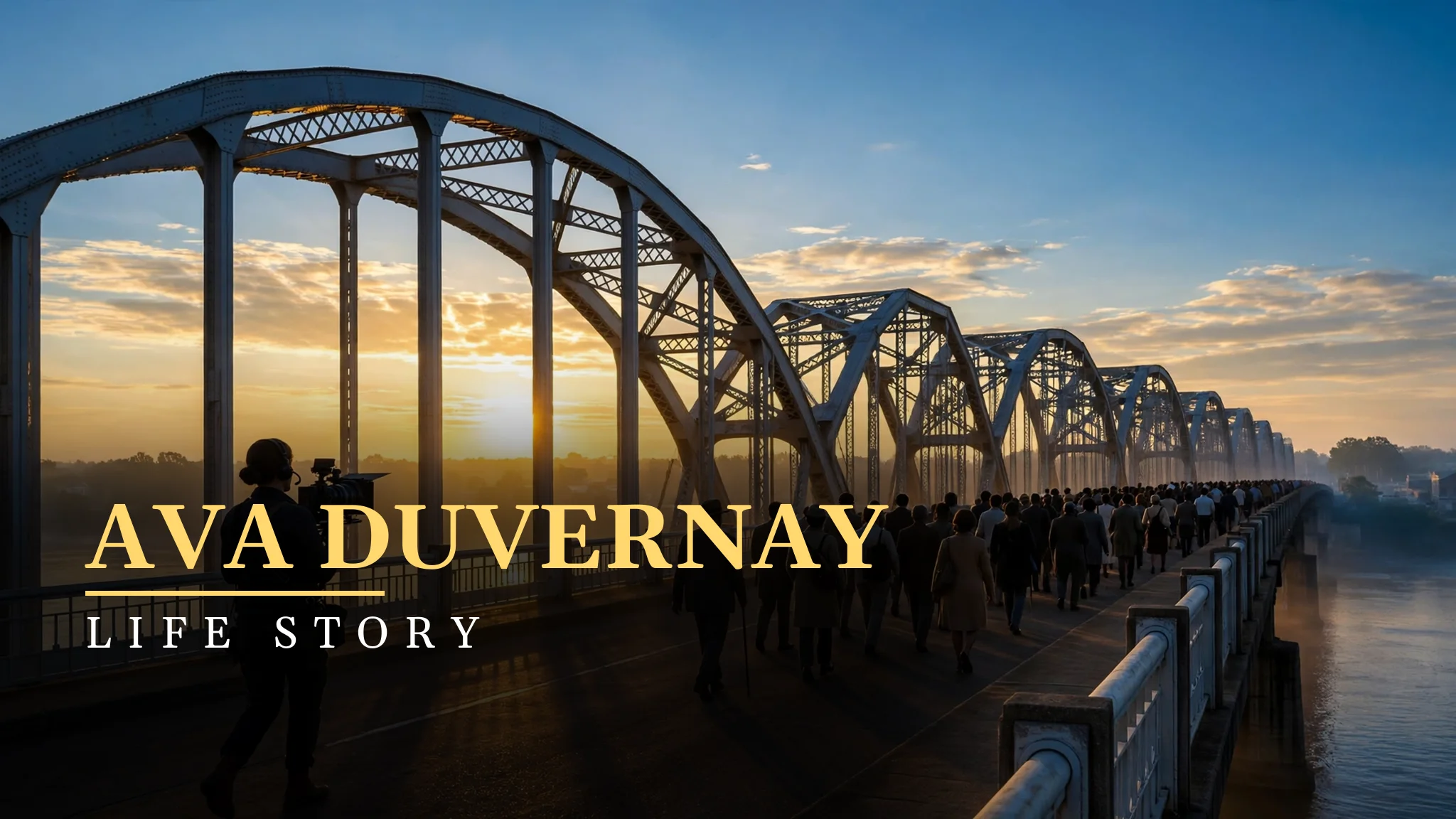
Selma was a difficult film to make. Ava was not the first choice to direct it, and she rewrote the script, focusing on the people of Selma, not just on King, and on the women who were part of the movement. She shot the film in Georgia and Alabama, and she recreated the march across the Edmund Pettus Bridge, the bridge she had walked across as a girl during her summers in Alabama. The film’s most powerful scene is the march itself, with hundreds of people walking across the bridge, and being met by police. Ava directed the scene with care, and with a sense of history, because she knew that bridge, and she knew what it meant.
Selma was not just a film. It was a statement about the importance of telling Black history, and about the need for Black directors to tell it. The film was released in the same year that protests were happening in Ferguson, Missouri, after the killing of Michael Brown, and its story about voting rights, police violence, and protest felt urgent and relevant. Ava had made a film about 1965 that spoke to 2014, and that is a rare achievement. The film’s song, “Glory,” by John Legend and Common, won the Academy Award for Best Original Song, and the film itself is now regarded as one of the great American films about civil rights.
13th, When They See Us, and the Documentaries That Accused
After Selma, Ava turned to documentary filmmaking, and she made a film that would change the conversation about race and justice in America. The film was called 13th, released in 2016 on a streaming service, and it was about the Thirteenth Amendment to the American Constitution, which abolished slavery, except as a punishment for a crime. The film argued that the exception had been used to create a system of mass incarceration, in which Black Americans were imprisoned at far higher rates than white Americans, and in which prisons had become a new form of slavery. The film used interviews, archival footage, and statistics to make its case, and it was powerful, clear, and damning. 13th was nominated for the Academy Award for Best Documentary Feature, and it won an Emmy Award.
In 2019, Ava made When They See Us, a limited series for a streaming service, about the Central Park Five, five Black and Latino teenagers who were wrongly convicted of raping a woman in Central Park in New York in 1989, and who spent years in prison before being exonerated in 2002. The series told their story in four parts, showing their arrest, their trial, their time in prison, and their release, and it was praised for its performances, its direction, and its honesty. The series won awards, and it led to a public reckoning, with the prosecutor in the case resigning from boards, and with the city of New York being forced to confront what had happened. When They See Us was not just a drama. It was an act of justice, a way of telling a story that had been told wrongly for thirty years, and of giving the five men a chance to be heard.
A Wrinkle in Time, Origin, and Building ARRAY
In 2018, Ava directed A Wrinkle in Time, a fantasy film based on the children’s book by Madeleine L’Engle, about a girl named Meg who travels through space and time to find her father. The film starred Storm Reid, Oprah Winfrey, Reese Witherspoon, and Mindy Kaling, and it had a budget of more than one hundred million dollars, making Ava the first woman of colour to direct a live-action film with a budget that large. The film was not a commercial success, and it received mixed reviews, but it was important because it showed that a Black woman could be trusted with a large, studio film, and that she could make a film for children that was about a Black girl as a hero. That representation mattered, even if the film itself did not fully succeed.
In 2023, Ava made Origin, a film based on the book Caste by Isabel Wilkerson, about the systems of hierarchy that divide people by race, caste, and class. The film was ambitious, difficult, and personal, and it was praised for its attempt to tell a complex story about history and society. Ava financed the film independently, raising money from foundations and from individuals, because studios would not pay for it. She made the film she wanted to make, in the way she wanted to make it, and she did not compromise. Origin was a reminder that Ava is not just a director for hire. She is a filmmaker with a vision, and she will find a way to make the films she believes in, even when the industry will not help her.
Ava also founded a company called ARRAY, a distribution company that helps films by people of colour, by women, and by independent filmmakers reach audiences. ARRAY buys films, releases them, and promotes them, giving a platform to filmmakers who might otherwise not be seen. It is a continuation of the work Ava began as a publicist: helping stories reach people. But now, instead of helping other people’s stories, she is helping other filmmakers tell their own, and she is building a system that does not depend on Hollywood’s permission. That is a significant achievement, and it is one that will last longer than any single film.
What Ava DuVernay Changed for Filmmakers
Ava DuVernay changed the way Hollywood thinks about who can direct a film. Before her, there was a belief that a director had to go to film school, had to make short films as a teenager, and had to follow a certain path. Ava showed that a director could come from publicity, from hip-hop, from a life outside film, and still make great films. She showed that a late start is not a disadvantage, and that the experience of a life lived outside the industry can be a strength, not a weakness.
She also changed the way films tell stories about race and justice. Selma, 13th, and When They See Us are not just films. They are records, arguments, and acts of memory, and they have changed the way Americans talk about their history. They have been shown in schools, they have been discussed in Congress, and they have been used by activists and by teachers. That is a rare achievement for a filmmaker, and it is one that Ava has earned by telling stories that are true, that are careful, and that are told with respect for the people in them.
Today, Ava DuVernay is regarded as one of the most important directors in America, and her influence is felt in film, in television, and in the wider culture. She has won awards, she has been honoured by the industry, and she has used her platform to help other filmmakers. She is still working, still making films, and still telling stories that matter. Her career is a reminder that it is never too late to start, and that a story, told well, can change the world.
Queen Sugar, Television, and Telling Stories Week After Week
Beyond her films, Ava DuVernay has done some of her most important work in television, where she has created and produced series that give Black stories a regular place on screen. Her most notable series is Queen Sugar, which she created for the Oprah Winfrey Network, based on a novel by Natalie Baszile, about three siblings in Louisiana who inherit their father’s sugarcane farm and have to learn to work together. The series ran for seven seasons, from 2016 to 2022, and it was notable for a policy Ava set: every episode was directed by a woman, and many of those women were first-time directors, including women of colour who had never directed television before. That policy gave opportunities to dozens of women, and it changed the way television thinks about who gets to direct.
Queen Sugar was also important because it told a story about a Black family, about land, about farming, and about the South, in a way that was patient, beautiful, and honest. It was not a show about crime or about poverty. It was a show about a family, about love, about work, and about the difficulty of holding on to land that has been in a family for generations. Ava produced the show, she directed some episodes, and she set its tone, and the show became a model for how television can tell Black stories without stereotypes, and with the time and care they deserve.
Colin in Black and White and the Stories She Keeps Telling
In 2021, Ava DuVernay co-created a series called Colin in Black and White, about the early life of the American football player Colin Kaepernick, who became famous for kneeling during the national anthem to protest police violence. The series, made with Kaepernick himself, told the story of his adolescence, his adoption by a white family, and his experiences of racism as a young athlete, and it was praised for its honesty, its performances, and its willingness to tell a story that was still unfolding. Ava has continued to work in television and film, producing series, directing episodes, and supporting other filmmakers through ARRAY. She is not a director who makes one film and stops. She is a storyteller who keeps working, who keeps finding new stories, and who keeps using her platform to give a voice to people who have not been heard.
Cherish the Day and the Work of Producing for Others
Ava DuVernay has also worked as a producer for other filmmakers, helping them to make the films they want to make, and one of her notable projects in television was Cherish the Day, a series she created for the Oprah Winfrey Network, about a couple in Los Angeles who fall in love, told one day at a time, with each episode covering a single day in their relationship. The series was gentle, romantic, and honest, and it showed a different side of Ava’s work: not a historical drama or a documentary about injustice, but a love story, told slowly, with care, and with a focus on Black love, Black life, and the small moments that make up a relationship. The series was praised for its beauty, its performances, and its patience, and it showed that Ava could tell a quiet, intimate story as well as a large, historical one.
She has also spoken about the importance of mentorship, and about the people who helped her when she was starting out, including the filmmakers and producers who gave her a chance when she had no credits, no film school degree, and no reason for anyone to trust her. She has said that she wants to be that person for others, and that ARRAY and her work as a producer are ways of doing it. That generosity, of using success to help others succeed, is one of the most admirable parts of her career, and it is a model for how power can be used well. A director who uses her platform to open doors for others is doing work that matters more than any single film, because the doors stay open long after the film is forgotten.
My Take:
I want to start with the thing that surprises me most about Ava DuVernay: she started late, and that is not a weakness. It is her strength. She did not go to film school. She did not make short films as a teenager. She worked in hip-hop, she ran a publicity company, and she was in her thirties before she picked up a camera. In a world that tells young people that they have to decide what they want to be by the time they are twenty, Ava’s story is a reminder that a life can take a different shape, and that a late start can be a good start, because it means you bring a whole life with you when you begin. She brought her summers in Selma, her work in hip-hop, her knowledge of how stories are sold, and her love of Black history, and all of that made her films richer than they would have been if she had started at eighteen.
What I admire most about her is that she did not wait for permission. Hollywood did not invite her in. She made a film with fifty thousand dollars, in fifteen days, with a small crew, and she told a story about a Black woman’s grief that Hollywood would never have told. Then she made another film, and another, and she kept going until Hollywood could not ignore her anymore. That is a lesson I think about often, because it applies to far more than film. When the people in power tell you that there is no place for you, you have two choices: you can believe them, or you can make your own place. Ava made her own place, and she called it ARRAY, and she used it to help other filmmakers make their own places too. That is not just a career. It is a movement, and it is one that I respect deeply.
I also think about her summers in Selma, and about the way a childhood experience can shape a whole life. She was a girl, visiting her stepfather’s family in Alabama, walking across the Edmund Pettus Bridge, and hearing stories about the march, about Martin Luther King Jr., and about the struggle for voting rights. She did not know, then, that she would one day make a film about Selma, but the experience stayed with her, and when the time came, she was ready. That is a beautiful idea: that the things we experience as children, the places we visit, the stories we hear, can stay inside us for decades, and can become the work we do as adults. Ava’s film Selma is not just a historical drama. It is a personal film, made by a woman who walked that bridge as a girl, and who understood what it meant.
Selma itself is a film I think about a lot, because it is a film about a man, Martin Luther King Jr., that is not just about the man. Ava focused on the people of Selma, on the women, on the ordinary marchers, and on the community that made the movement possible. That is a different way of telling a historical story, and it is a more honest one, because history is not made by one person. It is made by many people, working together, and Ava understood that. She also showed King as a man, with doubts and fears, not as a saint, and that honesty makes the film stronger, not weaker. A saint is hard to relate to. A man who is afraid, who argues with his friends, and who keeps going anyway, is someone we can understand. Ava gave us that man, and she gave us the people around him, and the film is better for it.
I also want to talk about 13th, because it is a film that changed the way I think about America. The film argues that the Thirteenth Amendment, which abolished slavery, left a loophole, and that the loophole was used to create a system of mass incarceration. I had not thought about that before I saw the film, and after I saw it, I could not unthink it. That is the power of a good documentary: it does not just tell you something new. It changes the way you see the world, and it makes you ask questions you had not asked before. Ava made 13th with clarity, with evidence, and with a moral force that is rare in film. She did not shout. She presented the facts, she let the people speak, and she let the audience decide. That is a respectful way to make a documentary, and it is a powerful one.
When They See Us is even more painful, because it is about five teenagers who were wrongly convicted, who spent years in prison, and who were exonerated only after they had lost their youth. The series is hard to watch, and it should be hard to watch, because what happened to those boys was wrong, and it should make us angry. Ava did not make the series to entertain. She made it to tell the truth, to give the five men a chance to be heard, and to force the audience to confront a system that failed them. The series led to real consequences, with people resigning, with apologies, and with a public reckoning. That is a rare achievement for a work of art, and it is one that I admire more than any award. A film that changes the world, even a little, is worth more than a film that wins prizes.
I also want to be honest about A Wrinkle in Time, because it was not a success, and I think it is important to say so. The film had a large budget, a large cast, and a beloved book, but it did not work as a film. It was messy, it was uneven, and it did not find its audience. Some people said that Ava was not ready for a film that large, and that she should have stayed with smaller films. I do not agree with that, and I think it is unfair to judge a director by one film. Every director makes a film that does not work, and the fact that Ava took on a large, difficult project, and that she was the first woman of colour to do so, matters more than whether the film succeeded. She opened a door, and even though the film did not walk through it perfectly, the door is now open for others. That is a significant achievement, and it should not be forgotten because the film was not perfect.
Her company, ARRAY, is something I want to highlight, because it is easy to overlook when we talk about her films, but it is one of the most important things she has done. ARRAY helps films by people of colour, by women, and by independent filmmakers reach audiences, and it does so without waiting for Hollywood’s permission. That is a continuation of the work Ava began as a publicist: helping stories reach people. But now, instead of helping one story at a time, she is building a system that can help many stories, for many years. That is a legacy that will last longer than any single film, because it is about changing the way the industry works, not just about making a good film within it. I respect that ambition, and I think it is the most important part of her career.
If I had to choose one lesson from her life, it would be this: it is never too late to start, and your past is not a waste. Ava spent years in hip-hop, in publicity, in a life outside film, and all of that experience made her a better director. She did not waste those years. She used them, and she brought them with her when she finally picked up a camera. That is a hopeful message for anyone who feels that they have started late, or that they have taken the wrong path, or that they have wasted time. You have not wasted it. You have been learning, and the learning will show in the work you do next. Ava’s life proves that, and I find it deeply encouraging.
Finally, I want to say that I am grateful for Ava DuVernay’s films, because they remind me that stories matter, and that who tells them matters too. She has told stories about Selma, about prisons, about five boys who were wrongly convicted, and about a girl who travels through time to find her father, and in each one, she has told the story with care, with respect, and with a belief that the audience is smart enough to understand it. She started late, she did not go to film school, and she changed film anyway. That is a remarkable story, and it is one that is still being written. I look forward to seeing what she does next, and I hope she keeps telling the stories that no one else will tell.
I also think about Queen Sugar, and about the decision to hire only women directors for the series, because that decision tells me something important about Ava’s values. She did not just talk about giving opportunities to women. She made a rule, and she followed it, for seven seasons, hiring dozens of women, many of them first-time directors, and giving them a chance to prove themselves. That is not a symbolic gesture. It is a practical one, and it changed lives. Those women went on to direct other shows, to build careers, and to hire other women in turn. That is how change happens: not by talking about it, but by making a rule and keeping it, even when it is difficult. Ava did that, and I admire her for it, because it is easy to say you believe in something, and hard to build it into the way you work.
There is one more thing I want to say, which is about the future, and about what Ava’s story means for young people who want to make films. She did not go to film school, she did not start young, and she did not follow the usual path, and she still became one of the most important directors in America. That is a hopeful message for anyone who feels that they have missed their chance, or that they are too old, or too different, or too late. You are not too late. Ava started in her thirties, and she is still going in her fifties, and her best work may still be ahead of her. That is a story worth telling, and it is a story worth believing, because it tells us that a life can begin again, at any age, and that the work we do next can be the work that matters most.
I also think about the responsibility that comes with telling stories about real people, because Ava’s films are about real events, real suffering, and real injustice, and that responsibility is heavy. She has to get the facts right, she has to treat the people in her films with respect, and she has to tell the truth without exploiting the pain. That is a difficult balance, and Ava handles it with care. In When They See Us, she worked with the five men, she listened to them, and she told their story as they remembered it. In 13th, she used evidence, interviews, and history to make her case, and she did not exaggerate. That care is part of what makes her films trustworthy, and it is a lesson for anyone who tells stories about real people: listen first, tell the truth, and do not use someone else’s pain for your own success.
I also think about Cherish the Day, because it is a love story, and it shows a side of Ava that is easy to miss when we talk about Selma and 13th. She can tell a quiet, romantic story, about two people falling in love, one day at a time, and she can do it with the same care she brings to a historical drama. That range matters, because it tells me that she is not just a filmmaker about injustice. She is a filmmaker about life, about love, about families, and about the small moments that make up a day. A director who can tell both kinds of stories is a director with a full range, and Ava has that range, and I hope she keeps using it.
Frequently Asked Questions
How did Ava DuVernay become a director without going to film school?
Ava DuVernay did not go to film school. She studied English and African-American studies at UCLA, worked as a journalist and then as a publicist in hip-hop, running her own company. She was in her thirties before she picked up a camera, making short films and a documentary about hip-hop, and then her first feature, I Will Follow, in 2010, which she financed herself on a small budget.
What is Selma about and why is it important?
Selma, released in 2014, is about the civil rights marches in Selma, Alabama, in 1965, and about Martin Luther King Jr., played by David Oyelowo, and his struggle to secure voting rights for Black Americans. The film was nominated for Best Picture, making Ava the first Black woman to direct a film nominated for that award. It is important because it tells Black history from the point of view of the people of Selma, not just King.
What does the documentary 13th argue?
13th, released in 2016, argues that the Thirteenth Amendment, which abolished slavery, left an exception for punishment for a crime, and that this exception was used to create a system of mass incarceration in which Black Americans are imprisoned at far higher rates. The film uses interviews, archival footage, and statistics to make its case, and it was nominated for an Academy Award for Best Documentary Feature.
Who were the Central Park Five in When They See Us?
When They See Us, released in 2019, tells the story of five Black and Latino teenagers who were wrongly convicted of raping a woman in Central Park in New York in 1989, and who spent years in prison before being exonerated in 2002. The series shows their arrest, trial, time in prison, and release, and it led to a public reckoning about what had happened to them.
What is ARRAY and what does it do?
ARRAY is a distribution company founded by Ava DuVernay that helps films by people of colour, by women, and by independent filmmakers reach audiences. It buys films, releases them, and promotes them, giving a platform to filmmakers who might otherwise not be seen. It is a continuation of Ava’s work as a publicist, helping stories reach people, but now on a larger scale.
Why was A Wrinkle in Time significant even though it was not a success?
A Wrinkle in Time, released in 2018, was significant because Ava DuVernay became the first woman of colour to direct a live-action film with a budget of more than one hundred million dollars. The film, based on the book by Madeleine L’Engle and starring Storm Reid, Oprah Winfrey, and Reese Witherspoon, was not a commercial success and received mixed reviews, but it opened a door for other women of colour to direct large studio films.


