Bay City Rollers: The Life Story Behind the Scottish Pop Band
In this post
- A Band From Edinburgh
- Shang-a-Lang, Bye Bye Baby, and the Madness of Rollermania
- Saturday Night and the Conquest of America
- The Fall, the Money, and the Long Arguments
- Reunions, New Audiences, and the Songs That Remain
- The Tartan Image and the Fans Who Wore It
- The Band’s Music and the Songwriters Behind It
- The Rollers on Tour: Screams, Hotels, and the Price of Fame
- My Take:
In the mid-1970s, a band from Edinburgh caused a kind of madness that Britain had not seen since the Beatles. Young girls screamed at their concerts, they wore the band’s colours, and they filled the streets outside the band’s hotels. The newspapers called it Rollermania. The band was called the Bay City Rollers, and for a short time they were the biggest pop group in the country. Their songs were simple and cheerful, their look was bright and unmistakable, and their fans loved them with a passion that surprised everyone, including the band themselves.
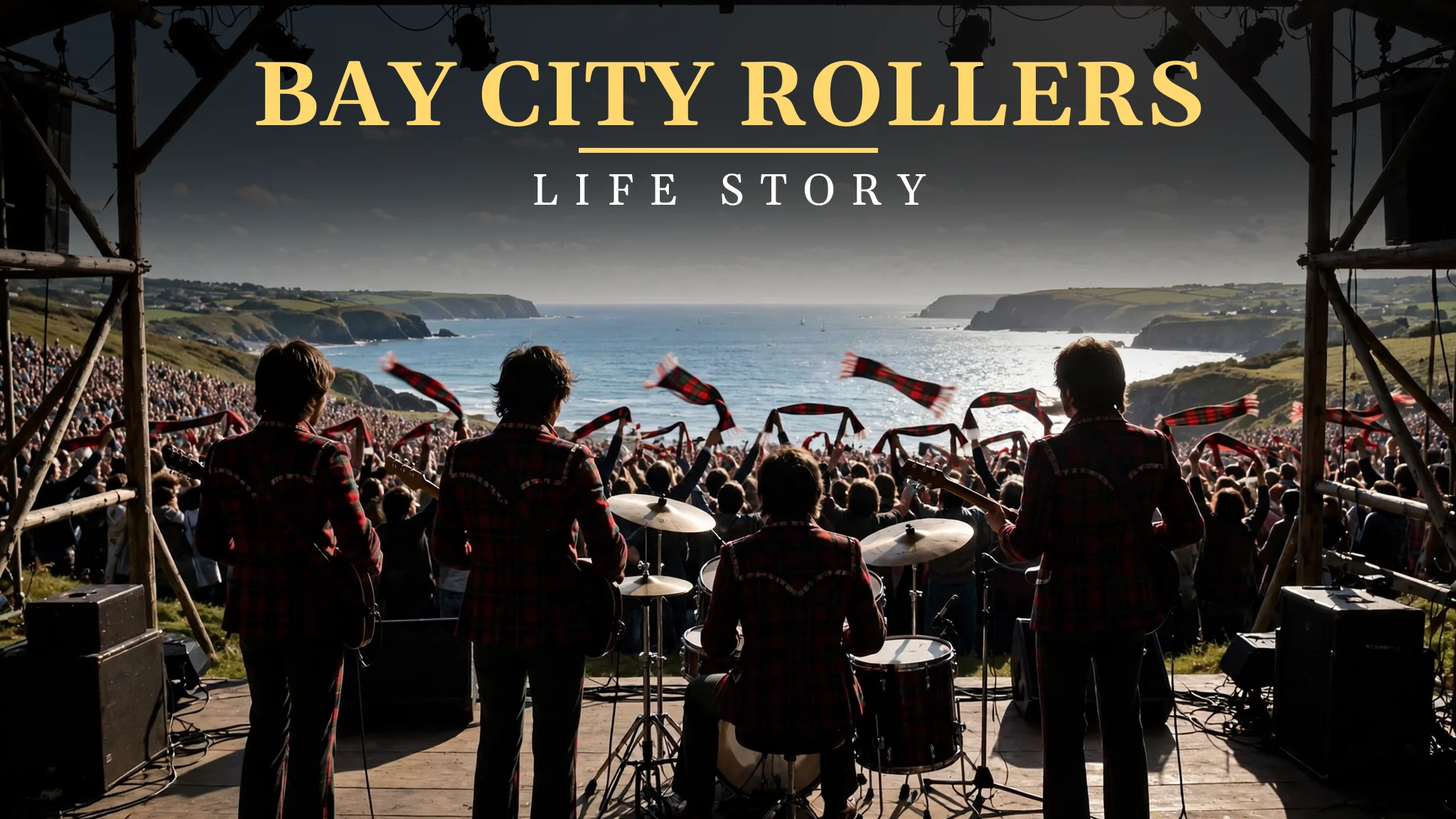
The Rollers wore tartan, the checked cloth of Scotland, on their trousers, their jackets, and their scarves. The tartan became their trademark, and fans copied it, wearing tartan scarves and badges wherever they went. The band’s songs, like Shang-a-Lang and Bye Bye Baby, were easy to sing, and they were played on the radio again and again. In America, the song Saturday Night became a number one hit, and the band toured the world. It was a remarkable rise for five young men from Edinburgh, and it happened very fast.
This is the story of the Bay City Rollers: how they began, how they became famous, how the madness of Rollermania changed their lives, and how the band’s story ended in sadness and in arguments about money. It is a story about fame arriving too fast, about young men who were not ready for what happened to them, and about songs that still make people smile, even when the story behind them is not a happy one.
A Band From Edinburgh
The Bay City Rollers began in Edinburgh, Scotland, in the late 1960s. The band was formed by brothers Alan and Derek Longmuir, who played bass and drums, along with other local musicians. The early line-up changed many times, and the band played in clubs and halls around Scotland, learning their trade and building a small following. They were young, they were keen, and they loved American pop music. They wanted to be stars, but they had no idea how big they would become.
In 1973, Les McKeown joined the band as the lead singer, and everything changed. McKeown was born in Edinburgh in 1955, and he had a strong, clear voice that was perfect for pop music. He was young, good-looking, and full of energy, and he became the face of the band. Eric Faulkner, who played guitar, and Stuart Wood, who also played guitar, completed the classic line-up, along with the Longmuir brothers. The five men were all from Scotland, and they were all in their late teens or early twenties. They looked like the boys next door, and that was part of their appeal.
The band’s manager was Tam Paton, a man from Edinburgh who had worked in the music business for years. Paton saw the band’s potential, and he worked hard to make them famous. He dressed them in tartan, he gave them a clean, cheerful image, and he made sure that they were seen in the right places. The tartan was a clever idea, because it made the band instantly recognisable. When you saw a group of young men in tartan, you knew who they were. The fans loved it, and they began to wear tartan themselves.
The band’s first hits came in 1974. The single Remember, Shang-a-Lang, and Summerlove Sensation all reached the top ten in Britain. The band were on television, on the radio, and in the newspapers. The fans, mostly young girls, began to follow them everywhere. The band had been working for years, and now, at last, the work was paying off. But none of them were prepared for what was about to happen. Rollermania was coming, and it would change their lives forever.
Shang-a-Lang, Bye Bye Baby, and the Madness of Rollermania
In 1975, the Bay City Rollers released the single Bye Bye Baby, a cover of a song by the Four Seasons, and it went to number one in Britain. The song was bright, cheerful, and easy to sing, and it became one of the band’s most famous records. Then came Give a Little Love, which also reached number one. The band were now the biggest pop group in Britain, and their concerts were wild. Fans screamed so loudly that the band could not hear themselves play. Girls fainted in the front rows, and the police had to hold back the crowds outside the venues.
Rollermania was a real phenomenon. The newspapers wrote about it every day, and the television news showed pictures of screaming fans. The band’s tartan scarves were everywhere, and the fans wore them with pride. The band toured Britain, and every concert sold out. They were mobbed at airports, at hotels, and in the streets. It was exciting, and it was frightening. The five young men from Edinburgh were suddenly famous in a way that few people ever experience, and they were very young. McKeown was only nineteen when the madness began, and the others were not much older.
The band’s music was simple pop, and that was part of its appeal. The songs were about love, summer, and having fun, and they were easy to sing along to. Shang-a-Lang, with its handclaps and its happy chorus, became an anthem for the band’s fans. The band did not try to be clever or serious. They made music for young people who wanted to have fun, and they did it very well. The critics did not always like the band, but the fans did not care about the critics. They loved the Rollers, and that was enough.
The madness was not only in Britain. The band became popular in Europe, in Australia, and in Japan. In Japan, the fans were especially enthusiastic, and the band were treated like royalty. The band toured the world, and they saw places they had never dreamed of visiting. It was a remarkable time, and it is easy to understand why the band enjoyed it. They were young, they were famous, and the whole world seemed to be singing their songs. But fame that arrives this fast can be hard to handle, and the band would soon learn that lesson.
Saturday Night and the Conquest of America
In 1976, the Bay City Rollers had their biggest success in America. The single Saturday Night, which had been a hit in Britain the year before, was released in the United States, and it went to number one. The song’s chorus, with its chant of S-A-T-U-R-D-A-Y Night, was perfect for American radio, and the band became famous across the Atlantic. They toured America, and they played to large crowds of screaming fans. The band had a television show in America, and they were featured in magazines and on the news. For a brief time, they were one of the biggest bands in the world.
The American success was a dream come true, but it also brought new pressures. The band were touring constantly, and they were exhausted. They were away from home for long periods, and they missed their families and their friends. The management controlled their lives, deciding where they went, what they wore, and what they said in interviews. The band members were young, and they had very little control over their own careers. They were earning a lot of money, or so they thought, but they did not know how much of it they were actually keeping. That question would become one of the saddest parts of the band’s story.
The band’s American fame did not last long. By 1977, the hits were slowing down, and the public’s taste was changing. The band tried new sounds, and they changed their image, dropping the tartan and trying to look more grown-up. But the fans who had loved the tartan did not want the band to change, and the new audiences did not want a band that had been famous as teenagers. The band were caught in the middle, too old for the young fans and too young for the older ones. It is a common problem for bands that become famous very young, and it is a hard one to solve.
The band also began to argue among themselves. The pressure of touring, the lack of control, and the questions about money all took their toll. McKeown, who had been the band’s singer and its most famous member, began to feel that he was not being treated fairly. The other members had their own worries. The friendship that had held the band together was under strain, and the arguments grew worse. The band that had once been a happy group of friends from Edinburgh was becoming a group of tired, unhappy young men who wanted different things.
The Fall, the Money, and the Long Arguments
By the late 1970s, the Bay City Rollers were no longer at the top of the charts. The band split up and reformed with different members, and McKeown left in 1978. The band carried on without him, but the magic was gone. The fans moved on to other bands, and the Rollers became a memory of a particular time in the 1970s. The band members went their separate ways, and they tried to build new lives. Some of them had solo careers, some of them worked in other jobs, and some of them struggled.
The saddest part of the band’s story is the argument about money. For many years, the band members said that they had not been paid fairly for their work. They said that the money from the records, the tours, and the merchandise had not reached them, and that they had been taken advantage of when they were young and did not understand the business. The arguments went on for decades, and they involved lawyers, courts, and public statements. The band members felt that they had been cheated, and they wanted justice. The case was complicated, and it was never fully resolved in a way that satisfied everyone.
The band’s manager, Tam Paton, died in 2009, and he had always denied that he had taken the band’s money. The band members continued to argue their case, and the story became one of the most famous examples of how young musicians can be treated badly by the music business. It is a sad story, because the band had worked hard, they had made records that millions of people loved, and they felt that they had not been rewarded for it. The money argument cast a shadow over the band’s legacy, and it is still talked about today.
Les McKeown died in April 2021, at the age of sixty-five, and his death was mourned by fans around the world. He had been the voice of the band’s greatest hits, and his death was a reminder of how much time had passed since Rollermania. Alan Longmuir died in 2018, and Derek Longmuir has also faced health problems. The band’s story, which began with such joy and excitement, has ended with loss and with arguments that were never fully settled. It is a story that shows how fame can be both wonderful and cruel.
Reunions, New Audiences, and the Songs That Remain
Despite the sadness, the Bay City Rollers’ music has survived. The band reformed several times over the years, with different line-ups, and they toured to audiences who still loved the old songs. McKeown toured with his own version of the band, and he was welcomed by fans who had grown up listening to the records. The concerts were full of people who remembered the 1970s, and who wanted to hear Shang-a-Lang and Bye Bye Baby one more time. The band’s music had become a part of their lives, and they did not want to let it go.
The band’s songs have also found new audiences. Saturday Night is still played on the radio, and it is used in films and television shows. The tartan image is still recognised, and the band’s name still makes people smile. The Bay City Rollers were a band of a particular time, but their music has lasted longer than that time. The songs are simple, cheerful, and well made, and that is why they still work. A good pop song does not need to be complicated. It needs to be honest, and it needs to make people feel happy, and the Rollers’ best songs do that.
The band’s place in music history is secure, even if their story is a sad one. They were one of the biggest pop bands of the 1970s, and they caused a craze that is still remembered today. They showed that a band from Scotland could become famous around the world, and they showed that pop music could be fun, bright, and full of joy. The arguments about money and the break-up of the band do not change the music. The records are still there, and they still sound as happy as they did when they were first made.
The Tartan Image and the Fans Who Wore It
The Bay City Rollers’ tartan was more than a costume. It was an idea, and it was a brilliant one. The band wore tartan trousers, tartan jackets, and tartan scarves, and the fans copied them. Soon, the whole country seemed to be wearing tartan, and the band’s image was everywhere. The tartan made the band instantly recognisable, and it gave the fans a way to show that they belonged. When a young girl wore a tartan scarf, she was saying that she was a Roller fan, and that she was part of something big. That sense of belonging was a powerful part of Rollermania, and it is why the band’s fans were so passionate.
The band’s image was carefully planned by their manager, Tam Paton, who understood that a pop band needs a look as well as a sound. The tartan was Scottish, it was bright, and it was different from anything else in pop music. The band’s clean, cheerful image was also important. The Rollers were not rebels, and they were not dangerous. They were nice young men from Edinburgh, and their fans’ parents approved of them. That made the band safe for young girls, and it helped the band to become even more popular. The image was a key part of the band’s success, and it is still remembered today.
But the tartan also became a trap. When the band tried to change their image and grow up, the fans did not want them to change. The band were stuck with the tartan, and with the image of cheerful teenagers, even as they grew older. It is a common problem for pop bands: the image that makes you famous can also hold you back. The Rollers learned that lesson, and they paid for it. The tartan that had made them stars became the thing that stopped them from growing, and that is a sad irony in the band’s story.
The Band’s Music and the Songwriters Behind It
The Bay City Rollers’ hits were written by a team of songwriters, and the band’s sound was shaped by the people who wrote for them. The songwriting team of Bill Martin and Phil Coulter wrote many of the band’s early hits, including Shang-a-Lang and Summerlove Sensation. Martin and Coulter were experienced songwriters, and they knew how to write a pop song that would sell. Their songs were bright, cheerful, and easy to sing, and they were perfect for the band’s young audience. The band’s music was a team effort, with the songwriters, the producers, and the band all working together.
The band also recorded songs written by other people, including Bye Bye Baby, which was originally recorded by the Four Seasons, and Saturday Night, which was written by Martin and Coulter. The band’s job was to take a good song and to make it their own, with McKeown’s clear voice and the band’s bright, cheerful sound. They did that very well, and the records sold in the millions. The band’s music was not complicated, but it was well made, and it was made with care. A good pop song does not need to be complicated. It needs to be honest, and it needs to make people happy, and the Rollers’ best songs did that.
The band’s later records included songs written by the band members themselves, especially Eric Faulkner, who wrote several of the band’s later singles. Faulkner was a talented songwriter, and he wanted the band to have more control over their music. But by the time the band were writing their own songs, the hits had stopped coming, and the public had moved on. It is a sad irony: the band found their own voice just as the audience stopped listening. That is a common story in pop music, and it is one that the Rollers lived through.
The Rollers on Tour: Screams, Hotels, and the Price of Fame
The Bay City Rollers’ tours in the mid-1970s were unlike anything the band had ever experienced. The concerts sold out in minutes, and the crowds outside the venues were so large that the police had to be called. Fans waited outside the band’s hotels for hours, hoping to catch a glimpse of the band, and the band had to be smuggled in and out through back doors. It was exciting, but it was also frightening, and the young men from Edinburgh were not prepared for it. They were teenagers, and they were suddenly famous in a way that few people ever experience.
The band’s daily life on tour was controlled by their management, who decided where they went, what they wore, and what they said. The band members had very little privacy, and very little freedom. They were woken early, they were driven to interviews, they performed at night, and they did it all again the next day. It was exhausting, and it left them with little time to rest or to think. The money was good, or so they thought, but the pressure was immense, and the band members began to feel trapped by the very fame they had wanted.
The screaming fans were the most visible part of Rollermania, but the quieter part was the loneliness. The band were surrounded by people all the time, but they were also isolated, because they could not go out, they could not walk down a street, and they could not live a normal life. That isolation took its toll, and it is a part of the band’s story that is often forgotten. Fame can be lonely, even when you are surrounded by thousands of people, and the Rollers learned that lesson at a very young age.
The tours also took the band around the world, to places they had never dreamed of visiting. They played in Japan, where the fans were especially enthusiastic, and they were treated like royalty. They played in Australia, in Europe, and in America, and they saw the world. Those experiences were wonderful, and they are a part of the band’s story that should be celebrated. The band were young men from Edinburgh who saw the world, and that is a remarkable thing, even if the price of it was high.
My Take:
When I think about the Bay City Rollers, I feel two things at the same time: happiness and sadness. The happiness comes from the music. Shang-a-Lang and Bye Bye Baby are songs that make me smile, even now, and I can imagine how wonderful it must have been to hear them for the first time in 1975, when you were young and the whole world seemed full of fun. The sadness comes from the story behind the music, from the young men who were not paid fairly, who argued for decades, and who lost their friendship in the process. I think both feelings are true, and I do not want to pretend that one of them does not exist.
I admire the band’s music for its simplicity. The Rollers did not try to be clever. They made songs about love, about summer, about Saturday night, and they made them well. There is a kind of honesty in that. The band knew who their audience was: young people who wanted to have fun, who wanted to dance, and who wanted to sing along. The band gave them exactly what they wanted, and they did it with skill and with heart. I think that is a fine thing to do. Not all music has to be serious. Some music is meant to make people happy, and the Rollers understood that better than almost anyone else.
I also think about the fans, and about how much the band meant to them. The girls who screamed at the concerts, who wore the tartan scarves, who waited outside the hotels: they were not being silly. They were young people who had found something that made them happy, and they wanted to be part of it. I have a lot of respect for that. The band gave those fans a sense of belonging, a feeling that they were part of something big and joyful. That is a powerful thing, and it is one of the best things that pop music can do. The fans who loved the Rollers in 1975 still remember that feeling today, and that is why the band’s music still matters to them.
The money story makes me angry, and I do not want to hide that. If it is true that the band were not paid fairly for their work, then that is a shameful thing. These were young men, some of them still teenagers, who trusted the adults around them to look after them. They worked hard, they toured the world, they made records that sold in the millions, and they deserved to be paid for that work. The fact that they spent decades arguing about money, and that the arguments were never fully settled, is a failure of the music business, and it is a lesson for young musicians today. You must understand your contracts, you must know where your money goes, and you must not trust anyone with your career without asking questions. The Rollers learned that lesson the hard way, and I hope that other bands have learned from them.
I also feel sad about Les McKeown, and about the way his life ended. He was the voice of the band’s greatest hits, and he was only nineteen when the madness began. He was a young man who was given fame, money, and attention, and he was not given the support he needed to handle them. He died at sixty-five, and his death was a reminder of how much time had passed, and of how much the band’s story had cost the people in it. I hope that he knew, before he died, how much his music meant to people, and how many fans still loved him. I think he did, because he kept touring and singing the old songs, and the audiences kept coming to hear him.
There is a lesson in the Rollers’ story about fame arriving too fast. The band went from playing small clubs in Edinburgh to being mobbed at airports in the space of about a year. That is too fast for anyone, and it is far too fast for a group of teenagers. They did not have time to learn how to handle fame, how to manage money, or how to protect their friendships. The adults around them should have helped them, but it seems that the adults were more interested in the money than in the young men. I think that is the real tragedy of the Bay City Rollers: not that the fame ended, because all fame ends, but that the young men were not looked after while it lasted.
I also think about the tartan, and about how clever it was. The band wore tartan, and the fans wore tartan, and suddenly the whole country knew who the Bay City Rollers were. It was a simple idea, and it worked brilliantly. But it also became a trap. When the band tried to drop the tartan and grow up, the fans did not want them to change. The band were stuck with an image that had made them famous, and they could not escape it. I think that is a common problem for pop bands, and it is a hard one. The image that makes you famous can also be the image that holds you back. The Rollers learned that, and they paid for it.
When I listen to Saturday Night today, I hear a song that is still full of joy. The chant of S-A-T-U-R-D-A-Y Night is simple, and it is impossible not to sing along. I think that is the band’s greatest gift: they made songs that people wanted to sing, and they made them with a warmth that has not faded. The arguments about money, the break-up, and the sadness are all part of the story, but they are not the whole story. The whole story includes the joy, the screaming fans, the tartan scarves, and the feeling of being young in 1975. That joy was real, and it is still there in the records.
In the end, I think the Bay City Rollers teach us that pop music is about more than just the music. It is about the people who make it, the people who listen to it, and the way it brings them together. The Rollers brought people together in a way that few bands have done, and they did it with simple songs and a bright, cheerful image. The fact that their story ended in sadness does not take away from the joy they gave. I am glad that their songs are still played, and I am glad that new listeners can still discover them. The band deserved better than they got, but the music they made is still here, and that is something to be grateful for.
I also think about the songwriters behind the band, and about how important they were. Bill Martin and Phil Coulter wrote many of the Rollers’ hits, and they did it with skill and with care. The band’s success was not just the band’s own. It was also the success of the people who wrote the songs, who produced the records, and who worked behind the scenes. I think it is important to remember that, because a band is never just the people on stage. It is also the people behind the scenes, and they deserve credit too. The Rollers’ hits were a team effort, and the team did a wonderful job.
There is a lesson in the Rollers’ story about the importance of looking after young people. The band members were teenagers when they became famous, and they were given fame, money, and attention, but they were not given the support they needed to handle them. The adults around them should have protected them, and it seems that they did not. I think that is the real tragedy of the Bay City Rollers, and it is one that the music business should have learned from. Young musicians need guidance, they need honest advice, and they need people who care about them more than about the money. The Rollers did not get that, and they paid for it.
I also think about the fans, and about how the band’s music has stayed with them. The girls who screamed at the concerts in 1975 are now in their sixties, and many of them still love the Rollers’ music. They play the records, they go to the reunion concerts, and they remember the joy of being young and being part of Rollermania. That loyalty is a wonderful thing, and it is a sign of how much the band meant to people. The band gave their fans a sense of belonging, and that sense has lasted for fifty years. I have a lot of respect for that, and I think it is one of the best things that pop music can do.
One more thought stays with me, and it is about the city of Edinburgh. The Rollers were from Edinburgh, and they were proud of it. They wore tartan, they sang about Scotland, and they carried the spirit of their city with them wherever they went. Edinburgh is a beautiful city, and the band’s music is a part of its history. I think that is a lovely thing: a band that sings about their own home, and that makes their home proud. The Rollers did that, and Edinburgh has not forgotten them. The band’s story is a part of the city’s story, and it will be for a long time.
In the end, I think the Bay City Rollers were a band that gave people joy, and that is no small thing. They made songs that made people dance, sing, and smile, and they did it with skill and with heart. Their story has sadness in it, as all real stories do, but the music is still joyful, and that joy is what I remember. When I hear Shang-a-Lang, I do not think about the arguments, the money, or the break-up. I think about a group of young men from Edinburgh, wearing tartan, singing a happy song, and I am glad that they did, and glad that the song is still here for us to hear.
I also think about the loneliness of fame, and about how hard it must have been for the Rollers to be surrounded by people all the time and yet to feel alone. The band were mobbed at airports, they were followed to their hotels, and they could not walk down a street without being recognised. That sounds exciting, but it is also frightening, and it leaves no room for a normal life. The band members were teenagers, and they were not given the time or the space to grow up properly. I think about that, and I feel sad for them, because they deserved better. Fame should not mean losing your freedom, and it should not mean losing yourself.
There is a lesson in the Rollers’ story about the importance of rest. The band toured constantly, they were woken early, they performed at night, and they did it all again the next day. That pace is not sustainable, and it is no wonder that the band members became tired and unhappy. A band needs time to rest, to think, and to live a normal life, and the Rollers were not given that time. I think the music business should have looked after them better, and I hope that young bands today are given more rest and more support. The Rollers’ story is a warning, and it is one that should not be ignored.
I also think about the band’s music, and about how it has survived the sadness. The records are still played, and they still sound as happy as they did in 1975. That is a remarkable thing, because the story behind the records is not a happy one. But the music is separate from the story, and the music is joyful. When I hear Saturday Night, I hear a song that makes people want to dance, and that is enough. The music does not need to be perfect, and the story does not need to be happy. The music just needs to be honest, and the Rollers’ best songs are honest.
One more thought stays with me, and it is about the importance of speaking up. The band members spent decades arguing about money, and they did it in public, through lawyers and through the press. I wonder if things would have been different if they had been able to speak honestly with each other, and with the people who managed them, when they were young. It is easy to say that now, but it is hard to know what really happened. What I do know is that young musicians today should learn from the Rollers’ story, and they should ask questions, read their contracts, and make sure that they understand where their money goes. That is a practical lesson, and it is one that could save a young band from the same fate.
Finally, I want to say that the Bay City Rollers gave people joy, and that is the most important thing I can say about them. They made songs that made people dance, sing, and smile, and they did it with skill and with heart. Their story has sadness in it, as all real stories do, but the music is still joyful, and that joy is what I remember. When I hear Shang-a-Lang, I hear a group of young men from Edinburgh, wearing tartan, singing a happy song, and I am glad that they did, and glad that the song is still here for us to hear.
Frequently Asked Questions
Who were the Bay City Rollers?
The Bay City Rollers were a Scottish pop band from Edinburgh, formed in the late 1960s. Their classic line-up was Les McKeown on lead vocals, Eric Faulkner and Stuart Wood on guitar, and brothers Alan and Derek Longmuir on bass and drums. They became famous in the mid-1970s with hits like Shang-a-Lang and Bye Bye Baby.
What is Rollermania?
Rollermania was the name given to the wild excitement of the Bay City Rollers’ fans in the mid-1970s. Young fans, mostly girls, screamed at concerts, wore the band’s tartan scarves, and followed the band everywhere. It was compared to the excitement around the Beatles in the 1960s.
What was the Bay City Rollers’ biggest hit?
In Britain, Bye Bye Baby and Give a Little Love both reached number one. In America, Saturday Night reached number one in 1976, and it became the band’s biggest hit outside Britain. Shang-a-Lang was also a major hit and became an anthem for the band’s fans.
Why did the Bay City Rollers wear tartan?
The band wore tartan, the checked cloth of Scotland, as their trademark. Their manager, Tam Paton, chose the look to make the band instantly recognisable. Fans copied the tartan scarves and clothes, and the tartan became a symbol of the band and of Rollermania.
What happened to the band’s money?
For many years, the band members said that they had not been paid fairly for their records, tours, and merchandise. They argued that the money had not reached them when they were young and did not understand the music business. The arguments went on for decades and were never fully settled.
When did Les McKeown die?
Les McKeown, the band’s lead singer, died in April 2021 at the age of sixty-five. He had continued to tour with his own version of the Bay City Rollers, singing the band’s classic hits to audiences who still loved them.
Are the Bay City Rollers still performing?
The original band no longer exists, but different versions of the band have toured over the years, playing the classic hits. The band’s music is still played on the radio, and Saturday Night and Shang-a-Lang are still loved by fans around the world.


