Benefits of Stretching Every Day
In this post
Stretching is one of the simplest health habits in existence, and one of the easiest to skip. It needs no equipment, no gym, and no special clothing, yet most people only stretch when something already hurts. That is a pity, because a few minutes of daily stretching can make the body feel noticeably easier to live in: joints move more freely, muscles feel less tight after sitting, and the day starts or ends with a moment of calm attention to the body. This guide explains what daily stretching can and cannot do, how to do it safely, and how to build a routine you will actually keep.
It is worth being honest at the start. Stretching is not a miracle cure, and it will not undo years of sitting, injury, or poor posture in a week. What it can do, when done gently and regularly, is maintain and gradually improve flexibility, reduce everyday stiffness, support better movement, and help you notice tension before it becomes pain. Those are modest claims, but they matter enormously in daily life, because most physical discomfort is not dramatic. It is the stiff neck after a long day at a desk, the tight hips after a long drive, or the aching lower back after lifting something awkwardly. Daily stretching addresses exactly that level of problem.
What Stretching Actually Does to Muscles and Joints
Muscles are elastic tissues that shorten and lengthen as you move. When you hold one position for hours, sitting at a desk, driving, or standing in one place, some muscles stay shortened while others stay lengthened, and the result is stiffness when you finally move. Stretching gently lengthens the shortened muscles and encourages blood flow to the area. It also stimulates sensors in muscles and tendons that report position and tension to the brain, which is one reason a good stretch can make movement feel smoother immediately afterwards. This effect is partly about the tissue itself and partly about the nervous system learning that a wider range of movement is safe.
Flexibility is not the same as being able to do the splits. In practical terms, flexibility means your joints can move through the range needed for daily life without strain: reaching overhead, bending to tie shoes, turning to look behind you, or squatting to pick something up. As people age, or spend long periods sitting, this range tends to shrink, and everyday movements start to feel harder. Regular stretching helps preserve that range. It does not need to be extreme. Gentle, regular stretches that take a joint slightly beyond its comfortable resting position, held without bouncing or forcing, are enough to maintain and slowly improve mobility for most people.
There is also a circulation angle worth understanding. Stretching is not a substitute for aerobic exercise, and it does not replace walking, cycling, or other activity that strengthens the heart. But moving muscles through their range does encourage blood flow to those muscles, which can help them feel less stiff after inactivity. Think of it as oiling a hinge rather than rebuilding the door. The hinge still needs to be used, and stretching is one of the gentlest ways to use it, which is why it suits almost every age and fitness level, provided it is done without pain.
Flexibility, Posture, and Everyday Movement
One of the most practical benefits of daily stretching is better posture, though the connection is indirect. Poor posture is rarely caused by a single weak muscle; it is usually a pattern of tight muscles pulling the body one way and weak muscles failing to hold it the other. For example, tight chest muscles and a stiff upper back can encourage rounded shoulders, while tight hip flexors from prolonged sitting can tilt the pelvis and strain the lower back. Stretching the tight areas, combined with general movement and strengthening over time, can make it easier to sit and stand tall without constant effort. Stretching alone will not fix posture, but it removes one of the obstacles to good posture.
Everyday movement improves in subtler ways too. People who stretch regularly often report that stairs feel easier, that they can turn and reach without a twinge, and that they recover more comfortably after gardening, housework, or sport. This is partly flexibility and partly body awareness. Stretching forces you to pay attention to how your body feels, which muscles are tight today, and which movements feel uneven. That awareness helps you adjust how you lift, sit, and move, and it can prevent the small awkward movements that cause strains. In that sense, stretching is as much a daily body check as it is an exercise.
For older adults, this maintenance role is especially valuable. Falls are a serious risk in later life, and they are often linked to reduced flexibility, balance, and strength. Gentle daily stretching, especially of the legs, hips, and ankles, combined with balance practice and walking, can help preserve the mobility needed to move confidently. This is general information only, and anyone with a medical condition, recent surgery, or a history of falls should discuss an appropriate routine with a health professional before starting. The principle, however, is sound: a body that moves regularly keeps moving more easily.
Stretching for Pain, Stiffness, and Stress
Many people turn to stretching because something hurts, and here honesty matters more than enthusiasm. Stretching can help with muscular stiffness and tension, especially the kind that comes from sitting, stress, or overuse. A tight neck after a stressful day, or stiff shoulders after hours at a computer, often eases with gentle stretches and slow breathing. The mechanism is partly physical, as muscles relax, and partly neurological, as slow, deliberate movement signals safety to a nervous system that has been on alert. That is why stretching feels calming as well as loosening: it is one of the few forms of exercise that directly slows you down.
However, stretching is not appropriate for every kind of pain, and it should never be pushed through sharp, shooting, or worsening pain. Pain that follows an injury, pain with numbness or weakness, pain that does not improve, or pain that is severe or unexplained should be assessed by a health professional before you stretch the area aggressively. Stretching a freshly injured muscle, an inflamed joint, or a trapped nerve can make things worse. The safe rule is simple: stretching should feel like a gentle pull or mild tension, never sharp pain, and you should feel the same or better afterwards, not worse. If a stretch consistently makes you feel worse, stop doing it and seek advice.
Stress relief is a genuine, if secondary, benefit. A short stretching routine forces slow breathing, stillness, and attention to the body, all of which help shift the body out of a stressed state. Many people find that five minutes of stretching in the evening helps them unwind and sleep better, not because stretching is a sleeping pill, but because it marks a clear boundary between the busy day and rest. Similarly, a morning stretch can serve as a gentle transition from sleep to activity, waking the body up without the shock of intense exercise. These psychological benefits are real, even if they are harder to measure than flexibility.
Static, Dynamic, and the Right Order
Not all stretching is the same, and using the right type at the right time makes a real difference. Dynamic stretching involves moving gently through a range of motion, such as leg swings, arm circles, or slow torso twists. It warms the muscles and prepares them for activity, which makes it well suited to mornings and to warming up before exercise or sport. Static stretching involves holding a stretch in one position, usually for 15 to 60 seconds, without bouncing. It is best suited to after activity or as a standalone calming routine, when muscles are already warm.
A common mistake is doing intense static stretches on cold muscles first thing in the morning, forcing a stiff body into a deep position. A safer morning sequence starts with gentle movement: a short walk around the room, shoulder rolls, arm circles, and easy leg swings, followed by light static stretches only once the body feels warm. After exercise, the order reverses in emphasis: cool down with gentle movement first, then hold static stretches for the muscles you used. This order respects how muscles behave. Cold muscles are less elastic and more vulnerable to strain, while warm muscles respond better to a held stretch.
Bouncing during a stretch, sometimes called ballistic stretching, is best avoided by beginners. Bouncing can trigger a reflex that makes the muscle tighten protectively, which defeats the purpose and increases strain risk. Instead, move slowly into a stretch until you feel mild tension, hold it while breathing normally, and ease slightly deeper only if the tension fades. Never hold your breath during a stretch. Normal, relaxed breathing helps muscles release, and it turns the routine into something calming rather than a test of endurance. If you cannot breathe normally in a position, you are pushing too far.
A Safe Daily Routine for Beginners
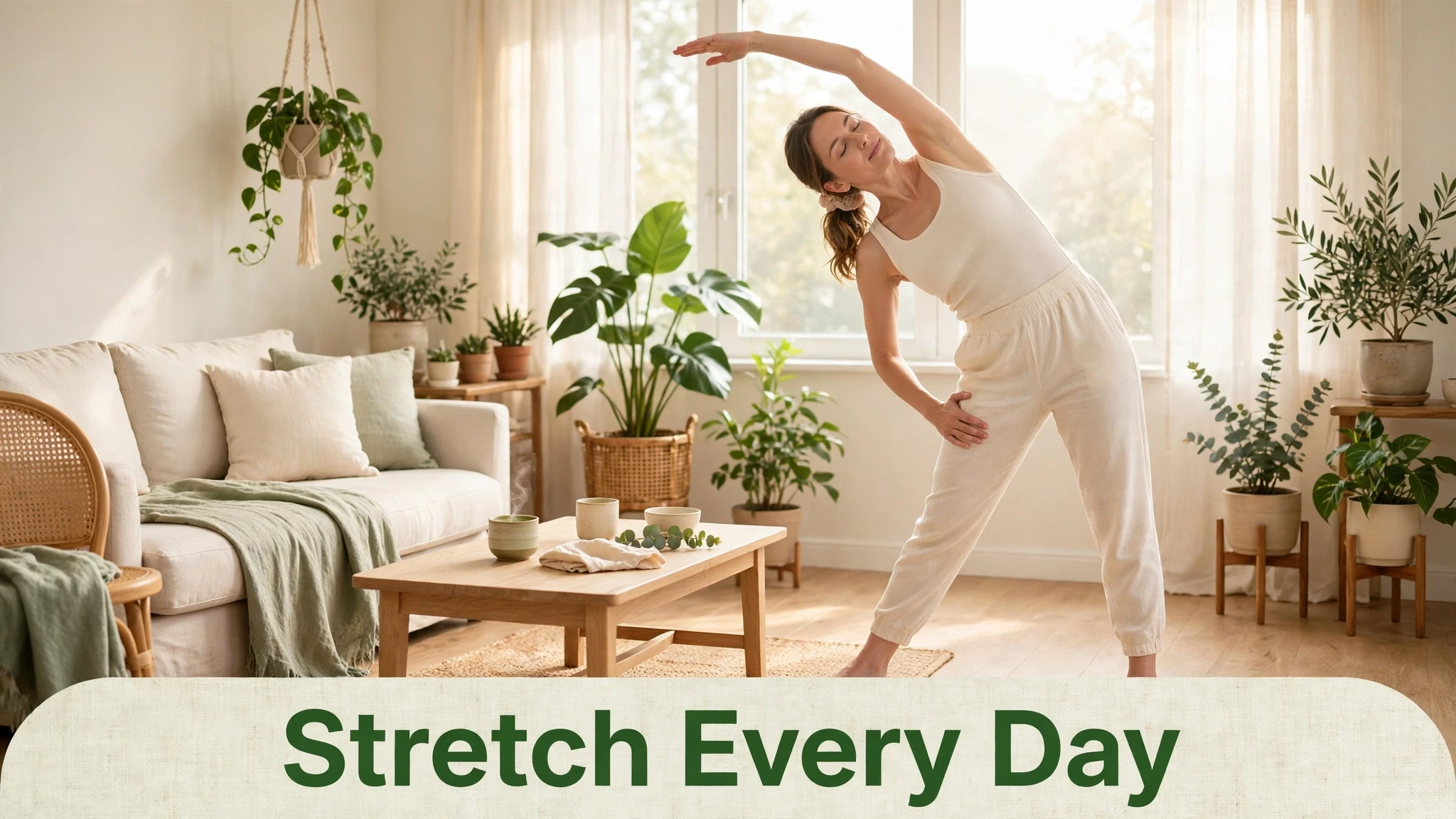
A good beginner routine takes ten minutes and covers the whole body without requiring flexibility you do not yet have. Start standing or sitting tall. Begin with the neck: slowly tilt the head to each side, holding gently, then turn to look over each shoulder. Move to the shoulders: roll them backwards and forwards, then bring one arm across the chest and hold it lightly with the other hand. For the upper back, clasp your hands in front of you and round the upper back gently, feeling a stretch between the shoulder blades. These three moves alone can transform how a desk worker feels by midday.
Next, address the hips and legs, where sitting creates the most tightness. From a standing position, hold a chair for balance and gently pull one foot towards your buttock for a thigh stretch, keeping your knees close together. For the hips, sit on a chair and cross one ankle over the opposite knee, leaning forward slightly until you feel a gentle stretch in the outer hip. For the calves, stand facing a wall, step one foot back, press the heel down, and lean forward. For the hamstrings at the back of the thigh, sit on the floor or a chair with one leg extended and lean forward from the hips, not by rounding the back aggressively. Hold each stretch for about 20 to 30 seconds, breathing normally, and repeat on the other side.
Finish with the back and chest. A gentle cat-cow movement on hands and knees, arching and rounding the back slowly, mobilises the spine without force. A doorway chest stretch, placing a forearm against a doorframe and turning gently away, opens the front of the shoulders. End with a full-body reach overhead, breathing deeply, and notice how you feel compared to the start. If any stretch causes pain, skip it or reduce the range. This routine is an example, not a medical programme, and it should be adapted to your body, your injuries, and your comfort. Doing it once a day, at the same time, matters far more than doing a perfect version occasionally.
How Long, How Often, and When to Expect Results
The question everyone asks is how much stretching is enough. For general maintenance, ten minutes a day, or a shorter five-minute routine done consistently, is a reasonable starting point for most people. Research on flexibility generally supports holding individual stretches for around 15 to 60 seconds, but the exact number matters less than regularity. A short routine done daily will beat a long routine done once a week, because flexibility is maintained by frequent, gentle reminders to the nervous system, not by occasional heroic efforts. If you have time for more, by all means stretch longer, but do not let the perfect routine become the enemy of a short one you will actually do.
Timing is flexible, and the best time is the time you will stick to. Morning stretching suits people who wake stiff and want to start the day moving. Midday stretching suits desk workers who need to break up sitting. Evening stretching suits people who want to unwind and release the tension of the day. Some people stretch twice a day, briefly in the morning and more slowly in the evening, and that is fine too. The only timing rule that matters is to warm up gently before deep static stretches, especially in the morning when the body is coldest and stiffest.
Results arrive gradually, and that is normal. Most people notice less morning stiffness within a week or two of daily practice, and measurable flexibility gains over several weeks. Progress is rarely linear: some days you will feel looser, some days tighter, depending on sleep, stress, activity, and weather. Keep a simple mental note, not a daily measurement, and judge by how everyday movements feel over a month. If you are stretching for a specific problem, such as a tight hip or a stiff shoulder, and nothing improves after several weeks of gentle, consistent practice, or if pain worsens, seek professional advice. A physiotherapist can identify whether the problem is tightness, weakness, joint restriction, or something else entirely, and stretching alone cannot solve all of those.
My Take:
I will be blunt: stretching has a marketing problem. It is sold either as a miracle that will fix your back, cure your stress, and add years to your life, or dismissed as a waste of time that real athletes skip. Both versions are wrong, and both miss why stretching is actually worth doing. Stretching is not exciting, it is not impressive, and nobody posts about their ten-minute hamstring routine with the pride they post about a marathon. But it is one of the few health habits that pays you back on the same day, in a currency you can actually feel: less stiffness, easier movement, and a few minutes of quiet. I think we undervalue habits that feel good immediately, because we have been trained to believe that only suffering counts as exercise. Stretching proves that idea wrong, gently, every day.
My second opinion is that most people stretch the wrong muscles, or rather, they stretch the muscles they already know how to stretch and ignore the ones that actually need it. Everyone stretches their arms overhead and touches their toes, because those are the stretches we learned as children. Far fewer people stretch their hip flexors, their upper back, or their calves, which are the areas that sitting ruins most reliably. If your stretching routine looks exactly like your school warm-up from twenty years ago, it is probably not addressing your adult life, which is spent sitting in cars, at desks, and on sofas. I think a useful test is to ask which movement feels hardest in your daily life, reaching, bending, turning, or standing up, and then build your routine around that movement, not around a generic poster.
I also want to defend the short routine, because the fitness world has a habit of turning every good idea into an hour-long programme that nobody with a job and a family can sustain. Ten minutes is not a compromise; it is the correct dose for most people, most days. A person who stretches for ten minutes every day for a year will be far more flexible, and far more in tune with their body, than a person who does an hour-long session once a month and spends the rest of the month feeling guilty. Consistency is not a motivational slogan here; it is the actual mechanism. Flexibility is maintained by frequent signals to the nervous system, and a short daily signal beats a rare loud one. If you only have five minutes, do five minutes. Do not skip the day because you cannot do the ideal version.
There is one more thing I feel strongly about, and it is the difference between stretching and forcing. I have watched people treat stretching as a competition, pushing into pain, bouncing aggressively, and comparing themselves to people with naturally flexible joints. That approach is not merely unpleasant; it is counterproductive, because a muscle that feels threatened tightens to protect itself. The best stretch I know is almost boring: move slowly until you feel a gentle pull, breathe, wait, and let the muscle decide whether it wants to release a little further. Some days it will, and some days it will not, and both days count. I think this attitude, patience over force, is useful far beyond stretching. It is a good way to treat a body that has to last you a lifetime, rather than a machine you are trying to beat into shape.
Finally, I think stretching earns its place not because it transforms you, but because it keeps you honest about your body. A daily stretch is a daily check-in: today my left hip is tight, today my neck is carrying stress, today I feel surprisingly good. That information helps you adjust the rest of your day, whether that means taking a walk, changing how you sit, or simply being kinder to yourself. In a world of health advice that promises transformation in thirty days, I appreciate a habit that promises something smaller and delivers it: a body that feels a little easier to live in, a mind that has had five quiet minutes, and a day that starts or ends with attention rather than autopilot. That is enough. That is, in fact, a lot.
Workplace stretching deserves its own mention, because most adults spend their stretching-relevant hours at a desk, not in a studio. A desk worker does not need a yoga mat or a change of clothes to benefit. Shoulder rolls between emails, a neck stretch while waiting for a file to load, standing to stretch the hips every hour, and a doorway chest stretch during a break can be woven into the working day without anyone noticing. The key is to link stretches to existing cues: stretch when you finish a call, when you stand to refill water, or when a meeting ends. These micro-stretches, each lasting under a minute, add up to meaningful daily movement, and they interrupt the prolonged sitting that creates most desk-related stiffness. Employers who encourage short movement breaks are not indulging staff; they are protecting the very bodies that do the work.
Athletes and active people need a different emphasis, and it is worth stating plainly. For them, stretching is not a warm-up on its own, and it should not replace the gradual, sport-specific warm-up that prepares muscles, joints, and coordination for effort. A runner benefits more from a few minutes of easy jogging and leg swings than from long static stretches before a run, while static stretching afterwards helps muscles cool down and return to resting length. A strength trainer benefits from mobility work for the joints they will load, rather than from a generic full-body routine. The principle is the same in both cases, match the stretching to the activity and to the body you actually have, but the application differs. Beginners should start general and gentle, and as they learn which areas feel tight after their own activities, they should tailor the routine to those areas, keeping what helps and dropping what does not.
A final practical consideration is how stretching fits alongside strength training and aerobic exercise, because many people treat it as an optional extra rather than as part of a balanced programme. Strength training builds the muscles that hold posture and protect joints, aerobic exercise builds heart and lung fitness, and stretching maintains the range of motion that lets both work properly. Neglecting any one of the three creates a gap: strong but stiff muscles strain more easily, fit but weak muscles fatigue sooner, and flexible but weak joints lack stability. A balanced week might include walking or cycling most days, strength work twice a week, and a short daily stretch, adjusted to age, health, and preference. You do not need to do everything every day, and you do not need a perfect programme. You need a pattern that covers movement, strength, and flexibility across the week, in proportions you can sustain, because the body responds to the whole pattern, not to any single session in isolation.
Frequently Asked Questions
How many minutes of stretching should I do each day?
Ten minutes a day is a good starting point for most people, and even five minutes done daily is useful. Consistency matters more than length, so choose a routine short enough to repeat every day rather than a long routine you only manage occasionally.
Is it better to stretch in the morning or the evening?
The best time is the time you will stick to. Morning stretching helps with stiffness after sleep, while evening stretching helps you unwind. Either is fine, but warm up with gentle movement before deep static stretches, especially in the morning.
Can stretching relieve back pain?
Gentle stretching can help muscular stiffness and tension that contribute to some back discomfort, but it is not a treatment for every cause of back pain. Sharp, shooting, worsening pain, or pain with numbness or weakness should be assessed by a health professional before aggressive stretching.
Should stretching hurt?
No. A stretch should feel like a gentle pull or mild tension, never sharp pain. If you cannot breathe normally in a position, or you feel worse afterwards, you are pushing too far. Ease off, reduce the range, or skip that stretch.
What is the difference between static and dynamic stretching?
Dynamic stretching moves gently through a range of motion, such as arm circles or leg swings, and suits warm-ups. Static stretching holds one position for 15 to 60 seconds and suits cooling down or a standalone calming routine when muscles are already warm.
Can I stretch every day, or do muscles need rest days?
Gentle daily stretching is generally fine for most people, as it is low intensity. If a stretch causes soreness or pain, rest that area and reduce intensity. Anyone with an injury, medical condition, or recent surgery should check with a health professional first.