Best Airports in the World in 2027
In this post
- Changi, Singapore: The Airport Other Hubs Copy
- Hamad International, Doha: Quiet Luxury at Scale
- Tokyo Haneda: Precision, Food and Short Walks
- Seoul Incheon, Istanbul and the European Challengers
- What Makes an Airport Great: The Tests That Matter
- Lounges, Sleep and Surviving a Long Layover
- How to Choose the Best Airport for Your Trip
- My Take:
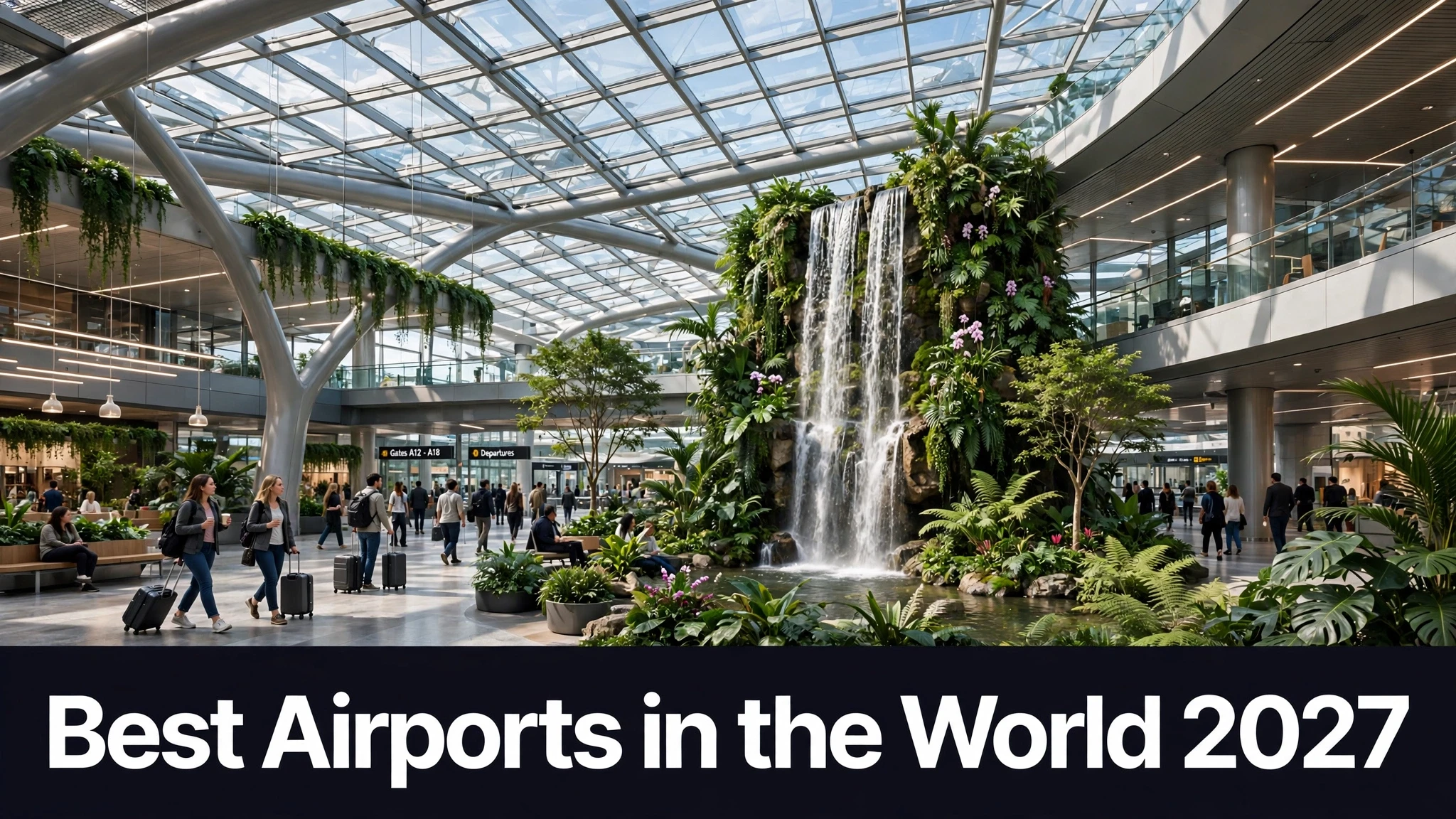
Singapore Changi has held the top spot in most airport rankings for years, and the reason is simple to see the moment you step off a plane there: a waterfall drops through the middle of a glass dome, gardens grow indoors, and the signs make sense before you even look for them. Changi won the Skytrax World’s Best Airport title again in 2025, ahead of Hamad International in Doha and Tokyo Haneda, and its Jewel complex turned a building most travellers rush through into a place people visit on purpose. Yet the best airport in the world is not only about beauty. A hub can have a rainforest inside and still fail you if the security queue eats an hour, the Wi-Fi drops, or a forty-minute connection becomes a sprint across two terminals. This guide ranks what actually matters in 2027: how easy it is to arrive, connect and leave, how comfortable the waiting feels, how good the food and lounges are, and how the airport treats a tired traveller at two in the morning. The airports below appear because they score across all of those tests, not because one photograph looks impressive. Some are giants moving more than eighty million passengers a year, and some are smaller hubs that simply run their operation with unusual care. Read the rankings with your own trip in mind, because the right airport depends on whether you are changing planes, starting a holiday, or flying home after a long day.
Changi, Singapore: The Airport Other Hubs Copy
Singapore Changi handles around sixty-eight million passengers a year across four terminals, and its reputation rests on details that other airports treat as extras. Jewel Changi Airport, the ten-storey dome joined to Terminal 1, holds the HSBC Rain Vortex, a forty-metre indoor waterfall, plus a forest valley, a canopy bridge and a hedge maze, all free to enter before security for anyone with time to spare. Inside the terminals, the free butterfly garden, sunflower garden and rooftop swimming pool at Terminal 1 give long layovers a shape, while the movie theatres at Terminals 2 and 3 run films around the clock without charge. Cleanliness is policed relentlessly, staff are easy to find, and the Skytrax survey of travellers has repeatedly placed Changi first because the whole experience, from the tray return at security to the carpet underfoot, feels considered rather than improvised.
Connections at Changi are among the fastest of any major hub, with minimum connection times of around fifty minutes on a single ticket, and the airport publishes walking times between gates so a tight transfer is a calculation, not a gamble. Free Singapore tours run for transit passengers with layovers of five and a half hours or more, taking visitors to the city and back, which turns dead time into a short holiday. Food ranges from hawker-style stalls serving chicken rice and laksa for a few Singapore dollars to full-service restaurants, and the prices stay closer to street level than to the inflated menus found in many European hubs. The one honest weakness is distance: Changi sits about twenty kilometres east of the city centre, so the taxi or MRT ride takes roughly half an hour, and late-night arrivals find fewer trains. Even so, for a traveller choosing a stopover, no other airport in 2027 combines gardens, food, sleep options and calm quite like this one.
Hamad International, Doha: Quiet Luxury at Scale
Hamad International opened in 2014 and now serves more than fifty million passengers a year, and its single vast terminal feels more like a gallery than a transit hall. The centrepiece is Urs Fischer’s Lamp Bear, a seven-metre yellow teddy bear under a lamp that has become the meeting point for connecting passengers, surrounded by sculptures and art installations that cost the airport a fortune and give the building a personality most hubs lack. The terminal is quiet by design, with carpeted floors that muffle footsteps, wide seating areas, and a sense of space that survives even at peak hours. Qatar Airways routes most of its network through Doha, so the airport is built around transfers, and it shows in the way gates, lounges and rest areas are arranged along one continuous, well-signed spine.
The Al Mourjan Business Lounge, open to business-class passengers and paying guests, is one of the largest lounges in the world, with restaurants, quiet rooms, showers and a spa, while the Oryx Airport Hotel inside the terminal lets economy travellers book a room by the hour for sleep between flights. Food options include Arabic, Asian and Western restaurants, and the prices are higher than in Doha itself but fairer than at many Gulf competitors. Hamad won second place in the 2025 Skytrax ranking and took the award for best airport shopping, with a range of stores that goes well beyond duty-free perfume. The main drawback is the desert heat outside and the scale of the walk from some gates, which can take fifteen minutes at a brisk pace. For a long-haul connection between Europe, Asia and Africa, however, Doha is the calmest large hub in the world, and its art, silence and lounge quality make a six-hour layover feel like a pause rather than a punishment.
Tokyo Haneda: Precision, Food and Short Walks
Tokyo Haneda handled more than eighty-five million passengers in 2024, making it one of the busiest airports on earth, yet it feels smaller than its numbers suggest because the terminals are compact, the signs are clear in Japanese and English, and the staff move with a discipline that keeps queues short. Haneda sits about thirty minutes by train from central Tokyo, far closer than Narita, and the monorail and Keikyu line run frequently, so arriving in the city costs little time or money. Inside, the Edo-style shopping street on the fourth floor of Terminal 3 recreates old Tokyo with wooden shopfronts and a replica Nihonbashi bridge, while the observation decks on the rooftops give plane spotters a free view of the runways against the bay. The airport has won Skytrax awards for cleanliness and for the world’s best domestic airport, and travellers notice the difference in small things: the toilets are spotless, the floors are polished, and the announcements are calm rather than shouted.
Haneda’s food is a genuine reason to arrive early, with ramen counters, sushi bars, wagyu restaurants and bakeries that would be worth visiting even without a flight attached, and the prices are close to what the same dishes cost in the city. Security and immigration move quickly for a hub of this size, and the minimum connection time on international-to-domestic transfers is around seventy-five minutes, which the airport usually meets because the shuttle between terminals runs every few minutes. The weakness is the early-morning and late-night schedule: the first and last trains leave gaps that can force a taxi, which costs far more than the train, and the airport hotels fill quickly during peak holiday periods. For a traveller who values punctuality, food and a short journey into the city, Haneda is the best big-city airport in Asia in 2027, and its combination of efficiency and eating makes it the easiest hub in Japan to love.
Seoul Incheon, Istanbul and the European Challengers
Seoul Incheon, which serves more than seventy million passengers a year, pairs Korean efficiency with cultural touches that make a layover memorable, including a Korean cultural museum, traditional performances and a free transit tour to temples and markets for passengers with longer stops. The airport’s Terminal 2, home to Korean Air, is bright and spacious, the free showers and rest zones are well kept, and the food court serves bibimbap, kimchi stew and fried chicken at prices that undercut most Western hubs. Incheon has won the Skytrax award for best airport staff service more than once, and the reason is visible at the information desks, where staff speak several languages and solve problems rather than pointing at a screen. The airport sits on an island about an hour from central Seoul, so the bus or express train is part of the journey, and winter fog can delay flights, but the operation itself rarely adds stress.
Istanbul Airport, which opened in 2019 and now handles more than eighty million passengers a year, is the newest mega-hub on this list and the most ambitious, with a single terminal under one roof that Turkish Airlines uses to connect Europe, Asia and Africa. The building is enormous, so walks between gates can reach twenty minutes, and first-time visitors should check the gate number early and use the moving walkways. Inside, the food hall serves Turkish dishes from across the country, the YOTEL inside the terminal offers rooms by the hour, and the lounge for business passengers is one of the largest in the world. European challengers include Munich, which travellers praise for its compact terminals, its beer garden in the central plaza and its short walks, and Zurich, which is small, quiet and famously punctual, with trains leaving from beneath the terminal every few minutes. None of these matches Changi for spectacle, but each one proves that a well-run medium hub can beat a famous giant on the things that matter at midnight: a clean seat, a hot meal and a gate that is easy to find.
What Makes an Airport Great: The Tests That Matter
The most honest way to judge an airport is to walk through it as a tired traveller with a heavy bag and a short connection, and that test exposes weaknesses that glossy photographs hide. First, the connection test: how far is the next gate, is there a second security check, and does the airport publish realistic minimum times rather than optimistic ones. Changi and Hamad pass this test because their terminals are built as single spines, while older airports with separate buildings joined by buses fail it, because a bus ride plus a queue can eat an hour. Second, the comfort test: are there enough seats, are they near power sockets, is there a quiet area, and can you sleep without being moved on. Airports that provide free rest zones, showers and sleeping pods score far higher than airports that expect every tired passenger to pay for a lounge.
Third, the food test: can you eat well for a fair price, or does every meal cost as much as a restaurant dinner in the city outside. Haneda and Incheon pass because their prices stay close to street level, while some North American hubs fail because a sandwich and a coffee can cost more than twenty dollars. Fourth, the information test: are signs clear in more than one language, are gate changes announced early, and does the airport app show real walking times. Fifth, the arrival test: how long does immigration take, how quickly do bags arrive, and how easy is the train or bus into the city. An airport can win awards for architecture and still score badly here, because a beautiful building with a slow border queue is a beautiful failure. Travellers who check these five tests before booking a connection will make better choices than travellers who simply pick the cheapest ticket and hope.
Lounges, Sleep and Surviving a Long Layover
A lounge can turn a five-hour wait into a rest, but the economics have changed in 2027, because credit-card lounge access has grown so popular that some lounges now run queues at peak times. The best lounges, such as the Al Mourjan in Doha, the SilverKris lounges in Singapore and the Pier in Hong Kong, still justify the cost with real food, showers, quiet rooms and fast Wi-Fi, and a day pass usually costs between fifty and one hundred dollars depending on the airport. Before paying, check whether your ticket already includes access, whether a cheaper pay-per-use lounge exists in your terminal, and whether the lounge is near your gate, because a lounge twenty minutes from departure is a worse deal than a good restaurant next to the gate. Priority Pass and similar memberships open hundreds of lounges, but they do not guarantee entry when a lounge is full, so arriving early matters more than the card in your pocket.
Sleep is the other half of the layover question, and airports differ wildly in how they treat it. Changi offers free rest areas with reclining chairs, Hamad has quiet rooms and a hotel inside the terminal, and Incheon provides free showers and a transit hotel, while many American airports still treat sleeping passengers as a security problem and keep the lights and announcements loud all night. Sleeping pods, such as those at Helsinki and Munich, rent by the hour and give a private bed, a charging point and a curtain, which is often better value than a full hotel room for a four-hour stop. Bring earplugs, an eye mask and a light blanket, because even the best airport is cold and bright at three in the morning. Eat a real meal before sleeping, set two alarms, and keep your passport and phone in a zipped pocket rather than on the seat beside you. A layover planned this way stops being wasted time and becomes the cheapest rest you will get on the whole trip.
How to Choose the Best Airport for Your Trip
Choosing an airport starts with the shape of your journey rather than with a ranking list. If you are changing planes, pick a hub with a single terminal, a short minimum connection time and a good record for on-time departures, and avoid any itinerary that asks you to change airports in the same city, because that transfer can take longer than the flight itself. If you are starting a holiday, pick the airport closest to your destination with the best train or bus link, because an hour saved on the ground is worth more than a slightly nicer departure lounge. If you are travelling with children, look for family lanes at security, play areas and nursing rooms, which Changi, Incheon and Munich all provide, and avoid hubs where the walk to the gate is longer than a child’s patience. If you are travelling with reduced mobility, check whether assistance must be booked in advance and whether the airport offers electric carts, because the newest mega-hubs have the longest walks and the most to gain from a booked cart.
Price still matters, and a cheaper ticket through a weaker airport can be the right choice if the saving is large and the connection is long enough to absorb a delay. The mistake is booking a forty-five-minute connection at a sprawling airport to save twenty dollars, because one missed flight costs far more than the saving. Check the airport’s own website for the terminal map, the gate walking times and the list of restaurants in your terminal, and read recent traveller reviews rather than the marketing photographs, because a lounge that was excellent three years ago may now be crowded. Finally, remember that rankings change: Skytrax publishes a new list each year, and airports invest heavily to climb it, so a hub that was average in 2024 can be excellent by 2027. The best airport for you is the one that fits your route, your budget and your body clock, and the rankings in this guide are a starting point for that choice, not a substitute for checking your own itinerary.
My Take:
My honest view is that we judge airports by the wrong thing, and I say that as someone who has spent far too many hours in them. We talk about the waterfall, the art and the roof garden, and all of those are lovely, but the airport that earns my loyalty is the one that lets me sleep for two hours without being woken, feeds me something warm for a fair price, and puts my next gate within a sensible walk. Changi wins because it does the spectacular things and the boring things at the same time, and that combination is rarer than it looks. Most airports pick one: they are either beautiful and chaotic, or efficient and miserable. The ones on this list are the exceptions, and the reason I keep returning to them is not the photograph I took in the terminal, it is the memory of arriving tired and being looked after without having to ask.
I also think the lounge boom has made airports worse for ordinary travellers, and that is an uncomfortable thing to admit when lounges are so pleasant inside. When the best seats, the quietest rooms and the cleanest toilets are all behind a paywall, the public areas get worse, because the airport has less reason to improve them. I have sat in terminals where the free seating was a row of metal benches under a loud speaker, while a lounge a hundred metres away served a hot buffet to people who had paid. That is a business model, not a failure, but it changes what an airport is for. I would rather see airports spend the lounge money on better free rest areas, more power sockets and cheaper food, because those are the things every passenger uses, not just the ones with the right card.
Another belief I hold is that connection time is the single most underrated part of booking a flight. People compare prices to the dollar and then accept a forty-minute connection at an airport they have never seen, as if the airport will bend to their schedule. It will not. I have watched passengers run through terminals, shouting for help, because they trusted a booking engine that treated a minimum connection time as a guarantee. It is not a guarantee, it is a best case, and the best case assumes your first flight is on time, your gate is close, and the security queue is short. I now build in at least ninety minutes at any hub I do not know, and two hours at the biggest ones, and I would rather spend an hour drinking coffee at the gate than spend a night in a city I did not plan to visit.
I feel strongly about food prices in airports, because they reveal how an airport sees its passengers. Haneda and Incheon charge roughly what the same meal costs in the city, and that tells me they see travellers as customers to keep. Other airports charge double, and that tells me they see travellers as a captive market to exploit. The difference matters most to families, who can spend a hundred dollars on a mediocre airport meal before the holiday has even started. I do not expect airport food to be cheap, because rents and wages are high, but I expect it to be fair, and I think travellers should reward the airports that are fair by choosing them when the price is close. Money is the only language airport operators reliably understand.
Finally, I think the best airport of the future will not be the one with the biggest waterfall, it will be the one that is honest about time. It will publish real walking times, real queue times and real connection risks, and it will let passengers decide with open eyes. It will give a tired traveller a free, quiet, dark place to sleep, because sleep is not a luxury on a long journey, it is a basic need. It will keep the announcements to a minimum and the signs to a maximum. Until that airport exists, I will keep choosing Changi for a long stopover, Haneda for a trip into a city, and Doha for a quiet night connection, and I will keep leaving an extra hour in every itinerary, because the cheapest insurance on any journey is time you have already given yourself.
I also think airports reveal a country’s attitude to strangers, and that is something I notice the moment I land. In some places the signs are in three languages, the staff smile, and the first thing you see is a garden or a piece of art, which says, we are glad you came. In other places the first thing you see is a queue, a warning sign, and a shop trying to sell you perfume at three times the street price, which says, we will tolerate you while we charge you. That first impression matters, because a traveller who has flown for twelve hours is tired, disoriented, and far from home, and a kind welcome at that moment is worth more than any lounge. I judge a country partly by its airport, and I think that is fair, because the airport is the front door, and a front door that is clean, clear, and welcoming tells you a great deal about the house behind it.
I also think airports reveal a country’s attitude to strangers, and that is something I notice the moment I land. In some places the signs are in three languages, the staff smile, and the first thing you see is a garden or a piece of art, which says, we are glad you came. In other places the first thing you see is a queue, a warning sign, and a shop trying to sell you perfume at three times the street price, which says, we will tolerate you while we charge you. That first impression matters, because a traveller who has flown for twelve hours is tired, disoriented, and far from home, and a kind welcome at that moment is worth more than any lounge. I judge a country partly by its airport, and I think that is fair, because the airport is the front door, and a front door that is clean, clear, and welcoming tells you a great deal about the house behind it.
Frequently Asked Questions
Which airport is the best in the world in 2027?
Singapore Changi is the most widely ranked number one, having won the Skytrax World’s Best Airport title in 2025 ahead of Hamad International in Doha and Tokyo Haneda, thanks to its gardens, food, cleanliness and fast connections.
What is the best airport for a long layover?
Changi and Hamad International are the strongest choices, because both offer free rest areas, gardens or art, good food and hotels or sleeping options inside the terminal, so a five-hour wait feels manageable.
How long should I allow for a connection at a big airport?
Allow at least ninety minutes at a hub you do not know and two hours at the largest airports, because a published minimum connection time is a best case that assumes your first flight arrives on time.
Are airport lounges worth paying for?
A lounge is worth it on a layover of three hours or more if it offers real food, showers and a quiet area near your gate, but check first whether your ticket or card already includes access before buying a day pass.
Which airport has the best food?
Tokyo Haneda and Seoul Incheon are often praised for food that is close to city prices and quality, with ramen, sushi, bibimbap and bakeries that are worth arriving early for.
What is the closest airport to central Tokyo?
Tokyo Haneda is about thirty minutes by train from central Tokyo, much closer than Narita, which is roughly an hour away, so Haneda is usually the easier choice for a short stay.