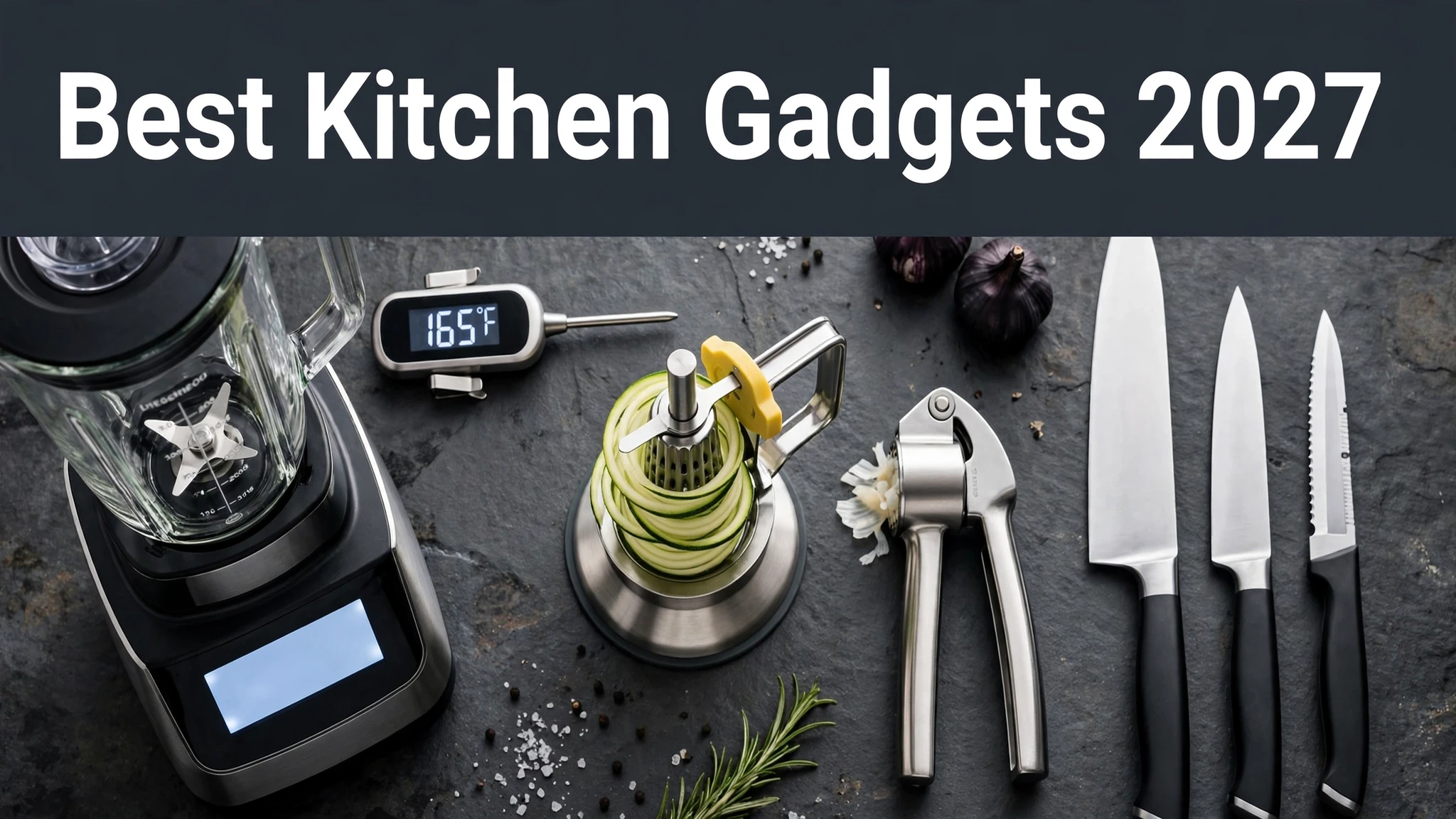
Best Kitchen Gadgets of 2027 Worth Your Money
In this post
- The Air Fryer: The Gadget That Earned Its Place
- A Good Knife and a Solid Chopping Board
- Blenders, Food Processors, and the Tools That Save Effort
- Rice Cookers, Slow Cookers, and Set-and-Forget Cooking
- Scales, Thermometers, and the Tools That Improve Results
- What to Skip: Gadgets That Waste Money and Space
- The Second Tier: Gadgets Worth Adding Later
- Buying Gadgets Second-Hand Without Regret
- The Kitchen of 2027: Smart Gadgets and What Is Next
- My Take:
A kitchen gadget is worth buying only if it saves you time, makes a task easier, or helps you cook better, and most gadgets fail that test. They sit in a cupboard, unused, while the cook reaches for a knife, a pan, and a board. The best gadgets of 2027 are different. They are the tools that earn their place on the counter, that get used every week, and that make a real difference to everyday cooking. This guide brings together the gadgets that are genuinely worth your money, and it is honest about the ones that are not.
It covers the tools that save time, the ones that improve results, and the ones that are worth their price, from air fryers to blenders, from a good knife to a rice cooker. It also covers what to skip, because a kitchen full of gadgets is not a better kitchen. A kitchen with a few good tools, used well, is. Whether you are setting up a first kitchen or upgrading the one you have, this guide will help you spend wisely.
The Air Fryer: The Gadget That Earned Its Place
The air fryer is the most useful kitchen gadget of recent years, and it has earned its place on the counter. It is a small convection oven that circulates hot air, making food crisp with little oil, and it cooks faster than a conventional oven. It is excellent for chips, chicken, fish, and vegetables, and it is superb for reheating leftovers, restoring crispness in a way a microwave cannot. A good air fryer costs less than a takeaway habit, it is easy to clean, and it is used several times a week by most owners. That is the test of a good gadget: it is used, not stored.
When choosing an air fryer, buy one that fits your household: a small basket for one or two people, a larger one for a family, and a dual-basket model if you want to cook two things at once. Do not buy the cheapest model, because the basket and the coating matter, and do not buy every accessory, because most are unnecessary. A basic basket, a pair of tongs, and a spray bottle are enough. The air fryer is the single gadget most worth buying in 2027, because it saves time, it saves energy, and it makes home cooking easier. If you buy one gadget this year, buy this one.
A Good Knife and a Solid Chopping Board
A good knife is the most important tool in any kitchen, and it is worth spending money on. A single, well-made chef’s knife, kept sharp, will do almost every cutting task, from chopping vegetables to slicing meat, and it will last for years. A cheap, blunt knife is slower, more dangerous, and more frustrating, because it slips and crushes rather than cutting. Buy one good knife, learn to keep it sharp with a honing steel or a sharpener, and store it safely, in a block or on a magnetic strip, not loose in a drawer.
A solid chopping board is the knife’s partner. A large wooden board is best for most tasks, because it is kind to the blade and it does not slip. A plastic board is useful for meat, because it can go in the dishwasher. Buy a board that is large enough to work on comfortably, and keep it clean and dry. A knife and a board are not gadgets in the usual sense, but they are the foundation of a kitchen, and they are worth more than any electrical device. A cook with a sharp knife and a good board can do almost anything. A cook with a drawer full of gadgets and a blunt knife cannot.
Blenders, Food Processors, and the Tools That Save Effort
A blender is a genuinely useful gadget, especially for smoothies, soups, and sauces. A good blender can turn frozen fruit, yoghurt, and oats into a breakfast in two minutes, and it can make a soup silky smooth. When choosing one, look for a powerful motor, a glass or sturdy plastic jug, and a design that is easy to clean. A personal blender, with a cup that doubles as a bottle, is a good choice for one person, while a full-size blender suits a family. Avoid the cheapest models, which struggle with frozen fruit and ice, and which break quickly.
A food processor is useful for chopping, grating, and making dough, and it saves a great deal of time if you cook in bulk. It is best for people who cook often and in quantity, and it is less useful for a single person who cooks simple meals. A hand blender, also called a stick blender, is a cheaper, smaller alternative that is excellent for soups and sauces, and it is easy to store. Choose based on what you actually cook: if you make smoothies daily, buy a blender. If you make soup weekly, buy a hand blender. If you rarely chop in bulk, skip the food processor. The right tool is the one that matches your cooking, not the one with the most features.
Rice Cookers, Slow Cookers, and Set-and-Forget Cooking
A rice cooker is a simple device that does one thing perfectly: it cooks rice. It is worth buying if you eat rice often, because it produces consistent results, it keeps rice warm, and it frees you from watching a pot. A basic rice cooker is inexpensive, and it is more reliable than cooking rice on the hob, where it can burn or boil over. A slow cooker is a different kind of set-and-forget device: it cooks stews, curries, and soups slowly, over hours, and it is ideal for busy people who want to come home to a ready meal. Put the ingredients in the morning, turn it on, and dinner is ready in the evening.
Both devices suit people who want to save time and effort, and they are particularly useful for batch cooking. A slow cooker can make a large stew that provides meals for several days, and a rice cooker can make a perfect pot of rice every time. They are not essential for everyone: if you rarely eat rice, skip the rice cooker, and if you do not cook stews, skip the slow cooker. But for the households that use them, they are among the most valued gadgets in the kitchen, because they turn cooking into a background task, rather than a demanding one.
Scales, Thermometers, and the Tools That Improve Results
A kitchen scale is a small, inexpensive tool that improves cooking more than almost any gadget. Baking by weight is far more accurate than baking by cups, and a scale removes the guesswork from recipes. It is also useful for portion control, for coffee, and for any recipe where accuracy matters. A digital scale is cheap, it is easy to use, and it takes up almost no space. Every kitchen should have one, and it is one of the best-value purchases you can make.
A food thermometer is another small tool that improves results, especially for meat. It tells you when a roast is cooked, when chicken is safe, and when a steak is done to your liking, without cutting into it and losing the juices. A simple probe thermometer is inexpensive and accurate. A pair of good tongs, a peeler, and a microplane grater are also worth having: they are cheap, they are used daily, and they make cooking easier. These small tools are not glamorous, but they are the ones that separate a kitchen that works from one that frustrates. Buy them, use them, and your cooking will improve.
What to Skip: Gadgets That Waste Money and Space
Not every gadget is worth buying, and some are a waste of money and space. An avocado slicer, an egg separator, a garlic press that is hard to clean, and a single-use device for one task are all examples of gadgets that do a job a knife can do better. A spiraliser, a popcorn maker, and a yogurt maker are useful only if you use them weekly, and most people do not. A bread machine is convenient, but it takes up a great deal of space, and a loaf made by hand, or bought from a bakery, is often better.
The test for any gadget is simple: will you use it at least once a week, will it save you time or improve your results, and do you have space to store it? If the answer to any of these is no, do not buy it. Be wary of gadgets sold on social media, which are often demonstrated in ideal conditions and rarely used in real kitchens. A kitchen with a few good tools, used well, is better than a kitchen full of gadgets that gather dust. Spend your money on the tools that earn their place, and skip the rest. Your kitchen, and your wallet, will thank you.
The Second Tier: Gadgets Worth Adding Later
Once you have the basics, a few second-tier gadgets can make cooking easier, and more enjoyable, but they are only worth buying if you have a clear use for them. A food processor is a good example: it chops, slices, and mixes, quickly, and it is useful if you cook for many people, or if you make sauces, and doughs, regularly. But if you cook simple meals, for one or two, a good knife will do the same job, and a food processor will sit in a cupboard, unused. A stand mixer is similar: it is excellent for baking, for kneading dough, and for whipping, but it is large, and expensive, and it is only worth the cost, and the space, if you bake often.
A slow cooker is another second-tier gadget that is worth considering, because it turns cheap cuts of meat, into tender stews, with very little effort, and it is ideal for busy days, when you want dinner ready, when you get home. A blender is useful for smoothies, and soups, but a small, simple one will do, and you do not need a high-powered model, unless you blend frozen fruit, or nuts, regularly. The rule for second-tier gadgets is the same as for the first tier: buy them when you have a specific need, and when you have used the basic tools, and found their limits. Add them slowly, one at a time, and you will build a kitchen that suits you, rather than a collection of gadgets that you do not use.
Buying Gadgets Second-Hand Without Regret
Buying a kitchen gadget second-hand can save you a great deal of money, and it is often a good choice, because many gadgets are used only a few times, and then sold, in excellent condition. A stand mixer, a food processor, or a bread machine, bought second-hand, may cost half the price of a new one, and it will work just as well, if you check it carefully. The key is to test it before you buy, if possible, and to check that all the parts are present, that the motor runs smoothly, and that there is no damage, or rust, or a burning smell. Ask the seller why they are selling it, and how often they used it, and look for signs of wear, on the blades, or the bowl.
It also helps to buy from a reputable source, such as a local shop that tests its goods, or a seller with good reviews, rather than a random listing, with no history. And remember that some gadgets are better bought new, because they are cheap, or because they wear out quickly, such as non-stick pans, or blenders with plastic parts. But for sturdy, expensive gadgets, second-hand is a sensible choice, and it is a way to get a better tool, for less money, and to reduce waste, at the same time. A gadget that is second-hand is not a compromise. It is a smart purchase, if you choose it well.
The Kitchen of 2027: Smart Gadgets and What Is Next
The kitchen is changing, and the gadgets of 2027 are smarter, more connected, and more capable than ever before, but the question is whether they are genuinely useful, or merely novel. Smart ovens that can recognise food, fridges that can order groceries, and cookers that can be controlled by voice are all available, and they promise convenience, but they also raise questions about cost, privacy, and reliability. A smart gadget that works well can save time, and make cooking easier, but a smart gadget that fails, or that requires a subscription, or that collects your data, may be more trouble than it is worth. The key is to judge a gadget by what it does for you, not by how clever it seems.
One of the most useful developments is the improvement in sensors and automation, which allow gadgets to do tasks more accurately than a person can. A sous-vide cooker that holds a precise temperature, a coffee machine that grinds and brews to your taste, or an oven that adjusts its heat automatically, can all produce better, more consistent results, and they can free you to focus on other parts of cooking. These are not gimmicks. They are tools that use technology to improve a real task, and they are worth considering, if they fit your cooking, and your budget. The best smart gadgets are the ones that disappear into the background, and that make your life easier, without demanding attention.
Another development is connectivity, which allows gadgets to be controlled remotely, to receive updates, and to work together. A slow cooker that you can start from work, or an oven that you can preheat on your way home, can be genuinely useful, especially for busy people. But connectivity also has drawbacks: it requires a reliable internet connection, it may require an app, and it may collect data about your habits. Before buying a connected gadget, ask whether you need the connectivity, or whether a simpler, non-connected version would do the same job, for less money, and with less risk. Often, the answer is that you do not need it, and that a simple gadget is better.
There is also the question of longevity, and of repair. A smart gadget that cannot be repaired, or that stops working when the manufacturer stops supporting it, is a poor investment, however clever it is. A simple, well-made gadget, such as a good knife, or a cast-iron pan, can last a lifetime, while a smart gadget may last only a few years. When you buy a gadget, consider how long it will last, whether it can be repaired, and whether it will still be useful in five years. The most sustainable gadget is the one you do not need to replace, and the most economical is the one that lasts. That is true in 2027, as it was in any year.
Finally, remember that the kitchen of the future is not about having the most gadgets, but about having the right ones, and using them well. A kitchen with a few good tools, used skilfully, will produce better food than a kitchen full of smart gadgets, used poorly. Technology can help, but it cannot replace skill, taste, and care, and the best cooks are the ones who understand that. Choose gadgets that solve a real problem, that fit your cooking, and that you will use regularly, and ignore the rest, however clever they seem. The kitchen of 2027 is exciting, but it is still a kitchen, and the most important thing in it is still the cook.
My Take:
I own a drawer full of gadgets I never use, and I’m going to be honest about that, because it’s the reason I can tell you which ones matter. The avocado slicer, the egg separator, the special garlic press: they seemed clever in the shop and they’ve been used twice. The air fryer, the sharp knife, and the kitchen scale get used every week. The difference isn’t the gadget. It’s whether it solves a problem I actually have, every week, or whether it solves a problem I imagined having once. That’s the test, and most gadgets fail it.
The purchase I would defend most is the least exciting one: a kitchen scale. It cost very little, it takes up no space, and it changed my baking completely. Recipes by weight are accurate in a way that cups never are, and the difference shows in the result. I think the most useful gadgets are often the most boring ones, and the most exciting-looking ones are often the least useful. A scale, a thermometer, a good knife: these are not glamorous, but they are the tools that make cooking better, day after day. The gadgets that look good in a video are usually the ones that gather dust.
Let me be direct about the air fryer, because it’s the gadget everyone asks about. Yes, it’s worth it, if you cook for one or two people and you eat chips, chicken, or vegetables regularly. It’s fast, it’s easy to clean, and it reheats leftovers better than anything else. But it’s not a miracle, and it won’t replace your oven. If you cook large meals for a family, a big oven is still better. The air fryer earns its place by being used constantly, not by being impressive. Buy the size that fits your household, skip the accessories, and use it for what it’s good at. That’s the whole secret.
What surprised me was how much space matters. A gadget that lives on the counter gets used. A gadget that lives in a cupboard gets forgotten. That’s not a flaw in the gadget. It’s human nature. Before you buy anything, ask where it will live. If there’s no space on the counter, and you’re not willing to get it out of a cupboard every time, don’t buy it. The best gadget is the one you can reach without thinking, and that’s why the knife, the board, and the scale matter more than the clever device in a box.
So my advice is simple. Buy a good knife and keep it sharp. Buy a scale. If you cook for one or two, buy an air fryer. If you make smoothies, buy a blender. Skip everything else until you’ve used those for a month and you know what’s missing. Your kitchen doesn’t need more gadgets. It needs fewer, better ones, used well. That’s the difference between a kitchen that works and a kitchen that’s full of good intentions.
Most gadgets are bought for a fantasy, not for a real habit, and it is worth being honest about that before you spend money. A bread machine is bought by someone who imagines baking every weekend, and a juicer is bought by someone who imagines a glass of fresh juice every morning, and in both cases the fantasy fades, and the gadget sits in a cupboard, used twice. The test is simple: have you done the thing the gadget does, by hand, in the last month? If you have baked bread by hand, and you want to do it more easily, a bread machine makes sense. If you have never baked bread, the machine will not make you a baker. Buy the gadget for the habit you already have, not for the habit you wish you had, and you will use it, and it will earn its place.
Maintenance is the other half of the story, and it is the part that decides whether a gadget lasts a year or a decade. A knife needs sharpening, not replacing, and a whetstone, or a professional sharpening once a year, will keep a good knife working for decades. A coffee machine needs descaling, a blender needs its seals checked, and a food processor needs its blades kept sharp, because a dull blade crushes food instead of cutting it, and the result is worse, and the motor works harder. Those small acts of care take minutes, and they are easy to forget, but they are what separate a kitchen full of broken gadgets from a kitchen full of tools that work. Buy less, buy for the habit you have, and look after what you own, and your kitchen will serve you far better than a cupboard full of promises.
The future is exciting, but I would urge caution, because not every smart gadget is a good gadget, and not every new technology is an improvement. A gadget that is clever, but unreliable, or that requires a subscription, or that collects your data, is not a good investment, however impressive it seems. I would judge a gadget by a simple test: does it solve a real problem, does it work reliably, and will I still use it in a year? If the answer is yes, then it is worth considering. If the answer is no, then it is a novelty, and it will end up in a drawer, with the other gadgets that seemed like a good idea at the time. Be sceptical, be practical, and choose well.
I also think we should be honest about the fact that the best kitchen tools are often the simplest, and the oldest. A good knife, a solid chopping board, a cast-iron pan, and a reliable oven have been the foundation of good cooking for generations, and they will still be the foundation in 2027, whatever smart gadgets are invented. Technology can improve cooking, but it cannot replace skill, and it cannot replace the judgement of a cook who knows their ingredients, and their tools. Invest in the basics first, master them, and then, if you want, add a smart gadget that genuinely helps. That order matters, and it will save you money, and frustration.
Another point I would make is about longevity, and about the environment, because a gadget that lasts a few years and then becomes waste is a poor choice, however clever it is. A well-made, repairable tool, that lasts a lifetime, is better for your wallet, and for the planet, than a smart gadget that must be replaced every few years. When you buy, ask how long it will last, whether it can be repaired, and what will happen when the manufacturer stops supporting it. Those questions are not boring. They are responsible, and they are the questions that a thoughtful buyer asks. Choose tools that last, and you will be happier, and you will waste less.
And the final thing I would say is to remember that the cook is more important than the gadget, and that no gadget, however smart, can replace taste, care, and attention. A good meal is made by a person who cares about ingredients, who pays attention, and who enjoys cooking, not by a machine. Use gadgets to help you, but do not let them replace you. Cook with your hands, taste as you go, and enjoy the process, because that is what cooking is: a human activity, a pleasure, and a way of caring for yourself, and for others. The kitchen of 2027 may be smart, but it is still yours, and the most important thing in it is still you.
Frequently Asked Questions
What is the best kitchen gadget to buy in 2027?
An air fryer is the most useful gadget for most households, because it cooks fast, crisps food with little oil, and reheats leftovers well. A good knife and a kitchen scale are equally important and are used even more often.
Is an air fryer worth the money?
Yes, for most households. It cooks faster than an oven, uses less energy for small meals, and is excellent for chips, chicken, vegetables, and reheating. Buy a size that fits your household and skip unnecessary accessories.
What kitchen gadgets are a waste of money?
Single-use gadgets such as avocado slicers, egg separators, and spiralizers are usually a waste, because a knife does the job better and they gather dust. Buy a gadget only if you will use it at least once a week.
Do I need a food processor?
A food processor is useful if you cook in bulk and chop, grate, or make dough often. For simple cooking, a good knife and a hand blender are enough, and a food processor may take up space without earning its place.
What is the most important kitchen tool?
A sharp chef’s knife is the most important tool, followed by a solid chopping board and a kitchen scale. These three cover almost every task and improve results more than any electrical gadget.
Is a rice cooker worth buying?
A rice cooker is worth it if you eat rice often, because it cooks consistently, keeps rice warm, and frees you from watching a pot. If you rarely eat rice, it is not worth the counter space.