The Best Waterfalls in the World to Visit in 2027
In this post
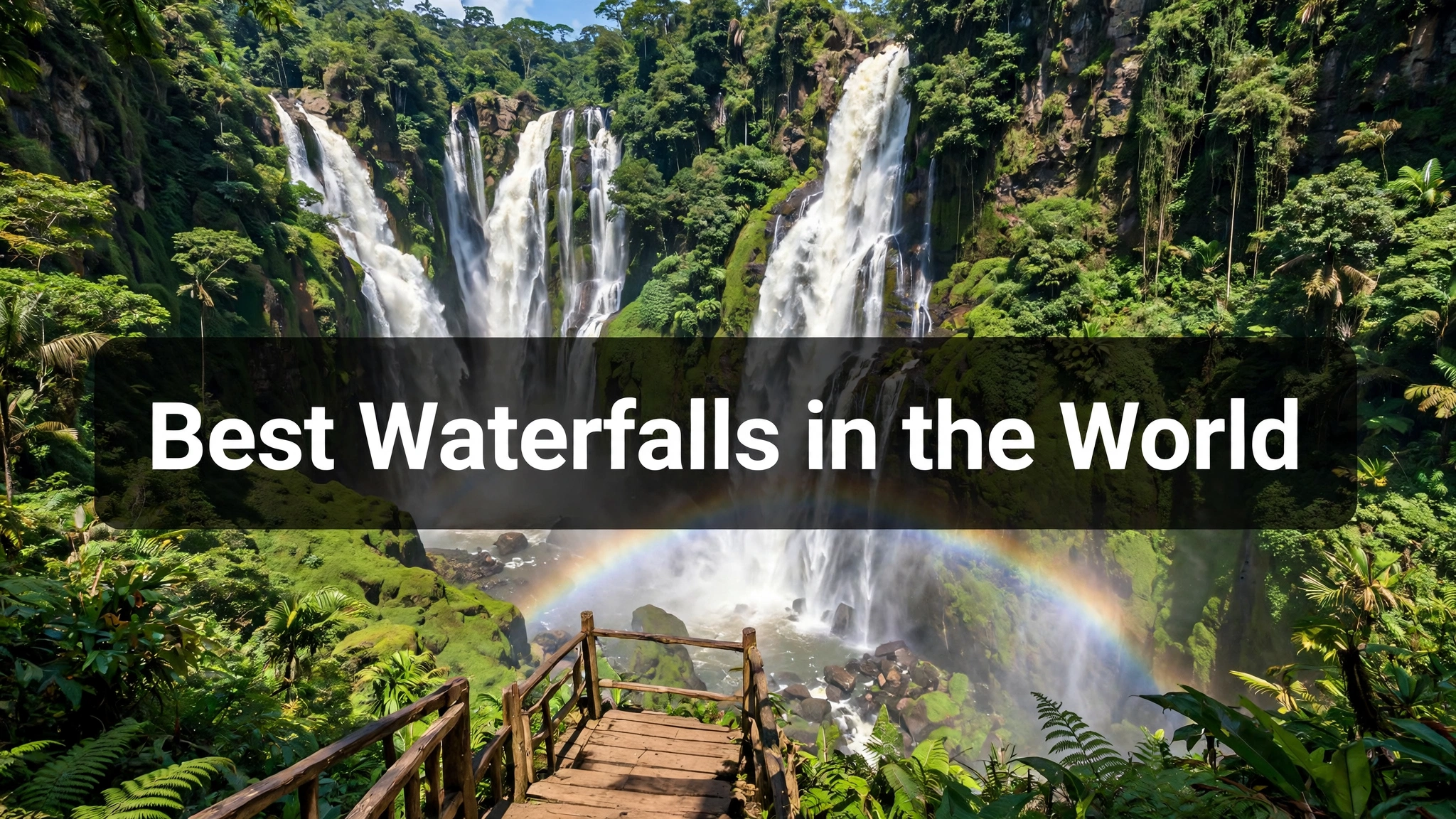
Waterfalls are among the most spectacular sights in nature, where a river drops suddenly over a cliff, creating a curtain of water, a cloud of mist, and a roar that can be heard from miles away. The best waterfalls are not just tall; they are powerful, beautiful, and set in landscapes that make the visit memorable. In 2027, with travel fully back to normal, many of the world’s great waterfalls are easier to visit than ever, and this guide covers the best of them, from Iguazu to Niagara to Victoria Falls, with practical tips for planning a trip. Conditions and access can change, so check local sources before travelling.
A waterfall forms where a river flows over a layer of hard rock, which erodes slowly, over a layer of soft rock, which erodes quickly, creating a step that grows into a fall. Over time, the waterfall retreats upstream, carving a gorge. That process has created some of the most famous landscapes on Earth, and it continues today. This article looks at the most impressive waterfalls, what makes each one special, and how to visit them safely and responsibly.
Iguazu Falls: The Greatest Waterfall System
Iguazu Falls, on the border of Argentina and Brazil, is one of the largest waterfall systems in the world, with around 275 separate falls spread over nearly three kilometres. The most famous part is the Devil’s Throat, a U-shaped chasm where water plunges more than eighty metres into a misty abyss. Iguazu is set in subtropical rainforest, home to toucans, monkeys, and butterflies, and it is a UNESCO World Heritage Site. The best time to visit is in the drier months, when the water is clear and the trails are accessible, although the falls are impressive year-round. Boardwalks take visitors close to the falls, and boat trips offer a thrilling, wet view from below.
That is why protecting biodiversity matters, not only for the species themselves, but for the services they provide, such as pollination, clean water, and healthy soil. Losing a species is not just losing a name on a list; it is losing a piece of a system that supports us all. Each species, no matter how small or how ordinary, has a role in its ecosystem, and removing one can have effects that ripple far beyond what anyone expected. A bee that pollinates a flower, a wolf that controls deer, a tree that shelters birds: each one is part of a web, and the web is stronger when it is diverse.
Clean air, clean water, fertile soil, and a stable climate are all provided by nature, and they are not free in the sense that they can be used without limit. When we damage nature, we damage ourselves, although the damage may not be visible immediately. Recognising that connection, and acting on it, is the most important lesson nature can teach us, and it is a lesson we are still learning. There is a temptation to treat nature as a resource to be used, or as a backdrop for photographs, but it is more than that. It is a system we belong to, and our health depends on it.
Niagara Falls: Power and History
Niagara Falls, on the border of the United States and Canada, is one of the most famous waterfalls in the world, and it is known for its power and its history. The falls consist of three parts, Horseshoe Falls, American Falls, and Bridal Veil Falls, and they carry a huge volume of water, especially in spring when snow melts. Niagara has been a tourist destination for more than a century, with boat trips, viewpoints, and a town built around the falls. The best time to visit is in summer, when the weather is warm and the falls are at their fullest, although winter offers a different, icy beauty. Niagara is accessible, affordable, and a good first waterfall for many travellers.
One more thing worth noting is how much of nature is invisible to the naked eye. Microbes in the soil, plankton in the ocean, and fungi underground all do work that is essential to life, yet we rarely see them. That invisibility makes them easy to ignore, but it does not make them unimportant. In fact, the smallest organisms frequently have the largest effect, because they are the foundation on which larger life depends. Paying attention to the invisible, through science and through curiosity, is a reminder that the world is far more complex than it looks.
That process is slow, and it is sometimes frustrating, because a question that seemed settled can reopen when fresh evidence arrives. That is not a weakness of science; it is its strength. A guide that admits uncertainty, that says what is known and what is still unknown, is more trustworthy than one that pretends to have all the answers. Readers should be wary of any account that sounds too certain about a complex natural system, because nature is rarely simple. Science is often presented as a collection of facts, but in reality it is a process of asking questions, testing ideas, and changing your mind when the evidence changes.
Victoria Falls: The Smoke That Thunders
Victoria Falls, on the border of Zambia and Zimbabwe, is known locally as Mosi-oa-Tunya, the Smoke That Thunders, because of the huge cloud of spray it produces. It is the largest waterfall in the world by combined width and height, with a width of more than 1,700 metres and a height of more than 100 metres. During the rainy season, the falls are at their most powerful, with a roar and a spray that can be seen from miles away. The best time to visit is from February to May, after the rains, when the water is high, although the spray can obscure the view. Activities include walking trails, helicopter flights, and white-water rafting on the Zambezi River below the falls.
Both kinds of knowledge matter, and the best naturalists combine them: they use technology to learn, and they use their senses to understand. Technology has changed how we study nature, and it has opened windows that were previously closed. Satellite tracking shows where animals migrate, underwater microphones record whale songs, and cameras in nests show behaviour that humans rarely see. That technology is exciting, but it does not replace the need to go outside, to look, and to listen. A satellite can tell you where a bird is, but it cannot tell you what it feels like to hear it sing at dawn.
Not everything needs to happen quickly, and some of the most important things happen gradually. Learning to wait, to watch, and to let nature take its course is a skill, and it is one that makes us better observers, better stewards, and better people. Patience is not passivity; it is attention over time, and it is the heart of natural history. Finally, the natural world teaches patience. A tree grows slowly, a river carves a valley over millions of years, and a species evolves over even longer timescales. That patience is a contrast to our fast, impatient culture, and it is a useful corrective.
Angel Falls and Other Tall Waterfalls
Angel Falls in Venezuela is the world’s tallest waterfall, with a drop of nearly 979 metres from a flat-topped mountain called a tepui. It is remote, requiring a flight and a river trip to reach, but it is one of the most awe-inspiring sights in the world. Other tall waterfalls include Tugela Falls in South Africa, which is the second tallest, and Yosemite Falls in California, which is one of the tallest in North America and is best visited in spring when snow melts. Tall waterfalls are often seasonal, with the best flow in spring or after rain, so timing matters. Visiting a tall waterfall requires planning, but the reward is a sight that few people ever see.
A walk with attention is more educational than a long journey without it, since attention turns a familiar place into a fresh one. That habit of noticing is the foundation of all natural history. The most interesting thing about the natural world is how much of it happens without us noticing, and how much we miss when we rush past it. A bee visiting a flower, a bird singing before dawn, a tree sharing nutrients underground: all of these are happening every day, in ordinary places, and they are easy to overlook. Slowing down, paying attention, and learning to notice modest details is the starting point for understanding nature, and it costs nothing.
A single beautiful park is not enough if the land around it is destroyed, because nature does not respect boundaries drawn on a map. Protected areas, such as national parks and nature reserves, are essential, but they are not enough on their own. Animals move, rivers flow, and birds migrate, so a park that protects one place may not protect the whole journey. Connecting protected areas with corridors, protecting habitats outside parks, and reducing pollution and habitat loss everywhere are all part of conservation. That work is slow and often unglamorous, but it is the work that matters most.
Plitvice, Krka and Europe’s Waterfalls
Europe has beautiful waterfalls too, although they are smaller than the great falls of the Americas and Africa. Plitvice Lakes in Croatia is a UNESCO site with a series of lakes and waterfalls connected by boardwalks, set in a forested valley. Krka National Park, also in Croatia, offers waterfalls where visitors can swim in summer. In Iceland, waterfalls such as Seljalandsfoss, where you can walk behind the fall, and Skógafoss, with its wide curtain of water, are popular stops on the Ring Road. In Norway, waterfalls cascade from mountains into fjords, creating dramatic scenery. European waterfalls are accessible, well managed, and a good option for a shorter trip.
Responsible visiting means staying on paths, keeping a distance from animals, leaving no trace, and supporting local people who protect the place. It is not about spoiling the fun; it is about making sure the fun is available for the next visitor, and for the wildlife that lives there. A wild place is a privilege to visit, not a right to consume, and treating it as a privilege keeps it wild. When we visit wild places, we leave a mark, whether we intend to or not. Footprints, litter, noise, and disturbance all affect wildlife and habitats, and the effect grows as more people visit.
Nature is everywhere, if you look for it, and looking for it is the first step to caring for it. Finally, it is worth saying that nature is not only out there, in parks and wilderness; it is also here, in cities, in gardens, and in the sky above a street. A pigeon on a roof, a tree on a pavement, a weed in a crack: all of these are nature, adapting to human life. Noticing that urban nature, and valuing it, is a way to stay connected to the natural world even when you cannot travel to a famous place.
How to Visit Waterfalls Safely and Responsibly
Visiting waterfalls safely requires common sense and respect for the power of water. Stay on marked paths and viewpoints, do not climb on wet rocks, and do not swim in pools above or below a waterfall unless it is explicitly allowed and safe. Waterfall spray can make paths slippery, so wear good shoes and carry a waterproof jacket. Respect local rules, do not litter, and do not disturb wildlife. If you visit in the rainy season, check conditions, because water levels can rise rapidly and trails can close. A waterfall is beautiful, but it is also powerful, and the best visits are those where you enjoy the view safely and leave the place as you found it.
A fisherman who knows where a species feeds, a farmer who knows when a bird arrives, a guide who knows which valley holds fog: all of these individuals know things that no textbook contains. Listening to that knowledge, and combining it with scientific research, gives a fuller picture than either one alone. Community science, where ordinary people record what they see, is also valuable, because it creates data over a large area and a long time that no single researcher could collect. Nature belongs to everyone, and everyone can contribute to understanding it. Local knowledge is often undervalued in science, but it is essential.
That is a hopeful message, since it means the world still holds surprises, and that curiosity is still rewarded. It also means we should be humble about what we know, because the next discovery could change our understanding completely. The natural world is not a closed book; it is an open one, and every cautious observer can add a page to it. Exploration is not finished. Fresh species are still being discovered, fresh caves are still being mapped, and new behaviours are still being observed, even in places that seem well known.
Choosing the Best Waterfall for Your Trip
Choosing the best waterfall depends on what you want. If you want power and scale, choose Iguazu or Victoria Falls. If you want accessibility and history, choose Niagara. If you want height and remoteness, choose Angel Falls. If you want a shorter, European trip, choose Plitvice or an Icelandic waterfall. Consider the season, the travel time, the cost, and your fitness, because some waterfalls require hiking or a boat trip. Whatever you choose, plan ahead, book early in peak season, and allow time to enjoy the surroundings, not just the fall itself. A waterfall is best experienced slowly, with time to watch the water, to listen to the roar, and to feel the mist on your face.
There is likewise a lesson in how animals adapt to changing conditions. A bird that changes its migration timing, a plant that flowers earlier, a fish that moves to cooler water: all of these are responses to a changing world. Some species adapt well, others do not, and the difference frequently decides whether they survive. Studying adaptation helps us understand resilience, and it helps us predict which species are most at risk. That knowledge is useful, since it tells us where to focus our protection efforts, and it reminds us that change is not invariably a disaster, but it can be.
The more we understand, the better we can protect the places and species we love. Climate change is not an abstract future problem; it is already changing where species live, when they breed, and how often extreme events happen. A bird that arrives too early for the insects it feeds on, a flower that blooms before its pollinator appears, a coral reef that bleaches in warm water: all of these are signs of a system out of sync. Understanding those changes requires long records, careful observation, and honest reporting, since a single warm year proves little, but a trend over decades proves a great deal.
My Take:
Waterfalls are a reminder that water, which seems so gentle, can be incredibly powerful, and I think that is why they inspire awe. A river that flows quietly through a forest can, in a single drop, become a roaring curtain of water that shakes the ground. That transformation, from calm to power, is dramatic, and it is a good metaphor for nature itself: beautiful, but not tame. I believe the best waterfall visits are the ones where you take time to feel that power, to stand in the mist, and to listen, rather than rushing to take a photo and leave. Another opinion I hold is that science writing should be honest about uncertainty. When researchers disagree, or when evidence is thin, saying so is respect for the reader, not weakness. Too much popular writing presents a single neat explanation as if the case were closed, and readers feel betrayed when the story changes. I would rather read an account that says what is known, what is guessed, and what is still unknown, because that account can be trusted when new evidence arrives. Nature is complicated, and a guide that admits that is more useful than one that pretends otherwise.
I also think waterfalls teach us about patience. A waterfall that looks eternal is actually changing, retreating upstream, carving a gorge, and reshaping the land over thousands of years. The water you see today will be gone in a moment, but the fall will remain, changed only slightly. That mix of permanence and change is part of what makes waterfalls so fascinating. If you visit one in 2027, take your time, respect the power, and enjoy the moment, because a waterfall is a place where the Earth’s history is visible, in water and in rock. I also want to say something about responsibility. Visiting wild places and sharing photographs all have an effect, and the effect grows as more people do it. Keeping a distance, staying on paths, and leaving no trace are not rules for other people; they are the price of being allowed to visit at all. The best travellers are the quiet ones, who leave a place as they found it and who support the local people who protect it. Enjoyment and care are not opposites; care is what makes enjoyment possible for the next person.
Waterfalls are a reminder that water, which seems so gentle, can be incredibly powerful, and I think that is why they inspire awe. A river that flows quietly through a forest can, in a single drop, become a roaring curtain of water that shakes the ground. That transformation, from calm to power, is dramatic, and it is a good metaphor for nature itself: beautiful, but not tame. I believe the best waterfall visits are the ones where you take time to feel that power, to stand in the mist, and to listen, rather than rushing to take a photo and leave. Finally, my take is that the real gift of learning about nature is a changed way of looking. Once you know why a whale sings, how a bee dances, or how trees share resources, you cannot unsee it. The world becomes more alive, more connected, and more worth protecting. That change in seeing lasts longer than any single trip, and I hope readers carry it with them on their next walk, their next night under the sky, and their next conversation about a place they love. That is where knowledge turns into care.
I also think waterfalls teach us about patience. A waterfall that looks eternal is actually changing, retreating upstream, carving a gorge, and reshaping the land over thousands of years. The water you see today will be gone in a moment, but the fall will remain, changed only slightly. That mix of permanence and change is part of what makes waterfalls so fascinating. If you visit one in 2027, take your time, respect the power, and enjoy the moment, because a waterfall is a place where the Earth’s history is visible, in water and in rock. I also believe that protecting nature is not only about saving rare species; it is about saving the ordinary places where we live. A local park, a river, a hedgerow: all of these matter, and they are often the places most at risk, because they are not famous enough to be protected. Caring for the ordinary is as important as caring for the spectacular, because the ordinary is where most life happens, and where most people meet nature. Start where you are, protect what is near, and the rest will follow.
Waterfalls are a reminder that water, which seems so gentle, can be incredibly powerful, and I think that is why they inspire awe. A river that flows quietly through a forest can, in a single drop, become a roaring curtain of water that shakes the ground. That transformation, from calm to power, is dramatic, and it is a good metaphor for nature itself: beautiful, but not tame. I believe the best waterfall visits are the ones where you take time to feel that power, to stand in the mist, and to listen, rather than rushing to take a photo and leave. My view is that nature is most interesting when we stop treating it as a backdrop and start treating it as a system we belong to. A river, a cave, or a light in the sky is not just a beautiful sight; it is evidence of forces that have worked for far longer than we have been watching. That perspective is humbling, because it reminds me how small a human life is, and hopeful, because it shows how much there is still to learn. Admiration without care is not enough; the places we love need protection, not just attention.
I also think waterfalls teach us about patience. A waterfall that looks eternal is actually changing, retreating upstream, carving a gorge, and reshaping the land over thousands of years. The water you see today will be gone in a moment, but the fall will remain, changed only slightly. That mix of permanence and change is part of what makes waterfalls so fascinating. If you visit one in 2027, take your time, respect the power, and enjoy the moment, because a waterfall is a place where the Earth’s history is visible, in water and in rock. I also believe curiosity is a skill that can be practised anywhere. You do not need an expensive trip to notice something worth understanding. A bird singing before dawn, a bee moving between flowers, a tree whose roots connect to its neighbours: all of these are within reach of an ordinary walk, if you slow down. We lose a great deal by rushing past the ordinary in search of the spectacular, because the ordinary is where understanding begins. The spectacular makes a good photograph, but the ordinary, understood properly, changes how you see everything.
Frequently Asked Questions
What is the best waterfall in the world to visit?
Iguazu, Niagara, and Victoria Falls are among the best, each offering a different experience: scale, accessibility, and power respectively.
What is the tallest waterfall in the world?
Angel Falls in Venezuela, with a drop of nearly 979 metres, is the world’s tallest waterfall.
When is the best time to visit Victoria Falls?
February to May, after the rainy season, is best for high water, although the spray can be intense at that time.
Can you swim at waterfalls?
Only where it is explicitly allowed and safe; many waterfall pools are dangerous due to currents, slippery rocks, and falling water.
What is the largest waterfall by width and height?
Victoria Falls is the largest by combined width and height, at over 1,700 metres wide and over 100 metres high.
How do waterfalls form?
They form where a river flows over hard rock onto soft rock, which erodes faster, creating a step that grows into a fall.