Billie Holiday: The Life Story Behind the Tragic Voice
In this post
Billie Holiday was born on 7 April 1915 in Philadelphia, Pennsylvania, and she grew up in Baltimore, Maryland, in poverty, raised by her mother, Sadie Fagan, who was herself barely more than a child when Billie was born. Her childhood was hard in ways that are difficult to describe, and she left school early, worked as a maid, and was sent to a reform school. She came to music late and by accident, singing along to records in a Baltimore brothel where her mother worked, and discovering that she had a voice that made people stop and listen.
She arrived in New York in 1928, at thirteen, and she began singing in Harlem nightclubs, where she was heard by the producer John Hammond, who arranged her first recording in 1933. Within a few years she was singing with the best bands in the country, including Count Basie and Artie Shaw, and her records were selling across America. Her voice was unlike anyone else’s, thin and husky, with a way of bending a note and delaying a beat that made every song sound like a confession.
Holiday’s career was shadowed by racism, addiction and the law, and she spent time in prison and in hospitals, but she kept singing, and the recordings she made in the 1930s and 1950s are among the most admired in all of jazz. Strange Fruit, recorded in 1939, was a protest against lynching that no other singer of her time would touch, and it became her most famous song. She died in 1959, at 44, but her voice has never left the culture.
She died on 17 July 1959 in New York, at the age of 44, of heart and liver disease, after a life that was both brilliant and brutal. This is her life story, from a childhood in Baltimore to the stage of Carnegie Hall, and the voice that carried it all.
Baltimore and the Childhood
Eleanora Fagan was born on 7 April 1915 in Philadelphia, Pennsylvania, to Sarah Julia Fagan, known as Sadie, who was nineteen, and Clarence Holiday, a banjo player who was rarely present. The family moved to Baltimore, where Billie grew up in a poor neighbourhood, living with her mother in a series of small rooms and boarding houses. She left school at an early age and worked as a maid in the home of a white family, and she spent time in a reform school, the House of the Good Shepherd, after being caught skipping school. The details of those years are painful, and Holiday wrote about them with unusual candour in her autobiography, Lady Sings the Blues.
Music came to her through records. In the brothel where her mother worked, there was a Victrola, and the young Billie spent hours listening to Bessie Smith and Louis Armstrong, singing along and memorising every phrase. She had no training, and she could not read music, but she had an ear that caught the smallest details of a performance, and she learned to shape a song the way Armstrong shaped a solo, bending the melody and playing with the rhythm. The records were her school, and she was a devoted student.
In 1928, when she was thirteen, Holiday moved to New York with her mother, and she began singing in Harlem clubs, including the Log Cabin and Pod’s and Jerry’s, where she was paid in tips. She sang for the customers and for the musicians who came in after their own gigs, and word spread about the young singer with the unusual voice. She was heard by the producer John Hammond, who was one of the most important talent scouts in jazz, and he arranged her first recording session in November 1933, with Benny Goodman. She was eighteen, and her career had begun.
John Hammond and the First Records
John Hammond was a wealthy young man from a prominent family who had made himself into the most influential talent scout in American music, and he recognised in Holiday something he had not heard before. Her voice was small and husky, without the power of Bessie Smith or the sweetness of Mildred Bailey, but it had a quality that Hammond described as a kind of ache, a feeling that the singer had lived the words she was singing. He arranged for her to record with Benny Goodman in 1933, and the records, including Your Mother’s Son-in-Law, were modest sellers, but they introduced her to the record-buying public.
Hammond also arranged her first recordings under her own name, with Teddy Wilson’s band, in 1935, and those records established her as a major artist. She recorded What a Little Moonlight Can Do, Miss Brown to You and I Wished on the Moon, and the records sold well enough to keep her working. She was still a teenager, and she was already singing with a maturity that startled older musicians. Wilson’s band gave her a swinging, elegant backing, and her voice floated over it with a lightness that belied the weight of the words.
The Wilson sessions also introduced her to Lester Young, the tenor saxophonist, who became her closest musical partner and her dearest friend. Young gave her the nickname Lady Day, and she called him Prez, short for President, and the two of them developed a musical understanding that was almost telepathic. When Young played behind her, he followed her phrasing the way a shadow follows a body, and their recordings together are among the most beautiful in jazz. The friendship lasted until Young’s death in 1959, four months before Holiday’s own.
The Wilson sessions of 1935 to 1937 were recorded at a remarkable pace, with Holiday cutting dozens of songs in a few years, backed by the best musicians in New York, including the trumpeter Bunny Berigan and the pianist Teddy Wilson himself. The sessions were arranged by Hammond, who chose the songs and the players, and Holiday sang them with a freshness that surprised everyone in the studio. The records were not big sellers at first, but they established her reputation among musicians, and they are now regarded as the foundation of her art.
Strange Fruit and the Protest
In 1939 Holiday recorded Strange Fruit, a song about lynching in the American South, written by Abel Meeropol, a Jewish schoolteacher from New York who wrote under the name Lewis Allan. The song had been written as a poem, and Holiday’s manager was reluctant to let her record it, fearing it would damage her career. She insisted, and the record was made for Commodore, a small label, because her regular label, Columbia, refused to release it. The record became her biggest seller and her most famous song.
The song’s power lay in its restraint. Holiday sang the lyrics plainly, without embellishment, letting the words do the work, and the effect was devastating. Audiences who heard it live fell silent, and club owners asked her to sing it last, so that people would leave quietly instead of staying to drink. The song made her a controversial figure, and the Federal Bureau of Narcotics, which had been pursuing her for drug use, used the song as a reason to harass her, pressuring club owners not to book her and following her from city to city.
Strange Fruit remains one of the most important protest songs ever recorded, and it is the song most closely associated with Holiday’s name. It was inducted into the Grammy Hall of Fame, and it has been covered by singers from Nina Simone to Jeff Buckley, but no version has matched the original. Holiday herself said that singing it left her drained, and she often wept after performing it, but she kept singing it for the rest of her life, because she believed the song mattered more than her comfort.
Lester Young and Lady Day
Lester Young was the most important musical influence on Holiday’s life, and their partnership shaped both of their careers. Young played tenor saxophone with a light, floating sound that was the opposite of the heavy style that dominated the instrument, and his phrasing matched Holiday’s exactly, delaying the beat, bending the note, and finding the emotion in the spaces between the notes. When they recorded together, in the 1930s with Teddy Wilson and later with Young’s own band, the results were extraordinary, and musicians still study those records as examples of how two artists can breathe together.
Their friendship was as close as their music. Young called Holiday Lady Day, a name that stuck for the rest of her life, and she called him Prez, and they looked after each other through the hard years, sharing money, food and encouragement. Young was a gentle man who struggled with alcohol and with the racism of the music business, and Holiday understood him in a way few others did. When Young died in March 1959, Holiday was already ill herself, and friends said she never recovered from the loss.
The recordings they made together include some of the finest in jazz, among them This Year’s Kisses, Mean to Me and He’s Funny That Way. In each of them, Young’s saxophone follows Holiday’s voice like a second singer, answering her phrases and completing her thoughts. The partnership is often compared to the great vocal-instrumental pairings in classical music, and it is one of the reasons Holiday’s 1930s records are still regarded as the peak of her art.
God Bless the Child and the Hits
God Bless the Child, recorded in 1941, was Holiday’s biggest commercial success, a song she wrote herself, based on a phrase her mother used to say. The record sold more than a million copies, and it became one of her signature songs, a blues about money and family that she sang with a mixture of toughness and tenderness. The song’s success showed that she could write as well as sing, and it remains one of the most covered songs in the jazz repertoire.
Her other hits of the 1940s included Lover Man, recorded in 1944, a song about longing that she sang with an intensity that made listeners uncomfortable, and Don’t Explain, recorded in 1946, a song about infidelity that she wrote with Arthur Herzog Jr. The records sold steadily, and her concerts drew large crowds, but the success was shadowed by her growing dependence on heroin, which had begun in the early 1940s and which would dominate the rest of her life. She was arrested for the first time in 1947, and the arrest changed everything.
The arrest led to a prison sentence, and to the loss of her cabaret card, the licence that New York required for performers in nightclubs. Without the card she could not sing in the clubs where she had made her name, and she was forced to tour concert halls instead, a change that suited her voice but limited her income. She continued to record, and her later records for Verve, including the albums of the 1950s, are among her finest, but the prison sentence marked the beginning of a long decline that she never fully reversed.
Before the hits of the 1940s, Holiday spent a year singing with Count Basie’s band in 1937, one of the great swing orchestras, and the experience taught her how to sing with a big band and how to survive on the road. The tour took her through the South, where the band faced segregated hotels, restaurants and concert halls, and she learned to endure humiliations that white singers never faced. She left Basie’s band after a year, partly because of the touring conditions and partly because she wanted to sing with smaller groups, but the year with Basie made her a stronger performer.
The Voice and the Phrasing
Holiday’s voice was small, with a range of barely more than an octave, and it grew thinner as she aged, but it was one of the most expressive instruments in jazz. She sang behind the beat, delaying the note until the last possible moment, and she bent the pitch in ways that made the melody feel like speech. She rarely sang a song the way it was written, and she changed the melody to suit the feeling of the lyric, a practice that infuriated some musicians and delighted others. Frank Sinatra, who admired her enormously, said that she was the greatest influence on his own singing.
Her phrasing was her genius. She treated a song as a story, finding the dramatic moment in each lyric and shaping her delivery around it. She would hold a word, drop her voice to a whisper, or break a phrase in half, and the effect was to make the listener feel that the song was being sung for the first time, directly to them. She did not have the range of Ella Fitzgerald or the power of Bessie Smith, but she had something neither of them had, a quality that made every song sound personal.
She was also a great interpreter of the American songbook, taking songs written for Broadway and Hollywood and making them sound like blues. Her versions of Embraceable You, The Man I Love and I’ll Be Seeing You are still the standard versions, and singers study them to learn how to find the feeling in a song without over-singing it. She proved that a voice did not need to be large to be great, and that feeling, properly placed, could do the work of technique.
Frank Sinatra was Holiday’s most famous admirer, and he spoke about her constantly, calling her the greatest influence on his own singing and the most important singer of his time. He said that he learned phrasing from listening to her records, and that her way of singing behind the beat taught him how to make a lyric feel personal. The two singers were friends, and Sinatra helped her financially in her later years, paying her medical bills and arranging work for her when she could no longer get bookings. His praise helped keep her reputation alive after her death.
The Arrest and the Cabaret Card
In 1947 Holiday was arrested in Philadelphia on a narcotics charge, and she pleaded guilty and was sentenced to a year and a day in a federal prison in Alderson, West Virginia. The sentence was a turning point, and it marked the beginning of a pattern of arrests, hospitalisations and comebacks that would define the rest of her life. She served ten months, and when she was released in March 1948, she gave a concert at Carnegie Hall that sold out, a sign that her audience had not abandoned her.
The loss of her cabaret card was a heavier blow than the prison sentence. New York required performers in nightclubs to hold a card, and the police revoked hers after the conviction, which meant she could not sing in the clubs of 52nd Street where she had built her career. She applied for the card repeatedly and was refused each time, and the refusal effectively exiled her from the New York club scene for the last decade of her life. She toured instead, playing concert halls and theatres, and she recorded for Norman Granz’s Verve label, but the loss of the clubs hurt her income and her spirit.
The Federal Bureau of Narcotics continued to pursue her, and its commissioner, Harry Anslinger, made her a personal target, in part because of Strange Fruit and in part because of her race. Agents followed her, pressured club owners not to book her, and arrested her again in 1956 in Philadelphia, a charge that was later dropped. The harassment was a form of punishment that went beyond the law, and it contributed to the decline in her health and her career. She was a victim of a system that treated Black artists as criminals, and she never stopped singing about it.
Lady in Satin and the Final Years
In 1958 Holiday recorded Lady in Satin, an album of ballads arranged by Ray Ellis, with a full string orchestra behind her voice. The record is painful to listen to, because her voice was ravaged by years of drug use and illness, and it cracks and fades on almost every track. But it is also one of the most moving records she ever made, because the feeling in it is so direct, and the songs, including I’m a Fool to Want You and You’ve Changed, sound like a farewell. The album has become one of her most admired recordings, and it is often cited as an example of how a damaged voice can still carry a song.
Her final years were marked by illness and by a series of hospital stays, and she continued to perform when she could, though her voice was often unreliable. She gave her last performances in 1959, and she was hospitalised in May of that year with heart and liver disease. She died on 17 July 1959 in Metropolitan Hospital in New York, at the age of 44, while under arrest on a narcotics charge, a detail that shocked the public and became a symbol of how she had been treated by the authorities.
Her funeral was held at St. Paul the Apostle Church in New York, and it was attended by thousands of mourners, including many of the musicians she had worked with. She was buried at Saint Raymond’s Cemetery in the Bronx. Her autobiography, Lady Sings the Blues, published in 1956 and written with William Dufty, became a bestseller, and it was made into a film in 1972 starring Diana Ross. The book and the film introduced her to a new generation, and her reputation has only grown since her death.
Her autobiography, Lady Sings the Blues, was published in 1956 and written with the journalist William Dufty, who recorded her stories over many long conversations. The book was frank about her childhood, her addiction and her encounters with the law, and it shocked readers who had only known her as a voice on a record. It became a bestseller, and it gave Holiday money she badly needed, but it also fixed a version of her life in the public mind that was only partly true. She later said that some of the stories had been exaggerated, but the book remains the most vivid account of her life.
The Legacy of Lady Day
Holiday’s influence on singing is immense. She changed the way popular songs were sung, introducing a conversational, behind-the-beat style that became the model for jazz singing and for much of popular music. Singers from Frank Sinatra to Amy Winehouse have named her as their primary influence, and her recordings are studied in music schools as examples of phrasing, timing and emotional directness. She proved that a singer could be an artist without a large voice, and that feeling was more important than technique.
Strange Fruit remains her most important legacy, a song that showed popular music could confront the hardest subjects in American life. The song has been inducted into the Grammy Hall of Fame, and it was named the song of the century by Time magazine in 1999. It is taught in schools and universities as a document of American history, and it is still performed as a protest song. Holiday’s willingness to sing it, at a time when it could have ended her career, is one of the bravest acts in the history of popular music.
Today Holiday is remembered as one of the great voices of the twentieth century, and her records are still in print, selling steadily to new listeners. Her life has been the subject of books, films and plays, and her voice is heard in commercials, films and television shows. She was born in poverty, she lived a hard life, and she died young, but the voice she left behind is one of the most beautiful and most honest sounds in American music.
My Take:
What I admire about Billie Holiday is that her voice was not perfect, but it was true, and that turned pain into art, and that sang Strange Fruit, a song about lynching, that is one of the most powerful songs ever recorded. That is a rare thing, because many singers have beautiful voices, but few have a voice that tells the truth, and Holiday’s voice told the truth, even when it was painful, and even when it cost her, and that is a form of courage, and a form of art, that is worth remembering, and worth honouring, and that is why she is Lady Day, and why her voice still haunts us, more than sixty years after her death.
Strange Fruit is the song I think about most, because it is one of the most powerful songs ever recorded, and Holiday’s performance is at its heart. She sang it, with a voice that was restrained, and that was emotional, and that made the song even more powerful, because she did not shout, she whispered, and that whisper was more powerful than any shout, and that is why Strange Fruit is still regarded as one of the greatest songs ever recorded, and why it is still sung today, by singers who want to protest, and who want to tell the truth, and who look to Holiday, as the model, and as the master, and that is a legacy that will never fade.
God Bless the Child is a song I love, because it is about self-reliance, and about a mother’s love, and Holiday sang it, with a voice that was warm, and that was emotional, and that made the song feel personal, and that is why it is still a classic, and why it is still one of her most beloved songs, a song that she co-wrote, and that is about a mother who tells her child that God bless the child that’s got his own, a lesson that is still relevant today, in a world where many people feel dependent, and where self-reliance is a gift, and Holiday sang it, with a voice that made it feel real, and that is a beautiful thing, and it is a part of her story that I am grateful to have learned about.
Her partnership with Lester Young is a part of her story that moves me, because they were close friends, and musical partners, and he gave her the nickname Lady Day, and she gave him the nickname Prez, and they made music together, that was beautiful, and that is still listened to today, as an example of great jazz, and of great partnership, and that is a legacy that will never fade, and that is a part of why Holiday is remembered, not just as a singer, but as a jazz artist, and as one of the greatest musicians who ever lived, a woman who made music, with a friend, and who made it beautiful, and that is a beautiful thing, and it is a part of her story that is both touching and inspiring.
The lesson I take from Holiday is that telling the truth matters, even when it is painful, and even when it costs you. She sang Strange Fruit, even though her record company did not want her to, and even though the government harassed her for it, and she kept singing it, because she believed in it, and because she knew it mattered, and that is a lesson for anyone who wants to tell the truth, because the truth is worth telling, even when it is hard, and Holiday proved it, in every song she sang, and in every performance she gave, and that is a legacy worth remembering, and a life worth celebrating, and it is a lesson I will carry with me, always.
I also think about her childhood, because it was difficult, and it was tragic, and she was a child who was abused, who was raped, and who was sent to a reform school, and who found her way, through singing, and who became a legend, and that is a hopeful message, for anyone who has suffered abuse, because it shows that you can survive, and you can become great, and you can turn your pain into art, and that is a gift that few singers possess, the gift of turning pain into beauty, and Holiday had it, and she used it, in every song she sang, and that is why her voice is still heard today, by people who have suffered, and who are moved by it, because it is honest, because it is true, and because it is Billie Holiday.
Her addiction is a part of her story that is often overlooked, and it is a reminder that addiction is a disease, and that it destroys lives, even the lives of the most talented people, and that Holiday, for all her talent, could not overcome it, and that is a tragedy, and it is a part of her story that is both sad and important, because it shows the human cost of fame, and of a system that did not care, and that is a lesson that we should not forget, because it is a lesson about compassion, and about caring for the people behind the fame, and that is a lesson that is still relevant today, in a world where addiction still destroys lives, and where fame still has a price.
Finally, I believe Billie Holiday was one of the greatest singers who ever lived, and her recordings are classics that will be listened to for as long as songs are sung. She was Lady Day, she was the greatest torch singer who ever lived, and she was a legend, and her story is one of talent, pain, and a life lived with truth. She will always be remembered as the woman who sang Strange Fruit, and who turned pain into the most haunting jazz ever sung.
One more thing I want to say is that her album, Lady in Satin, is one of my favourite recordings, because it shows her voice, even when it is fraying, still haunting, and still beautiful, and that is a testament to her talent, and to her determination, and to the power of a great singer, who, even when she is at her lowest, can still sing, and can still move an audience, with a voice that is a gift, and that will never fade, and that is a legacy that will never be forgotten, and a life that will always be remembered, as one of the greatest in the history of jazz.
When I think about Baltimore, her childhood home, I think about how far she travelled, from a poor girl in Baltimore to the most famous singer in the world, and how much she achieved. She was a girl who was abused, and who was sent to a reform school, and who became a legend, and that is a story that inspires anyone who has suffered, because it shows that you can survive, and you can become great, and you can turn your pain into art, and that is a hopeful message, and one that Holiday embodied, in every song she sang, and in every performance she gave.
I will end by saying that listening to Billie Holiday sing was a privilege, and I am grateful to have heard her voice. She was haunting, she was true, and she was beautiful, and those three things together make a great singer. She is Lady Day, she is the greatest torch singer who ever lived, and she is Billie Holiday, and she will always be remembered as such, as a legend, and as a voice that will never be forgotten.
There is a final thought I want to leave with, and it is about the line from Strange Fruit, where she sings, strange fruit hanging from the poplar trees, a line that has stayed with me, because it is a lesson about racism, about justice, and about telling the truth, even when it is painful. Holiday sang that line with a restraint that has stayed with me, because it is a lesson about life, about love, and about being human. That is the power of her singing: it teaches us how to live, and it makes us better people, by showing us that the truth matters, and that we should tell it, even when it is hard, and that is a lesson I will carry with me, always.
And if you have never heard Strange Fruit, listen to it, because it is one of the great songs of all time, and Holiday’s performance is at its heart. Listen to it for the story, for the voice, and for the woman who sang it with a restraint that is unforgettable. That is the Billie Holiday I will remember: not just the singer, but the woman, who was haunting, true, and beautiful, and who will never be forgotten.
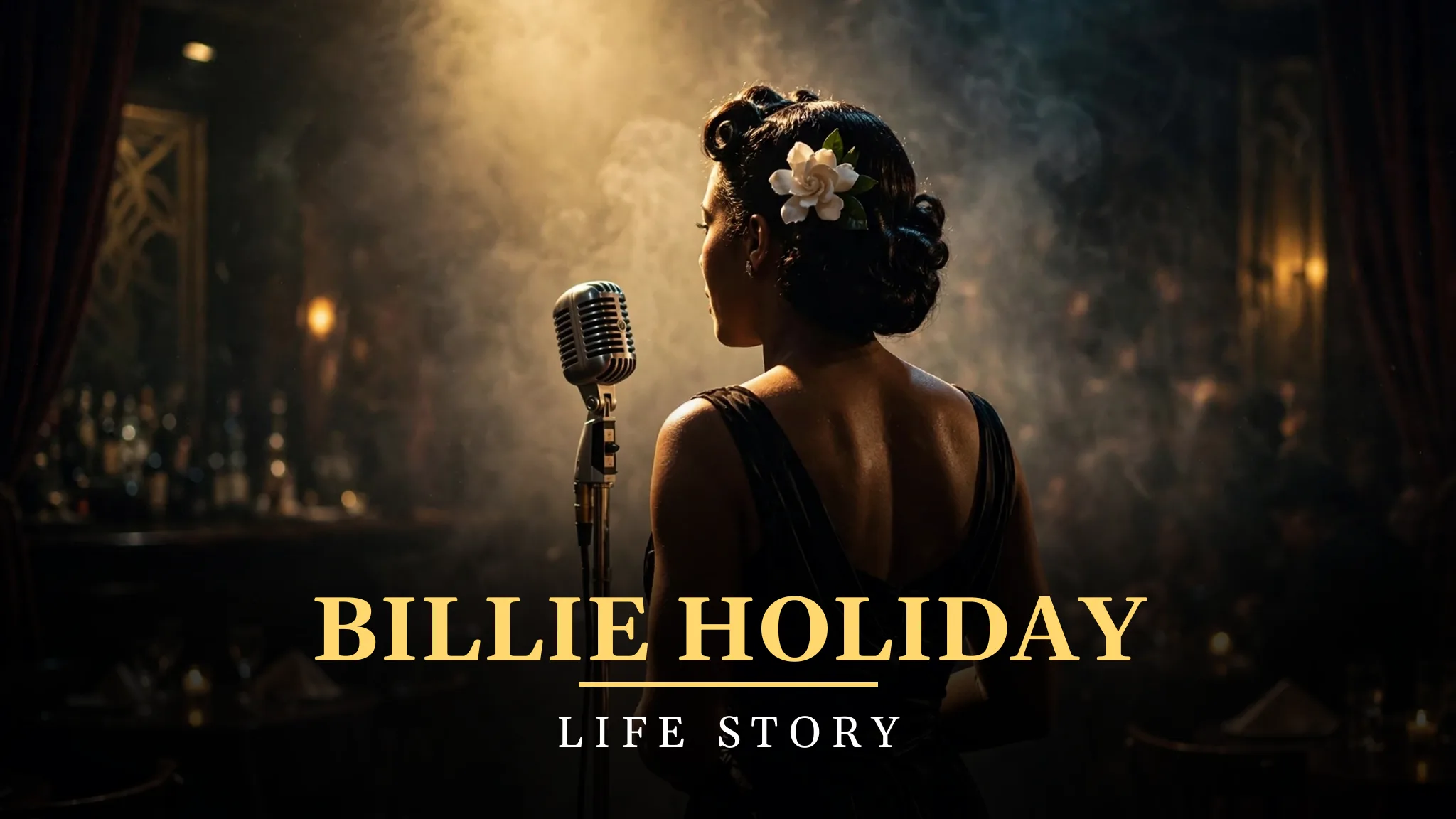
One last memory: the image of her with a gardenia in her hair, singing into a microphone, in a dim jazz club, with a voice that is haunting, and that fills the room, and that makes an audience feel, in a way that no other voice can. That image is iconic, and it is beautiful, and it is the image that will define her forever. She was Lady Day, and she was Billie Holiday, and she was the greatest torch singer who ever lived.
Her legacy will live on through her recordings, through her songs, and through the generations of singers she inspired, who heard her voice and wanted to sing the way she sang. That is a fitting legacy for a woman who defined a voice, and who did it with a haunting and a truth that will never be forgotten. She is gone, but her voice remains, and her name will be remembered as one of the greats.
Finally, I want to say thank you, Billie Holiday, for Strange Fruit, for God Bless the Child, and for a life lived with a voice that was true. You were a great singer, and you were a great woman, and the world is a better place because you were in it. Your recordings are still here, your legacy is still here, and your example is still here, and that is a life that mattered, and a life that will never be forgotten.
And one more thing: if you are a singer, sing like Holiday, because she is the singer every singer deserves to be, a singer who sings with her heart, and who makes an audience feel the truth. Sing like Holiday, the way Billie Holiday sang, and the world will be a better place for it, because the world needs more singers like her, who sing with truth, with pain, and with humanity.
There is a last lesson in her life that I carry with me, and it is this: tell the truth, even when it is hard, because the truth matters, and Holiday told it, every day, in every song, and in every part of her life. That is a lesson worth remembering, and it is one I will carry with me, always, because the world needs more people like Billie Holiday, who tell the truth, who are brave, and who are true.
One final thought: her influence on jazz, and on singing, is immeasurable, because she changed the way singers sing, with a phrasing that was unique, and a voice that was haunting, and that is a legacy that will never be matched, and it is one that I am grateful to have learned about, and to have shared, because it shows that talent, and truth, can change music, and can change the world, and Holiday did that, and she did it with a voice that was a gift, and that will never fade.
And if you ever doubt that a song can change the world, remember Billie Holiday, because she did, with Strange Fruit, a song that made America confront its racism, and that is still sung today, by singers who want to protest, and who want to tell the truth, and that is a legacy that will last, long after her songs are sung, because her voice is still here, and her influence is still here, and that is a gift that will never fade.
There is one more thing I want to say, and it is about her gardenia, because she wore a white gardenia in her hair, and it became her signature, a symbol of her elegance, and of her beauty, and it is a part of her image that is iconic, and that is still remembered today, as a symbol of Lady Day, and of a woman who was beautiful, even when she was in pain, and that is a beautiful thing, and it is a part of her story that shows her as a woman, not just as a singer, and that is a legacy that matters, in its own way, alongside her voice and her songs.
Her story also reminds me that a poor girl from Baltimore can become a legend, if she has talent, determination, and a voice, and that is a hopeful message for anyone who feels poor, or disadvantaged, or forgotten. Holiday was poor, and she was disadvantaged, and she became one of the greatest singers in history, because she embraced who she was, and she used her voice to become great. That is a lesson worth remembering, for every poor person out there, and for every singer who wants to be heard.
I also want to mention her mother, Sadie, because she was a teenage mother, who worked hard, to support her daughter, and who loved her, and who was, in many ways, the driving force behind her early life, and that is a reminder that a mother’s love can change a life, and that Holiday was lucky to have a mother who loved her, and who supported her, even when times were hard, and that is a beautiful thing, and it is a part of her story that shows the power of a mother’s love, and of a family that cares, even when it is difficult.
And finally, I think about the fact that she died at 44, and that she had so much more to give, and that is a reminder that life is short, and that we should make the most of it, the way Billie Holiday did, singing with a voice that was a gift, and living a life that was both beautiful and tragic, and that is a life worth living, and a life worth remembering, and I am grateful to have learned about it, and to have shared it with you.
Frequently Asked Questions
When was Billie Holiday born?
Billie Holiday was born on 7 April 1915 in Philadelphia, Pennsylvania, USA, as Eleanora Fagan. She grew up in Baltimore, Maryland, and began singing in Harlem jazz clubs in the early 1930s.
What is Billie Holiday most famous for?
She is most famous for Strange Fruit (1939), a protest song about lynching, and for God Bless the Child, Lady in Satin, and her haunting torch singing that changed jazz vocals.
What was Billie Holiday’s nickname?
She was known as Lady Day, a nickname given to her by saxophonist Lester Young, her closest musical partner. She called him Prez, short for President.
When did Billie Holiday die?
She died on 17 July 1959 in New York, at the age of 44, of complications from cirrhosis of the liver, after a career that began in Harlem clubs in the 1930s.
What is Strange Fruit about?
Strange Fruit, written by Abel Meeropol, describes the lynching of Black men in the American South. Holiday recorded it in 1939 despite her label’s objections, and it became her signature song.
Why was Billie Holiday arrested in 1947?
She was convicted of drug possession and served a year in prison. Many believe the arrest was partly motivated by the government’s desire to stop her singing Strange Fruit, and she lost her cabaret card afterwards.


