Black Sabbath: The Life Story Behind the Heavy Metal Pioneers
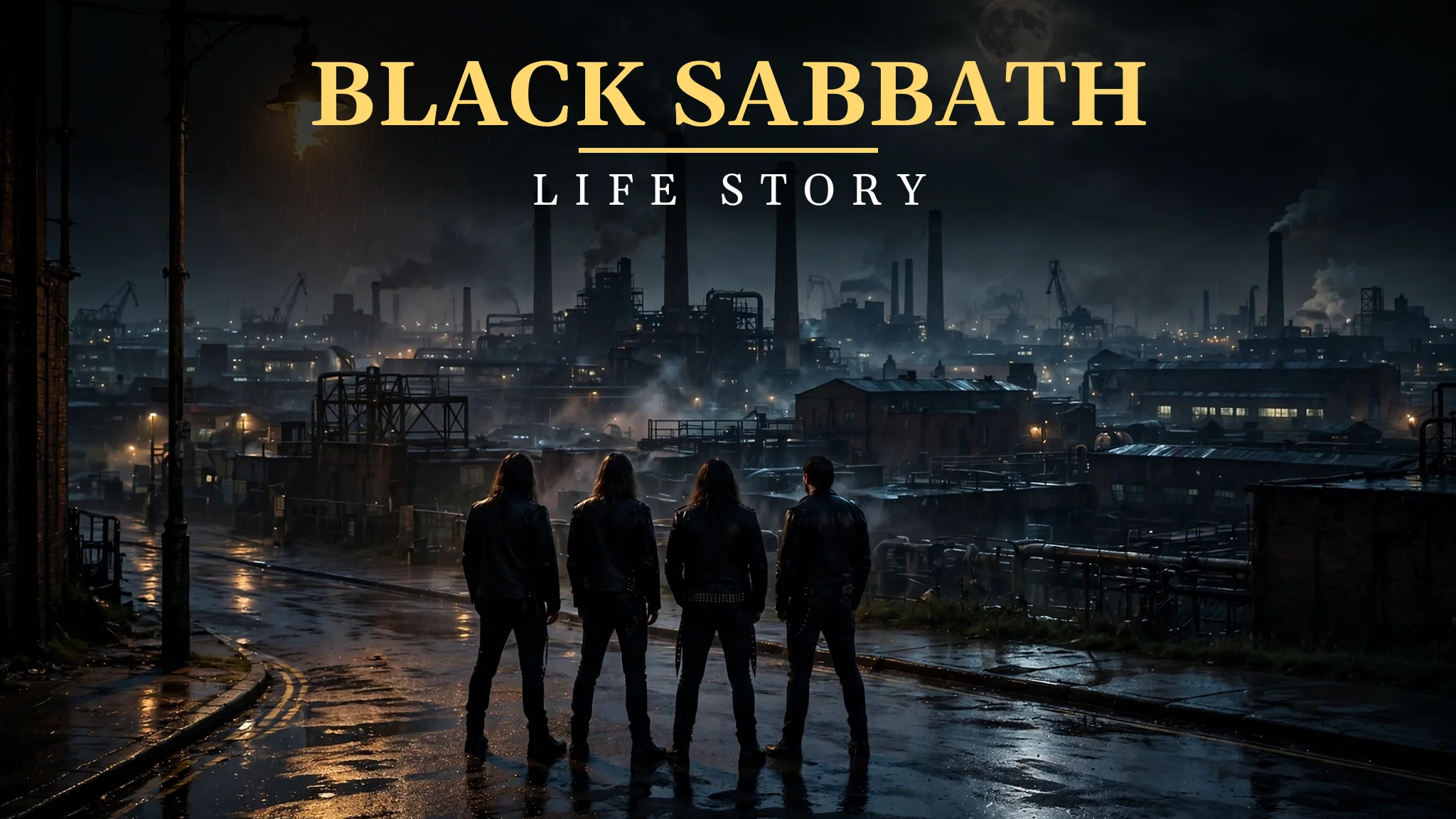
In this post
Black Sabbath invented heavy metal, and they did it in Birmingham, a city of factories, rain, and hard work. Before them, rock music was loud, but it was not heavy in the way that Black Sabbath were heavy. Their guitars were slow and low, their drums were huge and pounding, and their singer, Ozzy Osbourne, sang about war, about fear, about the devil, and about the world ending, in a voice that sounded both frightened and defiant. Their first album, released in 1970, sounded like nothing else on earth, and it scared some people and thrilled many others.
The four members were Ozzy Osbourne on vocals, Tony Iommi on guitar, Geezer Butler on bass, and Bill Ward on drums. They had grown up together in Aston, a working-class part of Birmingham, and they knew each other from school and from the streets. Iommi had lost the tips of two fingers in a factory accident when he was young, and he had to invent a new way to play guitar, tuning his strings down low and using plastic tips on his fingers. That accident, which could have ended his career before it began, gave Black Sabbath their sound. The low tuning made the guitar sound darker and heavier, and that darkness became the sound of heavy metal itself.
Their story is long and full of change. They made classic albums in the early 1970s, they fired Ozzy in 1979, they carried on with a new singer, Ronnie James Dio, they changed members many times, they reunited with Ozzy, they made a final album in 2013, and they played a farewell show in Birmingham in July 2025, only weeks before Ozzy died. It is a story about friendship, about addiction, about money, about music, and about four young men from Birmingham who changed the sound of the world.
Aston, Factories, and Four Young Men
Tony Iommi was born in Birmingham in 1948, and he grew up in Aston, a district of factories, terraced houses, and narrow streets. His family were Italian immigrants, and they worked hard to build a life in a new country. As a teenager, Iommi worked in a sheet metal factory, and one day a machine cut off the tips of the middle and ring fingers on his right hand. For a guitarist, that should have been the end. He was told that he would never play again, and he fell into a deep sadness. Then he heard about Django Reinhardt, a jazz guitarist who had lost the use of two fingers in a fire and had still become a great player. Iommi decided to try again. He made plastic tips for his fingers, he tuned his guitar strings down so that they were looser and easier to press, and he developed a style that was slow, heavy, and powerful.
Ozzy Osbourne was born in Birmingham in 1948 as well, in the same part of the city. He grew up in a poor family, in a small house with many brothers and sisters, and he left school early. He worked in factories, he spent time in prison for a short period as a young man for burglary, and he dreamed of becoming a singer. He had a high, strange voice, and he loved the Beatles. He wanted to be on stage, and he was willing to work hard to get there. He was funny, loud, and full of energy, and people remembered him even when they had only met him once.
Geezer Butler was born in Birmingham in 1949, and he grew up in a large Irish Catholic family. He loved music, he loved horror films, and he loved reading. He played bass guitar, and he wrote many of the band’s lyrics, drawing on his interest in the occult, in war, and in the darker side of life. Bill Ward was born in Birmingham in 1948, and he grew up playing drums. He was a powerful drummer with a jazz influence, and he gave the band a swing and a groove that other heavy bands lacked. The four of them knew each other from the local music scene, and they began to play together in the late 1960s.
They first called themselves Earth, and they played blues and rock in clubs around Birmingham and London. They were not yet Black Sabbath. They were a young band trying to find a sound, playing covers of other people’s songs and writing a few of their own. They rehearsed in a small room, they travelled in a van, and they lived on very little money. It was a hard life, but it was the life they had chosen, and they were determined to make it work. In 1969 they changed their name to Black Sabbath, taking the name from a horror film starring Boris Karloff that Geezer Butler had seen. The name fitted the dark sound they were developing, and it would become one of the most famous names in rock.
The First Album and a New Sound Is Born
Black Sabbath recorded their first album in a single day in late 1969, and it was released in February 1970. The album opened with the sound of rain, thunder, and a church bell, and then a slow, heavy guitar riff that sounded like a warning. The title song, Black Sabbath, was about a figure in black standing at the foot of a bed, and it was sung by Ozzy in a voice that sounded genuinely frightened. The rest of the album was just as dark, with songs about wizards, about war, and about evil. It was unlike anything else in rock music at the time, and many critics hated it. They called it crude, ugly, and depressing. But young listeners loved it, and the album sold well, reaching the top ten in Britain.
The band’s sound was new because it was slow and heavy. Most rock bands of the time played fast, bright music. Black Sabbath played slowly, with low guitars and pounding drums, and the effect was powerful and frightening. It was music that made you feel the weight of the world, and it spoke to young people who felt that the world was a dark and difficult place. The Vietnam War was still going on, factories were closing, and many young people felt angry and afraid. Black Sabbath gave that feeling a sound.
Later in 1970 they released their second album, Paranoid, which became their most famous record. It included the title song Paranoid, a fast, short song about a man who is worried and confused, and Iron Man, a song about a man who travels through time and returns as a metal figure, seeking revenge on the people who ignore him. War Pigs, another song on the album, was a powerful attack on politicians who start wars while other people die. Paranoid reached number one in Britain, and it became a hit in America too. It is now regarded as one of the greatest rock albums ever made, and its songs are still played on radio and at concerts today.
The band toured constantly, playing in Britain, America, and Europe, and they built a reputation as a loud, exciting live act. Their concerts were dark and theatrical, with Ozzy prowling the stage, Iommi playing huge riffs, Butler and Ward driving the rhythm, and the audience shouting along. They were not a polite band. They were a band that played as if their lives depended on it, and the audience responded with the same energy. By the end of 1970, Black Sabbath were no longer a small Birmingham band. They were one of the biggest rock bands in the world.
Master of Reality, Vol. 4, and the Golden Years
In 1971 Black Sabbath released Master of Reality, an album that was even heavier and slower than the ones before it. It included the songs Sweet Leaf, about smoking, Children of the Grave, about young people and war, and Into the Void, about travelling into space. The album went to the top ten in Britain and America, and it showed that the band could keep making great music without repeating themselves. The sound was deep, low, and powerful, and it influenced a whole generation of bands who wanted to play heavy music.
In 1972 they released Vol. 4, which included the songs Supernaut, with its driving drum beat, and Changes, a quiet piano song about a relationship ending, sung by Ozzy with a tenderness that surprised many listeners. The album showed that Black Sabbath could be soft as well as heavy, and that Ozzy could sing a ballad as well as a heavy rock song. The band were now living in America for much of the time, recording in Los Angeles, and they were enjoying the success, the money, and the fame that came with it. But the life was also taking a toll. They were using drugs and drinking heavily, and the pressure of constant touring was wearing them down.
In 1973 they released Sabbath Bloody Sabbath, an album that mixed heavy rock with more complex arrangements, including keyboards and orchestral parts. The title song became a favourite with fans, and the album was a success. In 1975 they released Sabotage, which included the songs Hole in the Sky and Symptom of the Universe, both fast and powerful. The band were still making good records, but the arguments were growing. Ozzy and Iommi disagreed about music, about money, and about the direction of the band. The other members were tired, and the drugs and drink were making everything worse.
By the late 1970s, the band were in trouble. Their albums, Technical Ecstasy in 1976 and Never Say Die! in 1978, did not sell as well as earlier records, and the band sounded tired. Ozzy left briefly in 1977 and then returned, but the friendship was broken. In 1979, after a tour, the band fired Ozzy. It was a painful decision, made by men who had been friends since childhood, and it marked the end of the first and most famous chapter of Black Sabbath. Ozzy went on to have a hugely successful solo career, but the band that had invented heavy metal was now without its singer.
Dio, Heaven and Hell, and a Second Life
After Ozzy left, Black Sabbath found a new singer, Ronnie James Dio, who had sung with Ritchie Blackmore in Rainbow. Dio was a small man with a huge voice, and he brought a new energy to the band. He also brought a love of fantasy, of dragons and castles and magic, which fitted the band’s dark image in a new way. With Dio, the band recorded the album Heaven and Hell in 1980, which was a great success. The title song, Heaven and Hell, became a classic, and the songs Neon Knights and Children of the Sea showed a band that was reborn and full of power.
The band followed Heaven and Hell with Mob Rules in 1981, another strong album, and they toured the world with Dio. The concerts were huge, and the fans loved the new line-up. But the happiness did not last. Dio and Iommi argued about the mix of a live album, and Dio left in 1982. The band went through a series of singers in the 1980s, including Ian Gillan from Deep Purple, who sang on the album Born Again in 1983, and Tony Martin, who sang on several albums in the late 1980s and early 1990s. None of these line-ups had the same magic as the original band or the Dio band, and the group’s fortunes faded.
Tony Iommi was the one member who stayed through it all. He was the heart of Black Sabbath, the guitarist who had invented the sound, and he kept the band going even when others left. He recorded albums, he toured, and he kept the name alive, even when the crowds were smaller and the records sold less. It was a difficult time, but it showed Iommi’s determination. He believed in Black Sabbath, and he was not willing to let it die.
In the 1990s, the original members began to talk again. Ozzy had become a huge solo star, with his own band and his own television show, but he still missed Black Sabbath. Geezer Butler and Bill Ward also missed the band. In 1997, the original four reunited for concerts, and they recorded a live album, Reunion, in 1998. The reunion was a success, and it showed that the old magic was still there. The band toured again in the years that followed, playing their classic songs to crowds who had waited many years to see them together.
13, The End, and the Final Farewell
In 2013 Black Sabbath released 13, their first studio album with Ozzy in thirty-five years. The album was produced by Rick Rubin, and it included the songs God Is Dead? and End of the Beginning. It went to number one in Britain and America, a remarkable achievement for a band that had formed in 1968. The album showed that the band could still write heavy, powerful music, and that Ozzy’s voice still had its strange, haunting quality. Bill Ward did not take part in the reunion, for reasons that were widely reported to involve a contract dispute, and he was replaced on drums by Brad Wilk. His absence was sad for many fans, but the album was still a triumph.
The band toured the world in support of 13, playing to huge crowds and receiving a warm welcome everywhere they went. They were now in their sixties, and they were playing music that they had written when they were in their early twenties. The songs still sounded powerful, and the audiences still sang along to every word. It was a reminder of how long Black Sabbath had lasted, and how much their music meant to people of different generations.
In 2017 the band played their final tour, called The End, which finished with concerts in Birmingham, their home city. The shows were emotional, with fans coming from all over the world to say goodbye. Ozzy, Iommi, and Butler played together for the last time as a touring band, and they thanked the fans who had supported them for almost fifty years. It seemed like the end of the story, but there was one more chapter to come.
In July 2025, Black Sabbath played one final concert, Back to the Beginning, in Birmingham, with Ozzy, Iommi, Butler, and Ward together on stage for the first time in twenty years. The show was a celebration of the band and of heavy metal, with other famous bands playing in support. Ozzy, who was now seventy-six and in poor health, sang from a chair, but his voice was still recognisable, and the crowd sang with him. It was a powerful and moving night, and it felt like a proper goodbye. Ozzy Osbourne died on 22 July 2025, just weeks after the show, at the age of seventy-six. His death was mourned around the world, and it marked the end of Black Sabbath as a living band.
What Black Sabbath Changed Forever
Black Sabbath changed music in a way that few bands ever do. Before them, there was no heavy metal. After them, there was a whole world of heavy metal, with thousands of bands playing music that owed something to the slow, low, dark sound that Iommi, Butler, Ward, and Osbourne had invented in Birmingham. Bands like Metallica, Iron Maiden, Judas Priest, and many others have named Black Sabbath as their biggest influence, and their music would not exist in the same way without them.
Their influence is not only about sound. It is also about attitude. Black Sabbath sang about war, about fear, about death, and about the darker side of life, and they did it without apology. They showed that rock music could be serious, that it could talk about real fears, and that it could be heavy in both sound and meaning. That honesty gave heavy metal its power, and it is why the music still matters today.
The band were inducted into the Rock and Roll Hall of Fame in 2006, which was a formal recognition of their importance. They had waited a long time for that honour, and it was welcomed by fans who had always known that Black Sabbath were one of the greatest bands in history. Their albums are still sold, their songs are still played, and their name is still known to young people who were not born when Paranoid was released. That is a legacy that few bands can match, and it is one that will last for many years to come.
Geezer Butler, Bill Ward, and the Rhythm That Made It Heavy
Geezer Butler’s bass playing and lyrics were central to Black Sabbath’s sound, and they deserve to be talked about as much as Iommi’s guitar or Ozzy’s voice. Butler wrote many of the band’s lyrics, drawing on his interest in horror, in war, in religion, and in the darker side of life. His words for War Pigs, Iron Man, and Black Sabbath are powerful and direct, and they gave the band a voice that was serious and thoughtful. He was not just a bass player. He was a writer, and his writing made the band’s music deeper and more meaningful.
Butler’s bass playing was also distinctive, because he played with a heavy, melodic style that followed Iommi’s guitar riffs and gave them a deep foundation. His bass lines on Paranoid, Iron Man, and War Pigs are strong and memorable, and they are a key part of the band’s sound. He played with a pick, with a fast, driving style, and he gave the band a rhythm that was both powerful and musical. Without Butler, Black Sabbath would not have sounded the same, and their music would not have had the same depth.
Bill Ward’s drumming was another key part of their sound, because he played with a jazz influence, with swing and with groove, that other heavy metal drummers lacked. Ward was a powerful drummer, but he was also a musical one, and he gave the band a feel that was both heavy and human. His drumming on War Pigs, Iron Man, and Children of the Grave is superb, with fills and patterns that are both complex and exciting. He was the drummer who made Black Sabbath swing, even when they were playing the heaviest music in the world.
The band’s relationship with Birmingham is also worth talking about, because they were a band from a working-class city, and their music reflected that city. Birmingham in the late 1960s was a city of factories, of smoke, of rain, and of hard work, and Black Sabbath’s music sounded like that city. It was dark, it was heavy, and it was honest. The band did not try to sound like a London band or an American band. They sounded like Birmingham, and they were proud of it. That pride in place is a part of their story that fans in Birmingham still cherish today.
Their influence on later bands is also enormous, and it is felt in the work of Metallica, Iron Maiden, Judas Priest, and countless other groups. Those bands learned from Black Sabbath how to play heavy, how to write about dark subjects, and how to be honest about fear and anger. Without Black Sabbath, heavy metal would not exist in the same way, and rock music would be a poorer place. That is a legacy that few bands can claim, and it is one that Black Sabbath earned through talent and through hard work.
In the end, Butler, Ward, Birmingham, and the band’s influence are all part of the same story, a story about four young men who made music that changed the world. Their songs are still played, their albums are still sold, and their name is still known to young people who were not born when Paranoid was released. That is a legacy that will last for many years to come.
My Take:
When I think about Black Sabbath, I think about a sound that should not have existed. A guitarist loses the tips of two fingers in a factory accident, and instead of giving up, he invents a new way to play. He tunes his strings down low, he uses plastic tips, and he creates a sound that is darker and heavier than anything anyone has heard before. That is not just a story about music. It is a story about turning a disaster into a gift, and it is one of the most inspiring stories in rock history. I admire Tony Iommi for that more than for any single song, because it shows what a person can do when they refuse to accept that their life is over.
I love Paranoid because it is an album that does not waste a single moment. Every song on it has a purpose, and every song is played with power and with feeling. War Pigs is a song about war that is still relevant today, because wars are still started by politicians while other people die. Iron Man is a song about a man who is ignored and who seeks revenge, and it speaks to anyone who has ever felt invisible. Paranoid itself is a short, fast song about worry and confusion, and it captures a feeling that many people know well. The album is not perfect in a polished way. It is perfect in a raw, honest way, and that is better.
Ozzy Osbourne is a singer who fascinates me, because his voice is so strange and so recognisable. He does not sing like other people. His voice is high, thin, and full of feeling, and it sounds like a person who is both afraid and brave at the same time. When he sings Black Sabbath, I believe that he is frightened. When he sings War Pigs, I believe that he is angry. When he sings Changes, I believe that he is sad. That ability to make the listener believe is rare, and it is why Ozzy became a star. He was not a perfect singer. He was a true singer, and that is more important.
I also think about Birmingham, and about how important the city is to the band’s story. Black Sabbath sounded like Birmingham, like a city of factories, of rain, of smoke, and of hard work. Their music was not made in London or in Los Angeles. It was made in a city where people worked with their hands, where life was tough, and where the future was uncertain. That gave their music a weight and an honesty that other bands lacked. They did not pretend to be from somewhere else. They were from Aston, and they were proud of it, and their music carried that pride with it.
The firing of Ozzy in 1979 is a sad part of the story, and I feel sympathy for all four men. They had been friends since childhood, they had made great music together, and then they fell apart because of drink, drugs, and arguments. That is a common story in rock music, but it is still sad every time it happens. I do not blame any one person, because the problems were shared. Ozzy was drinking too much, the others were tired, and the band had been working without a break for ten years. It was a human failure, not a villain’s plot, and it is a reminder that even the closest friends can lose each other if they do not take care of the friendship.
Ronnie James Dio deserves a lot of credit for what he did with Black Sabbath. He joined a band that had lost its singer, and he helped them to make Heaven and Hell, which is one of their best albums. Dio was a different kind of singer from Ozzy, with a stronger, more operatic voice, and he brought a love of fantasy that gave the band a new direction. He did not try to copy Ozzy, and that was the right choice. He was himself, and the band was better because of it. I admire him for his courage in taking on such a difficult job, and for the music he made while he was there.
I think about the reunion in 2013 and the album 13, because it is a rare thing for a band to come back after thirty-five years and make a number one album. Most bands that reunite sound tired, or they sound like they are trying to copy their old work. Black Sabbath sounded alive on 13. The songs were heavy, the playing was strong, and Ozzy’s voice still had its power. It proved that the band still had something to say, and that their music was not just a memory. It was a living thing, and it could still move people.
The final show in July 2025 moves me deeply, because it was a proper goodbye. Ozzy was seventy-six, he was in poor health, and he sang from a chair, but he was there, with his bandmates, in Birmingham, in front of a crowd that loved him. That takes courage, and it takes love. He could have stayed at home, and no one would have blamed him. Instead he chose to say goodbye on stage, in the city where it all began. That is a beautiful ending to a long story, and it is one that I will remember for a long time.
Ozzy’s death, only weeks after that show, makes the farewell even more poignant. He lived a long life, he had a huge career, and he became a star in music and on television. But he was also a man who struggled with addiction, with health problems, and with the pressures of fame. I do not want to pretend that his life was perfect, because it was not. But I can say that his music touched millions of people, and that his voice will keep playing long after he is gone. That is a legacy worth having.
One thing that stays with me is how many bands owe their existence to Black Sabbath. Metallica, Iron Maiden, Judas Priest, and countless others have said that Black Sabbath were their biggest influence. That is a special kind of success. It means that your music did not just sell records. It also taught other people how to make music, how to play heavy, and how to be honest about dark subjects. Black Sabbath did not just make albums. They made a whole world of music, and that world is still growing today.
If I have a criticism, it is that Black Sabbath were not always given the respect they deserved while they were active. Critics called them crude and ugly, and they were often ignored by the music press. That was unfair, and it must have been frustrating for the band. But time has corrected that mistake. Today, they are recognised as one of the greatest bands in history, and their albums are studied and loved. That is a slow kind of justice, and I am glad that Ozzy lived long enough to see it, even if only for a few weeks after the final show.
In the end, I will remember Black Sabbath as four young men from Birmingham who turned a factory accident into a new sound, who sang about war and fear with honesty, and who changed music forever. Their story is long, it is sad in places, and it is triumphant in others, but above all it is a story about music that mattered. Paranoid, Iron Man, War Pigs, and Heaven and Hell will keep playing, and people will keep listening, because those songs speak to something deep in us, something about fear, about anger, and about the hope that music can make those feelings bearable.
I also think about Geezer Butler’s lyrics, because they are often overlooked in favour of Iommi’s guitar and Ozzy’s voice. Butler wrote about war, about fear, about religion, and about the darker side of life, and he did it with a seriousness that gave the band’s music depth. War Pigs is not just a song about war. It is a song about politicians who start wars while other people die, and it is still relevant today. That kind of writing is rare in rock music, and it deserves more credit than it usually gets. Butler was a thoughtful writer, and his words made Black Sabbath more than just a loud band.
Bill Ward’s drumming is another part of their sound that I admire, because he played with a jazz feel that other metal drummers lacked. He swung, he grooved, and he gave the band a human touch, even when they were playing the heaviest music in the world. His drumming on Children of the Grave and on War Pigs is superb, and it shows a musician who understood that drums are not just about volume. They are about feel, about rhythm, and about making the music move. I think his contribution is often forgotten, and it deserves to be remembered.
I think about the band’s early days in Birmingham, playing in small clubs and rehearsing in a small room, and about how far they came from those beginnings. They were four young men from Aston, with little money and with big dreams, and they became one of the biggest bands in the world. That is a remarkable journey, and it shows what can happen when talent meets determination. They did not have connections, they did not have money, and they did not have a polished image. They had music, and they had each other, and that was enough.
The album Master of Reality is another record that I love, because it is even heavier and slower than Paranoid, and it shows a band that was not afraid to be heavy. Sweet Leaf, Children of the Grave, and Into the Void are all powerful songs, and they are played with a weight that is almost physical. The album went to the top ten, and it influenced a whole generation of bands who wanted to play heavy music. I admire the band for making a record that was so uncompromising, and for trusting their fans to follow them into darker, heavier territory.
I also think about Sabbath Bloody Sabbath, because it showed a band that was willing to experiment, with keyboards and with orchestral parts, even though they were known for heavy guitars. The title song is a favourite of mine, with a powerful riff and a vocal that is both angry and melodic. The album was a success, and it showed that Black Sabbath could grow and change without losing their identity. That willingness to experiment is a sign of a great band, and it is one that Black Sabbath had throughout their career.
The final show in Birmingham in July 2025 is a moment that I will never forget, because it was a proper goodbye. Ozzy sang from a chair, he was in poor health, but he was there, with his bandmates, in the city where it all began. The crowd sang with him, and the night felt like a celebration of a long life in music. It was sad, because everyone knew that it was the end, but it was also joyful, because the band had come home to say goodbye. That is a beautiful ending, and it is one that few bands get.
In the end, I come back to the idea that Black Sabbath invented a whole world of music. Before them, there was no heavy metal. After them, there was a world of bands, of fans, of festivals, and of music that owed something to their slow, low, dark sound. That is a legacy that few bands can claim, and it is one that will last for many years. Paranoid, Iron Man, and War Pigs will keep playing, and people will keep listening, because those songs speak to something deep in us.
I also think about the band’s song Children of the Grave, because it is about young people and about war, and it shows Geezer Butler’s concern for the future. The song is powerful, it is angry, and it is sung with a voice that sounds like a warning. When I hear it, I think about the young people who will inherit the world, and about the responsibility that older generations have to leave them a better place. That is a serious message, and it is one that Black Sabbath delivered with honesty and with power.
In the end, I think about Birmingham again, because that is where it all began, with four young men from Aston who made music that changed the world. Their story is a story about a city, about factories, about hard work, and about talent that refused to be ignored. Paranoid, Iron Man, and War Pigs will keep playing, and people will keep listening, because those songs speak to something deep in us, something about fear, about anger, and about hope. That is a legacy that will last for many years.
Frequently Asked Questions
How did Black Sabbath get their name and their heavy sound?
Black Sabbath took their name from a horror film starring Boris Karloff that Geezer Butler had seen, after first calling themselves Earth. Their heavy sound came partly from Tony Iommi tuning his guitar strings down low after losing the tips of two fingers in a factory accident, which made the guitar sound darker and heavier.
What are Black Sabbath’s most famous songs?
Their most famous songs include Paranoid, Iron Man, War Pigs, Black Sabbath, and Sweet Leaf from the early albums, and Heaven and Hell from the Dio era. Each song shows their slow, heavy guitar sound and Ozzy Osbourne’s distinctive voice.
Why was Ozzy Osbourne fired from Black Sabbath in 1979?
Ozzy was fired in 1979 after years of heavy drinking, drug use, and arguments within the band, which had made working together very difficult. The other members felt that the band could not continue with him at that time, and Ozzy went on to a successful solo career.
Who replaced Ozzy as the singer of Black Sabbath?
Ronnie James Dio replaced Ozzy in 1979, and he sang on the successful albums Heaven and Hell in 1980 and Mob Rules in 1981. Other singers, including Ian Gillan and Tony Martin, sang with the band in later years before Ozzy returned for the reunion.
When did Black Sabbath play their final show?
Black Sabbath played their final show, Back to the Beginning, in Birmingham on 5 July 2025, with Ozzy, Tony Iommi, Geezer Butler, and Bill Ward together for the first time in twenty years. Ozzy died on 22 July 2025, just weeks after the farewell concert.
Were Black Sabbath inducted into the Rock and Roll Hall of Fame?
Yes, Black Sabbath were inducted into the Rock and Roll Hall of Fame in 2006, recognising them as the pioneers of heavy metal. Their influence on later bands, including Metallica and Iron Maiden, is widely acknowledged.


