BlackCat Attacked America's Healthcare Giant
In this post
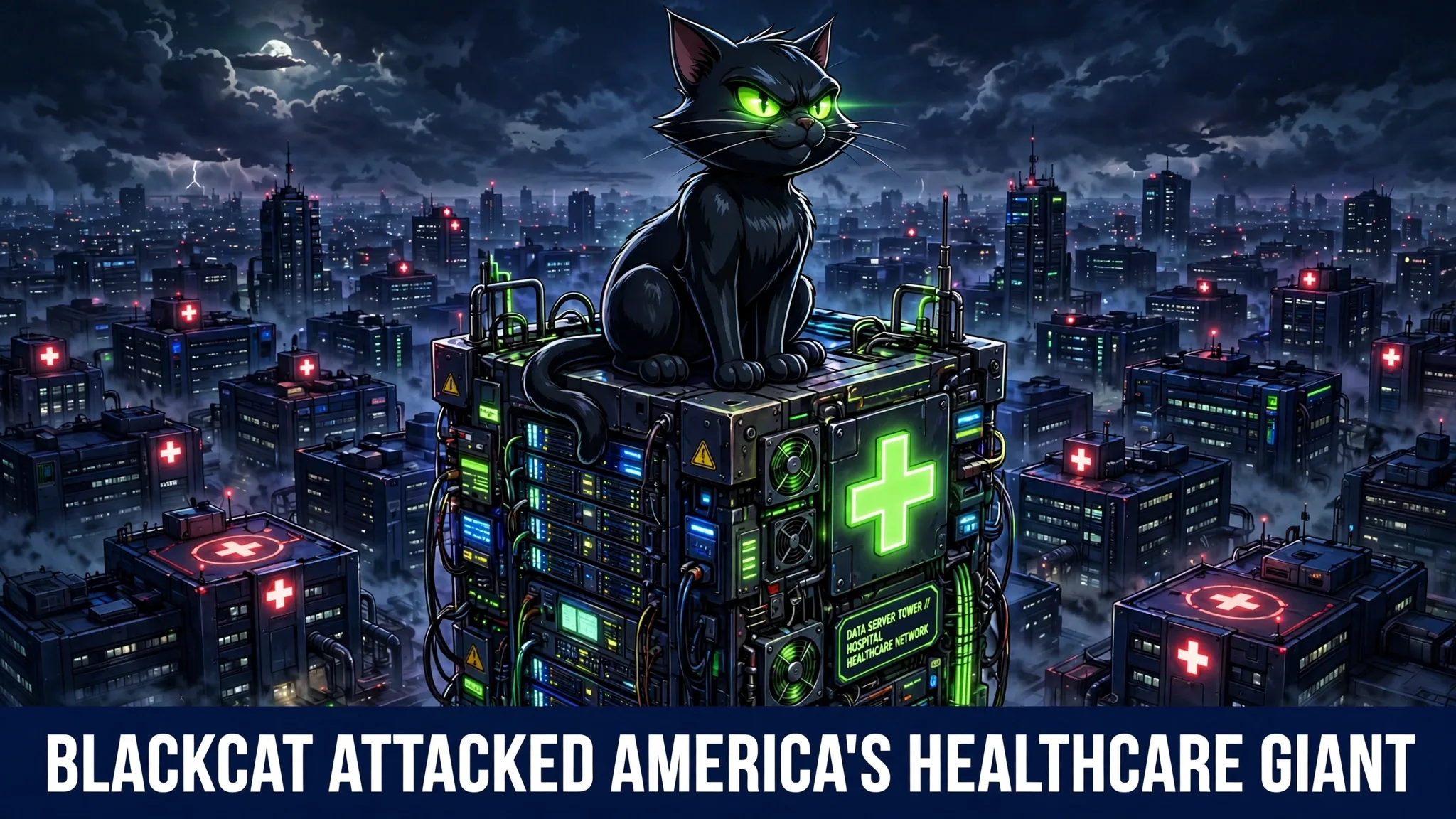
The cat did not roar. It did not smash a window or leave muddy footprints on the floor. It moved the way real cats move at night: softly, patiently, and with its eyes fixed on the weakest living thing in the room. In the digital world, that weakest thing was not a single patient or pharmacy. It was a giant company most patients had never heard of, sitting quietly behind prescriptions, payments, and insurance claims across the United States.
Its name was Change Healthcare. In February 2024, an attack widely attributed by US authorities to a BlackCat affiliate struck that company, and the pain spread far beyond one server room. Pharmacy counters slowed down. Insurance claims would not go through. Hospitals and small clinics began to worry about money. Patients stood in lines and waited for systems they could not see.
That is why BlackCat matters. It showed how modern crime hunts: one hidden doorway, shared by millions, can hurt people who never touched the infected computer.
What BlackCat ransomware is
BlackCat is a ransomware gang and a ransomware toolkit, also known as ALPHV. The group appeared in late 2021, and security researchers quickly noticed something unusual. BlackCat was described as the first major ransomware written in Rust, a modern programming language. That mattered because the same toolkit could attack both Windows and Linux systems. In plain words, the gang had built a weapon that could walk through more than one kind of digital house.
Ransomware has one basic job: it locks a victim’s files so the victim cannot use them. The files may still be sitting on the computer, but they are scrambled, like a diary rewritten in a secret code. The criminals then demand money for the key. For a family, that could mean photos or business papers. For a hospital system, it can mean records, billing tools, and the quiet machinery that lets care move from desk to desk.
BlackCat did not stop at locking files. Its pressure method was called triple extortion. First, the attackers encrypted the victim’s files, making normal work hard or impossible. Second, they threatened to publish stolen data, which is a frightening threat for any company that holds private records. Third, they threatened to flood the victim’s websites with traffic until those websites fell offline. Each threat pushed from a different side: you cannot work, your secrets may be exposed, and your public doors may be slammed shut.
How ALPHV worked as a service
BlackCat ran as ransomware-as-a-service. That phrase sounds technical, but the idea is simple. The core group built and controlled the ransomware, the leak site, and the brand. Affiliates did much of the attacking. If an affiliate succeeded, the core group took a cut of the money. Think of it as a criminal franchise: one group owns the recipe and the signboard, while other criminals open local branches of trouble.
This model helps a gang grow fast. The core team does not need to carry out every break-in itself. Affiliates bring their own access, their own targets, and their own pressure. For victims, that makes the danger less predictable. The name on the ransom note may be BlackCat, but the hands inside the network may belong to a separate affiliate working for a share.
The first step toward a big company can still be painfully ordinary. Public reporting on BlackCat does not give one single doorway used every time, so the honest lesson is broader: companies are made of people, accounts, laptops, servers, and shared services. A weak sign-in, a reused password, or one trusted system connected to many others can become the crack a criminal group needs. For an ordinary person, the same rule applies at home. Your email account, your phone, and your backups are small doors, but they are doors all the same.
The day the leak site changed hands
Before the healthcare attack, BlackCat had already felt the hand of the law. In December 2023, the FBI seized its dark-web leak site. A leak site is part threat, part billboard: gangs use it to name victims and warn that stolen data will be published if payment does not arrive.
What followed was strange enough to sound like a schoolyard fight. The gang briefly claimed to have “unseized” the site, as if it had snatched its billboard back from the police. For a short moment, the story looked like a tug-of-war played in public. Then the site was firmly in law-enforcement hands.
That performance of confidence matters in the ransomware world. Affiliates choose brands they think are strong, and victims pay gangs they think are organized. A leak site is therefore more than a webpage. It is a stage. When police seize the stage, the gang loses some of its power to frighten.
The Change Healthcare damage story
The biggest BlackCat-linked blow landed in February 2024. Change Healthcare, part of UnitedHealth Group, was not a hospital with beds and nurses. It was something less visible and, in one way, even more central: its systems quietly processed prescriptions and payments for a huge share of American healthcare. Most people only notice such a company when it stops working. Then they notice it everywhere.
After the attack, pharmacies across the United States could not process insurance claims for weeks. Imagine standing at a counter with medicine in front of you, only to learn that the payment path behind the counter is broken. The pills exist. The pharmacist exists. But the digital bridge between them has fallen.
Hospitals and small clinics also reported serious money trouble. Healthcare runs on claims, approvals, and payments moving at the right time. If those payments freeze, the problem is not only technical. Staff and suppliers still need paying, and small clinics often have thinner safety margins than giant hospitals. Patients faced delays too, because modern care depends on records, authorizations, and payment checks moving smoothly.
I find the saddest part is that the people standing in pharmacy lines had done nothing wrong, yet they were the ones left waiting.
UnitedHealth’s chief executive later confirmed that the company paid a ransom to protect patient data. Blockchain researchers traced a payment of about $22 million at the time. That detail needs careful words: the $22 million figure comes from researchers following public blockchain records. It shows why healthcare is such a tempting target: when private records and urgent care are both at risk, the cost of saying no can look terrifying.
The gang that robbed its own side
The ending was not a police raid with flashing lights. It was quieter, uglier, and fitting for a group built on distrust. In March 2024, BlackCat suddenly shut down. Security researchers widely assessed the shutdown as an “exit scam” — when the people running a criminal service disappear with money that should have been shared.
The gang claimed the FBI had seized everything. But an affiliate complained publicly that BlackCat had stolen the healthcare ransom instead of sharing it. Researchers treated that complaint, together with the sudden shutdown, as signs that the core group may have taken the money and vanished. Criminals can survive police pressure for a while. They cannot easily survive the belief that the boss will rob every partner.
That is the black cat’s final lesson. It hunted the sick by striking the shared systems behind their care. Then, at the end, researchers say it turned on the very people who had helped it hunt. The predator disappeared into the dark, but it left behind a bright warning for everyone else.
How to protect yourself from ransomware like BlackCat
You cannot control a giant healthcare network, and you cannot arrest a gang from your kitchen table. But you can control your own doors. Do not keep everything behind one sign-in. If your email, photos, work files, and money apps all depend on one password, one stolen password can open too much of your life. Use different passwords for important accounts, and turn on two-factor sign-in wherever it is offered. Two-factor sign-in means a password alone is not enough; the account also asks for a second proof, such as a code on your phone.
Keep backups that are not always connected. A backup plugged into the same computer all the time may be locked along with everything else. An offline backup — for example, a copy kept on a drive that you unplug after backing up — gives you a road back if your main files are scrambled. Test the backup sometimes. A backup you have never opened is a hope, not a plan.
Be careful with shared doors in daily life. A family may share one tablet, one email account, or one cloud folder without thinking about it. A small shop may give every worker the same login because it feels easier. Ease is exactly what criminals count on. Give each person their own account where possible, and remove access for people who no longer need it.
For work, even in a tiny business, treat the computer used for banking and accounts with extra care. Install updates for your system, browser, and security software, because updates often close holes that criminals use. If an app or website offers a stronger sign-in option, use it before trouble arrives, not after.
Finally, remember the Change Healthcare lesson: one supplier can affect thousands of strangers. At home, the risk is smaller but real. If all your photos sit in one account and all your documents sit on one laptop, one bad day can take everything. Spread the risk. Back up. Lock accounts properly. Make the cat work harder than it wants to.
Common questions
What is BlackCat ransomware?
BlackCat, also called ALPHV, is a ransomware operation that appeared in late 2021. It scrambled victims’ files and demanded payment, while also threatening to leak stolen data and knock websites offline. Researchers noted it as the first major ransomware written in Rust.
Was BlackCat one hacker working alone?
No. BlackCat ran as ransomware-as-a-service, which means a core group controlled the tools and brand while affiliates carried out attacks for a share of the money. The Change Healthcare attack was widely attributed by US authorities to a BlackCat affiliate, not simply to one lone person.
Why did the Change Healthcare attack hurt so many pharmacies?
Change Healthcare’s systems processed prescriptions and payments for a huge share of American healthcare. When those systems were hit, pharmacies could not process insurance claims normally for weeks. One shared company had become a bridge for countless patients, clinics, and hospitals.
Did UnitedHealth pay a ransom?
UnitedHealth’s chief executive confirmed that the company paid a ransom to protect patient data. Blockchain researchers traced a payment of about $22 million at the time. That traced figure is reported carefully because it comes from following blockchain records, while the company’s own confirmation was about paying to protect data.
Did the FBI defeat BlackCat completely?
The FBI seized BlackCat’s leak site in December 2023, and the gang briefly claimed it had taken the site back before it was firmly in police hands. In March 2024, BlackCat shut down suddenly. Researchers widely assessed that shutdown as an exit scam after an affiliate complained the gang had kept the healthcare ransom instead of sharing it.
Sources
- Wikipedia — BlackCat (cyber gang): https://en.wikipedia.org/wiki/BlackCat_(cyber_gang)