Bourvil: The Life Story Behind France's Gentle Comedy Star
In this post
Bourvil made France laugh, and he did it without ever being cruel. In a time when many comics shouted, mocked, and played clever tricksters, he played a simple, kind man from the country, a man who was a little slow, a little lost, and full of good heart. Audiences loved him at once, because they saw in him someone they knew: a neighbour, an uncle, a farmer, a man who tried his best and often got things wrong. He did not laugh at people. He laughed with them, and that made all the difference.
His real name was André Raimbourg, and he came from a small village in Normandy. He was not born into show business, and he did not study comedy in Paris. He worked on a farm, he sang in local halls, and he slowly found his way to the stage. He took his stage name from the village of Bourville, near his home, and he kept that name for the rest of his life. It was a name that sounded like the countryside, and it suited him perfectly.
His life was short. He died at the age of fifty-three, after an illness he kept private for a long time. But in that short life, he made some of the most loved films in French history, he sang songs that are still sung today, and he showed that kindness on screen could be just as powerful as anger or cleverness. His story is a gentle one, but it is not a small one. It is the story of a farm boy who became the soul of French comedy.
A Farm Boy in Normandy
Bourvil was born André Robert Raimbourg on 27 July 1917 in Prétot-Vicquemare, a small village in Normandy, in the north of France. His father worked on the land, and the family lived a simple rural life. André grew up among fields, animals, and the quiet rhythms of village life. He went to the local school, he helped with farm work, and he learned the manners and the speech of the Normandy countryside. Those early years stayed with him, and they shaped the characters he would later play on screen.
He was not a child who dreamed of Paris and fame. He was a country boy who liked to sing and to make people laugh. He sang at village gatherings, at weddings, and in local halls, and people noticed that he had a warm voice and a natural gift for comedy. He did not learn to perform from books. He learned from the people around him: from farmers telling stories, from old men joking in the café, and from the everyday humour of village life. That humour was gentle, slow, and kind, and it became the heart of his art.
As a young man, he worked on the farm and tried different jobs, but the wish to perform kept growing. He began to sing in small halls in Normandy, and then in Paris, where he performed in music halls and cabarets. He was not an overnight success. He worked for years in small venues, learning how to hold an audience, how to time a joke, and how to make a song feel like a story. He was patient, and he did not give up. He believed that if he kept working, people would come to love him.
He chose the stage name Bourvil from Bourville, a village near his home in Normandy. It was a simple choice, but it showed what he wanted to be: a man of the countryside, a man of the people, not a star from Paris. He kept that name, and France came to know him by it. The farm boy from Normandy was on his way to becoming one of the most loved performers in the country, and he did it without ever losing the village boy inside him.
Songs and the Music Hall
Bourvil’s first success came as a singer. He had a soft, warm voice, and he sang songs that were simple, funny, and tender. He sang about everyday life, about love, about the countryside, and about the small joys and sorrows of ordinary people. His songs were not grand or dramatic. They were like conversations with a friend, and audiences loved them for that. He performed in the music halls of Paris, where singers and comics shared the stage, and he slowly built a name for himself.
One of his most loved songs was La Tendresse, a gentle song about tenderness and love, which he recorded in the early 1960s. The song became a classic, and it is still sung in France today. It is a song about being kind to the people you love, about holding them close, and about the quiet power of tenderness. The song suited Bourvil perfectly, because it was about the very thing he stood for: kindness, warmth, and a simple, honest heart. When people hear the song today, they think of him, and of a gentler time.
He also sang comic songs, in which he played the part of a naive country man lost in the big city, or a man trying to understand modern life. These songs made people laugh, but they never made fun of the character. Bourvil’s comic man was always good-hearted, even when he was confused. The audience laughed at his mistakes, but they also loved him for his honesty. That balance, between laughter and love, was his great gift, and it made him different from comics who only wanted to be clever.
The music hall years taught him everything he needed for film. He learned how to use his voice, how to use silence, and how to wait for a laugh. He learned that a small gesture could be funnier than a big one, and that a kind face could win an audience faster than a clever line. By the time he began to make films in earnest, he was already a complete performer, with a style that was entirely his own. He was ready, and French cinema was ready for him.
La Traversée de Paris and the First Films
Bourvil began to appear in films in the 1940s and 1950s, and he quickly found his place. His early film roles were often small, but he made them memorable. He played simple men, honest men, and men who were a little out of their depth, and audiences recognised him at once. He was not a handsome leading man, and he did not try to be one. He was a character actor with a warm heart, and that was enough.
His first great film role came in La Traversée de Paris in 1956, directed by Claude Autant-Lara, in which he starred alongside Jean Gabin. Bourvil played Marcel Martin, a man who carries goods across Paris during the German occupation of the Second World War. The film was both funny and sad, and it showed a different side of Bourvil. He was not only a comic. He could play a man in danger, a man who was afraid, and a man who had to make hard choices. His performance next to Gabin, one of the giants of French cinema, proved that he was a serious actor, not only a singer who made films.
The film was a success, and it opened the door to bigger roles. Bourvil began to work with the best directors in France, and he began to choose films that mixed comedy with real life. He played men who were caught in the troubles of their time: the war, the changes in France after the war, and the clash between the countryside and the city. He brought to each role the same qualities he had brought to his songs: warmth, honesty, and a quiet sense of humour.
In these years, he also became known as a man who was easy to work with. Directors liked him because he was professional, kind, and always ready to try again if a scene did not work. Actors liked him because he was generous, and he did not try to steal the scene. He was a team player, on screen and off it, and that made him one of the most loved men in French cinema. He was building a career, film by film, and he was doing it with the same patience he had shown in the music halls.
Le Corniaud and La Grande Vadrouille
The greatest years of Bourvil’s film career came in the 1960s, when he formed a famous partnership with Louis de Funès, the other great comic of French cinema. The two men were opposites: de Funès was fast, angry, and loud, while Bourvil was slow, calm, and gentle. Together, they were perfect. De Funès shouted, and Bourvil smiled. De Funès ran in circles, and Bourvil walked slowly behind him. Audiences loved the contrast, and the two films they made together became legends.
The first was Le Corniaud in 1965, directed by Gérard Oury, in which Bourvil played Antoine Maréchal, a simple man whose car is wrecked, and who is given a new car to drive to Italy, not knowing that the car is full of hidden treasure. De Funès played the crook who is chasing him. The film was a road comedy, full of chases, mistakes, and misunderstandings, and Bourvil’s calm, innocent performance was at the heart of it. The film was a huge success, and it made the partnership famous.
The second film was even greater. La Grande Vadrouille, released in 1966 and also directed by Gérard Oury, was a comedy about the Second World War, in which Bourvil and de Funès played two Frenchmen who help British airmen escape from occupied Paris. The film was funny, warm, and brave, and it became the most successful French film of its time, seen by millions of people. Bourvil played Augustin Bouvet, a house painter, a simple man who finds himself in a dangerous adventure, and who faces it with courage and kindness. The film is still one of the most loved French films ever made, and it is still shown on television in France, year after year.
These two films made Bourvil a national treasure. He was no longer only a singer and a comic. He was a star of the biggest films in France, and he was loved by people of all ages. Children loved his gentle humour, and adults loved the warmth behind it. He had reached the top, and he had done it without changing who he was. He was still the farm boy from Normandy, still kind, still simple, and still honest.
The Last Films and a Hidden Illness
After La Grande Vadrouille, Bourvil continued to work, and he took on roles that showed new sides of his talent. He starred in L’Arbre de Noël in 1969, a sad and moving film about a father and his sick son, in which he gave a performance full of tenderness and pain. The film showed that Bourvil could play drama as well as comedy, and that his kindness on screen was not only for laughs. It was also for sorrow, and for love. Audiences who saw the film were moved, and they saw a deeper side of the man they thought they knew.
His last film was Le Cercle rouge, released in 1970 and directed by Jean-Pierre Melville. It was a crime film, a serious and stylish story about thieves and policemen, and Bourvil played a policeman. It was a very different role from his comedies, and it showed that he could hold his own in a dark, serious film. He gave a quiet, strong performance, and the film is now seen as a classic. It was a fitting last film for an actor who had always been more than a comic.
Behind the scenes, Bourvil was ill. He was suffering from a serious disease, a form of cancer of the bone marrow, and he knew that he did not have long to live. He kept his illness private, and he kept working as long as he could. He did not want pity, and he did not want his illness to become a public story. He wanted to work, to make people laugh, and to live his life with dignity. Those who worked with him in his last years said that he never complained, and that he kept his humour to the end.
He died on 23 September 1970 in Paris, at the age of fifty-three. His death was a shock to France, because he had seemed so full of life, so warm, and so permanent. Tributes came from across the country, from the film world, from singers, and from ordinary people who had grown up with his songs and his films. He was buried in Normandy, in the countryside he had never left behind. He had come from the land, and he returned to it.
A Gentle Star Who Never Left
Bourvil’s legacy lives on in France in a way that few stars can match. La Grande Vadrouille is still one of the most watched French films, and it is still shown on television every year, bringing new generations to his work. Le Corniaud is still loved, and his songs, above all La Tendresse, are still sung at weddings, at family gatherings, and on the radio. His name has become a byword for kindness in French culture. When people say that someone is like Bourvil, they mean that the person is gentle, honest, and good-hearted.
He also left behind an example of a different kind of stardom. He was not a star who chased fame, or who lived a wild life in Paris. He lived quietly, with his wife Jeanne, whom he married in 1943, and their two sons, Dominique and Philippe. He did not seek scandal, and he did not seek attention. He worked, he sang, he acted, and he went home. He was a family man, a country man, and a professional, and he stayed true to those things even when he became famous.
His life teaches us that comedy does not have to be cruel to be funny, and that kindness does not have to be weak to be strong. Bourvil made people laugh by being kind, and he made them cry by being honest. He showed that a simple man from a village could become a star, not by pretending to be something else, but by being himself. He did not hide his roots. He celebrated them, and France loved him for it.
Today, when people in France think of Bourvil, they think of a bicycle on a country lane, of a song about tenderness, of a painter helping airmen escape, and of a man who smiled even when life was hard. They think of warmth, of laughter, and of a gentle heart. He died young, but he left behind a warmth that has not faded. That is a rare thing, and it is why his name is still spoken with love, more than fifty years after his death.
The Voice That Sang to France
Bourvil’s voice was one of the most loved voices in France. It was soft, warm, and a little rough, like a man speaking to a friend in a village café. He sang songs that were simple, and he sang them as if he meant every word. His most famous song, La Tendresse, is a song about being gentle with the people you love, and it has become a classic in France. It is sung at weddings, at family gatherings, and on the radio, and it still moves people today, more than sixty years after he recorded it. The song is short, the words are simple, and the feeling is deep. That is Bourvil in a song: simple words, deep feeling, and a warmth that never fades.
He also sang comic songs, in which he played a country man lost in the city, a man trying to understand the modern world. These songs made people laugh, but they also made them think about the changes in France, about the move from the village to the city, and about the loss of a simpler life. Bourvil sang about those changes with humour and with sadness, and audiences recognised their own lives in his songs. He was not only a singer. He was a storyteller, and his stories were about France itself.
His voice is still heard in France today, on the radio, in films, and in the memories of people who grew up with his songs. A voice that is warm and honest does not fade, and Bourvil’s voice has not faded. It is a voice that reminds France of a gentler time, and of a man who sang with his whole heart.
A Family Man from Normandy
Bourvil was a family man, and he kept his family at the centre of his life. He married Jeanne Lefrique in 1943, and they stayed together until his death in 1970. They had two sons, Dominique and Philippe, and Bourvil was a devoted father. He did not live a wild life in Paris, and he did not seek the attention of the press. He worked, he sang, he acted, and he went home to his family. He was a star, but he was also a husband and a father, and he took those roles as seriously as he took his films.
He lived in a way that matched his screen characters: simply, honestly, and with kindness. He did not buy grand houses, and he did not show off his wealth. He lived quietly, and he spent his time with his family, his friends, and his work. Those who knew him said that he was the same man off screen as he was on it: gentle, funny, and good-hearted. That is a rare thing for a star, and it is part of why he was so loved. He did not pretend to be kind. He was kind, and everyone who met him knew it.
His sons have spoken about their father with love, and about the warmth of their home. They remember a man who sang at home, who made them laugh, and who taught them to be kind. That memory, of a father who was also a star, is a precious one, and it is a part of Bourvil’s legacy that is just as important as his films. He was a great actor, but he was also a great father, and that is a legacy that his family carries with pride.
My Take:
When I think about Bourvil, the first word that comes to me is gentle. Not weak, not soft in a bad way, but gentle in the way that a kind person is gentle. He made people laugh without hurting anyone, and that is a rare gift. So much comedy today is about mocking people, about being clever at someone else’s expense, about shouting the loudest joke. Bourvil did the opposite. He played a man who was simple, who made mistakes, and who kept trying, and the audience laughed because they recognised themselves in him. I think that is a better kind of comedy, and a harder kind, because it asks the comic to be kind first and funny second. Bourvil was kind first, and the laughter followed.
I admire his roots, because he never left them behind. He was born on a farm in Normandy, and he stayed a country man in his heart, even when he was a star in Paris. He took his stage name from a village near his home, he sang about the countryside, and he played men from the countryside on screen. He did not pretend to be a Parisian, and he did not try to be sophisticated. He was proud of where he came from, and that pride gave his work a truth that no acting school can teach. I think about the people who leave their villages and try to forget them, because they think the village is something to be ashamed of. Bourvil shows the opposite. Your home is not a weakness. It is your strength, if you carry it with pride.
What moves me most is La Grande Vadrouille, because it is a comedy about a war, and that is a hard thing to do well. The film is about occupied France, about danger, about people risking their lives to help strangers. It could have been a heavy, sad film. Instead, it is funny, warm, and brave, and Bourvil is at the centre of that warmth. He plays a house painter, an ordinary man, who finds himself helping British airmen escape. He is not a hero in the usual sense. He is afraid, he is confused, and he keeps going anyway. I think that is the truest kind of heroism: not the hero who is fearless, but the ordinary person who is afraid and still helps. Bourvil played that person, and he made millions of people believe in it.
I think about his partnership with Louis de Funès, and I smile, because it is a perfect lesson in contrast. De Funès was fast and angry, Bourvil was slow and calm, and together they made something greater than either of them alone. I think about my own life, and about the people who are different from me, and I see that difference is not a problem. It is a gift. Bourvil and de Funès did not try to be like each other. They stayed themselves, and their difference made the films work. That is a lesson for any team, any friendship, any marriage: do not try to make the other person like you. Let them be themselves, and the work will be better for it.
There is a sadness in his story that I cannot ignore. He died at fifty-three, after an illness he kept private. He knew he was dying, and he kept working. He did not tell the public, he did not ask for pity, and he did not stop. I find that both brave and heartbreaking. Brave, because it takes great strength to keep smiling when you know you are ill. Heartbreaking, because he was so young, and he had so much more to give. I think about the films he might have made, the songs he might have sung, and the years he might have had with his family. He lost those years, and France lost a star too soon. That loss is real, and I do not want to make it sound smaller than it was.
I also think about the song La Tendresse, because it is a small song with a large meaning. It is about tenderness, about being gentle with the people you love, about holding them close. In a world that often praises strength, speed, and success, tenderness can seem like a small thing. Bourvil sang about it as if it were the most important thing in the world, and I think he was right. Tenderness is what holds a family together. It is what makes a friendship last. It is what makes a life feel warm. I listen to that song in my mind, and I think about the people I love, and I remember to be gentle with them. That is a gift from a singer who died more than fifty years ago, and it is still working today.
When I compare Bourvil with other comics, I see a man who chose kindness over cleverness, and who won. Many comics are clever, and they are forgotten. Bourvil was kind, and he is remembered. That tells me something about what lasts. Cleverness fades, because new jokes come along. Kindness lasts, because people always need it. A joke can make you laugh for a minute. A kind character can stay with you for a lifetime. Bourvil understood that, and he built his whole career on it. He did not chase the loudest laugh. He chased the warmest one, and the warmest laugh is the one that stays.
For a young reader, I think the lesson of Bourvil’s life is to stay yourself. He was a farm boy, and he stayed a farm boy. He was kind, and he stayed kind. He was simple, and he stayed simple, even when the world offered him fame, money, and the chance to become someone else. He did not take that offer. He stayed Bourvil, and that was enough. In a world that tells young people to change, to be louder, to be more modern, to be someone else, his life says something different: be yourself, be kind, work hard, and let people come to you. They will come, if what you offer is true.
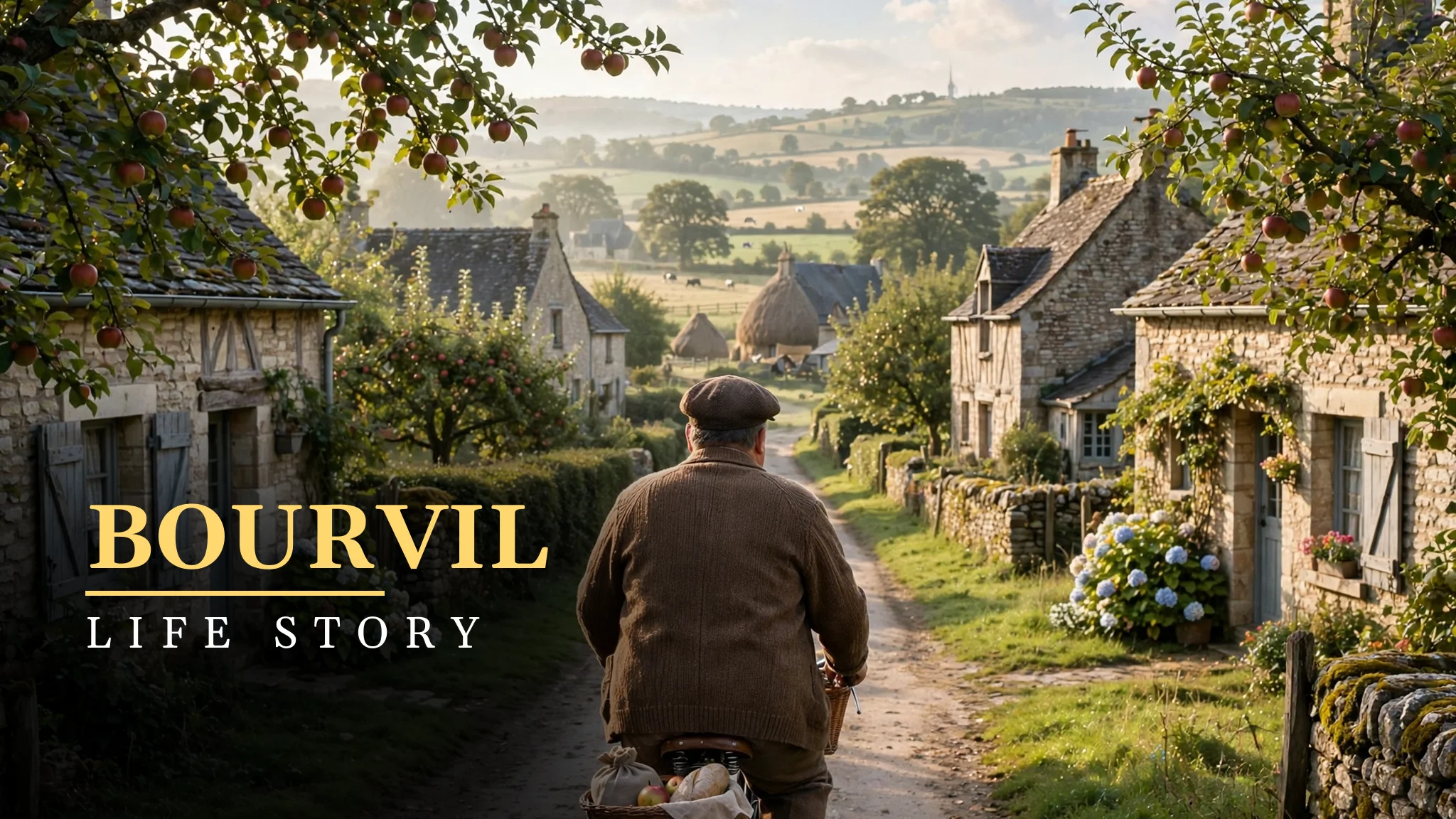
I keep thinking about the bicycle in the image, the basket with bread and apples, the stone cottages, and the quiet lane. It is a picture of a simple life, and it fits Bourvil perfectly. He was a man of simple things: bread, apples, a bicycle, a song, a laugh. He did not need grand things to be happy, and he did not need grand things to make others happy. He needed only his voice, his face, and his heart. In the end, I think that is why France still loves him. He reminds us that a good life is not a grand life. It is a kind life, lived simply, with the people you love, doing the work you love. Bourvil lived that life, and he left it behind as a gift for all of us.
I also think about his voice, and about how a voice can be a home. When I hear La Tendresse in my mind, I feel a warmth, as if someone is speaking kindly to me. That is a rare feeling, and it is one that Bourvil gave to millions of people. His voice was not perfect, and it was not grand. It was warm, and it was true, and that was enough. I think about the singers today who have perfect voices, trained in schools, and I wonder if they can give that same warmth. A perfect voice can impress, but a warm voice can comfort, and comfort is what people need most. Bourvil’s voice comforted France, and it still does.
I think about his illness, and about the way he kept it private. He knew he was dying, and he did not tell the public. He kept working, he kept smiling, and he kept his humour. I find that both brave and sad. Brave, because it takes great strength to keep going when you know you are ill. Sad, because he was alone with that knowledge, and he carried it without asking for help. I think about the people who are ill today, and who keep it private, and I understand why they do it. They do not want pity. They want to live their lives with dignity, and Bourvil lived his with dignity to the end. That is a lesson in courage, and it is one I respect deeply.
I also think about Normandy, and about the countryside he came from. He was born in a small village, he grew up among fields and animals, and he never forgot it. He took his stage name from a village, he sang about the countryside, and he played men from the countryside. He was proud of his roots, and that pride gave his work a truth that no school can teach. I think about the people who leave their villages and try to forget them, because they think the village is something to be ashamed of. Bourvil shows the opposite. Your home is not a weakness. It is your strength, if you carry it with pride, and if you let it shape your work.
There is one more thing I want to say about Bourvil, and it is about laughter. He made people laugh, and he did it without hurting anyone. That is a rare gift, and it is one that is needed today more than ever. So much comedy today is about mocking, about being cruel, about laughing at someone else’s pain. Bourvil laughed with people, not at them, and his laughter was warm, not cold. I think about the laughter in my own life, and about the times when laughter made a hard day better. That is the laughter Bourvil gave, and it is a laughter that heals. He did not just make people laugh. He made them feel better, and that is a greater gift than laughter alone.
Finally, I think about what it means to die young, at fifty-three, with so much still to give. Bourvil died too soon, and France lost a star who had many more films and songs in him. That loss is real, and I feel it when I think about the films he might have made. But I also think about what he left behind: films that are still loved, songs that are still sung, and a memory of kindness that has not faded. A life is not measured by its length, but by what it leaves behind, and Bourvil left behind a great deal. He left laughter, he left warmth, and he left a song about tenderness that still teaches us how to love. That is a full life, even if it was a short one, and it is a life worth remembering.
I think about his family, and about the sons who remember a father who sang at home, who made them laugh, and who taught them to be kind. That memory, of a father who was also a star, is a precious one, and it is a part of Bourvil’s legacy that is just as important as his films. He was a great actor, but he was also a great father, and that is a legacy that his family carries with pride, and that France carries with love.
Finally, I think about the bicycle, the basket with bread and apples, the stone cottages, and the quiet lane. It is a picture of a simple life, and it fits Bourvil perfectly. He was a man of simple things: bread, apples, a bicycle, a song, a laugh. He did not need grand things to be happy, and he did not need grand things to make others happy. He needed only his voice, his face, and his heart, and he gave them to France, and France still loves him for it.
I also think about La Traversée de Paris, and about the man who carries goods across occupied Paris during the war. Bourvil plays Marcel Martin with a quiet courage, a man who is afraid, but who keeps going. I think about the ordinary people who lived through the war, who carried goods, who hid friends, and who risked their lives in small ways. Bourvil honours them in that film, and he shows that heroism is not always grand. Sometimes it is quiet, it is daily, and it is done by a man who is afraid but who keeps walking. That is a beautiful idea, and it is one that Bourvil plays with honesty and with heart.
Frequently Asked Questions
What was Bourvil’s real name, and where was he born?
Bourvil was born André Robert Raimbourg on 27 July 1917 in Prétot-Vicquemare, a small village in Normandy, France. He took his stage name from Bourville, a village near his home, and he kept his country roots at the heart of his work for his whole life.
How did Bourvil first become famous?
He first became known as a singer in the music halls of Paris, where his warm voice and gentle comic songs made him popular. His song La Tendresse, recorded in the early 1960s, became a classic, and his stage success led him into films, where he became one of France’s best-loved comic actors.
What are Bourvil’s most famous films?
His most famous films are La Traversée de Paris, Le Corniaud, and La Grande Vadrouille, the last two made with Louis de Funès and directed by Gérard Oury. La Grande Vadrouille, released in 1966, became one of the most successful and most loved French films of all time.
Why was Bourvil’s partnership with Louis de Funès so popular?
The two men were opposites: de Funès was fast, loud, and angry, while Bourvil was slow, calm, and gentle, and the contrast made their films very funny. Audiences loved seeing the two styles together, and Le Corniaud and La Grande Vadrouille are still watched and loved in France today.
What was Bourvil’s last film?
His last film was Le Cercle rouge, a serious crime film directed by Jean-Pierre Melville and released in 1970, in which he played a policeman. It was very different from his comedies, and it showed that he was a strong dramatic actor as well as a comic star.
When and how did Bourvil die?
He died in Paris on 23 September 1970, at the age of fifty-three, after a serious illness of the bone marrow that he had kept private. He continued to work as long as he could, and he was buried in Normandy, in the countryside where he had grown up.


