Jean Gabin: The Life Story Behind France's Toughest Screen Legend
In this post
- Paris, 1904, and a Music Hall Childhood
- Pépé le Moko, La Grande Illusion, and Fame
- La Bête humaine, War, and the Free French
- Touchez pas au grisbi and the Second Career
- The Last Years and a Quiet Goodbye
- Gabin and Jean Renoir: A Great Partnership
- Gabin, Melville, and the Gangster Film
- Gabin and Lino Ventura: Two Giants
- Gabin’s Children and Family Life
- Gabin and the Port of Le Havre
- My Take:
Jean Gabin was the face of French cinema for forty years. He was a big man, with a heavy face, a deep voice, and eyes that seemed to have seen everything. He played gangsters, soldiers, workers, and policemen, and he played them all with a quiet strength that made audiences believe him. He did not shout, and he did not show off. He stood still, he looked, and he spoke in a low voice, and the audience listened. He was a legend, and he knew it, but he never acted like one.
He was born in Paris in 1904, and he grew up in a family of performers. His father was a singer in music halls, and his mother was also a performer. Young Jean did not want to be an actor at first. He worked in many jobs, and he was a soldier, a labourer, and a singer before he became a film star. He made his first films in the early 1930s, and by the end of that decade he was the biggest star in France. Pépé le Moko in 1937, La Grande Illusion in 1937, and Le Quai des brumes in 1938 made him famous around the world.
Gabin served in the Second World War, fighting with the Free French Forces, and he was decorated for his bravery. After the war, he came back to the cinema, and he had a second career as an older actor, playing tough, weary men in films such as Touchez pas au grisbi and Le Clan des Siciliens. He made more than ninety films, and he worked until the end of his life. He died in 1976, at the age of seventy-two, and France mourned him as a national hero.
The story of Gabin is a story about a man who was tough on screen and gentle off it, about a man who lived through war and came back to make films, and about a man who became a symbol of France itself. He was a working-class hero, a man of the people, and his films are still watched today because they are honest, powerful, and true.
Paris, 1904, and a Music Hall Childhood
Jean Gabin was born Jean Alexis Moncorgé on 17 May 1904 in Paris. His father, Ferdinand Moncorgé, was a singer and actor in music halls, and his mother, Marie Petit, was also a performer. The family lived in the world of the music hall, with songs, jokes, and applause. Young Jean grew up backstage, watching his father perform, and he learned about the stage from an early age. But he did not want to be a performer at first. He wanted a normal life, and he tried many jobs.
He left school early, and he worked as a labourer, a builder, and in other manual jobs. He was a big, strong young man, and he was not afraid of hard work. He also served in the army, and he learned discipline and toughness. He was a man of the people, and he understood the lives of working men, because he had lived that life himself. That understanding would later make his performances so believable. When he played a worker, a soldier, or a gangster, he knew what he was talking about, because he had been close to those lives.
In the 1920s, Gabin began to work in the theatre and in music halls, following his father. He sang, he acted, and he learned his craft. He was not a natural star. He was a working actor, and he learned slowly. He made his first film in 1930, and he played small roles in the early 1930s. He was a tall, heavy man, with a face that was not handsome in the usual way, but it was a face that the camera loved. It was a face that showed character, strength, and sadness, all at the same time.
The 1930s were a time when French cinema was growing, and Gabin was in the right place at the right time. He worked with directors who saw his talent, and he began to get bigger roles. He was a man who had lived a real life, and that real life showed in his acting. He did not act like a star. He acted like a man, and that was what made him a star.
Pépé le Moko, La Grande Illusion, and Fame
Pépé le Moko, released in 1937, made Gabin famous. He played Pépé, a gangster who hides in the Casbah of Algiers, a maze of narrow streets where the police cannot find him. He is safe in the Casbah, but he is also a prisoner there, because he cannot leave without being caught. He falls in love with a beautiful woman, and he risks everything to be with her. The film was a success in France and in America, and it made Gabin a star. His performance was quiet, strong, and sad, and it showed a man who was tough on the outside and lonely on the inside.
In the same year, Gabin made La Grande Illusion, directed by Jean Renoir, one of the greatest directors in cinema history. The film is about French prisoners of war in Germany during the First World War, and Gabin played Maréchal, a working-class soldier who tries to escape. The film is a masterpiece, and it is regarded as one of the greatest films ever made. Gabin’s performance was natural, honest, and moving. He played a man who was brave, loyal, and human, and he did it without showing off. The film was a success around the world, and it made Gabin known internationally.
The next year, in 1938, Gabin made Le Quai des brumes, directed by Marcel Carné, playing Jean, a deserter from the army who arrives in the port of Le Havre in the fog. He meets a young woman, and he falls in love, but his past catches up with him. The film is dark, poetic, and sad, and it is one of the great films of French cinema. Gabin’s performance was perfect for the film: quiet, weary, and full of feeling. The fog, the port, and the sad music all fitted his face and his voice. It was a film that defined an era, and it defined Gabin as an actor.
These three films, made in two years, made Gabin the biggest star in France. He was a man who represented France: tough, honest, and romantic. He was a working-class hero, and he was loved by audiences who saw themselves in him. He was not a pretty star. He was a real man, and that was why people loved him.
La Bête humaine, War, and the Free French
In 1938, Gabin also made La Bête humaine, directed by Jean Renoir, playing Jacques Lantier, a train driver who is driven to murder by jealousy and by a dark side in his nature. The film was based on a novel by Émile Zola, and it was a powerful, dark drama. Gabin’s performance was intense and tragic, and it showed that he could play a man who was not a hero, but a man with flaws. He was not afraid to play dark characters, and he played them with honesty.
When the Second World War began, Gabin was already a famous actor, but he chose to fight. He joined the Free French Forces, led by General de Gaulle, and he served as a tank commander. He fought in North Africa and in France, and he was decorated for his bravery. He was a man who had played soldiers on screen, and now he was a real soldier. That experience changed him, and it gave him a deeper understanding of war, of courage, and of loss. He did not talk much about the war after it ended, but it was a central part of his life.
After the war, Gabin returned to France, and he tried to restart his film career. It was not easy. He was older, the cinema had changed, and he had been away for years. He made films in the late 1940s, but they were not as successful as his earlier work. Some people thought his career was over, and that he was a star of the past. But Gabin was a patient man, and he waited for the right roles. He knew that he had more to give, and he was right.
The war had made him a hero in real life, not only on screen. He had fought for France, and France remembered that. He was a man who had risked his life for his country, and that gave him a dignity that no film could give. When he returned to the cinema, he brought that dignity with him, and it showed in his performances. He was no longer a young romantic hero. He was an older man, with experience, with scars, and with a quiet strength that came from having lived through war.
Touchez pas au grisbi and the Second Career
In 1954, Gabin made Touchez pas au grisbi, directed by Jacques Becker, and it gave him a second career. He played Max, an ageing gangster who wants to retire, but who is pulled back into crime by a younger man. The film was a success, and it showed Gabin as an older actor, playing a man who is tired, wise, and dangerous. His performance was quiet, controlled, and powerful. He did not need to shout. He only needed to look, and the audience understood. The film won awards, and it made Gabin a star again, this time as an older man.
The 1950s and 1960s were a golden period for Gabin as an older actor. He made films such as Le Désordre et la nuit, Maigret, and Le Président, playing policemen, judges, and gangsters. He worked with the director Jean-Pierre Melville, and he made films that were stylish, dark, and elegant. He was a man who had grown older, and his face showed it, but that made him more interesting, not less. He was a legend, and he played legends.
In 1969, he made Le Clan des Siciliens, with Alain Delon and Lino Ventura, playing a gangster who plans a daring robbery. The film was a huge success, and it showed that Gabin could still carry a big film, even in his sixties. He was a star who had been famous for thirty years, and he was still at the top. That is a rare achievement, and it shows his talent and his staying power. He was not a star who faded. He was a star who grew, and who became more respected as he got older.
Gabin also played the detective Maigret, based on the novels by Georges Simenon, in several films. Maigret is a quiet, thoughtful policeman, and Gabin was perfect for the role. He played Maigret with a calm, a patience, and a humanity that made the character believable. The films were popular, and they showed another side of Gabin: not a gangster, but a man of the law, a man who understood people and who solved crimes by listening, not by shouting.
The Last Years and a Quiet Goodbye
In the 1970s, Gabin continued to make films, including L’Affaire Dominici, Le Chat, and L’Année sainte. He was in his seventies, but he was still working, and he was still respected. He was a man who loved his work, and he did not want to stop. He also loved his family, and he lived a quiet life away from the cameras. He had married three times, and he had children. He was a private man, and he did not seek publicity. He was a star, but he was also a man who valued his privacy.
He became ill in the 1970s, and he died on 15 November 1976, at the age of seventy-two, in Neuilly-sur-Seine, from leukaemia. His death was mourned across France, and tributes came from actors, directors, and politicians. He was a national hero, not only because of his films, but because of his service in the war. His ashes were scattered at sea, off the coast of Brest, by a French warship, a fitting farewell for a man who had served his country. France had lost one of its greatest actors, and one of its bravest men.
Gabin’s legacy is immense. He made more than ninety films, and he worked with the greatest directors in French cinema. He was a star for forty years, and he was a symbol of France. His films are still shown, still studied, and still loved. Pépé le Moko, La Grande Illusion, Le Quai des brumes, and Touchez pas au grisbi are films that every student of cinema should see, and they are films that every lover of French cinema knows by heart. Gabin was a giant, and his shadow is still long.
He is remembered for his face, for his voice, and for his quiet strength. He showed that an actor does not need to shout to be powerful. He showed that stillness can be more dramatic than movement, and that silence can be more moving than words. That is a lesson for any actor, and it is a lesson that Gabin taught by example. He was a master, and his work will be remembered for as long as people watch films.
Gabin and Jean Renoir: A Great Partnership
Jean Gabin worked with Jean Renoir, one of the greatest directors in cinema, on La Grande Illusion and La Bête humaine, and that partnership was one of the most important in French film. Renoir was a director who loved actors, who let them be natural, and who believed in the humanity of his characters. Gabin was an actor who was natural, honest, and human, and together they made films that are still regarded as masterpieces. Renoir gave Gabin room to be himself, and Gabin gave Renoir a face that the camera loved. That is a perfect partnership, and it is one that film students still study today. It shows that great films are made when a great director and a great actor trust each other, and when they share a vision of what cinema can be.
Renoir and Gabin also shared a love of France, of its people, and of its stories. Their films are about Frenchmen, about workers, about soldiers, and about ordinary people trying to live with dignity. That is a theme that runs through Gabin’s career, and it is a theme that Renoir understood. Together, they made films that are not only French, but universal, because they are about what it means to be human. That is a legacy that will last as long as people watch films.
Gabin, Melville, and the Gangster Film
In the 1960s, Gabin worked with Jean-Pierre Melville, a director known for stylish gangster films. Melville’s films are cool, elegant, and precise, and Gabin was perfect for them, because he had a cool, elegant presence, even as an older man. He played gangsters who were tired, wise, and dangerous, and he did it with a stillness that made them believable. Melville and Gabin made films that are still admired by directors today, including American directors who learned from them. That influence is a part of Gabin’s legacy: he helped to create the modern gangster film, and his style is still copied today.
Gabin and Lino Ventura: Two Giants
Jean Gabin worked with Lino Ventura, another great French actor, in films such as Le Clan des Siciliens, and the two men were a formidable pair. Ventura was a former wrestler, a big, strong man with a quiet presence, and Gabin was a big, strong man with a quiet presence as well. Together, they made a team that was powerful and believable. They played gangsters, policemen, and tough men, and they did it with a realism that came from their own lives. Ventura had been a wrestler, Gabin had been a soldier and a labourer, and they both knew what it was to be a working man. That shared experience made their performances authentic, and it made their films more than just entertainment. They were films about real men, played by real men, and that is why they are still watched today.
The partnership between Gabin and Ventura is a reminder that great acting often comes from great partnerships. When two talented actors work together, they push each other to be better, and the result is greater than the sum of its parts. Gabin and Ventura did that, and their films together are among the best in French cinema. They were two giants, and they respected each other, and that respect shows on screen. It is a lesson for any artist: find people who make you better, and work with them, even if they are as strong as you are. That strength will make you stronger, not weaker.
Gabin’s Children and Family Life
Jean Gabin had children from his marriages, and he was a devoted father, even though he was often away filming. He loved his family, and he tried to be present for them, even when his work took him away. That is a difficult balance for any famous person, and Gabin did his best. He was a private man, and he did not talk much about his family in public, but those who knew him said he was warm, generous, and loving at home. That is a side of him that the public did not see, because on screen he was tough and silent, but at home he was a father who cared. That contrast is a reminder that actors are not their characters. They are people, with families, with loves, and with a private life that is just as important as their public one.
Gabin and the Port of Le Havre
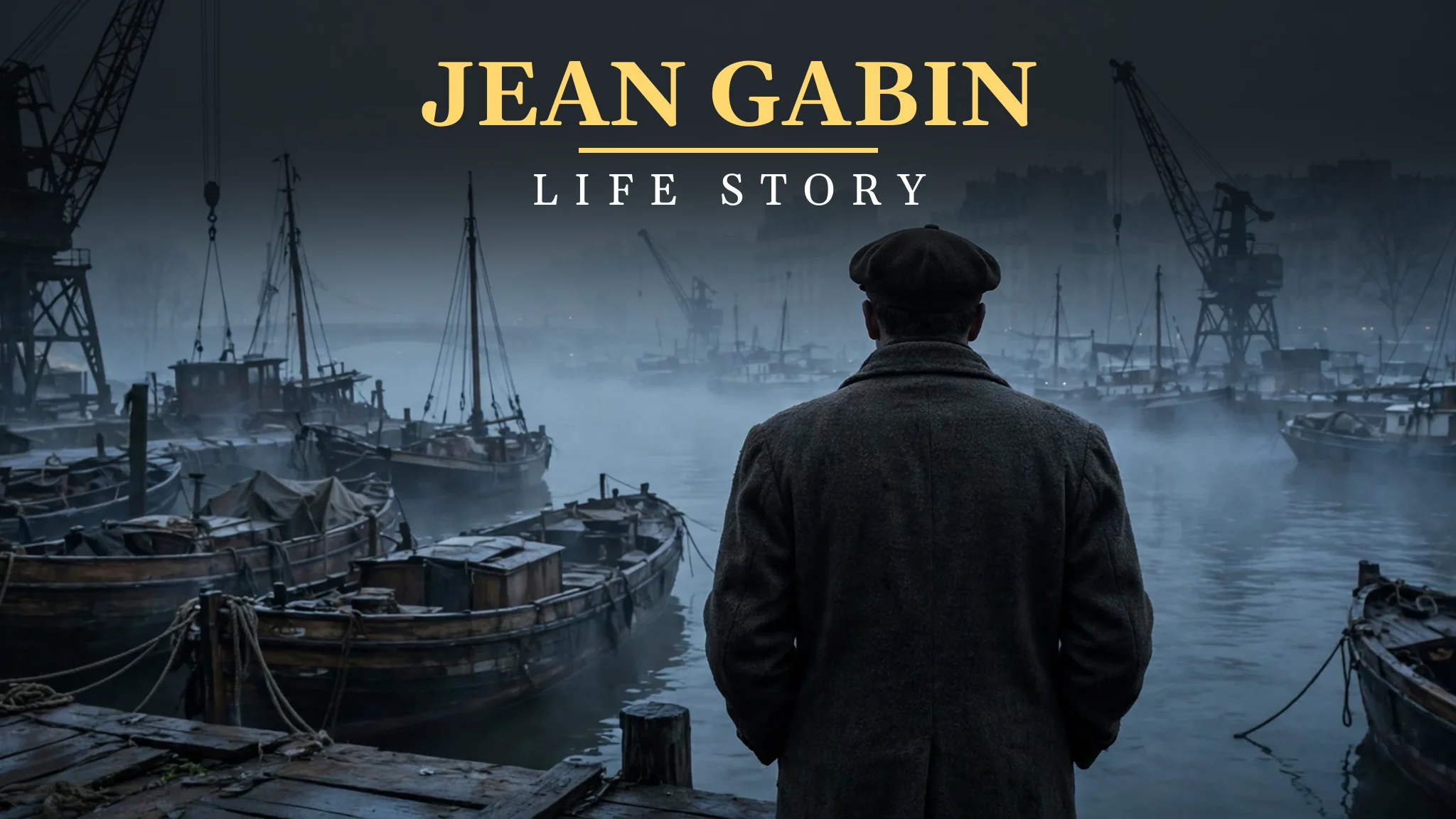
Le Quai des brumes is set in Le Havre, a port town in northern France, and the fog, the sea, and the ships are a central part of the film. Gabin’s character, Jean, arrives in the fog, and he is a stranger in a strange town, looking for a way out. That setting is perfect for Gabin, because he was a man who often played strangers, men who arrive somewhere and do not belong. The fog hides him, but it also traps him, and that is a metaphor for his life in the film. He wants to escape, but he cannot, because his past follows him. That is a tragic story, and Gabin plays it with a sadness that is deeply moving. The film is a masterpiece of mood, and Gabin’s face, in the fog, is one of its most memorable images.
The port is also a symbol of France itself, a country of ports, of sailors, and of men who work with their hands. Gabin was a man of the ports, a working-class hero, and Le Quai des brumes captures that identity perfectly. It is a film about France, about its workers, and about its soul, and Gabin is the perfect actor to embody that soul. He was not a Parisian sophisticate. He was a man of the people, and his films show that, again and again. That is why he is still loved in France, because he represented the France that most French people knew: hard-working, honest, and a little bit sad.
My Take:
When I think about Jean Gabin, I think first about his eyes, because they seemed to have seen everything. He had a heavy face, a deep voice, and eyes that were sad and wise at the same time. When he looked at the camera, you felt as if he was looking at you, and as if he knew something about life that you did not yet know. That is a powerful thing for an actor to do, and it is a thing that few actors can do. Gabin could do it, because he had lived a real life, with hard work, with war, and with loss, and that life showed in his face.
Pépé le Moko is a film that stays with me, because it is a story about a man who is safe and trapped at the same time. Pépé is a gangster who hides in the Casbah of Algiers, where the police cannot find him, but he cannot leave without being caught. He is free in the Casbah, but he is also a prisoner. That is a powerful idea, and it is an idea that many people understand. We all have places where we feel safe, but where we also feel trapped. Gabin plays Pépé with a sadness that makes the film more than a gangster story. It becomes a story about freedom, about love, and about the price of safety. I think that is a great film, and Gabin’s performance is a great one.
La Grande Illusion is another film that I admire deeply, because it is about war, about class, and about humanity. Gabin plays Maréchal, a working-class soldier who is a prisoner of war, and he plays him with a naturalness that is rare. He does not act like a hero. He acts like a man, a man who is brave, loyal, and funny, even in a prison camp. The film is a masterpiece, and it is a film that every person should see, because it is about how people from different countries and different classes can understand each other, even in war. Gabin’s performance is a key part of that, because he makes Maréchal a man you believe in, and a man you care about.
What I find most admirable about Gabin is that he fought in the Second World War. He was already a famous actor, and he could have stayed safe in America or in France. Instead, he joined the Free French Forces, and he fought as a tank commander. He risked his life for his country, and he was decorated for his bravery. That is a real kind of courage, not the kind you see in films, but the kind you see in life. I respect him for that, and I think it makes his films more meaningful. When he played a soldier on screen, he knew what he was talking about, because he had been a soldier in real life. That is a depth that few actors have.
I also think about his second career, after the war, when he became an older actor playing gangsters and policemen. Touchez pas au grisbi is a film that I love, because it shows Gabin as an ageing gangster who wants to retire, but who is pulled back into crime. He plays Max with a quiet strength, a weariness, and a dignity that is moving. He does not shout, he does not show off. He just looks, and speaks in a low voice, and the audience understands. That is a masterclass in acting, and it is a lesson for any actor: you do not need to be loud to be powerful. You need to be true, and Gabin was true.
If I have a sadness about Gabin’s story, it is that he died relatively young, at seventy-two, from leukaemia. He had made more than ninety films, but he could have made more. He was still working in the 1970s, and he was still respected. I feel sad that he did not live longer, to make more films and to enjoy his old age. But I also think that he lived a full life, with a career that lasted forty years, with a war service that made him a hero, and with a family that loved him. That is a full life, and it is a life to be proud of.
I think the lesson for a young reader is about being real. Gabin was not a pretty star. He was a big, heavy man, with a face that showed his life. He did not try to be beautiful. He tried to be true, and that made him a star. That is a lesson for anyone who feels that they do not look right. You do not have to look like a model. You have to be real, and you have to have something to say. Gabin had something to say, and he said it with his face, his voice, and his silence. That is a powerful lesson, and it is one that I think is important today, when so much of fame is about looks.
Another lesson is about service. Gabin served his country in war, and he did it without making a big show of it. He did not talk much about the war after it ended, but he had done his duty. That is a quiet kind of patriotism, and it is one that I respect. You do not need to shout about your service. You need to do it, and then get on with your life. Gabin did that, and he is remembered for it, not because he talked about it, but because he did it.
When I watch Gabin today, I see a man who was a giant of French cinema, and who is still a giant. His films are still shown, still studied, and still loved. Pépé le Moko, La Grande Illusion, and Le Quai des brumes are films that every lover of cinema should see, and they are films that will be watched for as long as people watch films. Gabin was a master, and his work is a reminder that great acting is not about showing off. It is about being true, about being still, and about letting the audience come to you. I will keep watching his films, and I will keep learning from them, because they are films about a man who lived, who fought, and who acted with honesty and with strength. That is a legacy that will last.
I also want to reflect on Le Quai des brumes, because it is a film that captures a mood as much as a story. The fog, the port of Le Havre, the sad music, and Gabin’s weary face all work together to create a feeling of loneliness and longing. Jean, the deserter, arrives in the fog, meets a young woman, and hopes for a new life, but his past will not let him go. That is a tragic story, but it is also a beautiful one, because it is about hope in a dark place. Gabin plays Jean with a quiet sadness that makes you care about him, even though he is a deserter and a man with a troubled past. That is the power of his acting: he makes you care about flawed men, because he shows their humanity.
Another thought that stays with me is about his work as Maigret. Maigret is a detective who solves crimes by listening, by watching, and by understanding people, not by chasing them or by shouting at them. Gabin was perfect for that role, because he was a listener. He had a stillness that made people trust him, and a patience that made him a good detective. I think that is a lesson for life as well as for acting: sometimes the best way to understand a problem is to sit still, listen, and watch. Gabin did that on screen, and he did it in life, and it made him a wise man as well as a great actor.
I also think about the fact that Gabin was a working-class hero, and what that meant in France. He played workers, soldiers, and gangsters, and he played them with dignity. He did not make them into caricatures. He made them into real men, with real feelings, real fears, and real hopes. That mattered to French audiences, who were largely working-class people themselves. They saw themselves in Gabin, and they felt proud to see themselves on screen. That is a powerful thing for an actor to do, and it is a thing that Gabin did better than anyone else in France. He was their hero, because he was one of them.
In the end, I keep returning to the idea of quiet strength. Gabin did not need to be loud to be strong. He was strong because he was still, because he was patient, and because he had lived a life that had taught him what matters. That is a strength that is rare today, when so much of life is loud and fast. Gabin reminds me that silence can be powerful, that a look can say more than a speech, and that a man who has lived through war and through loss has a depth that cannot be faked. I will remember him as a giant, not because he was big, but because he was true, and because his truth still speaks to us today.
I also think about Gabin’s voice, and how important it was to his acting. He had a deep, gravelly voice, and he spoke slowly, with pauses that made you listen. That voice was a part of his identity, just as his face was. When he spoke, you believed him, because his voice sounded like a man who had lived, who had worked, and who had suffered. That is a lesson about voice: it is not only what you say, but how you say it. Gabin said little, but he said it with a voice that carried weight, and that weight made his performances powerful. I think young actors should listen to Gabin, not only watch him, because his voice teaches as much as his face does.
Another thought is about his ashes being scattered at sea by a French warship. That is a military honour, and it is a fitting farewell for a man who served his country. It shows that France remembered Gabin not only as an actor, but as a soldier, as a man who had risked his life. That is a rare honour, and it is one that Gabin earned. When I think about it, I feel moved, because it is a reminder that a person’s life is not only about their work. It is also about their service, their duty, and their love for their country. Gabin served, and France honoured him for it, and that is a beautiful ending to a great life.
I also think about the film Le Chat, in which Gabin played an old man in a troubled marriage, with Simone Signoret as his wife. It is a sad, quiet film, about two old people who have grown apart, and who live together in silence. Gabin’s performance is heartbreaking, because he plays a man who has lost the love of his life, but who cannot leave. That is a difficult role, and Gabin plays it with a restraint that is powerful. He does not shout, he does not cry. He just sits, and looks, and the audience understands his pain. That is great acting, and it is a reminder that Gabin could play not only gangsters and soldiers, but also ordinary men in ordinary pain. That range is what made him a legend.
Another thought is about his service in the war, and how it is remembered in France. Gabin was a tank commander, and he fought in North Africa and in France. He was decorated, and he was proud of his service, but he did not boast about it. He was a modest man, and he believed that doing your duty was its own reward. That modesty is a quality I admire, because it is rare in a world where people often boast about their achievements. Gabin did not boast. He served, he came home, and he got on with his life. That is a dignified way to live, and it is one that I think is worth remembering, especially today, when so much of life is about showing off.
I also think about the film Un singe en hiver, in which Gabin plays an old man who drinks with a younger man, played by Jean-Paul Belmondo, and the two men share stories and dreams. It is a film about friendship between generations, and it is a warm, funny, and sad film. Gabin and Belmondo were two generations of French stars, and their film together is a meeting of those generations. It is a film that I love, because it shows Gabin as an older man, wise and weary, and Belmondo as a younger man, full of energy. Together, they make a pair that is both funny and moving, and the film is a reminder that French cinema is a family, with old and young stars working together.
Frequently Asked Questions
When was Jean Gabin born and when did he die?
He was born on 17 May 1904 in Paris and died on 15 November 1976 in Neuilly-sur-Seine at the age of seventy-two from leukaemia.
What film made Jean Gabin famous?
Pépé le Moko, released in 1937, made him famous as a gangster hiding in the Casbah of Algiers, and La Grande Illusion in the same year made him known around the world.
Did Jean Gabin fight in the Second World War?
Yes, he joined the Free French Forces, served as a tank commander in North Africa and France, and was decorated for his bravery.
What was Touchez pas au grisbi about?
Released in 1954, it is about an ageing gangster played by Gabin who wants to retire but is pulled back into crime, and it gave him a successful second career as an older actor.
Who did Jean Gabin play in the Maigret films?
He played the detective Maigret, based on the novels by Georges Simenon, a quiet and thoughtful policeman who solved crimes by listening and understanding people.
How many films did Jean Gabin make?
He made more than ninety films in a career that lasted from 1930 until his death in 1976, working with the greatest directors in French cinema.
What happened to Jean Gabin’s ashes?
His ashes were scattered at sea off the coast of Brest by a French warship, a fitting farewell for a man who had served his country in war.


