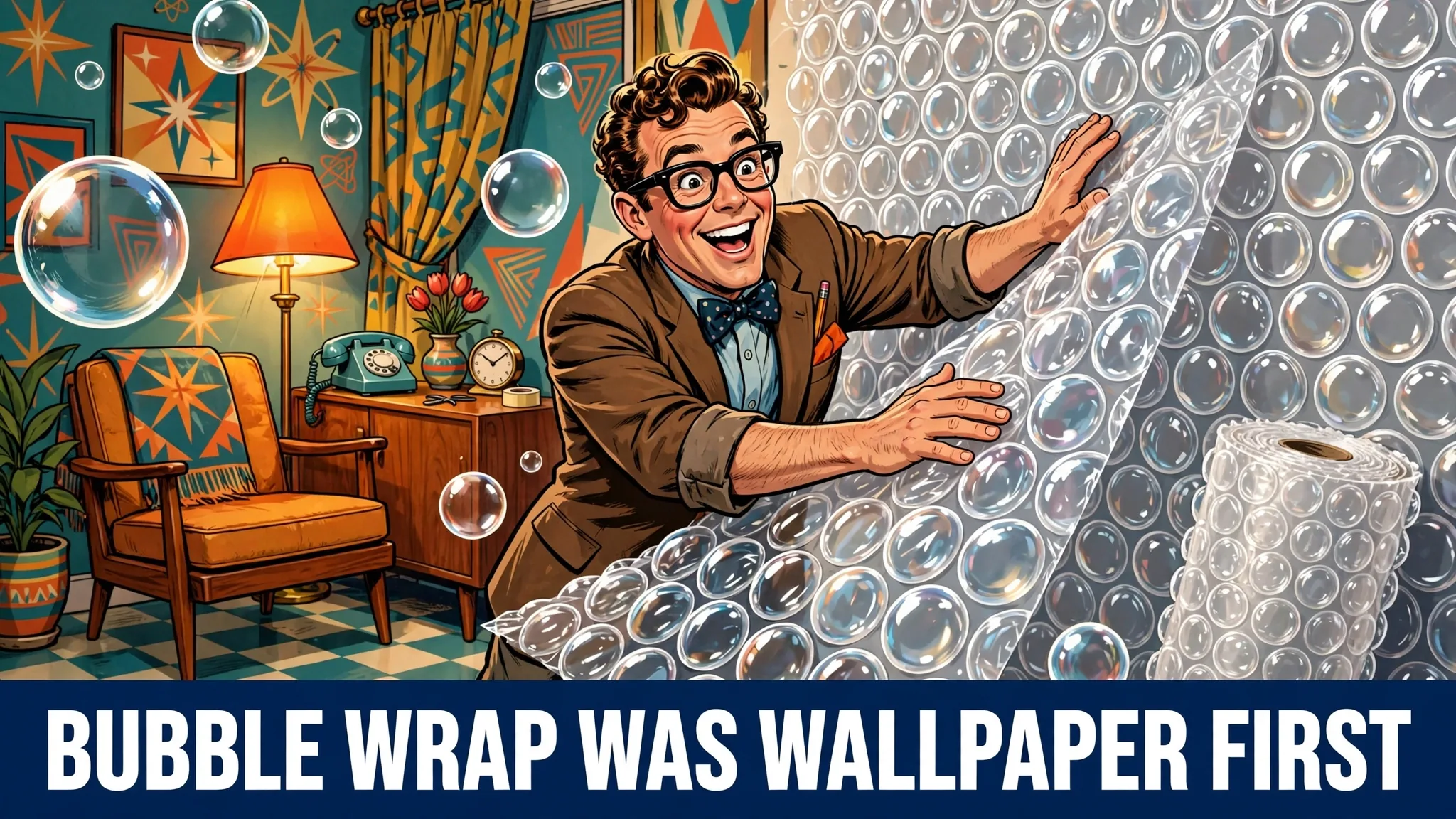
Bubble Wrap Was Wallpaper First
In this post
Hawthorne, New Jersey, 1957.
Two engineers, Alfred Fielding and Marc Chavannes, feed two plastic shower curtains through a heat-sealing machine. Fielding is the hands-on engineer; Chavannes, a Swiss chemist and inventor, is the dreamer beside him. They are not trying to protect anything. They are not thinking about parcels, or boxes, or shipping.
They are trying to decorate your walls.
What comes out of the machine is a plastic sheet full of trapped air bubbles. It will fail at its first job. It will fail at its second job. And then it will quietly take over the world.
Failure One: The Wallpaper Nobody Wanted
The plan sounded clever. The 1950s loved new textures and bold, modern homes, and the inventors aimed their idea at the young, artistic Beat generation. A three-dimensional plastic wallpaper, soft and bubbly to the touch — nothing like it existed.
There was just one problem. Nobody wanted it.
Homeowners looked at the bubbly plastic sheets and said no. A wall covering that looked like it was covered in blisters was not the future of interior design. The great wallpaper experiment died almost as soon as it began.
Failure number one.
Failure Two: The Greenhouse Blanket
Lesser inventors would have thrown the sheets away. Fielding and Chavannes did something smarter: they sat down and brainstormed what a sheet full of sealed air pockets might actually be good for. By their own company’s count, they came up with more than 400 possible uses.
One idea made it off the drawing board: greenhouse insulation. The air pockets trapped warmth, so perhaps the sheets could keep plants cosy.
They tested it in real greenhouses. It proved ineffective.
Failure number two.
The Sheet That Refused to Die
The story could easily have ended there — in a bin, in 1958, forgotten. Instead, the two men protected their strange invention. They were granted the first of several patents for embossing and laminating plastic; in the end they held six patents around the process, including a 1964 patent for making laminated cushioning material.
And in 1960, they backed their bubbly sheet with a whole company: Sealed Air Corporation. The product’s first brand name was Air Cap.
Around this time, the invention also found its first true fan. Alfred Fielding’s son Howard, about five years old, picked up a sheet, felt the fat bubbles under his fingers — the bubbles were much bigger in those days — and did what the whole world would soon do. He popped them. “They were really fun to pop,” he remembered later. “The bubbles were a lot bigger then, so they made a loud noise.”
To my mind, that little boy understood the product better than any customer the inventors had pitched so far. Adults kept asking what the sheet was for. The child simply felt what it did — it delighted the hands. The delight would matter as much as the engineering.
The Turn: A Computer That Needed a Hug
Now enter a problem from a completely different world.
In those days, if you shipped something delicate, you wrapped it in balled-up newspaper. That was the best protection available. It was messy — the ink rubbed off on the product and on the hands of everyone who packed it — and honestly, it did not protect very much.
Then, on 5 October 1959, IBM announced its new 1401 computer — a machine so important it has been called the Model-T of the computer industry. It was valuable. It was delicate. And it had to travel.
A marketer at Sealed Air named Frederick W. Bowers looked at the company’s failed wallpaper and saw the answer. He pitched Bubble Wrap to IBM as protective packaging and demonstrated what it could do. IBM was convinced, and began using it to protect the 1401 and its other fragile products during shipping. By 1961, Sealed Air had decided to use its bubbly sheet as packaging material — and its very first packaging client was IBM, wrapping the 1401 in the failed wallpaper for its journeys.
The sheet had finally found its real job.
From One Customer to a Packaging Empire
IBM’s trust opened the door, and smaller packaging companies hurried through it. To them, the material was a godsend: clean, light, flexible, and far kinder to fragile goods than a fistful of old newspaper.
The product family grew — big bubbles and little bubbles, wide rolls and short rolls, different strengths and thicknesses for different jobs. It even wandered into swimming pool covers for a few years, its large air pockets trapping the sun’s warmth in pool water.
The company grew up too. The inventors themselves were happier inventing than managing — as Dunphy put it, “neither wanted to run the company. They just wanted to work on their inventions” — so when T.J. Dermot Dunphy became chief executive in 1971, he built annual sales from 5 million dollars in his first year to 3 billion dollars by 2000. In later years, Bubble Wrap alone accounted for roughly a tenth of the company’s billions in annual sales: hundreds of millions of dollars a year from a sheet nobody would put on a wall. By 2017, Sealed Air was a Fortune 500 company with sales of 4.5 billion dollars, 15,000 employees and customers in 122 countries, selling everything from food films to an inflatable version of Bubble Wrap that ships flat and fills with air only when needed. In 1993, Fielding and Chavannes were inducted into the New Jersey Inventors Hall of Fame — the shower-curtain men, honoured among the greats. In January 2010, the company even celebrated Bubble Wrap’s 50th birthday.
The Second Life: The World’s Favourite Pop
And then there is the career nobody planned at all.
Bubble Wrap became the world’s favourite thing to pop. People who would never read a single fact about packaging history will sit happily squeezing bubble after bubble for the small, perfect pop and the calm that follows it. Sealed Air’s own offices keep “stress relief boxes” filled with Bubble Wrap for employees to pop, and one of the company’s own executives, Chad Stephens, cheerfully admits he is a “stress-relief popper.”
One name note, because words matter here: Bubble Wrap is a trademark — a brand owned by Sealed Air, which first sold the material as Air Cap. The ordinary name for the stuff itself is air-bubble cushioning. But the brand name won so completely that the whole planet now calls every bubbly sheet by it.
The Lesson Inside the Bubbles
Fielding and Chavannes never invented what they set out to invent. The wallpaper failed. The insulation failed. If they had judged their sheet only by the two jobs it flopped at, they would have thrown away one of the most successful materials of the modern age.
Instead, they kept asking a better question: not “why did our product fail?” but “what is this thing actually good at?” The answer — light, soft, springy, clean, and oddly joyful — was there from the very first sheet that came out of that heat-sealing machine in 1957. It just took two failures, one clever marketer, and one very expensive computer to reveal it.
So the next time you pop a bubble in a delivery box, remember what your fingers already know. You are not playing with rubbish. You are playing with a failure that refused to quit — and that is exactly why it is in your hands.
Frequently Asked Questions
What was bubble wrap originally invented to be?
Wallpaper. In 1957, engineers Alfred Fielding and Marc Chavannes sealed two plastic shower curtains together in Hawthorne, New Jersey, hoping to create a textured plastic wallpaper for modern homes. Nobody bought it, and a second attempt to sell it as greenhouse insulation also failed.
Who invented bubble wrap, and when?
Bubble wrap was invented in 1957 by Alfred Fielding and Marc Chavannes. In 1960 they founded Sealed Air Corporation to develop it, first selling the material under the name Air Cap before the Bubble Wrap brand took over.
Why did IBM use bubble wrap?
IBM needed to ship its delicate new 1401 computer safely, at a time when the standard protection was messy balled-up newspaper. Sealed Air marketer Frederick W. Bowers pitched Bubble Wrap as protective packaging, IBM tested it, and became the material’s first packaging customer.
Is Bubble Wrap a brand name or the product’s real name?
Bubble Wrap is a trademarked brand of the Sealed Air Corporation. The generic material — plastic cushioning filled with air bubbles — is called air-bubble cushioning, though almost everyone simply says “bubble wrap” for any version of it.
Why do people love popping bubble wrap so much?
Nobody fully planned it, but popping the bubbles turned out to be deeply satisfying and stress-relieving — so much so that Sealed Air keeps boxes of Bubble Wrap at its own offices purely for employees to pop. The joy started early: inventor Alfred Fielding’s young son Howard was popping the bubbles for fun back when the material was still a failed experiment.
Sources
- Smithsonian Magazine — “The Accidental Invention of Bubble Wrap”: https://www.smithsonianmag.com/innovation/accidental-invention-bubble-wrap-180971325/
- Wikipedia — “Bubble Wrap (brand)”: https://en.wikipedia.org/wiki/Bubble_Wrap_(brand)
- Mental Floss — “Happy Bubble Wrap Appreciation Day!”: https://www.mentalfloss.com/history/bubble-wrap-was-originally-supposed-be-wallpaper