Man Sold Rocks As Pets
In this post
- What Was the Pet Rock, Exactly?
- The Price Maths, Part 1: What Did One Pet Rock Cost to Make?
- The Price Maths, Part 2: Why $3.95 Was the Perfect Price
- Why Was the Pet Rock Manual So Funny?
- How Many Pet Rocks Did Gary Dahl Sell?
- Why Did the Pet Rock Fad End So Fast?
- What Did Gary Dahl Do After the Pet Rock?
- What Does the Pet Rock Teach About Selling?
- Sources
A bar in California, 1975. The drinks are going around, and the talk turns to pets. One friend complains about vet bills. Another moans about walking the dog in the rain. A third is tired of cleaning up messes, feeding animals, and repairing chewed furniture.
Listening to it all is a freelance advertising copywriter named Gary Dahl — a man who, by his own cheerful description, was basically broke. Dahl grins and announces that he has no such problems at all. His pet never needs food. It never needs walks. It never needs a vet, never makes a mess, and never dies.
His pet is a rock.
His friends laughed. America, it turned out, was about to laugh too — and pay $3.95 a time for the pleasure. Let us open the box, do the maths, and see how a joke became one of the silliest and smartest businesses of the twentieth century.
What Was the Pet Rock, Exactly?
The Pet Rock was exactly what the name says: a smooth, ordinary stone, sold as a pet. There was no trick inside it, no battery, no chip, no hidden machinery. Dahl himself never pretended otherwise, and that honesty was the whole joke.
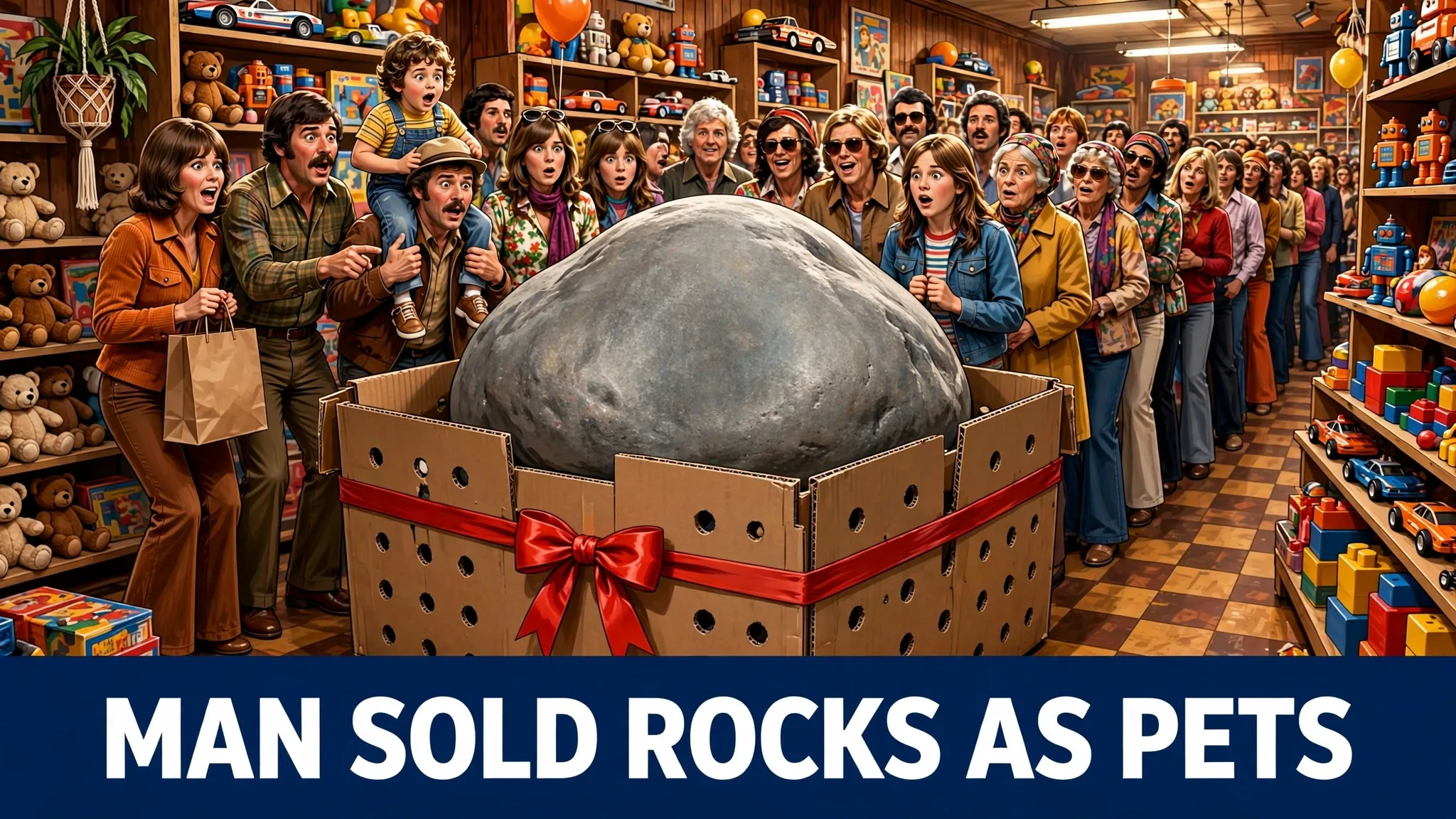
Each stone came in its own cardboard carrying box, designed like the carriers pet shops use, complete with air holes punched in the sides — because, of course, your new pet needed to breathe. Inside the box, the rock rested on a soft bed of straw-like packing, like a treasured animal being carried home. And tucked in with it was the true treasure of the package: a printed booklet called The Care and Training of Your Pet Rock.
People were not really buying a stone. They were buying the laugh that came with it.
The Price Maths, Part 1: What Did One Pet Rock Cost to Make?
Now let us count pennies, because this is where the story turns from funny to brilliant.
The rock itself: about one penny. Dahl’s stones were smooth beach pebbles collected from Rosarito Beach in Mexico. They reached him through a local sand and gravel company, and in bulk they cost around a penny apiece — some reports say even less.
The bedding: nearly free. The soft packing inside the box was cheap wood-shaving material, the kind used to protect fragile goods.
The box: the biggest real cost. The custom cardboard carrier, with its neat air holes, was the most expensive part of the package to manufacture.
The booklet: almost free at first. For the earliest print run, Dahl cleverly attached his little manual to another printing job, so producing it cost him next to nothing.
Add it all up, and the product inside that box cost Dahl a tiny fraction of its selling price. Hold that thought.
The Price Maths, Part 2: Why $3.95 Was the Perfect Price
Dahl set the selling price at $3.95.
Think about that number for a moment. It was not $1, which would have made the gift feel cheap and throwaway. It was not $10, which would have made buyers stop and think seriously. At $3.95, the Pet Rock sat in the golden zone of joke gifts: cheap enough to buy on impulse, expensive enough to feel like a real present when you handed it to a friend.
And people did the maths exactly the way Dahl hoped. Everyone knew the rock itself was nearly worthless. That was not a flaw in the product. That was the product. Paying real money for something proudly useless was the punchline, and buyers were delighted to be in on it.
Why Was the Pet Rock Manual So Funny?
If the box made people smile, the manual made them howl — and it was written by a professional. Dahl earned his living writing advertising, and he poured all of that skill into a straight-faced, 32-page guide to looking after a stone.
The booklet never once broke character. It treated the rock as a living pet with total seriousness, and it taught owners how to train it. A rock, it explained, learns some commands beautifully. “Stay” is no problem at all. “Play dead” was reportedly the most popular trick of all, performed perfectly, every single time, for hours on end. House-training advice suggested that if your rock seemed excited when you lifted it from its box, you should place it on some old newspapers — the rock would know what the paper was for.
The comedy worked because it was generous. The manual gave the buyer something real for their money: a few minutes of genuine laughter, and a gift that kept being funny every time it was shown to someone new. The stone was free anywhere on Earth. The words were what people paid for.
Honestly, my own view is that Dahl’s customers were far smarter than the joke suggests. Nobody was fooled for a second — they knew precisely what was in the box, and they bought the shared laugh on purpose, the way we still pay for greeting cards and novelty gifts today.
How Many Pet Rocks Did Gary Dahl Sell?
The Pet Rock reached shops in October 1975, just in time for the Christmas season, after Dahl had shown it at gift shows and newspapers across America had spread the story. Then the wave hit.
At the peak of the craze, Dahl estimated he was selling up to 100,000 Pet Rocks a day. By the time the dust settled, roughly 1.5 million Pet Rocks had been sold.
Now the fun part — the multiplication:
- 1.5 million rocks × $3.95 = about $5.9 million in sales, in just a few months.
- Dahl’s profit was reported at roughly 95 cents per rock.
- 1.5 million × 95 cents = well over $1 million in profit.
A freelance copywriter who had been struggling to pay his bills became a millionaire before spring, selling stones. He appeared on television, was featured in major magazines, and watched the whole country repeat his bar joke back to him.
Why Did the Pet Rock Fad End So Fast?
For the same reason it began: it was a joke, and every joke has a last telling.
By February 1976 — barely six months after the craze exploded — sales had collapsed. Copycat products flooded the shops, and Dahl could not truly stop them, because nobody can own the idea of a rock. Even his own two business partners turned on the success: the investors who had helped fund the idea sued him, claiming their share of the profits was too small, and after a court judgment Dahl wrote them a cheque for a six-figure sum.
Dahl later admitted, with the wisdom of hindsight, that he had let the fad run too long and had started believing his own publicity. His advice to anyone riding a craze was simple: enjoy it while it lasts.
What Did Gary Dahl Do After the Pet Rock?
With his profits, Dahl bought and renovated a bar in Los Gatos, California, and named it Carrie Nation’s Saloon. Success followed him there, too — would-be inventors kept turning up at the bar, hoping the rock man would bless their ideas, many of which involved packaging animal droppings. He had little patience for them.
He tried other joke products, because lightning was surely polite enough to strike twice. There was the Official Sand Breeding Kit, which offered guidance on growing sand. There was Canned Earthquake, a coffee can with a wind-up mechanism that made it jump around a table. There was even a scheme jokingly described as smuggling mainland China into America one cubic centimetre at a time. None of them came close to the rock.
In time Dahl returned to his real trade, advertising, and in 2001 he published what might be the most honest possible summary of his career: a book called Advertising for Dummies. Gary Dahl died on 23 March 2015, at the age of 78. Of the unsold rocks left over at the end of the fad, he used to say that if they did not sell, he would simply use them to repave his driveway.
What Does the Pet Rock Teach About Selling?
Strip away the laughter, and one serious lesson remains, which is why this story is still told in marketing classes half a century later.
Dahl did not sell a product. He sold an idea wrapped around a product: a story people could repeat, a package that made them smile before they even opened it, and a booklet that gave them words to enjoy and share. The raw material cost a penny because raw material was never the point. The value lived in the presentation — the box, the bedding, the dead-serious training manual, and the perfect price.
Every modern business that sells an ordinary thing at an extraordinary price through story, humour and packaging is walking a path that a broke copywriter first paved in 1975 — with, quite literally, a pile of beach stones.
Frequently Asked Questions
Who invented the Pet Rock?
The Pet Rock was invented in 1975 by Gary Dahl, a freelance advertising copywriter from California. He got the idea as a joke in a bar, while friends complained about the cost and effort of keeping real pets.
How much did a Pet Rock cost?
A Pet Rock sold for $3.95 in 1975. The rocks themselves cost Dahl about a penny each in bulk, since they were ordinary smooth pebbles gathered from Rosarito Beach in Mexico.
How many Pet Rocks were sold?
Around 1.5 million Pet Rocks were sold within a few months, mostly during the Christmas season of 1975. Dahl’s profit was reported at roughly 95 cents per rock, making him a millionaire.
What was inside a Pet Rock box?
Each box contained one smooth stone resting on soft bedding, with air holes punched in the cardboard carrier, plus a humorous booklet titled The Care and Training of Your Pet Rock, which taught owners to train their rock to obey commands such as “stay” and “play dead.”
Did Gary Dahl make other products after the Pet Rock?
Yes, he tried several other joke products, including a Sand Breeding Kit and a wind-up Canned Earthquake, but none matched the Pet Rock’s success. He later returned to advertising and wrote the book Advertising for Dummies, published in 2001.
Sources
- Inc. — “50 Years Ago, This Brilliant Invention Was America’s No. 1 Christmas Gift”: https://www.inc.com/bill-murphy-jr/50-years-ago-this-4-product-was-americas-1-christmas-gift-and-taught-a-brilliant-lesson-in-marketing/91281083
- Mental Floss — “Hard Sell: A History of the Pet Rock”: https://www.mentalfloss.com/fun/toys/pet-rock-history
- Geological Society Blog — “Never a Dahl Moment”: https://blog.geolsoc.org.uk/2015/04/09/never-a-dahl-moment/