Burt Lancaster: The Life Story Behind Hollywood's Tough Star
In this post
- A New York Boy Who Learned to Fly
- An Injury, the Army, and a Chance on Broadway
- From Here to Eternity and the Beach Scene the World Remembers
- Elmer Gantry, the Oscar, and the Preacher Who Sold Salvation
- The Later Films, Atlantic City, and a Quiet Goodbye
- The Train, The Swimmer, and the European Years
- My Take:
Burt Lancaster was not the kind of actor Hollywood expected. He did not come from a stage family, and he did not spend his youth dreaming of applause in a theatre. He came from the circus, from the trapeze and the high wire, and he brought the body of an acrobat and the grin of a showman into films that were usually played by quieter, softer men. He was big, he was strong, and he moved like a man who had spent his life in the air. That physical gift made him a star, but what kept him a star was something else: a sharp mind, a love of hard stories, and a refusal to be only the handsome hero the studios wanted him to be.
He was born Burton Stephen Lancaster on 2 November 1913, in New York City, in the neighbourhood of East Harlem. His father worked for the post office, and his mother was a homemaker, and the family lived in a modest home in a city that was full of noise, crowds, and opportunity. Young Burt grew up on the streets of New York, and he was a strong, active boy who loved sport and loved to climb, jump, and swing from anything he could find. He was not a quiet child, and he was not a bookish one. He was a boy of the body, and the body would shape his whole life.
What makes Lancaster’s story different from the other stars of his time is how late he came to acting, and how much he did before he ever faced a camera. He was a circus acrobat, a soldier, and a man who had already lived a full life by the time Hollywood found him at the age of thirty-two. He was not a young man learning his trade. He was a grown man with a past, and the camera could see it. This is the story of how a boy from East Harlem became one of the most respected actors in American film, and how he kept reinventing himself long after other stars had faded.
A New York Boy Who Learned to Fly
Burt Lancaster grew up in East Harlem, a working-class part of New York City where families lived close together and children played in the streets. His father, James, was a postman, a steady job that kept the family fed but never rich, and his mother, Elizabeth, ran the home. Burt was the youngest of five children, and he was a restless, energetic boy who was always moving. He played sports at school, he ran, he jumped, and he was drawn to anything that let him use his strength. The streets of New York were his playground, and he learned there how to be tough, how to be quick, and how to take a fall without crying about it.
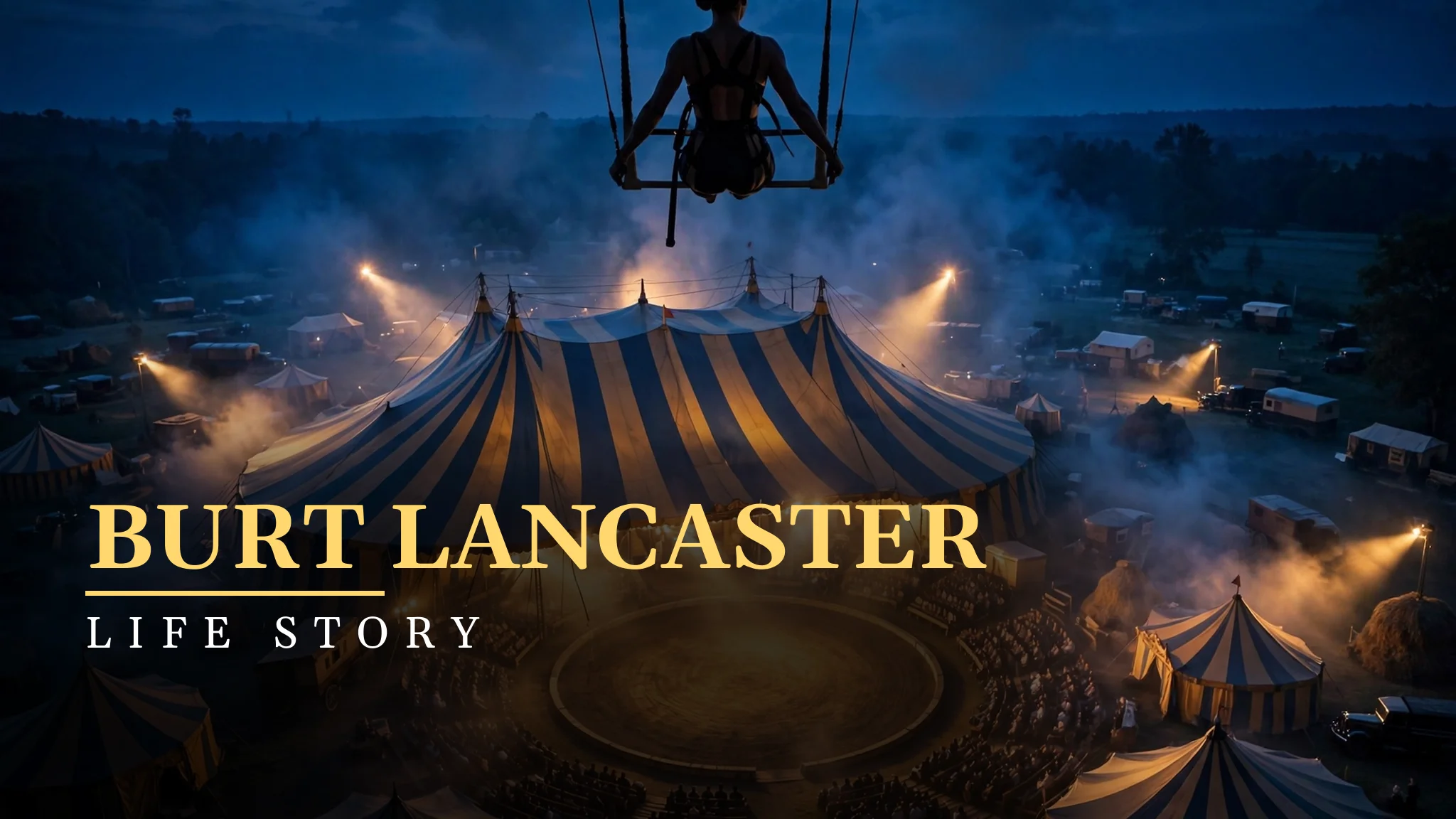
As a boy, he met another young man named Nick Cravat, and the two became close friends. They shared a love of gymnastics and acrobatics, and they began to practise together, learning to tumble, to balance, and to swing on the trapeze. It was a dangerous hobby, and it took strength, trust, and courage, because a mistake in the air could mean a broken bone. But Burt loved it. He loved the feeling of flying, of being high above the ground with nothing but his own body to hold him up, and he loved the applause that came when he and Nick performed for a crowd. It was his first taste of show business, and it was not in a theatre. It was in a circus ring.
He went to college for a time, studying at New York University, but the classroom was not where his heart was, and he soon left to follow the life of a performer. He and Nick Cravat formed an acrobatic act, and they joined a circus, travelling from town to town, performing their trapeze routines for audiences who had never seen anything like them. The circus was a hard life. The pay was small, the travel was constant, and the work was dangerous. But Burt was happy, because he was doing what he loved, and he was free. He spent years in the circus, and he learned lessons there that would serve him in Hollywood: how to work with a partner, how to trust your body, and how to perform when the crowd is watching.
The circus years ended when Burt was injured, and he had to give up the trapeze. It was a painful moment, because the circus had been his whole life, but it pushed him toward a new path. He took other jobs, he worked in a circus office, and he tried to find a way to stay in show business without risking his body in the air. Then the Second World War came, and he joined the army, where he served in North Africa and Italy, entertaining the troops with the USO. The war took him far from New York, and it showed him a world that was larger and harder than the circus ring. When he came home, he was a man of thirty, with no clear future, and no idea that the next few years would change his life completely.
An Injury, the Army, and a Chance on Broadway
When Lancaster came back from the war, he needed work, and he found it in the theatre almost by accident. He was asked to take a small part in a Broadway play, and he discovered that he could act. He had never trained as an actor, but he had spent years performing in front of crowds, and he knew how to hold a stage. He was big, he was strong, and he had a smile that could fill a room, and audiences liked him at once. The play was not a great success, but it was enough to bring him to the attention of people in Hollywood, who were looking for new kinds of leading men after the war.
One of the people who noticed him was the producer Hal Wallis, who saw him on stage and offered him a film contract. Lancaster was thirty-two years old, far older than most new stars, and he had never made a film before. But Wallis saw something in him that the camera would love: a body that had been trained by the circus, a face that could be both charming and dangerous, and a natural ease in front of a crowd. Lancaster took the offer, and he went to Hollywood to make his first film, The Killers, in 1946, based on a short story by Ernest Hemingway.
The Killers was a film noir, a dark crime story about a man who is murdered and the insurance investigator who tries to find out why. Lancaster played the Swede, a former boxer who has given up on life and waits for his killers to come. It was a sad, quiet part, and Lancaster played it with a stillness that surprised people who had expected him to be only a strongman. He did not overact. He did not try to charm the audience. He simply stood there, big and sad, and let the camera do the work. The film was a success, and it made him a star overnight. He had gone from the circus to Hollywood in a single step, and he had done it without any of the training that other actors spent years acquiring.
The years that followed were busy ones. He made films with the great actresses of the time, and he played gunfighters, soldiers, and lovers, and he became known as a reliable and exciting leading man. But he was not content to be only a handsome face. He wanted to make films that mattered, and he wanted to play parts that were harder and more interesting than the ones the studios kept offering him. So he began to look for stories that would challenge him, and he began to build a career that was different from the one Hollywood had planned for him.
From Here to Eternity and the Beach Scene the World Remembers
In 1953, Lancaster made the film that many people remember him for, even if they have never seen his other work. From Here to Eternity was a story about soldiers in Hawaii in the days before the attack on Pearl Harbor, and Lancaster played Sergeant Milton Warden, a tough, honest soldier who falls in love with the wife of his commanding officer. The film is famous today for one scene: Lancaster and the actress Deborah Kerr rolling in the surf on a Hawaiian beach, kissing as the waves wash over them. It was a daring scene for its time, and it became one of the most famous love scenes in the history of film. It also showed a softer, more romantic side of Lancaster, a man who could be tender as well as strong.
The film was a great success, and it won the Academy Award for Best Picture, and Lancaster was nominated for the Academy Award for Best Actor. It was his first nomination, and it proved that he was not only a physical actor, but a serious one, capable of playing a man torn between duty and love. The beach scene made him a symbol of romance, but the rest of the film showed something deeper: a man who knows what is right, who does his job, and who pays a price for loving the wrong person. It was a part that suited Lancaster, because he understood the soldier’s code, having been a soldier himself, and he understood the loneliness of a man who does his duty without thanks.
In the years after From Here to Eternity, he made a string of strong films. He played a gunfighter in Vera Cruz, a film that showed a darker, more violent side of the western, and he played a soldier in Run Silent, Run Deep, a tense story about a submarine in the Second World War. He also began to produce his own films, because he wanted the freedom to choose the stories he told. He formed a production company with the producer Harold Hecht, and together they made films that were bolder than the ones the big studios were making. They made Marty, a small, quiet film about a lonely butcher in the Bronx, which won the Academy Award for Best Picture, and they made Sweet Smell of Success, a dark film about a newspaper columnist and a press agent in New York.
Sweet Smell of Success, made in 1957, is now seen as one of the greatest films of the 1950s. Lancaster played J. J. Hunsecker, a powerful and cruel newspaper columnist who can make or break a man’s career with a few words. It was a cold, hard part, and Lancaster played it without any of the warmth that had made him a romantic star. He was terrifying in the role, and the film showed that he could be a villain as well as a hero. It was a brave choice, because stars of his size usually avoided playing men the audience would hate, but Lancaster did not care about being liked. He cared about being good, and Sweet Smell of Success proved that he was.
Elmer Gantry, the Oscar, and the Preacher Who Sold Salvation
The greatest honour of Lancaster’s career came in 1960, when he won the Academy Award for Best Actor for Elmer Gantry. He played a travelling salesman who becomes a preacher, a man who can move a crowd with his voice and his charm, and who uses religion to get money, women, and power. It was a daring part, because it attacked the way some preachers used faith for their own gain, and it was a film that many people found shocking. Lancaster played Gantry as a big, loud, joyful man, full of energy and full of lies, and he made the character both funny and frightening. The audience laughed at him, and then they felt uneasy, because they saw how easily a crowd could be led by a man who knew how to speak.
The Oscar was a long time coming. Lancaster had been nominated before, and he had been one of the biggest stars in Hollywood for more than a decade, but he had never won. When his name was called, it was a moment of joy for him and for the people who had watched him grow from a circus acrobat into a great actor. He accepted the award with thanks, and he went back to work, because work was what he had always done. The Oscar did not change him. It only confirmed what many people already knew: that Burt Lancaster was not only a strongman and a romantic lead, but one of the finest actors of his generation.
After Elmer Gantry, he made Birdman of Alcatraz in 1962, where he played Robert Stroud, a prisoner who becomes an expert on birds while locked in a cell for many years. It was a quiet, inward part, almost the opposite of Elmer Gantry, and Lancaster played it with a stillness and a patience that surprised audiences. He was nominated for another Oscar, and the film showed that he could play a man who had almost nothing, no freedom, no future, and still make the audience care about him. It was one of his finest performances, and it proved that his range was wider than anyone had guessed when he first appeared in The Killers.
He also made The Leopard in 1963, a great Italian film directed by Luchino Visconti, where he played a Sicilian prince watching his world fade away as Italy changed around him. It was a slow, beautiful film, and Lancaster, an American actor, played an Italian aristocrat with a grace and a sadness that won praise across Europe. It was a sign of how far he had come: from the circus ring in America to the palaces of Sicily, playing a prince in a film that is now seen as one of the masterpieces of world cinema. He was not only a Hollywood star anymore. He was an actor of the world.
The Later Films, Atlantic City, and a Quiet Goodbye
As the 1970s came, Lancaster was in his sixties, and the leading-man parts began to go to younger actors. But he did not stop, and he did not fade. He took character parts, he took supporting roles, and he kept working with the same care he had always brought to his work. He made The Professionals, a western about men hired to rescue a kidnapped woman, and he made films in Europe, where directors still wanted him for his strength and his presence. He was no longer the young acrobat, but he was still a powerful actor, and his face, lined and weathered, told a story that a younger face could not.
In 1980, he made Atlantic City, a film about an ageing gangster who dreams of a better life and falls in love with a young woman who is trying to escape her own past. It was a small, sad, beautiful film, and Lancaster played the old man with a tenderness and a humour that moved audiences and critics alike. He was nominated for the Academy Award for Best Actor again, his fourth nomination, and though he did not win, the performance is now seen as one of the great late performances in American film. It was a fitting role for a man in his late sixties: a man who had lived hard, who had made mistakes, and who still hoped for something better.
His health began to fail in the late 1980s. He suffered a stroke in 1990, and he became weaker, and he stopped working. He lived his final years quietly, with his family, and he died on 20 October 1994, at the age of 80, in Los Angeles. He had been married twice, first to June Ernst and then to Norma Anderson, with whom he had five children, and he had lived a life that had taken him from the streets of New York to the circus, to the army, to Broadway, and to the top of Hollywood. It was a long road, and he had walked it with a strength and a joy that few actors have matched.
He left behind more than eighty films, and a reputation as one of the most honest and hard-working actors of his time. He was not a man who chased fame for its own sake. He chased good stories, and he chased the chance to play men who were complicated, difficult, and real. His films are still watched today, from The Killers to Atlantic City, and they show an actor who never stopped growing, never stopped learning, and never settled for the easy part. The boy who learned to fly on a trapeze became a man who could carry a whole film on his shoulders, and he did it with a smile that the audience never forgot.
The Train, The Swimmer, and the European Years
In 1964, Lancaster made The Train, a film about the Second World War, where he played a French railway worker who tries to stop the Germans from taking great works of art out of Paris. It was a tense, physical film, full of real trains, real crashes, and real danger, and Lancaster did much of his own stunts, as he had always done. He was in his fifties, and he was still strong, still fast, and still willing to risk his body for a film. The Train was a success, and it showed that Lancaster could still carry an action film, even as he grew older, and that his circus training had never left him. He knew how to move, how to fall, and how to make danger look real, because he had spent his youth learning exactly those things in the air.
Four years later, in 1968, he made The Swimmer, a strange and haunting film about a man who decides to swim home through the pools of his wealthy neighbours, and who discovers, pool by pool, that his life has fallen apart. It was a quiet, sad film, very different from the action films, and Lancaster played the swimmer with a confusion and a pain that surprised audiences. He was a man who had everything, and who had lost it, and who did not yet know it, and the film showed his decline in a way that was both beautiful and terrible. It was not a great commercial success, but it is now seen as one of his most interesting films, and as proof that he was willing to take risks that other stars would not take.
In the 1960s and 1970s, he also made films in Europe, where directors still wanted him for his strength and his presence. He made The Leopard in Italy, and he made other films in France and in Germany, and he was respected across Europe as a serious actor, not only as a Hollywood star. He loved working in Europe, because the films were slower, more thoughtful, and more willing to take their time, and because the directors treated him as an artist, not only as a star. It was a happy part of his career, and it showed that his talent was recognised far beyond America, in countries where audiences had never seen a circus, but where they knew a great actor when they saw one.
My Take:
I think Burt Lancaster is the most underrated of the great stars of his time, and I say that because people remember the smile and the body, and they forget the brain. When I watch his films, I see a man who was always thinking, always choosing, always pushing against the easy path. He could have spent his whole career playing handsome heroes, and the studios would have been happy, and the money would have kept coming. He did not do that. He played a cruel newspaper columnist, a lying preacher, a prisoner in a cell, and an Italian prince watching his world die. Those are not the choices of a man who only wants to be loved. They are the choices of a man who wants to be good, and who is willing to be hated for it.
What I admire most about him is the circus. I know that sounds strange, because the circus was only the start of his life, but I think it explains everything else. A trapeze artist learns to trust his body, to trust his partner, and to perform when there is no net below him. That is a lesson that stays with you. Lancaster carried it into Hollywood. He performed as if there were no net, as if every film could be his last, and he gave everything he had to each part. I think that is why his performances feel so alive. He was not acting from a safe place. He was acting from the air, where a mistake means a fall, and where you have to be brave every single time.
I also admire the way he used his power. When he became a star, he did not only take the money and the fame. He started his own production company, and he made films that the studios would not have made on their own. Marty is a small film about a lonely butcher, and it won the Academy Award for Best Picture. That would not have happened without Lancaster, because the studios did not believe that a film about an ordinary, lonely man could succeed. Lancaster believed it, and he was right. That is what a star should do with power: not only to take the best parts for himself, but to open a door for stories that would otherwise never be told.
Elmer Gantry is the film I think about most when I think about Lancaster, because it is a film about a man who lies to a crowd and the crowd believes him. Gantry is charming, he is funny, he is full of life, and he is a fraud. Lancaster played him without making him a simple villain. He made him human, and that is what makes the film frightening. It shows how easily people can be led by a man who knows how to speak, and how hard it is to tell the difference between a true believer and a man who is only performing. I think that lesson is still important today, when so many people in public life are performers, and when the crowd still loves a good show more than it loves the truth.
Sweet Smell of Success is another film that stays with me, because it shows a side of Lancaster that is cold and hard. J. J. Hunsecker is a man who destroys people with a few words in a newspaper column, and Lancaster played him with a stillness that is more frightening than any shouting. I think about that film when I think about power in the modern world, because Hunsecker is not a gangster with a gun. He is a man with a pen, and a pen can do more damage than a gun. Lancaster understood that, and he played Hunsecker as a man who enjoys his power, who likes to watch people squirm, and who never feels sorry for what he does. It is a brave performance, because it asks the audience to look at a powerful man and to see him clearly, without the comfort of a happy ending.
What I find most moving about his later life is Atlantic City. By then, Lancaster was an old man, and he played an old man, and there was no pretending. He played a gangster who had never really been a gangster, a man who had spent his life dreaming of a bigger life and who had never quite got there. There is a sadness in that performance that I find deeply human, because it is the sadness of a man who knows that time has passed him by, and who still hopes. I think many older people feel that way, and I think Lancaster gave them a face and a voice. He did not play the old man as a joke, or as a fool. He played him as a man who still mattered, and who still deserved love. That is a kind thing to do, and it is one of the reasons I respect him so much.
I also think about his friendship with Nick Cravat, because it tells me something about loyalty. Cravat was his partner in the circus, and he stayed his friend for the rest of his life. Lancaster gave him small parts in his films, and he kept him close, even when he became a great star. That is not a small thing. Many stars forget the people who were with them before they were famous. Lancaster did not. He remembered the man who had held the trapeze with him, and he kept that bond alive. I think that loyalty is part of what made him a good man, not only a good actor, and I wish more people in Hollywood had learned from it.
If I had to choose one Lancaster film to show to someone who had never seen him, I would choose Birdman of Alcatraz, because it shows everything he could do without any of the things people expect from him. There is no smile, no romance, no action. There is only a man in a cell, with birds, learning to be patient, learning to care about something small and living. It is a quiet film, and Lancaster is quiet in it, and the quiet is the point. He shows that a man who has lost everything can still find a reason to live, and that reason can be as small as a bird in a cage. I find that hopeful, and I find it true, and I think it is one of the finest performances in American film.
In the end, I think Burt Lancaster’s story teaches me that it is never too late to start, and that a life can have more than one act. He was a circus acrobat, then a soldier, then a stage actor, then a film star, then a producer, then an old man playing old men, and at every stage he gave it his best. He did not let the circus define him, and he did not let Hollywood define him. He defined himself, again and again, and he did it with a smile and with a strength that the audience could feel. That is a rare thing, and it is a good way to live a life. I hope people remember him not only for the beach scene in From Here to Eternity, which is famous, but for the whole of his work, which is rich, brave, and honest, and which deserves to be seen by every new generation.
I also think about The Swimmer, because it is a film that haunts me, and because it shows a side of Lancaster that is easy to miss. He plays a man who swims from pool to pool, through the gardens of his rich neighbours, and who slowly realises that his life has fallen apart, that his wife has left him, and that his friends have turned away. It is a sad film, and a strange one, and Lancaster plays the swimmer with a confusion that feels real, as if he truly does not understand what has happened to him. I think that is a powerful image, of a man who has everything and who has lost it, and who keeps swimming anyway, because there is nothing else to do. It is a film about the American dream, and about what happens when the dream ends, and Lancaster played it with an honesty that few actors could have matched.
I also think about his work in Europe, because it shows that his talent was recognised far beyond Hollywood. He made The Leopard in Italy, a film about a prince watching his world die, and he played the prince with a grace and a sadness that won praise across Europe. That is not a small achievement. An American actor, from the circus, playing an Italian prince, in a film that is now seen as a masterpiece, and doing it well enough that Italian audiences believed him: that is a measure of his gift. It tells me that Lancaster was not only a Hollywood star. He was an actor of the world, and his work belonged to everyone, not only to America.
If I had to choose one more Lancaster film to show to someone who had never seen him, I would choose The Train, because it is a film about courage, and about art, and about a man who risks his life to save paintings. Lancaster plays a railway worker who tries to stop the Germans from taking great art out of Paris, and he does it with a physical strength that is thrilling to watch. He climbs on trains, he jumps, he runs, and he does it all himself, because he was a circus man, and because he knew how to move. It is a film that shows everything he was: strong, brave, and willing to risk his body for something he believed in. That is a good film, and it deserves to be seen by more people.
In the end, I keep coming back to the trapeze, to the image of a young man flying through the air, with no net below him, and trusting his body and his partner to catch him. That image is Lancaster’s whole life, in a single picture. He flew, he fell, he got up, and he flew again, in the circus, in Hollywood, and in Europe, and he never stopped trying to be better. He was a man who lived without a net, and who made it look easy, and who gave the world films that still move us today. I hope people keep watching them, and keep remembering the boy from East Harlem who learned to fly, and who never came down.
I also think about his son Michael, because their relationship tells me something about both men. Michael became a great star himself, and he has spoken openly about what he learned from his father: about work, about discipline, and about never giving up. He has also spoken about how hard his father was to please, and about how their bond was close but not easy. I believe that, because a man who drives himself as hard as Lancaster did will often drive the people around him just as hard, without meaning to be cruel. But the fact that Michael still speaks of his father with love, and that the family still carries on the charity work that Lancaster and his wife began, tells me that the love was real, and that it lasted, even through the hard times. That is a good legacy for a father to leave behind.
I also want to say something about his smile, because it is the thing people remember first, and because it hides how hard he worked. Lancaster smiled on screen, a big, bright, joyful smile, and the audience smiled back, and they thought that the work was easy. It was not easy. Behind the smile were years in the circus, years of rehearsal, and a demand for perfection that few people could match. He made it look easy because he had worked so hard that it became easy, and that is the highest praise a performer can earn. I hope people remember the smile, but I also hope they remember the work behind it, because the work is what made the smile possible, and the work is what made Lancaster great.
Frequently Asked Questions
How did Burt Lancaster start his career before films?
He was a circus acrobat, performing on the trapeze with his friend Nick Cravat. He spent years travelling with a circus before an injury ended his acrobatic career, and he only began acting on Broadway after the Second World War.
What was Burt Lancaster’s first film?
His first film was The Killers in 1946, based on a short story by Ernest Hemingway. He played a former boxer known as the Swede, and the film made him a star at the age of thirty-two.
Which role won Burt Lancaster his Academy Award?
He won the Academy Award for Best Actor for Elmer Gantry in 1960, where he played a travelling salesman who becomes a preacher and uses religion for money and power. It was his only Oscar win.
What is the famous beach scene in From Here to Eternity?
In the 1953 film, Lancaster and Deborah Kerr kiss while rolling in the surf on a Hawaiian beach. It became one of the most famous love scenes in film history and helped make the film a great success.
Did Burt Lancaster produce his own films?
Yes, he formed a production company with Harold Hecht, and they made films including Marty, which won the Academy Award for Best Picture, and Sweet Smell of Success, a dark film about a newspaper columnist.
What was Burt Lancaster’s last great film role?
Many people point to Atlantic City in 1980, where he played an ageing gangster who dreams of a better life. He was nominated for an Oscar for the part, and it is seen as one of the finest late performances in American film.


