Carol Burnett: The Life Story Behind the Comedy's Beloved Star
In this post
- A Texas Childhood and a Grandmother’s Love
- New York, Struggle, and the First Break
- The Garry Moore Show and Learning Television
- The Carol Burnett Show and Eleven Years of Laughter
- Annie, Film, and a Career That Kept Growing
- Later Years, Books, and a Legacy of Kindness
- What Her Life Still Means
- The Cast Who Became a Family
- My Take:
Carol Burnett made America laugh for more than sixty years, and she did it with a warmth that made people feel as if she were a friend, not a distant star. She could play a silly cleaning lady, a spoiled movie star, a nervous housewife, or a wicked orphanage matron, and she made each character funny without ever making them cruel. Her comedy came from kindness, from understanding people, and from a willingness to look foolish herself, and that is why audiences trusted her and loved her for so long.
She was born in Texas, and she grew up in California in a home that was often difficult, with parents who struggled with alcohol and with money, and with a grandmother who raised her with love and with discipline. She learned early how to find humour in hard times, and how to use laughter to get through a difficult day. She went to university, she studied theatre, and she moved to New York with almost no money, determined to become a performer even though no one had promised her success.
What makes her story worth telling is not only the eleven years of The Carol Burnett Show, though that show is one of the greatest in television history. It is also the way she kept working, kept learning, and kept giving, through personal loss, through changing times in television, and through a career that could have ended many times. She is a woman who turned a hard childhood into a gift for making other people happy, and that gift has lasted for generations. This is the story of how a girl from San Antonio became the queen of American comedy.
A Texas Childhood and a Grandmother’s Love
Carol Creighton Burnett was born on 26 April 1933 in San Antonio, Texas, and she grew up in a family that faced many difficulties. Her parents, Joseph and Louise Burnett, both struggled with alcohol, and their marriage was unhappy. When Carol was still a young child, her parents separated, and she moved to Hollywood, California, with her grandmother, Mabel White, who became the most important person in her early life. Her grandmother raised her with love, with discipline, and with a strong sense of what was right, and Carol often spoke about her grandmother as the person who saved her childhood.
They lived in a small apartment in Hollywood, near the studios, and money was often tight. Carol’s mother lived nearby, but she was not always able to care for her daughter, and it was her grandmother who made sure she went to school, who cooked for her, and who taught her to be kind and to work hard. Carol learned to find joy in small things, in a trip to the cinema, in a story told at home, and in making her grandmother laugh. She was a bright and funny child, and she used humour to cope with the sadness around her, a habit that stayed with her for the rest of her life.
She attended Hollywood High School, where she discovered a love for theatre and for writing. She was not the most popular girl in school, and she was not the richest, but she was funny, she was smart, and she was determined. She took part in school plays, she wrote for the school newspaper, and she began to think seriously about a life in entertainment. She was not dreaming of fame in a vague way. She was thinking about how to make a living by making people laugh, and how to turn her talent into a career that could support her and her grandmother.
After high school, she went to the University of California, Los Angeles, where she studied theatre and English. She was a good student, and she worked hard, but she also struggled with money, and she often worried about how she would pay for her education. A turning point came when a wealthy benefactor, who had seen her perform, gave her money to move to New York and to try to become an actress. It was a gift that changed her life, and she never forgot it. She moved to New York with a small amount of money, a big dream, and a determination to succeed, even though she had no connections and no guarantee of work.
New York, Struggle, and the First Break
New York in the 1950s was a hard place for a young actress, with many talented people competing for a small number of jobs, and Carol Burnett arrived with almost no money and no famous name. She worked as a hat-check girl, she took small jobs, and she auditioned for everything she could find. She lived in a small room, she ate cheaply, and she kept going, even when the rejections piled up. She was not a glamorous leading lady, and she knew it, but she was funny, she was brave, and she was willing to work harder than anyone else.
Her first break came in the theatre, when she was cast in the musical Once Upon a Mattress in 1959, playing Princess Winnifred, a loud and funny princess who swims the moat to win the prince. The show was a success, and her performance was praised for its energy, its humour, and its warmth. She sang, she acted, and she made audiences laugh with a performance that was both silly and smart. She was nominated for a Tony Award, and she became known as a Broadway star with a gift for comedy that was rare and special.
She also began to appear on television, where her relaxed and funny style worked very well. She appeared on The Garry Moore Show, a popular variety show, where she became a regular performer and where she learned how to work in front of a live television audience. She sang, she did sketches, and she made people laugh with a naturalness that felt like she was performing for friends. She was not a distant star. She was a warm presence, and audiences felt as if they knew her. That feeling was real, because she treated her audiences as friends, and she spoke to them as if they were sitting in her living room.
During these years, she married Don Saroyan, a producer, in 1955, though the marriage later ended in divorce. She also began to build a career that would take her from Broadway to television to film, and she did it with a steady and determined approach. She was not in a hurry, and she was not willing to change herself to fit someone else’s idea of a star. She was herself, funny and warm and a little bit awkward, and that honesty made people love her.
The Garry Moore Show and Learning Television
The Garry Moore Show was an important step in Carol Burnett’s career, because it taught her how television worked, and how to perform for a camera as well as for a live audience. She appeared on the show regularly from 1959 to 1962, and she became known to millions of viewers across America. She did comedy sketches, she sang songs, and she worked with other performers who taught her about timing, about listening, and about making a sketch work in a short time. She was a quick learner, and she was a hard worker, and she earned the respect of her fellow performers.
She also won an Emmy Award for her work on the show, her first of many Emmy Awards, and she began to be recognised as one of the best comedic performers on television. She was not a traditional television star. She was a woman who could be funny without being mean, who could be silly without being stupid, and who could make people laugh while also making them feel something real. That combination was rare, and it made her stand out in a world of television that was often loud and shallow.
She also appeared in films during this period, including Who’s Been Sleeping in My Bed? and other comedies, but her real home was television, where she could perform live, where she could interact with an audience, and where she could do a variety of characters in a single show. She liked the feeling of a live audience, of a sketch unfolding in real time, and of a character growing and changing as she played it. She was a performer who thrived on that energy, and she brought it to every show she did.
In 1963, she married Joe Hamilton, a television producer, and they had three daughters together: Carrie, Jody, and Erin. Her family became central to her life, and she balanced her career with her role as a mother in a way that many working women found difficult. She was proud of her daughters, and she spoke about the importance of family, even when her career demanded long hours and travel. She was a working mother in a time when that was still unusual for a television star, and she did it with grace and with humour.
The Carol Burnett Show and Eleven Years of Laughter
The greatest achievement of Carol Burnett’s career came in 1967, when she was given her own television variety show, The Carol Burnett Show, on CBS. The show ran for eleven seasons, from 1967 to 1978, and it became one of the most beloved and most awarded shows in television history. Each week, Carol and her cast, including Harvey Korman, Tim Conway, Vicki Lawrence, and Lyle Waggoner, performed comedy sketches, sang songs, and made audiences laugh with a warmth and a wit that was unlike anything else on television.
The show was famous for its opening, where Carol would come out, tug her ear as a signal to her grandmother, and take questions from the audience. That tug on the ear was a message to her grandmother, who had raised her, and it became one of the most famous gestures in television history. It showed that Carol had not forgotten where she came from, and that she was still the girl from Hollywood who loved her grandmother. Audiences loved that honesty, and they loved the feeling that they were part of the show.
The sketches on the show became classics, including the “Went with the Wind” sketch, a parody of Gone with the Wind, where Carol, playing Starlett O’Hara, wears a dress made from curtains, complete with a curtain rod through her shoulders. The sketch is still regarded as one of the funniest in television history, and it showed Carol’s gift for physical comedy, for timing, and for making an audience laugh without saying a word. She was not afraid to look foolish, and that willingness to be silly made her comedy even funnier.
The show won many Emmy Awards, and Carol herself won several Emmy Awards for her work on it. It was a place where she could do everything she loved: sing, act, dance, and make people laugh, all in one show. It was also a place where she could work with some of the best comedic actors in America, and where she could mentor younger performers. She was the star, but she was also a generous performer who shared the stage with her cast and who made them look good. That generosity is part of why the show is still loved today.
Annie, Film, and a Career That Kept Growing
After The Carol Burnett Show ended in 1978, Carol Burnett continued to work in film, television, and theatre, and she showed that her talent was not limited to variety television. In 1982, she played Miss Hannigan in the film version of Annie, the cruel and funny orphanage matron who torments the young orphan Annie. Her performance was praised for its humour and its energy, and it introduced her to a new generation of young viewers who had not seen her television show. She sang, she acted, and she made Miss Hannigan both funny and a little bit frightening, in a way that only she could.
She also appeared in dramatic roles, including in the television film Friendly Fire in 1979, where she played a mother whose son is killed in Vietnam, and her performance was praised for its depth and its emotional truth. She showed that she could do drama as well as comedy, and that she was not only a funny woman. She was an actress, and she could play a serious role with the same honesty she brought to comedy. That range made her career even more remarkable, and it showed that she had grown as a performer.
She continued to appear on television in guest roles, in specials, and in her own shows, and she remained a beloved figure in American entertainment. She was honoured with the Presidential Medal of Freedom in 2005, the Mark Twain Prize for American Humor in 2013, and the Kennedy Center Honors, among many other awards. She was also given a Golden Globe named after her, the Carol Burnett Award, given to people who have made outstanding contributions to television. She was a legend, and she was treated as one, but she remained humble, funny, and warm.
Her personal life also had deep sadness. Her daughter Carrie Hamilton, who had become an actress and a writer, died in 2002 at the age of thirty-eight, after battling cancer and addiction. Carol spoke openly about her daughter’s death, and about the pain of losing a child, and she used her experience to help other families facing similar struggles. She did not hide her grief. She shared it, and she turned it into a way to help others. That honesty made people love her even more, because it showed that she was not only a funny woman. She was a real person who had faced real loss.
Later Years, Books, and a Legacy of Kindness
In her later years, Carol Burnett continued to work, to write, and to perform, and she remained a vibrant presence in American life. She wrote memoirs, including One More Time in 1986 and This Time Together in 2010, in which she told the story of her life in her own words, with humour and honesty. Her books were praised for their warmth and their candour, and they became bestsellers, read by people who loved her television show and who wanted to know more about the woman behind the comedy.
She also appeared on television in later years, including in the series Better Call Saul, where she played a dramatic role, and in other shows that introduced her to younger audiences. She was in her eighties and nineties, and she was still working, still learning, and still making people laugh. She was a woman who had never stopped, and who had never lost her love for performing. She was also a mentor to younger comedians, who looked up to her as a role model and as a pioneer for women in comedy.
She is remembered today as one of the greatest comedians in American history, and as a woman who changed television for the better. Her show proved that a variety show could be smart, funny, and kind, and that a woman could be the star of such a show. She opened doors for women in comedy, and she showed that comedy could be both hilarious and humane. That legacy is still felt today, in the work of comedians who grew up watching her show and who learned from her example.
What Her Life Still Means
Carol Burnett’s story matters because it shows that comedy can come from kindness, and that laughter can be a way to heal. She grew up in a difficult home, she lost a daughter, and she faced many challenges in her career, yet she kept making people laugh, and she kept doing it with warmth and generosity. She showed that humour is not about being mean. It is about understanding people, about seeing their flaws, and about loving them anyway.
Her influence can be seen in the work of comedians who admire her example, from Tina Fey to Amy Poehler to many others who grew up watching her show. She showed that a woman could be funny, smart, and successful on television, and that she did not need to be cruel to be funny. She also showed that a career in comedy could last for decades, if you kept learning, kept working, and kept treating people well. That lesson is still relevant today, when comedy is often loud and angry.
She is remembered for The Carol Burnett Show, for Annie, for her books, and for her ear tug, but she is also remembered for the way she lived: with humour, with kindness, and with a deep love for her family and her audience. She was a woman who made America laugh, and who made America feel a little bit better, and that is a legacy that does not fade.
The Cast Who Became a Family
The Carol Burnett Show worked because the cast worked as a family, and Carol Burnett was the heart of that family, not only as the star, but as a generous colleague who shared the stage and who made everyone else look good. Harvey Korman was a master of sketch comedy, with a straight face that could make an audience laugh just by trying not to laugh, and Tim Conway was a genius of improvisation, who could take a simple sketch and turn it into something unforgettable by adding a small detail, a pause, or a look. Vicki Lawrence was a young actress who could play a teenager, a mother, and an old woman, all in the same show, and Lyle Waggoner was a handsome leading man who was not afraid to look silly. Together, they made a team that was stronger than any one of them alone.
Carol understood that a variety show is not about one star. It is about a group of people who trust each other, who listen to each other, and who are willing to take risks together. She created an atmosphere on set where actors felt safe to try things, to fail, and to laugh at themselves, and that safety allowed them to do their best work. She was not a diva who demanded all the attention. She was a leader who shared the spotlight, and who celebrated her cast’s successes as if they were her own. That generosity is part of why the show lasted for eleven years, and why the cast remained friends long after it ended.
The sketches on the show became famous because they were built on that trust. In the “Went with the Wind” sketch, Carol wore a dress made from curtains, and Harvey Korman, playing Rat Butler, looked at her and said, “Thank you,” in a way that made the audience laugh for minutes. That moment worked because the actors trusted each other, because they knew each other’s timing, and because they were willing to let a joke breathe, to let the audience laugh, and to not rush to the next line. That patience, that willingness to wait for a laugh, is a mark of great comedy, and it is something Carol learned from her years in the theatre and on television.
The show also featured guest stars, including many of the greatest performers of the time, from Lucille Ball to Rock Hudson to many others, and Carol treated each guest with respect and with warmth. She did not try to outshine them. She tried to make them look good, and she tried to create a sketch that would show their talent as well as her own. That generosity made guests want to return, and it made the show a place where the best performers in America wanted to work. She was a star, but she was also a host, and she understood that a good host makes her guests feel welcome.
In later years, the cast reunited for specials and for tributes, and they spoke about Carol with love and with gratitude, saying that she had taught them how to be funny, how to be generous, and how to work as a team. Tim Conway, who died in 2019, was remembered by Carol as a friend and as a genius, and she spoke about him with affection and with sadness. Harvey Korman, who died in 2008, was also remembered as a great partner, and Carol spoke about the joy of working with him. Those friendships, built over eleven years of working together, are a testament to Carol’s leadership, and to the family she built on that show. It was not only a television programme. It was a home, and Carol was its heart.
My Take:
I think Carol Burnett’s story is one that makes me feel warm, and I think that warmth is exactly what she gave to her audiences for more than sixty years. She was not a comedian who made people laugh by being cruel, or by making fun of others. She made people laugh by being kind, by being silly herself, and by showing that it is okay to look foolish. I admire that kind of comedy deeply, because it is harder than it looks. It is easy to make people laugh by being mean. It is much harder to make them laugh by being generous, and she did that every week for eleven years.
What moves me most is her childhood, and the role her grandmother played in it. She grew up in a home where her parents struggled, where money was tight, and where life was often hard, yet she had a grandmother who loved her, who raised her, and who taught her to be kind and to work hard. I think about that ear tug at the start of every show, that small gesture she made to let her grandmother know she was thinking of her. It was a private message in a public show, and it told the audience something important: she had not forgotten where she came from, and she had not forgotten the woman who raised her. That loyalty is beautiful, and it is rare in a world where fame often makes people forget their roots.
I also think about how she learned to use humour to cope with hard times. She was a child in a difficult home, and she learned to make people laugh as a way to get through the day. I believe that early lesson shaped her whole career. She did not use comedy to hide from pain. She used it to face pain, to make it bearable, and to help other people face their own pain. That is a powerful use of humour, and it is one reason her comedy feels different from so much of the comedy we see today. It is not angry. It is not bitter. It is warm, and it is healing.
The Carol Burnett Show is the centre of her story for me, and I keep thinking about what it must have been like to watch it live, week after week, with a cast that loved working together and an audience that loved watching them. The sketches were funny, the songs were beautiful, and the feeling was one of joy. I love the “Went with the Wind” sketch, where she wears a dress made from curtains, because it shows everything I admire about her: she is willing to look silly, she is willing to take a risk, and she trusts the audience to laugh with her, not at her. That trust is the heart of her comedy, and it is why the show is still loved today.
I am also struck by her work after the show ended, especially in Annie, where she played Miss Hannigan. That role could have been played as a simple villain, but she played it with humour, with energy, and with a touch of sadness that made the character feel real. She sang, she acted, and she made a new generation of children love her, even though she was playing a woman who was not kind. I think that shows her range as an actress, and it shows that she could do more than variety television. She could do film, she could do drama, and she could do it all with the same honesty.
Her daughter Carrie’s death is the hardest part of her story to think about, and I do not want to look away from it. She lost a child, and she spoke openly about that loss, and she used her experience to help other families. I think that takes a courage that is hard to describe. It is one thing to make people laugh. It is another thing to talk about grief in public, and to turn that grief into help for others. She did that, and she did it with grace, and it made people love her even more, because it showed that she was not only a funny woman. She was a real person who had faced real loss, and who had found a way to keep going.
What I learn from her is that kindness is not a weakness in comedy. It is a strength. She was kind to her cast, she was kind to her audience, and she was kind to the characters she played, even when they were silly or flawed. That kindness made her comedy last, because people do not get tired of kindness in the way they get tired of cruelty. I think we need more comedy like hers today, comedy that makes us laugh and makes us feel better, not comedy that makes us feel angry or divided. She showed us how to do that, and her example is still there for us to learn from.
I also learn from her that a career can be long if you keep growing. She started on Broadway, she moved to television, she did film, she wrote books, and she was still acting in her nineties. She did not stop learning, she did not stop working, and she did not stop making people laugh. That is a hopeful message for anyone who feels that their best years are behind them. Your best years can be ahead of you, if you keep going, keep learning, and keep sharing what you love with others.
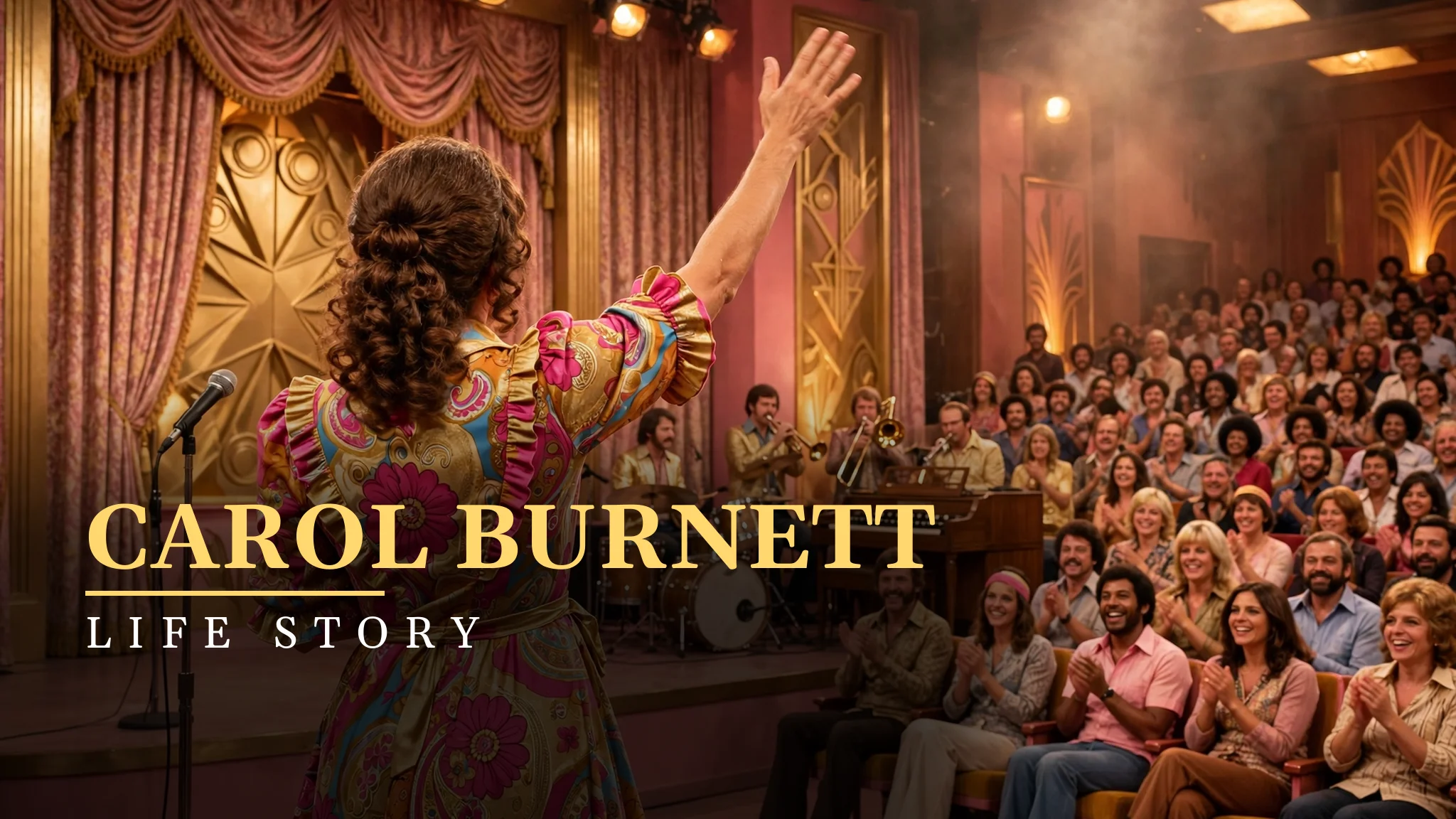
When I think of Carol Burnett now, I think of a woman in a bright floral dress, waving to a laughing audience, with a band behind her and pink curtains around her. She is not a distant star. She is a friend, waving hello, and the audience is waving back. That image stays with me, because it captures her warmth, her joy, and her connection to the people who loved her. She was a comedian who made America feel like a family, and that is a rare and beautiful gift.
I hope readers who meet her for the first time will watch The Carol Burnett Show, and I hope they will watch Annie, and I hope they will read her books. I hope they will see that she was more than a funny woman. She was a great actress, a great writer, a devoted mother and grandmother, and a woman who turned a hard childhood into a lifetime of laughter. That is why I think her story matters, and that is why I think it will still matter many years from now, when new comedians are still learning from her example.
In the end, I think Carol Burnett teaches us that laughter is a gift, and that it is a gift we can share with others. She shared it for more than sixty years, and she shared it with generosity, with kindness, and with love. I will remember her ear tug, her curtain dress, her Miss Hannigan, and her warm smile, and I will remember that she showed us how to be funny without being cruel, and how to live with humour even when life is hard. That is a life worth celebrating, and it is a life I am glad to have learned about.
I also think about how Carol Burnett’s story connects to the way we think about women in comedy today, and to how much has changed since she started. When she began, women were rarely the stars of their own variety shows, and they were often expected to be pretty, to be sweet, and to not be too funny. She broke those rules, and she did it with a warmth that made people love her, not fear her. She showed that a woman could be funny, smart, and successful, and that she did not need to be cruel to be funny. That lesson is still relevant today, when many comedians are told that they need to be angry or shocking to be noticed. She proved that kindness can be funny, and that generosity can be powerful, and I think we need more of that kind of comedy today.
Another thought that stays with me is her work as a writer, and how she told her own story in her books. She wrote memoirs that were honest about her childhood, about her grandmother, about her marriages, and about the loss of her daughter, and she did it with humour and with grace. I think that takes a courage that is hard to describe. It is one thing to make people laugh on television. It is another thing to write about your own pain, in your own words, and to share it with strangers. She did that, and she did it because she believed that sharing her story could help others who were facing similar struggles. That generosity, that willingness to be honest, is part of why I admire her so much.
I also wonder what she would say to a young comedian today who is just starting out, who is funny, who is nervous, and who is not sure if they will succeed. I think she would tell them to work hard, to be kind, to listen to the audience, and to not be afraid to look foolish. She would tell them to find their own voice, to not copy someone else, and to trust that their humour is valuable, even if it is different from what is popular. She would tell them to keep going, even when the rejections pile up, because she knows what it feels like to be rejected, and she knows that persistence can lead to success. That advice is simple, but it is true, and it is advice I want to remember.
When I think of Carol now, I do not only think of The Carol Burnett Show. I think of a young girl in Hollywood, living with her grandmother, making her laugh, and learning how to find humour in hard times. That image stays with me, because it captures the origin of her comedy, in a small apartment, with a grandmother who loved her, and with a girl who learned to laugh to get through a difficult day. She carried that lesson with her for her whole life, and she shared it with millions of people. That is a beautiful thing, and it is a legacy I will carry with me.
I hope that people who read her story will watch her show, will read her books, and will understand that she was more than a funny woman. She was a great actress, a great writer, a devoted mother and grandmother, and a woman who turned a hard childhood into a lifetime of laughter. Her life is proof that humour can heal, that kindness can be powerful, and that a career built on generosity can last for decades. That is a life worth celebrating, and it is a life I am glad to have learned about.
I also think about the way Carol Burnett’s show is remembered today, and how often it is shown in clips, in tributes, and in reruns, and how new generations are still discovering it. Young people who have never seen a variety show are watching her sketches on the internet, laughing at the curtain dress, and learning about a kind of comedy that is warm, generous, and smart. I think that is a wonderful thing, because it means that her work is not locked in the past. It is alive, it is still making people laugh, and it is still teaching new comedians how to be funny without being cruel. That kind of lasting influence is rare, and it is a testament to the quality of her work and to the kindness behind it.
I also want to remember her grandmother, Mabel, because she is the hidden heart of Carol’s story. She raised Carol, she loved her, she taught her to be kind and to work hard, and she gave her a home when her parents could not. Carol never forgot her, and she tugged her ear at the start of every show to let her know she was thinking of her. That small gesture tells us everything about Carol: she was grateful, she was loyal, and she did not forget where she came from. I think we should all be grateful for the people who raised us, and we should find our own way to say thank you, even if it is only a small tug on the ear.
Frequently Asked Questions
What was The Carol Burnett Show, and how long did it run?
The Carol Burnett Show was a television variety show on CBS that ran for eleven seasons, from 1967 to 1978. Each week Carol and her cast, including Harvey Korman, Tim Conway, and Vicki Lawrence, performed comedy sketches, sang songs, and entertained a live audience. The show won many Emmy Awards and is regarded as one of the greatest variety shows in television history.
Why did Carol Burnett tug her ear at the start of her show?
At the start of each show, Carol Burnett tugged her ear as a signal to her grandmother, Mabel White, who had raised her. It was a private message in a public show, letting her grandmother know she was thinking of her. The gesture became one of the most famous in television history and showed that Carol had not forgotten her roots.
What role did Carol Burnett play in Annie?
In the film version of Annie in 1982, Carol Burnett played Miss Hannigan, the cruel and funny orphanage matron who torments the young orphan Annie. Her performance was praised for its humour and energy, and it introduced her to a new generation of young viewers who had not seen her television show. She sang and acted with a warmth that made the character memorable.
How did Carol Burnett start her career in New York?
After studying at UCLA, she moved to New York in the 1950s with help from a benefactor who had seen her perform. She worked as a hat-check girl, auditioned for many roles, and was cast in Once Upon a Mattress on Broadway in 1959. She also became a regular on The Garry Moore Show, where she learned television comedy and won her first Emmy Award.
Did Carol Burnett write books about her life?
Yes, she wrote memoirs including One More Time in 1986 and This Time Together in 2010, in which she told the story of her life with humour and honesty. Her books cover her childhood, her grandmother, her career on Broadway and television, and her family life. They became bestsellers and are praised for their warmth and candour.
Is Carol Burnett still alive, and what honours has she received?
Carol Burnett was born on 26 April 1933 in San Antonio, Texas, and she is still alive and working in her nineties. She has received the Presidential Medal of Freedom, the Mark Twain Prize for American Humor, and the Kennedy Center Honors, and a Golden Globe award was named after her, the Carol Burnett Award, for outstanding contributions to television.


