Lucille Ball: The Life Story Behind the Comedy's Beloved Star
In this post
- A Jamestown Childhood and a Dream of the Stage
- Hollywood, Hard Work, and a Long Wait for Stardom
- I Love Lucy and the Birth of Television Comedy
- Desilu and the First Woman to Run a Studio
- Later Years, Loss, and a Lasting Laugh
- What Her Life Still Means
- The Business Mind Behind the Laughs
- The Laugh That Built a Studio
- My Take:
Lucille Ball was the funniest woman on American television, and she was also one of the smartest businesswomen in Hollywood history. She could make people laugh by falling down, by stuffing chocolates into her mouth, by stomping grapes in a vat, or by simply raising an eyebrow, and she did it with a timing and a physical courage that few comedians have ever matched. She was not afraid to look silly, and that fearlessness made her a star.
She was born in New York State, and she grew up in a small town where life was ordinary and where show business seemed far away, yet she found her way to New York, to Hollywood, and to the top of television through sheer determination. She worked as a model, she acted in films for many years without becoming a major star, and she kept going, even when Hollywood did not know what to do with her. Then, in her forties, she found the role that changed everything, Lucy Ricardo in I Love Lucy, and she became the most loved woman on American television.
What makes her story worth telling is not only the laughter, though the laughter is legendary. It is also the business she built with her husband, Desi Arnaz, a studio called Desilu that produced I Love Lucy and other great shows, and that made her the first woman to run a major television studio. She was a comedian, a producer, and a pioneer, and she did it all at a time when women were rarely given that kind of power. This is the story of how a girl from Jamestown became the queen of television.
A Jamestown Childhood and a Dream of the Stage
Lucille Désirée Ball was born on 6 August 1911 in Jamestown, New York, a small town in the western part of the state. Her father, Henry Ball, worked for a telephone company, and her mother, Désirée, was a homemaker. When Lucille was only three years old, her father died of typhoid fever, and her mother was left to raise her and her younger brother on her own. The family moved in with her mother’s parents, and Lucille grew up in a home where money was tight, but where love and laughter were part of daily life.
She was a lively and funny child, with a love of performing that showed itself early. She liked to make people laugh, she liked to dress up, and she liked to be the centre of attention in a friendly way. She took part in school plays, and she dreamed of becoming an actress, even though Jamestown seemed far from Broadway and Hollywood. She was not a shy girl. She was a girl who knew what she wanted, and who was willing to work hard to get it, even when the odds were against her.
When she was a teenager, she attended the John Murray Anderson School for the Dramatic Arts in New York, where she studied acting alongside other young performers, including Bette Davis, who was also a student there. The school was a hard place, and Lucille was told that she did not have the talent to succeed, but she did not give up. She worked as a model, she took small jobs, and she kept auditioning, even when the rejections piled up. She was determined to become an actress, and she was willing to start at the bottom and to work her way up.
She moved to Hollywood in the 1930s, where she began to work as a model and as a chorus girl, and then as a contract actress at RKO Pictures. She appeared in many films, often in small roles, and she learned how Hollywood worked, how to perform for a camera, and how to work with a crew. She was not yet a star, but she was learning, and she was building a reputation as a hard worker who could be relied upon to do a good job, no matter how small the part was.
Hollywood, Hard Work, and a Long Wait for Stardom
In the 1930s and 1940s, Lucille Ball worked steadily in Hollywood, appearing in more than sixty films, often as a supporting actress or as a leading lady in B-films. She was known as the “Queen of the B’s”, because she starred in many low-budget films that were not major hits, but that kept her working and that taught her the craft of film acting. She appeared in films such as Stage Door in 1937, Room Service in 1938, and The Big Street in 1942, and she earned a reputation as a reliable and talented actress, even if she was not yet a major star.
She was beautiful, with red hair that became her trademark, and she was funny, but Hollywood did not know what to do with her. She was not a glamorous leading lady in the usual sense, and she was not a dramatic actress in the usual sense. She was a comedian, and Hollywood in the 1940s did not always know how to use a funny woman. She kept working, she kept learning, and she kept waiting for the right role, even when the wait was long and frustrating.
In 1940, she met Desi Arnaz, a Cuban bandleader and actor, on the set of the film Too Many Girls, and they fell in love and married later that year. Their marriage was passionate, complicated, and often difficult, but it was also a creative partnership that would change television history. Desi was a musician and a businessman, and he understood the entertainment industry in a way that Lucille did not, and together they made a team that was stronger than either of them alone. They had two children, Lucie and Desi Jr., and they built a life together that was both personal and professional.
She continued to work in film and in radio in the 1940s, and she became known for her radio show My Favorite Husband, where she played a funny and scatterbrained wife. The show was a success, and it gave her a chance to develop the character that would later become Lucy Ricardo. She was learning how to be funny on the radio, how to use her voice, and how to make an audience laugh without being seen. Those lessons would help her enormously when she moved to television, where she would need to be funny with her whole body, not only with her voice.
I Love Lucy and the Birth of Television Comedy
In 1951, Lucille Ball and Desi Arnaz created I Love Lucy, a television comedy about Lucy Ricardo, a funny and ambitious housewife in New York, and her husband Ricky, a Cuban bandleader played by Desi. The show was a sensation from the start, and it became the most popular show on American television, watched by millions of people every week. Lucy was a character who wanted to be a star, who got into trouble trying to achieve her dreams, and who made audiences laugh with her schemes, her mistakes, and her physical comedy.
The show was groundbreaking in many ways. It was filmed in front of a live studio audience, using three cameras, a technique that Lucille and Desi helped to pioneer, and it was filmed in Hollywood, not in New York, where most television was made at the time. It was also one of the first shows to feature a mixed-race couple, a white woman married to a Cuban man, and it showed their marriage as loving and funny, at a time when such a portrayal was rare on television. The show was not only funny. It was also a quiet revolution in how television was made and in what it could show.
Lucille’s physical comedy became legendary. She stuffed chocolates into her mouth in a candy factory, she stomped grapes in a vat in Italy, she tried to sell a tonic called Vitameatavegamin, and she did it all with a timing and a courage that made audiences laugh until they cried. She was not afraid to fall down, to get messy, or to look foolish, and that fearlessness made her comedy even funnier. She was a woman in her forties, and she was doing physical comedy that younger actresses would have been afraid to try, and she was doing it better than anyone else.
The show ran for six seasons, from 1951 to 1957, and it is still watched today by people around the world. It won Emmy Awards, it made Lucille Ball a household name, and it changed American television forever. She was no longer a B-film actress. She was the queen of television, and she was loved by millions of people who felt as if Lucy Ricardo were a friend, a neighbour, or a member of their own family.
Desilu and the First Woman to Run a Studio
Lucille Ball and Desi Arnaz did not only star in I Love Lucy. They also built a production company, Desilu Productions, to make the show and other television programmes. Desilu became one of the most successful production companies in Hollywood, producing shows such as The Untouchables, Star Trek, and Mission: Impossible, in addition to I Love Lucy and its follow-ups. Lucille was not only an actress. She was a businesswoman, and she understood how television worked, how to produce a show, and how to make money from it.
When she and Desi divorced in 1960, Lucille bought out Desi’s share of Desilu, and she became the sole owner of the company, making her the first woman to run a major television studio in Hollywood history. That was a remarkable achievement, especially in 1960, when women were rarely given that kind of power in business. She ran the studio with a firm hand, she made decisions about which shows to produce, and she proved that a woman could be a successful studio head. She was not only funny. She was smart, she was tough, and she was a pioneer for women in business.
She continued to star in television after I Love Lucy, in The Lucy Show from 1962 to 1968, and in Here’s Lucy from 1968 to 1974, where she played different characters but with the same humour and the same physical comedy that audiences loved. She was in her fifties and sixties, and she was still making people laugh, still working hard, and still proving that a funny woman could be a star at any age. She was a television legend, and she was treated as one, but she remained a worker, always ready to rehearse, always ready to perform.
She also appeared in films, including Mame in 1974, where she played a flamboyant aunt, though the film was not a great success. She was honoured with awards, including Emmy Awards and the Kennedy Center Honors in 1986, and she was inducted into the Television Hall of Fame. She was a star, a producer, and a businesswoman, and she did all three with a determination that inspired many people, especially women who wanted to work in television and in business.
Later Years, Loss, and a Lasting Laugh
In her later years, Lucille Ball continued to work, though she took on fewer roles. She appeared on television in guest roles, she worked on specials, and she remained a beloved figure in American entertainment. She was honoured for her work, and she was admired by younger comedians who saw her as a role model and as a pioneer for women in comedy. She was a legend, and she was treated as one, but she remained humble, funny, and warm, and she never forgot where she came from.
Her personal life had deep sadness. She and Desi Arnaz had divorced, though they remained friends, and Desi died in 1986, three years before Lucille. She had two children, Lucie and Desi Jr., who both became performers, and she was proud of them, though her relationship with her son was sometimes difficult. She was a mother, a grandmother, and a woman who had lived a full and complicated life, with great success and great loss, and she faced it all with courage and with humour.
She died on 26 April 1989 in Los Angeles, California, at the age of seventy-seven, after suffering a heart condition. Her death was mourned across America, and tributes came from actors, comedians, and ordinary viewers who had grown up watching I Love Lucy. She was buried in Jamestown, New York, her hometown, and her legacy was remembered in the many television shows, films, and business achievements she had left behind. She had changed television, she had changed how women were shown on screen, and she had made millions of people laugh.
What Her Life Still Means
Lucille Ball is remembered today as the greatest female comedian in American television history, and as a woman who changed how television was made and who could run a studio. Her show I Love Lucy is still watched by people around the world, and her physical comedy is still studied by comedians who want to learn how to make people laugh. She showed that a funny woman could be a star, a producer, and a businesswoman, all at the same time, and that she did not need to be young or glamorous to be loved.
Her influence can be seen in the work of comedians who admire her example, from Carol Burnett to Tina Fey to many others who grew up watching her show. She showed that comedy could be physical, smart, and kind, and that a woman could be funny without being mean. She also showed that a woman could run a business, make decisions, and succeed in a male-dominated industry, and that lesson is still relevant today.
She is remembered for Lucy Ricardo, for the chocolate factory, for the grape stomping, and for Desilu, but she is also remembered for the way she lived: with humour, with determination, and with a deep love for her work and her audience. She was a woman who made America laugh, and who made television better, and that is a legacy that does not fade.
The Business Mind Behind the Laughs
Lucille Ball’s business sense is one of the most remarkable parts of her story, and it is worth thinking about in detail, because it shows that she was not only a funny woman, but a smart and tough businesswoman who understood how television worked. She and Desi Arnaz founded Desilu Productions in 1950, to produce I Love Lucy, and they made decisions that changed television forever. They decided to film the show in Hollywood, using three cameras in front of a live audience, rather than filming it live in New York, as most shows were done at the time. That decision allowed them to make a high-quality show, to keep the films, and to sell reruns, which made them a great deal of money and which changed how television was made.
They also decided to own the show, rather than letting a network own it, and that decision gave them control over their work and over their future. In the 1950s, most television stars did not own their shows. They were employees, and they were paid a salary, while the network or the sponsor owned the rights. Lucille and Desi understood that owning the show was more valuable in the long run, and they negotiated for that ownership, even when it was difficult. That business sense made them rich, and it also gave them the freedom to make the show they wanted, without interference from sponsors or from network executives who did not understand comedy.
When Lucille bought out Desi’s share of Desilu in 1960, she became the sole owner, and she ran the studio with a firm hand. She made decisions about which shows to produce, she hired talented people, and she approved projects that other studios had rejected, including Star Trek and Mission: Impossible, two shows that became classics and that made Desilu a great deal of money. She was not a businesswoman who relied on others to make decisions for her. She read scripts, she watched pilots, and she trusted her own judgement. That judgement was often right, and it showed that she understood audiences, understood television, and understood what made a good show.
Her business success also gave her a sense of independence that was rare for a woman in Hollywood in the 1960s. She did not need a husband to support her, she did not need a studio to employ her, and she did not need anyone’s permission to make a show. She was a studio head, and she ran her company with the same determination she brought to her comedy. She was tough, she was smart, and she was not afraid to make difficult decisions. That toughness is part of her legacy, and it is one reason she is admired not only as a comedian, but as a pioneer for women in business.
The Laugh That Built a Studio
Lucille Ball’s laugh was famous, but her business sense was just as important, and it is worth remembering that she was not only a comedian. She was a woman who understood money, who understood contracts, and who understood that owning your work is more valuable than renting it. She and Desi Arnaz made a decision in 1951 to film I Love Lucy, rather than performing it live, and to own the films, and that decision made them rich, because they could sell reruns for decades after the show ended. It also changed television, because other producers saw that owning a show was a smart business move, and they began to do the same. She was a pioneer in business, as well as in comedy, and her decisions are still studied by television executives today.
She also understood the importance of hiring talented people and trusting them to do their work. At Desilu, she hired writers, directors, and producers who were creative, who were ambitious, and who wanted to make great television, and she gave them the freedom to try new ideas, even when those ideas seemed risky. Star Trek was a risky idea, a science fiction show about a starship, and many studios had rejected it, but Lucille believed in it, and she produced it. That belief, that trust in creative people, is a mark of a great studio head, and it is one reason Desilu produced so many classic shows. She was not a businesswoman who only cared about money. She cared about quality, and she believed that quality would lead to success.
My Take:
I think Lucille Ball’s story is one that makes me laugh just thinking about it, and I think that laughter is exactly what she gave to America for more than forty years. She was the funniest woman on television, and she was also one of the smartest businesswomen in Hollywood, and I admire both of those things equally. It is easy to be funny, and it is easy to be smart, but it is rare to be both, and to be both at the highest level. She was, and that is why her story still matters.
What moves me most is how long she waited for stardom. She worked in Hollywood for almost twenty years, in more than sixty films, often in small roles, and she was known as the “Queen of the B’s”. I think about what that must have felt like, to work hard every day, to be good at your job, and to not be recognised as a star. Most people would have given up, or they would have become bitter. She did not. She kept working, she kept learning, and she kept waiting for the right role. When I Love Lucy finally came, she was forty years old, and she was ready, because she had spent twenty years preparing for it. That patience is a lesson I want to remember: keep working, even when no one is watching, because the right chance may come late, and you need to be ready for it.
I love her physical comedy, and I think it is one of the bravest kinds of comedy there is. She fell down, she got messy, she stuffed chocolates into her mouth, she stomped grapes, and she did it all with a timing that made audiences laugh until they cried. She was not afraid to look foolish, and that fearlessness is what made her funny. I think many comedians are afraid to look silly, because they want to look cool or smart. She did not care about looking cool. She cared about making people laugh, and she was willing to do anything to make them laugh. That generosity is the heart of her comedy, and it is why people still love her today.
Her business story also impresses me deeply. She built Desilu with Desi Arnaz, and then she bought him out and became the first woman to run a major television studio. I keep thinking about what that must have meant in 1960, when women were rarely given that kind of power. She ran the studio, she made decisions about which shows to produce, and she proved that a woman could be a successful business leader. She produced Star Trek and Mission: Impossible, shows that are still loved today, and she did it because she understood television, because she understood audiences, and because she was smart. I think that part of her story is often overlooked, because people focus on the laughter, but it is just as important as the comedy. She was a pioneer, and she opened doors for women in business that are still open today.
I also think about her marriage to Desi Arnaz, and about how complicated it was. They loved each other, they worked together, they built a business together, and they also hurt each other, and they eventually divorced. I do not think their story is a simple love story. It is a real story, about two strong and passionate people who created something great together, even though their personal life was difficult. I admire them for what they built, and I feel sad for what they lost. Their partnership changed television, and it also cost them a marriage, and both of those truths matter.
What I learn from her is that you can be funny and smart at the same time, and that you do not need to choose between them. She was a comedian who made people laugh, and she was a businesswoman who made smart decisions, and she did both with the same determination. I think we are often told to pick one thing and to be good at it, but her life shows that you can be good at many things, if you work hard and if you are willing to learn. She learned acting, she learned comedy, she learned business, and she used all of those skills to build a career that lasted for decades.
I also learn from her that it is okay to start late, and that it is okay to be a star in your forties, fifties, and sixties. She was forty when I Love Lucy began, she was fifty when The Lucy Show began, and she was still working in her seventies. She did not stop, she did not give up, and she did not let age stop her from being funny. That is a hopeful message for anyone who feels that their best years are behind them. Your best years can be ahead of you, if you keep going and keep learning.
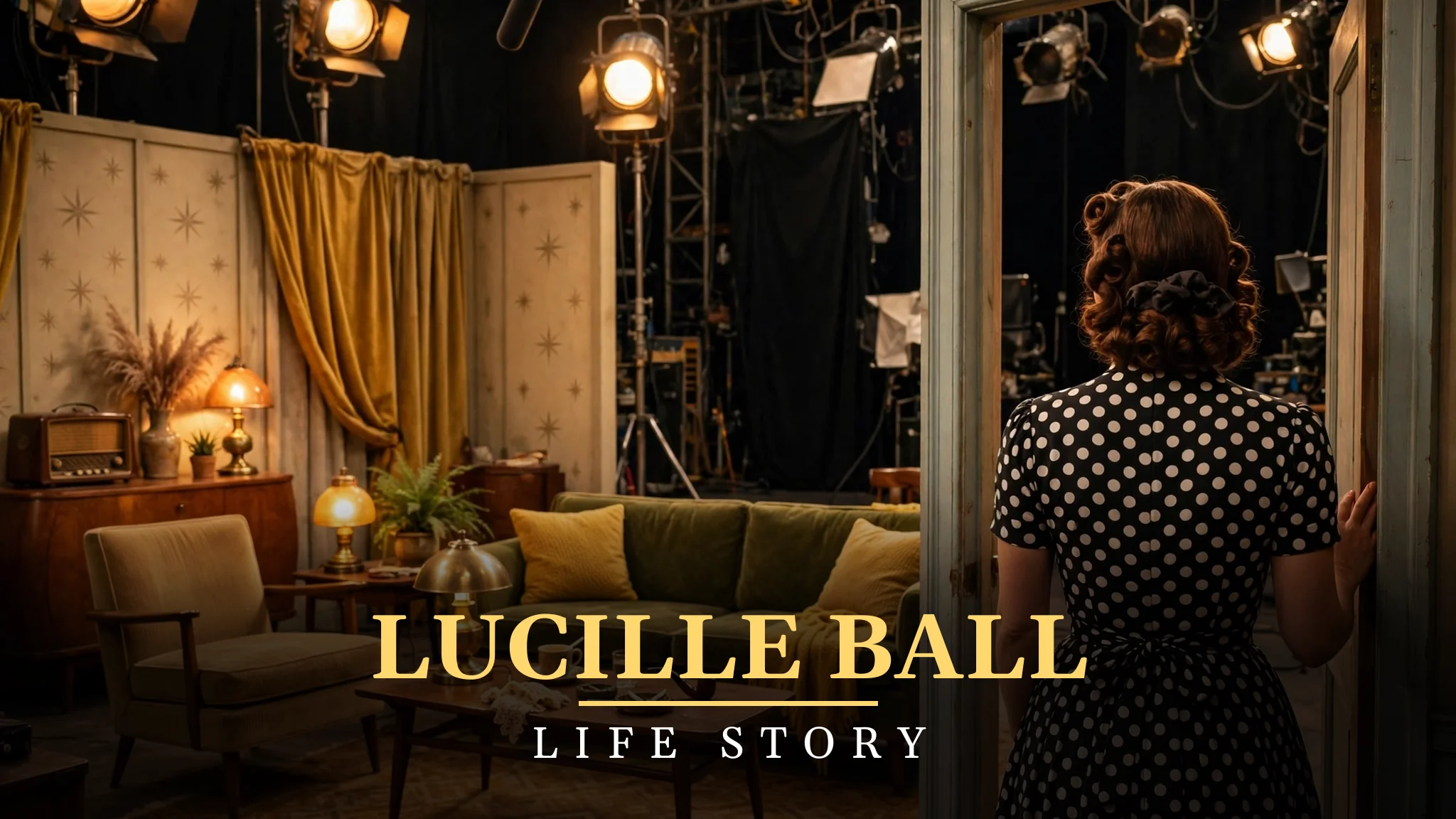
When I think of Lucille Ball now, I think of a woman in a black polka-dot dress, standing in a doorway and looking at a 1950s television living-room set, with warm studio lights around her. She is about to step onto the set, about to make people laugh, and she is ready. That image stays with me, because it captures her readiness, her humour, and her love for television. She was a woman who loved her work, and who shared that love with millions of people.
I hope readers who meet her for the first time will watch I Love Lucy, and I hope they will watch the chocolate factory episode, and I hope they will learn about Desilu and about Star Trek. I hope they will see that she was more than a funny woman. She was a great actress, a great businesswoman, and a pioneer who changed television forever. That is why I think her story matters, and that is why I think it will still matter many years from now, when new generations are still laughing at Lucy Ricardo.
In the end, I think Lucille Ball teaches us to laugh, to work hard, and to not be afraid to look foolish. She laughed, she worked, and she was not afraid, and she left a legacy of laughter that is still felt today. I will remember her as Lucy, as a studio head, and as a woman who showed us that comedy and business can go together, and that a funny woman can change the world. That is a life worth celebrating, and it is a life I am glad to have learned about.
I also think about how Lucille Ball’s story connects to the way women are treated in business today, and to how much has changed since she became the first woman to run a major studio. Today, there are more women running companies, more women producing television, and more women making decisions about what shows get made, and that is partly because Lucille proved that a woman could do it, and do it well. She ran Desilu, she made smart decisions, and she produced shows that are still loved today. She did not ask for permission. She took control, and she proved that she deserved it. That is a powerful example for any woman who wants to lead, in any field, not only in television.
Another thought that stays with me is her relationship with her children, Lucie and Desi Jr., and the way a mother’s career affects her family. She was a working mother in a time when that was still unusual for a television star, and she tried to balance her work with her role as a mother, even when her career demanded long hours and travel. She was proud of her children, and she spoke about the importance of family, even when her personal life was difficult. I think that balance must have been hard, especially after her divorce, when she was running a studio and starring in a show at the same time. She did it, and she did it with determination, and that is a part of her story that should be remembered alongside her comedy.
I also wonder what she would think of television today, where there are hundreds of channels, where shows are streamed on demand, and where comedy is made in many different ways. I think she would be pleased that television is still popular, but I also think she would remind young comedians that the basics have not changed: you need to be funny, you need to be honest, and you need to be willing to work hard. She would tell them to learn their craft, to listen to the audience, and to not be afraid to look foolish. That advice is simple, but it is true, and it is advice I want to remember, even though I am not a comedian. Work hard, be honest, and do not be afraid to fail.
When I think of Lucille now, I do not only think of Lucy Ricardo. I think of a woman in a production office, reading a script for Star Trek, deciding to produce a show that other studios had rejected, and trusting her own judgement. That image stays with me, because it captures her intelligence, her courage, and her belief in herself. She was a comedian, a businesswoman, and a pioneer, and she did all three with the same determination. That is a life I admire, and a life I am glad to have learned about.
I hope that people who read her story will watch I Love Lucy, will learn about Desilu, and will understand that she was more than a funny woman. She was a great actress, a great businesswoman, and a woman who changed television forever. Her life is proof that you can be funny and smart at the same time, and that you do not need to choose between them. That is a legacy worth remembering, and a legacy I will carry with me.
I also think about how Lucille Ball’s business decisions are studied today, and how often young producers are told to learn from her example. She owned her show, she hired talented people, and she trusted her own judgement, even when others doubted her. That is a powerful lesson for anyone who wants to build a business, in any field, not only in television. Own your work, hire good people, and trust yourself. She did that, and she built a studio that produced some of the greatest shows in television history. Her business sense is as important as her comedy, and it should be remembered alongside her laugh.
I also want to remember her as a mother, because that part of her story is often overlooked when we focus on her career. She had two children, Lucie and Desi Jr., and she tried to balance her work with her role as a mother, even when her career demanded long hours and travel. She was proud of her children, and she spoke about the importance of family, even when her personal life was difficult. She was a working mother in a time when that was still unusual for a television star, and she did it with determination. That balance must have been hard, especially after her divorce, when she was running a studio and starring in a show at the same time, but she did it, and she did it with courage.
I also think about the way she is remembered today, and how often people who have never seen I Love Lucy still know her name, because her comedy is so famous that it has become part of American culture. She is mentioned in books, in films, and in conversations about the greatest comedians of all time, and her influence is still felt in the work of comedians who grew up watching her show. That kind of lasting fame is rare, and it is a testament to the quality of her work and to the joy she brought to millions of people. She made America laugh, and America has never forgotten her.
Frequently Asked Questions
What is Lucille Ball best known for?
Lucille Ball is best known for playing Lucy Ricardo in I Love Lucy, which ran from 1951 to 1957 and became the most popular show on American television. Her physical comedy, including the chocolate factory scene and the grape stomping scene, became legendary. The show changed television comedy and is still watched by people around the world today.
How did Lucille Ball become the first woman to run a major TV studio?
She and her husband Desi Arnaz built Desilu Productions to make I Love Lucy and other shows. When they divorced in 1960, Lucille bought out Desi’s share and became the sole owner of Desilu, making her the first woman to run a major television studio. Desilu produced shows including Star Trek and Mission: Impossible.
What films did Lucille Ball appear in before television?
Before I Love Lucy, she appeared in more than sixty films in the 1930s and 1940s, often in supporting roles or in B-films, and she was known as the “Queen of the B’s”. Her films included Stage Door in 1937, Room Service in 1938, and The Big Street in 1942. She learned film acting during those years, even though she did not become a major film star.
Was Lucille Ball married to Desi Arnaz, and did they have children?
Yes, she married Desi Arnaz, a Cuban bandleader and actor, in 1940, after meeting him on the set of Too Many Girls. They had two children, Lucie and Desi Jr., and they built Desilu together. They divorced in 1960, though they remained friends, and Desi died in 1986, three years before Lucille.
What other TV shows did Lucille Ball star in after I Love Lucy?
After I Love Lucy ended in 1957, she starred in The Lucy Show from 1962 to 1968 and in Here’s Lucy from 1968 to 1974, playing different characters with the same humour and physical comedy. She was in her fifties and sixties during those shows, and she remained a beloved television star throughout that time.
When did Lucille Ball die?
Lucille Ball was born on 6 August 1911 in Jamestown, New York, and she died on 26 April 1989 in Los Angeles, California, at the age of seventy-seven. She had been a television star for almost forty years, and she is remembered as the greatest female comedian in American television history and as a pioneering studio head.


