Christian Clavier: The Life Story Behind France's Comedy Hitmaker
In this post
- A Student Who Loved to Make People Laugh
- Les Bronzés: Holidays, Laughter, and Fame
- Les Visiteurs: Jacquouille Conquers France
- Astérix and the Big Screen Hits
- A Writer, a Star, and a Man of the Theatre
- The Writer Behind the Laughter
- A Star Who Loves His Audience
- Les Visiteurs 2 and the Return of Jacquouille
- Fifty Years of Making France Laugh
- My Take:
Christian Clavier has made more French people laugh than almost any other actor alive. He is the man behind Jacquouille, the smelly, funny, loyal servant from the Middle Ages who lands in modern France, and he is the man behind some of the biggest box office hits in French cinema history. He is not a quiet actor, and he is not a subtle one. He is loud, fast, and full of energy, and when he is on screen, the audience knows that something funny is about to happen. He has been making France laugh for more than fifty years, and he shows no sign of stopping.
He began with Le Splendid, a group of young friends in Paris who wrote their own plays and changed French comedy. He was one of the founders, one of the writers, and one of the stars, and the group became a legend. From Les Bronzés to Les Visiteurs, from Astérix to Qu’est-ce qu’on a fait au Bon Dieu?, his career has been a series of hits that have brought millions of people into cinemas. He is a writer, an actor, and a showman, and he understands the French audience better than almost anyone.
His story is also a story of hard work and of a team. He did not become a star alone. He became a star with his friends, and he has kept working with them, and with new partners, for his whole life. He is a man who loves to make people laugh, and who has built his life around that love.
A Student Who Loved to Make People Laugh
Christian Clavier was born on 6 May 1952 in Paris. He grew up in the French capital, in a family that valued learning and culture. He was a bright student, and he went to the Lycée Pasteur in Neuilly-sur-Seine, a school known for its strong academic standards. It was there that he met the young people who would change his life: Gérard Jugnot, Thierry Lhermitte, and others who shared his love of acting and of comedy. They were students who liked to make each other laugh, and they soon began to put on plays together.
Clavier was not the quietest member of the group. He was energetic, funny, and full of ideas, and he loved to write sketches and to perform them. He studied political science at university, and for a time it seemed that he might follow a more serious path. But the theatre kept calling him back, and he chose the stage over a safe career. It was a brave choice, because acting is never a safe job, and in the early 1970s, there was no guarantee that a group of young friends could make a living from comedy. Clavier took the risk, and he never looked back.
In the early 1970s, he and his friends formed Le Splendid, a theatre company that performed in a small café-theatre in Paris. They wrote their own plays, they acted in them, and they built a following among young audiences. The plays were fresh, funny, and full of the spirit of the time. Clavier was one of the main writers, and he was also one of the main actors. He learned to write for the stage, to write for his friends, and to write for an audience that wanted to laugh. Those years in a small theatre taught him everything about comedy: timing, character, and the importance of listening to the audience.
The Splendid years were not easy. The group was poor, they worked long hours, and they did not know if they would succeed. But they had each other, and they had a shared dream. Clavier’s energy and his talent for writing kept the group going, and his friendship with the other members became the foundation of his whole career. He was not only an actor. He was a founder, a writer, and a leader, and those roles would stay with him for the rest of his life.
Les Bronzés: Holidays, Laughter, and Fame
The Splendid group moved from the stage to the screen with Les Bronzés in 1978, a comedy about French people on holiday at a club in the sun. Clavier played Michel, a man on holiday who gets into trouble with his wife, his friends, and the other holidaymakers. The film was a great success, and it became a classic of French comedy. Audiences recognised themselves in the characters, and they quoted the film for years. Clavier’s performance was sharp, funny, and full of energy, and it made him a star.
The group followed it with Les Bronzés font du ski in 1979, set in the mountains, and with Le Père Noël est une ordure in 1982, a wild Christmas comedy that became one of the most loved French films of all time. In Le Père Noël est une ordure, Clavier played Katia, a transvestite character, with a boldness and a humour that surprised audiences. He was not afraid to play a role that was different, and he played it with warmth and with laughter, not with mockery. The film was a huge success, and it confirmed Le Splendid as the most important comedy group in France.
These films made Clavier famous, but they also showed his range as an actor and a writer. He could play a holidaymaker, a transvestite, a husband, a friend, and many other characters, and he could write the lines that made audiences laugh. He was not only a performer. He was a creator, and he understood how a comedy worked from the inside. He knew how to build a character, how to write a joke, and how to make a scene work.
By the early 1980s, Clavier was one of the best-known comic actors in France. He had come from a small theatre in Paris, and he had become a star of the cinema. He had done it with his friends, and he had done it by writing and performing comedy that spoke to ordinary French people. He was at the start of a long career, and the biggest successes were still ahead of him.
Les Visiteurs: Jacquouille Conquers France
The greatest moment of Clavier’s career came in 1993, when he starred in Les Visiteurs, directed by Jean-Marie Poiré. The film told the story of a knight from the Middle Ages, played by Jean Reno, and his servant Jacquouille, played by Clavier, who are sent by magic into modern France. Jacquouille is dirty, smelly, loyal, and hilarious, and he does not understand the modern world at all. He eats with his hands, he talks in old French, and he causes chaos wherever he goes. Clavier played him with total commitment, and the audience loved him.
Les Visiteurs became one of the biggest hits in the history of French cinema, seen by more than thirteen million people in France. It was a phenomenon. People quoted Jacquouille’s lines, they imitated his voice, and they went to see the film again and again. Clavier had created a character who became part of French culture, a character that children and adults both loved. He had also co-written the film, and his writing was at the heart of its success. The jokes, the characters, and the story all came from his understanding of what makes French audiences laugh.
He returned to the role in Les Visiteurs 2: Les Couloirs du temps in 1998, and again in Les Visiteurs: La Révolution in 2016. The sequels were also successful, and Jacquouille remained a beloved figure. Clavier had created something rare: a comic character who lasted for more than twenty years, and who was still funny when he returned. That is a mark of a great creation, and it is a mark of Clavier’s talent as a writer and an actor.
Les Visiteurs also made Clavier a star beyond France. The film was seen in many countries, and Jacquouille became known around the world. Clavier had gone from a small theatre in Paris to international fame, and he had done it by playing a medieval servant who could not even use a modern toilet. It was a strange journey, but it was a true one, and it showed that great comedy does not need to be sophisticated. It needs to be honest, funny, and full of heart, and Clavier understood that better than anyone.
Astérix and the Big Screen Hits
After Les Visiteurs, Clavier took on another famous role: Astérix, the small, clever Gaul from the beloved French comic books. He played Astérix in Astérix et Obélix contre César in 1999, and again in Astérix & Obélix: Mission Cléopâtre in 2002, directed by Alain Chabat. The films were huge productions, with big budgets, famous actors, and audiences of millions. Clavier played Astérix with wit, energy, and charm, and he made the comic book hero live on screen. The films were successes, and they confirmed his place as one of the biggest stars in French cinema.
He also starred in many other comedies in the 1990s and 2000s, working with the best directors and actors in France. He was a reliable star, a man who could carry a film, and a man who could make an audience laugh from the first minute to the last. He was not afraid to play different kinds of characters, and he was not afraid to take risks. He played heroes, cowards, lovers, and fools, and he played them all with the same energy and commitment.
In 2014, he starred in Qu’est-ce qu’on a fait au Bon Dieu?, a comedy about a French couple whose four daughters marry men from different backgrounds. The film became one of the biggest French box office hits of all time, seen by more than twelve million people in France. Clavier played the father, Claude Verneuil, a man who is shocked by his daughters’ choices, and who slowly learns to accept them. The film was funny, warm, and full of heart, and Clavier’s performance was at the centre of it. He returned to the role in sequels, and the films became a beloved series.
These hits showed that Clavier’s appeal had not faded with time. He was still making France laugh, still creating characters that people loved, and still breaking box office records. He had been a star for more than forty years, and he was still at the top. That is a rare achievement, and it is a sign of a talent that has never stopped growing.
A Writer, a Star, and a Man of the Theatre
Clavier has always been more than an actor. He is a writer, and he has co-written many of his greatest films, including Les Visiteurs and Qu’est-ce qu’on a fait au Bon Dieu?. He understands how to build a story, how to create a character, and how to write a joke that works on screen. He has also worked on stage, returning to the theatre throughout his career, and he has directed films as well. He is a complete man of the theatre and the cinema, and he has used all of his talents to make people laugh.
He was married for many years to Marie-Anne Chazel, another member of Le Splendid, and the two shared a long partnership on stage and in life. They were part of the same group, the same world, and the same story. Their relationship was a part of the Splendid legend, and it showed how deeply the group’s lives were woven together. Clavier has kept his personal life mostly private, but he has spoken about his love of the theatre, his love of writing, and his love of making people laugh.
He has also been a generous colleague, working with young actors, supporting new comedies, and helping to keep French popular cinema alive. He believes that comedy is important, that it should be for everyone, and that a good laugh can bring people together. That belief has guided his whole career, from the small café-theatre of Le Splendid to the biggest cinemas in France. He has never looked down on his audience. He has always tried to give them his best.
Today, Christian Clavier is still working, still acting, and still writing. He is one of the most successful French actors of all time, and his films have been seen by tens of millions of people. He is a star, a writer, and a founder of one of the great comedy groups in French history. His story is not finished, and French audiences are glad of that, because they still want to laugh with him.
The Writer Behind the Laughter
Clavier is not only an actor. He is a writer, and his writing is at the heart of his success. He co-wrote Les Visiteurs, he co-wrote Qu’est-ce qu’on a fait au Bon Dieu?, and he has written many of the films that made him famous. He understands how to build a joke, how to create a character, and how to write a scene that works on screen. He learned to write in the small theatre of Le Splendid, where he wrote plays with his friends, and he has kept writing ever since. Writing is hard work, and it is lonely work, but Clavier loves it, because it is where the laughter begins.
He writes for his friends, for the actors he knows, and for the audience he understands. He knows what makes French audiences laugh, because he has listened to them for fifty years. He knows that a good joke needs a clear character, a surprising twist, and a truth behind it. His jokes are not only funny. They are true, and that is why they last. People still quote Jacquouille’s lines today, more than thirty years after Les Visiteurs, because those lines are funny and true. That is the mark of a great writer, and Clavier is one.
He has also written for the theatre, returning to the stage throughout his career, and he has directed films as well. He is a complete artist, a man who can write, act, and direct, and who uses all of his talents to make people laugh. He does not wait for someone to give him a good script. He writes his own, and that is a powerful lesson for any young artist: do not wait for permission. Write your own story, and make it happen yourself.
A Star Who Loves His Audience
Clavier loves his audience, and his audience loves him back. He makes films for families, for ordinary people, for viewers who want to laugh on a Saturday night. He does not make films for a small group of critics. He makes films for everyone, and he is proud of that. He believes that popular cinema is important, that a good comedy can bring people together, and that laughter is a serious thing. That belief has guided his whole career, from Le Splendid to Les Visiteurs to Qu’est-ce qu’on a fait au Bon Dieu?.
He is known for being a hard worker, for rehearsing carefully, and for giving his best in every film. He does not take his audience for granted. He knows that people pay to see his films, and he wants to give them value for their money. He works on his characters, on his lines, and on his timing, until the comedy feels effortless. That effort is invisible to the audience, but it is there, in every scene, and it is why his films work. He respects his audience, and his audience respects him back.
He has also been generous with his colleagues, working with young actors, supporting new comedies, and helping to keep French popular cinema alive. He is a star who has used his success to help others, and who has kept the spirit of Le Splendid alive: a group of friends, working together, making people laugh. That generosity is part of his story, and it is part of why he is so loved in France.
Les Visiteurs 2 and the Return of Jacquouille
In 1998, Clavier returned to the role of Jacquouille in Les Visiteurs 2: Les Couloirs du temps, the sequel to the great hit of 1993. The film brought back the knight and his servant, and it sent them through time again, with new jokes, new adventures, and new chaos in the modern world. Audiences were delighted to see Jacquouille again, and the film was a huge success, seen by millions of people in France. Clavier played the servant with the same energy, the same voice, and the same love, and he showed that a great character does not fade with time. He had created Jacquouille, and Jacquouille was still alive, still funny, and still loved.
He returned to the role again in 2016, in Les Visiteurs: La Révolution, taking Jacquouille to the time of the French Revolution. The film was another success, and it showed that the character could work in any period of history, because he is a simple man in a complicated world, and that is a story that never gets old. Clavier had played Jacquouille for more than twenty years, and he still found new jokes, new energy, and new love for the character. That is a rare thing for an actor, and it is a sign of how deeply he understood the man he had created.
The sequels proved that Les Visiteurs was not a one-time success. It was a world, with characters that audiences wanted to visit again and again. Clavier had built that world with his friends, and he kept returning to it, because he loved it, and because his audience loved it too. That loyalty, to a character and to an audience, is part of what makes him a great star.
Fifty Years of Making France Laugh
Clavier has been making France laugh for more than fifty years, from a small café-theatre in Paris to the biggest cinemas in the country. His films have been seen by tens of millions of people, and his characters have become part of French life. Jacquouille is quoted in schools, in offices, and in homes. Claude Verneuil, the father in Qu’est-ce qu’on a fait au Bon Dieu?, is recognised by families across France. Astérix is loved by children who were not yet born when Clavier first played him. That kind of lasting fame is rare, and it comes from making films that speak to everyone, not only to a few.
He has worked in every decade since the 1970s, and he has adapted to each one. He made wild comedies with Le Splendid, he made time-travel films in the 1990s, he made comic book films in the 2000s, and he made family comedies in the 2010s. Each decade brought a new style, and Clavier found a way to make it his own. He did not stay in the past. He kept learning, kept writing, and kept performing, and that is why his career has lasted so long. He is a man who loves his work, and who has never stopped loving it, and that love is visible in every film he makes.
My Take:
When I think about Christian Clavier, I think about energy. He is not a quiet actor. He is loud, fast, and full of life, and when he is on screen, you cannot look away. I admire that energy, because it is not easy to keep it up for fifty years. Many actors burn bright for a few years and then fade. Clavier has kept his fire for a whole lifetime, and he has used it to make millions of people laugh. That is a gift, and it is a gift that takes hard work. Energy alone is not enough. You need timing, you need writing, and you need to understand people. Clavier has all of those things, and that is why he has lasted.
I admire his work as a writer, because it is easy to forget that the man who plays Jacquouille also wrote Jacquouille. He did not only act the part. He created it, with his friends, from nothing. He imagined a medieval servant in the modern world, he wrote the jokes, he built the character, and then he played him. That is a complete act of creation, and it is much harder than only acting a part someone else wrote. I think about the writers who work in the dark, without fame, and I see that Clavier is both a writer and a star. He gets the applause, but he also does the hard work of writing, and that deserves respect.
What moves me most is Les Visiteurs, because it is a film about time, about the past meeting the present, and about a simple man who does not understand the modern world. Jacquouille is dirty, he is rude, and he is loyal. He does not know how to use a modern toilet, but he knows how to be faithful to his master. I think there is something beautiful in that: that loyalty matters more than manners, and that a simple heart matters more than modern knowledge. Clavier plays Jacquouille with total love, and the audience loves him back. I think that is a lesson for our time, when we are so proud of our modern world. A man from the past can teach us something, if we listen: be loyal, be brave, and do not be ashamed of who you are.
I think about his partnership with Jean Reno in Les Visiteurs, and I see the same lesson as in Bourvil and de Funès: opposites make great comedy. Reno is tall, quiet, and noble. Clavier is small, loud, and wild. Together, they are perfect. I think about my own friendships, and about the people who are different from me, and I see that difference is a gift. Clavier and Reno did not try to be like each other. They stayed themselves, and their difference made the film work. That is a lesson for any team: let people be themselves, and the work will be better.
There is something I respect about the way Clavier has handled fame. He is one of the biggest stars in France, and he has been for decades. He could have become arrogant, or distant, or difficult. By most accounts, he has stayed a working actor and writer, a man who loves his craft, and a man who keeps making films for his audience. I do not know him personally, and I do not want to pretend that I do. But I can see his work, and his work shows a man who respects his audience. He does not make films for critics. He makes films for people, for families, for ordinary viewers who want to laugh on a Saturday night. That respect is a good thing, and it is rare.
I also think about Qu’est-ce qu’on a fait au Bon Dieu?, because it is a film about a father who has to accept that his daughters marry men from different cultures. It is a comedy, but it is also a film about tolerance, about family, and about France today. Clavier plays a man who is shocked, who is prejudiced, and who slowly learns to open his heart. I think that is a brave role for a comic actor, because it asks the audience to laugh at a man who is wrong, and then to love him as he changes. Clavier plays that change with humour and with warmth, and the film became a huge hit because people recognised themselves in it. That is the power of comedy: it can teach us about tolerance without preaching, and Clavier understands that power.
For a young reader, I think the lesson of Clavier’s life is to write, not only to perform. He did not wait for someone to give him a good role. He wrote his own roles, with his friends, and he created his own chances. That is a powerful lesson. If you want to do something, do not wait for permission. Write it, make it, and show it to the world. Clavier wrote Les Visiteurs, he wrote his characters, and he built his career on his own words. That is a model for any young person who wants to create: do not wait. Write, act, and make it happen yourself.
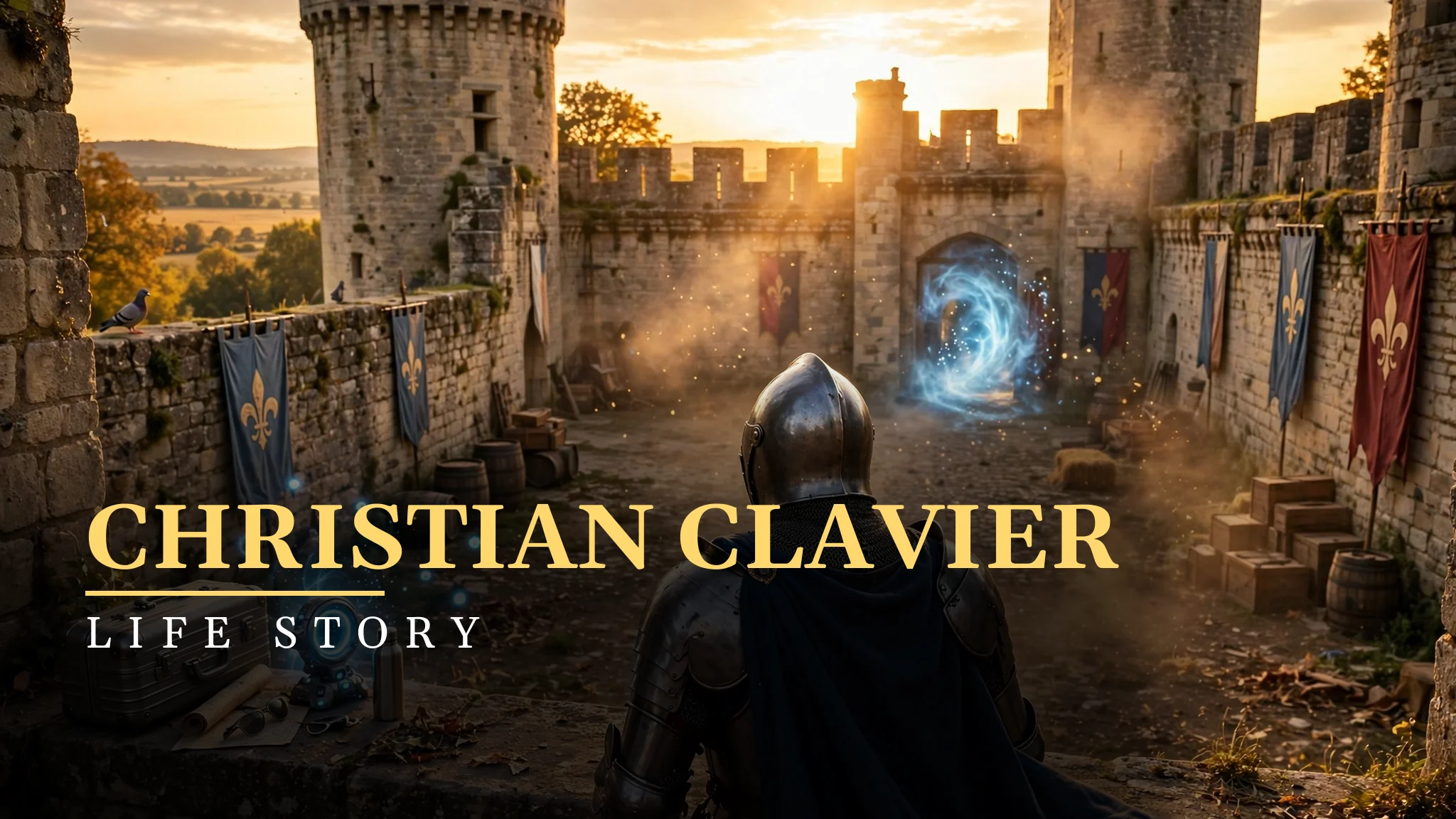
I keep thinking about the knight in the castle courtyard, facing a glowing portal, with a suitcase and a strange device beside him. It is a picture of time travel, of the past meeting the future, and it fits Clavier perfectly. He is a man who has travelled through time, from the Middle Ages to the present day, from a small theatre in Paris to the biggest cinemas in France. He has carried his humour with him, like a suitcase, and he has used it to open doors for millions of people. In the end, I think that is his gift: he makes the past and the present laugh together, and he reminds us that laughter is timeless.
I also think about his energy, and about how hard it is to keep it up for fifty years. Many actors burn bright for a few years and then fade, because they run out of ideas, or because they get tired. Clavier has not faded. He is still making films, still writing, and still making France laugh. That takes a kind of stamina that is rare, and it comes from loving the work. He loves to write, he loves to act, and he loves to see an audience laugh. That love has kept him going, and it is why his career has lasted so long. I think about the work I love, and about how love makes hard work feel lighter. Clavier loves his work, and that love shows in every film he makes.
I think about Jacquouille, and about what makes a character last for thirty years. Jacquouille is dirty, he is rude, and he is loyal, and he does not understand the modern world. He is a simple man in a complicated world, and that is why people love him. We all feel a little lost in the modern world, a little confused by new technology, by new manners, and by new rules. Jacquouille feels that confusion too, and he makes us laugh at it. Clavier created a character who speaks for all of us, for the part of us that does not understand the modern world, and that is why Jacquouille has lasted. He is not only a joke. He is a mirror, and we see ourselves in him.
I also think about the partnership between Clavier and Jean Reno in Les Visiteurs. Reno is tall, quiet, and noble, and Clavier is small, loud, and wild. Together, they are perfect, because their difference makes the comedy work. I think about my own friendships, and about the people who are different from me, and I see that difference is a gift. Clavier and Reno did not try to be like each other. They stayed themselves, and their difference made the film a triumph. That is a lesson for any team, any friendship, and any marriage: let people be themselves, and the work will be better for it.
There is something I respect about the way Clavier has written his own career. He did not wait for a director to give him a role. He wrote his own roles, with his friends, and he created his own chances. That is a powerful way to live, and it is a way that takes courage. It is easy to wait, to hope, and to complain that no one gives you a chance. It is much harder to write your own chance, to create your own work, and to show it to the world. Clavier did that, and he built a career on his own words. I think about the young people who want to create, and I wish they knew his story. Do not wait. Write, act, and make it happen yourself.
Finally, I think about the knight in the castle, facing a glowing portal, with a suitcase beside him. He makes the past and the present laugh together, and he reminds us that laughter is timeless. That is his gift, and it is a gift that will last as long as people watch his films.
I also think about the sequels to Les Visiteurs, and about what it means to return to a character after many years. Clavier played Jacquouille in 1993, in 1998, and again in 2016, and each time he found something new in the role. That is not easy, because it is tempting to repeat yourself, to do the same jokes, and to rely on the audience’s memory. Clavier did not repeat himself. He found new energy, new jokes, and new heart in Jacquouille, and he made the character live again. I think about the things I have returned to in my own life, the old friends, the old places, and the old work, and I see that returning is not about repeating. It is about finding something new in something old, and Clavier does that beautifully.
I think about his work as a writer, and about the long hours it takes to write a comedy. Writing is lonely, it is hard, and it is often thankless, but Clavier loves it, because it is where the laughter begins. He writes for his friends, for the actors he knows, and for the audience he understands. He knows what makes French audiences laugh, because he has listened to them for fifty years. That listening is a gift, and it is one that many writers forget. They write for themselves, and they forget the audience. Clavier writes for the audience, and that is why his films work.
Finally, I think about the knight in the castle courtyard, facing a glowing portal, with a suitcase beside him. He makes the past and the present laugh together, and he reminds us that laughter is timeless, and that a good joke never gets old.
I also think about the generations who have laughed with Clavier. Grandparents saw Les Bronzés, parents saw Les Visiteurs, and children see Astérix, and all three generations laugh at the same man. That is a rare thing, and it is a sign of a comic who speaks to everyone. He does not make jokes for one age group. He makes jokes about family, about time, and about being human, and those jokes work for everyone. I think about the families who watch his films together, and about the laughter they share, and I see that Clavier has given France something precious: a shared laugh, across generations, that brings people together.
I also think about the families who watch his films together, grandparents, parents, and children, all laughing at the same jokes. That shared laughter is a precious thing, and Clavier has given it to France for fifty years. He makes films that bring people together, and that is a gift that goes beyond box office numbers. A film that makes a family laugh together is a film that matters, and Clavier has made many of them, and he continues to make them, with the same energy and the same love.
Frequently Asked Questions
When and where was Christian Clavier born?
Christian Clavier was born on 6 May 1952 in Paris, France. He studied at the Lycée Pasteur in Neuilly-sur-Seine, where he met the friends who would form the comedy group Le Splendid with him.
What is Le Splendid?
Le Splendid was a theatre company formed in Paris in the early 1970s by Clavier, Gérard Jugnot, Thierry Lhermitte, and their friends, who wrote and performed their own plays. The group went on to make classic French comedies such as Les Bronzés and Le Père Noël est une ordure.
Who is Jacquouille, and why is the character so famous?
Jacquouille is the medieval servant played by Clavier in Les Visiteurs, released in 1993, who travels by magic with his master into modern France. The film was seen by more than thirteen million people in France, and Jacquouille’s lines and manner became part of French popular culture.
What role did Christian Clavier play in the Astérix films?
He played Astérix, the small and clever Gaul, in Astérix et Obélix contre César in 1999 and in Astérix & Obélix: Mission Cléopâtre in 2002. Both films were major hits, and they confirmed his place as one of the biggest stars in French cinema.
What is Qu’est-ce qu’on a fait au Bon Dieu?
It is a comedy released in 2014 in which Clavier plays Claude Verneuil, a father whose four daughters marry men from different backgrounds. The film became one of the biggest French box office hits of all time, and Clavier returned to the role in sequels.
Is Christian Clavier also a writer?
Yes, he is a writer as well as an actor, and he co-wrote many of his greatest films, including Les Visiteurs and Qu’est-ce qu’on a fait au Bon Dieu?. His writing has been central to his success as a comic star.


