Gérard Jugnot: The Life Story Behind France's Warm Comedy Star
In this post
- A Young Actor in Paris
- Les Bronzés and the Birth of a Comedy Star
- A Director of His Own Films
- Les Choristes: The Teacher Who Changed Everything
- A Life in Film, Still Going
- Boudu and the Love of Classic Comedy
- A Teacher On and Off Screen
- Rose et noir and the Films of Later Years
- Une époque formidable: A Man Who Loses Everything
- My Take:
Gérard Jugnot is the kind of actor who feels like someone you already know. He is not a distant star with a perfect face. He is a warm, round-faced man with a gentle smile, and when he appears on screen, the audience relaxes. He plays ordinary men: a teacher, a father, a worker, a man trying his best in a difficult world. He makes those men funny, and he makes them real, and he does it without ever making them look foolish. That is a rare gift, and it has made him one of the most loved actors in France for more than fifty years.
He began as part of Le Splendid, a group of young actors in Paris in the 1970s who changed French comedy. They wrote their own plays, they performed together, and they made films that became classics. Jugnot was one of the heartbeats of that group. He was not the loudest, and he was not the most glamorous, but he was the one who held the stories together with warmth and truth. From Les Bronzés to Les Choristes, his career has moved from wild comedy to deep, moving drama, and he has done it all with the same honest face.
His story is also the story of a director. He did not only act. He directed films of his own, about ordinary people, about war, about family, and about France. He is a man who has spent his life telling stories about the people around him, and he has done it with kindness, with humour, and with a deep respect for the audience.
A Young Actor in Paris
Gérard Jugnot was born on 4 May 1951 in Paris. He grew up in the French capital, in a time when the city was full of change. He was a young man in the late 1960s, when students and workers were taking to the streets, and when French culture was opening up to new ideas. He was drawn to the theatre, to acting, and to the idea of making people laugh. He was not from a famous family, and he did not have a clear path into show business. He had only a wish to perform, and a talent for making people smile.
He studied at the Lycée Pasteur in Neuilly-sur-Seine, and it was there that he met the young people who would become his lifelong friends and partners: Christian Clavier, Thierry Lhermitte, and others who would form Le Splendid. They were students who loved to act, to write, and to make each other laugh. They put on plays, they tried out new ideas, and they dreamed of a theatre of their own. Jugnot was a natural part of that group. He was funny, he was warm, and he was a good listener, and those qualities made him a fine actor and a fine friend.
In the early 1970s, the group formed Le Splendid, a theatre company and a café-theatre in Paris. They wrote and performed their own plays, and they built a following of young audiences who loved their fresh, wild humour. The plays were about holidays, about Christmas, about everyday life, and they were full of the energy of young people who had something to say. Jugnot played many roles in those plays, and he learned his craft on stage, night after night, in front of a live audience. That training, in a small theatre with no safety net, made him a strong and honest actor.
The Splendid years were hard work, but they were also joyful. The group lived together, worked together, and shared everything. They were not rich, and they were not famous yet, but they were free. They could write what they wanted, perform how they wanted, and learn from their mistakes. Jugnot’s time with Le Splendid shaped his whole career. It taught him that comedy is a team effort, that a good actor listens as much as he speaks, and that the audience is the best teacher of all.
Les Bronzés and the Birth of a Comedy Star
The Splendid group moved from the stage to the screen in the late 1970s, and their films became huge successes. Les Bronzés, released in 1978 and directed by Patrice Leconte, was a comedy about French holidaymakers at a club in the sun. Jugnot played Bernard Morin, a man on holiday with his wife, trying to enjoy himself and getting into trouble again and again. The film was funny, sharp, and full of the spirit of the group, and it became a classic of French comedy. Audiences loved it, and they quoted its lines for years.
A year later, the group made Les Bronzés font du ski, a sequel set in the mountains, and it was also a great success. Jugnot’s character, Bernard, became a familiar figure to French audiences: a man who is a little clumsy, a little lost, and full of good intentions. He was not a hero, and he was not a villain. He was an ordinary man on holiday, and that was why people loved him. They saw themselves in him, and they laughed with him, not at him.
In 1982, the group made Le Père Noël est une ordure, a dark and wild Christmas comedy that became one of the most loved French films of all time. Jugnot played a man who comes to a charity helpline on Christmas Eve, and the film was full of the group’s anarchic humour. It was not a gentle film. It was sharp, rude, and very funny, and it showed a different side of Jugnot. He could be part of a wild comedy, and he could hold his own with the loudest members of the group. He was a team player, and the team was at its best when they were together.
These films made Jugnot a star, but they also made him part of a group that France would never forget. Le Splendid changed French comedy, and Jugnot was at the heart of that change. He was not the most famous member of the group, but he was one of the most loved, because his warmth gave the wild comedies a human centre. When he was on screen, the audience felt safe, even when the jokes were wild.
A Director of His Own Films
Jugnot did not only act. From the 1980s onwards, he also directed films, and he proved that he had a voice of his own behind the camera. His first film as a director was Pinot simple flic in 1984, a comedy about a simple policeman, in which he also starred. The film was a success, and it showed that Jugnot could direct a comedy with the same warmth and timing that he brought to his acting. He followed it with Scout toujours in 1985, and with Une époque formidable in 1991, a film about a man who loses his job and his home, and who tries to rebuild his life.
His films as a director were often about ordinary people in hard times. He liked to tell stories about men who were down on their luck, about families trying to stay together, and about France as it really was. He did not make grand films about kings or heroes. He made films about workers, about fathers, about people who were trying their best. That choice came from his own heart, and from his years with Le Splendid, where the comedy was always about real life.
In 2002, he directed Monsieur Batignole, a film set during the Second World War, in which he played a shopkeeper in Paris who helps Jewish children escape from the Nazis. The film was serious, moving, and full of quiet courage. It showed a different side of Jugnot: not only a comic, but a director who could tell a story about the war with honesty and with heart. The film was praised by critics and by audiences, and it remains one of his finest works as a director.
Directing gave Jugnot a new way to tell stories, and it gave him control over the films he made. He could choose the subject, he could work with the actors he trusted, and he could make the kind of film he believed in. He was not a director who chased fashion. He was a director who told simple, human stories, and he told them well. That is a rare thing, and it is part of why his films are still watched and loved today.
Les Choristes: The Teacher Who Changed Everything
The greatest moment of Jugnot’s acting career came in 2004, when he starred in Les Choristes, directed by Christophe Barratier. The film was set in a boarding school for difficult boys in France in the late 1940s, and Jugnot played Clément Mathieu, a failed musician who becomes a teacher at the school. Mathieu is a quiet, kind man who discovers that the boys can sing, and who starts a choir. Through music, he gives the boys confidence, hope, and a reason to believe in themselves. The film was a huge success in France and around the world, and it was nominated for the Academy Award for Best Foreign Language Film.
Jugnot’s performance as Mathieu was the heart of the film. He played the teacher with a gentle, weary warmth, a man who had failed in his own dreams, but who found a new purpose in helping children. He did not play the role with big gestures. He played it with small moments: a look, a smile, a hand on a boy’s shoulder, a song sung softly. Audiences loved him, and the film became one of the most loved French films of the twenty-first century. The songs from the film, sung by the children’s choir, became famous, and the film is still shown in schools and in cinemas today.
Les Choristes changed Jugnot’s career. He was no longer only a comic from Le Splendid. He was an actor who could carry a serious, moving drama, and who could touch the hearts of audiences around the world. The film also showed that his warmth, which had always been there in his comedies, was perfect for a story about a teacher and his pupils. He was the right man for the role, because he was, in real life, a kind and patient man.
After Les Choristes, Jugnot continued to act in films and on television, and he continued to direct. He took on roles that suited his age and his experience, playing fathers, grandfathers, and men of wisdom. He did not try to be young again. He embraced the later years of his career, and he gave strong, honest performances in each new role. He had become a national treasure, a man whose face meant warmth, kindness, and good humour to millions of people in France.
A Life in Film, Still Going
In the years since Les Choristes, Jugnot has kept working, in films, on television, and on stage. He has appeared in comedies and in dramas, and he has directed films such as Boudu in 2005, a remake of a classic French comedy, and Rose et noir. He has also worked with his son Arthur Jugnot, who became an actor and a theatre director, and the two have shared the stage and the screen. Family and work have always been close for Jugnot, and he has been proud to see his son follow him into the theatre.
He has also been involved in the life of French cinema beyond his own films. He has supported young actors, he has taken part in festivals, and he has spoken about the importance of comedy and of popular cinema. He believes that films should be for everyone, not only for a small group of critics, and that a good comedy can be as important as a serious drama. That belief has guided his whole career, from Le Splendid to Les Choristes, and it is why his films are loved by so many people.
Jugnot’s personal life has been kept mostly private, but he has spoken about his family, his son, and his love of the theatre. He has been married, and he has built a life that balances work and home. He is not a star who lives for gossip or for the press. He is a working actor and director, a man who loves his craft, and who has kept doing it for more than fifty years. That long, steady career is itself a great achievement.
Today, Gérard Jugnot is still active, still acting, and still directing. He is a man who has seen French comedy change, who has helped to change it, and who has kept his warmth through it all. He is loved by audiences who grew up with Les Bronzés, by children who learned to sing from Les Choristes, and by new viewers who discover his films for the first time. His story is not finished yet, and that is a happy thing for French cinema.
Boudu and the Love of Classic Comedy
In 2005, Jugnot directed Boudu, a remake of a classic French comedy from the 1930s, about a tramp who is saved from drowning and who turns the life of a respectable bookseller upside down. Jugnot played Boudu, a wild, dirty, funny man who does not care about manners or money, and who lives by his own rules. The film was a tribute to the great French director Jean Renoir, who had made the first version, and it showed Jugnot’s love of classic French cinema. He did not remake the film to be modern. He remade it because he loved it, and because he wanted a new generation to discover it.
Boudu was a film about freedom, about a man who refuses to live by the rules of society, and who reminds the respectable people around him that life is more than money and manners. Jugnot played the role with joy, with energy, and with a wild humour that made audiences laugh. He was not afraid to be dirty, to be rude, or to be foolish on screen. He was a comic who was willing to look foolish, and that willingness made him funny. The film was a success, and it showed that Jugnot, in his fifties, was still a comic with great energy.
The film also showed his respect for the past. He did not think that old films were old-fashioned. He thought that they were treasures, and that they deserved to be seen again. He remade Boudu with love, and he gave it to a new audience, who laughed at the same jokes that had made people laugh seventy years earlier. That is a sign of great comedy: it does not age, because it is about human nature, and human nature does not change. Jugnot understood that, and he honoured it.
A Teacher On and Off Screen
Jugnot’s role as Clément Mathieu in Les Choristes was not only a role. It was a picture of the man himself. Mathieu is a teacher who believes in children, who listens to them, and who helps them to find their voices through music. Jugnot, in real life, is a man who believes in young actors, who listens to them, and who helps them to find their voices. He has supported young performers, he has worked with his son Arthur, and he has taken part in theatre schools and festivals. He is a teacher as well as an actor, and he takes that role seriously.
He has also spoken about the importance of music in schools, and about the power of a choir to change a child’s life. He knows, from Les Choristes, that a song can give a child confidence, hope, and a reason to believe in himself. He has used his fame to support music education, and to talk about the need for art in schools. He is not an actor who only thinks about himself. He thinks about children, about schools, and about the future, and he uses his voice to help them.
His work as a teacher, on screen and off it, is one of the most important parts of his legacy. He has shown that a teacher does not need to be strict or loud to change a life. A teacher needs to listen, to be patient, and to believe in the child. Mathieu does that in the film, and Jugnot does it in real life. That is a beautiful match between an actor and a role, and it is why Les Choristes feels so true. The man and the character understand each other, and the audience feels it.
Rose et noir and the Films of Later Years
In later years, Jugnot continued to direct and to act, making films such as Rose et noir, a comedy set in the world of fashion, and other films that showed his range as a director. He took on stories about families, about work, and about France, and he told them with the same warmth he had always brought to his work. He did not chase fashion, and he did not try to be young. He made the films he believed in, and he made them well. That steadiness is part of what makes his career so respected: he has never stopped working, and he has never stopped caring about his audience.
He also returned to the theatre, performing on stage and directing plays, and he worked with his son Arthur, who became an actor and a theatre director in his own right. The theatre was where Jugnot began, with Le Splendid, and it is a place he has never left. He loves the feeling of a live audience, the sound of laughter in a hall, and the shared experience of a play. He has spent his life in the theatre and in the cinema, and he has given both his best. That double life, on stage and on screen, is a rare thing, and it is one that he has carried with grace.
His later films may not be as famous as Les Bronzés or Les Choristes, but they are made with the same care, the same humour, and the same love of people. He is a director and an actor who has never stopped learning, and who has never stopped trying to tell a good story. That is a career worth admiring, and it is one that is still going, more than fifty years after he began.
Une époque formidable: A Man Who Loses Everything
In 1991, Jugnot directed Une époque formidable, a film about a man who loses his job, his home, and his family, and who tries to rebuild his life. The film was about France in the early 1990s, about unemployment, about the difficulty of starting again, and about the kindness of strangers. Jugnot played the man with warmth, with humour, and with a deep sense of humanity, and the film was praised for its honesty. It was a comedy, but it was also a serious film about a real problem, and Jugnot directed it with care, showing both the pain and the hope of a man who has lost everything.
The film was personal for Jugnot, because it was about ordinary people in hard times, the kind of people he had always played. He knew their lives, their jokes, and their struggles, and he put all of that into the film. It was a film that made audiences laugh, and it also made them think about the world around them. That combination, of laughter and thought, is at the heart of Jugnot’s work as a director, and it is why his films are still watched today.
My Take:
When I think about Gérard Jugnot, I think about warmth. Not the warmth of a bright light, but the warmth of a room where someone has lit a fire, and where you feel safe. That is what he brings to the screen. He is not a star who makes you feel small. He is an actor who makes you feel welcome. I think about the teachers I have known, the fathers I have known, and the kind men who helped me when I was young, and I see Jugnot in all of them. He plays those men, and he plays them truly, because he understands them. That understanding is his gift, and it is a gift that cannot be learned in a school. It comes from paying attention to people, and from caring about them.
I admire his time with Le Splendid, because it was a team, and teams are hard to build. A group of young friends, writing plays together, performing together, failing together, and succeeding together, is a rare thing. Jugnot was part of that team, and he stayed loyal to it. He did not leave the group when he became famous. He kept working with his friends, and he kept the spirit of the group alive in his films. I think about my own friends, and about the teams I have been part of, and I see how hard it is to stay together when life pulls you in different directions. Jugnot and his friends stayed together, and they made something lasting. That loyalty is something I respect deeply.
What moves me most is Les Choristes, because it is a film about a teacher who changes children’s lives through music. I think about the teachers who changed my life, and about the teachers who change the lives of children every day, without fame and without praise. Jugnot plays Clément Mathieu as a man who has failed in his own dreams, but who finds a new dream in helping others. That is a beautiful idea: that your own failure can become someone else’s hope. Mathieu does not become a famous musician. He becomes a teacher, and that is enough. I think that is a lesson for all of us. Success is not always about becoming famous. Sometimes it is about helping a child to sing, and to believe in himself.
I also think about his work as a director, and about Monsieur Batignole. It is a film about the war, about a shopkeeper who helps Jewish children escape. It is a quiet film, a brave film, and a film that asks the audience to think about what they would do in a time of danger. Jugnot directed it with care, and he starred in it with humility. He did not play a hero. He played an ordinary man who does the right thing, slowly, and with fear. I think that is the truest kind of heroism, and it is the kind that Jugnot understands best. He has spent his career playing ordinary men, and he knows that ordinary men can do extraordinary things.
There is something I admire about the way he has aged as an actor. He did not try to stay young. He did not try to play romantic leads when he was sixty. He played teachers, fathers, and grandfathers, and he played them with dignity. That is a hard thing for an actor to do, because the world tells actors to stay young, to hide their age, to pretend. Jugnot did not pretend. He let his face show his years, and he let his roles grow with him. I think that is a good way to live, not only for an actor, but for anyone. Do not fight your age. Let it teach you, and let it give you new roles to play.
I feel a deep respect for his kindness on screen and off it. He is known as a man who is easy to work with, who treats the crew well, and who does not act like a star. That may seem like a small thing, but it is not. A film set is a hard place, with long hours and high pressure, and a kind actor can make it better for everyone. Jugnot has done that for fifty years, and the people who have worked with him remember it. I think about the workplaces I have known, and about the people who made them better by being kind, and I see the same truth: kindness is not a weakness. It is a strength, and it makes the work better for all.
For a young reader, I think the lesson of Jugnot’s life is about teamwork and about patience. He did not become a star alone. He became a star with his friends, in a small theatre, writing plays together. He did not become a great actor in one film. He became a great actor over fifty years, film by film, role by role. He did not rush. He learned, he listened, and he kept going. That is a lesson for anyone who wants to do something well: find good people, work with them, be patient, and keep going. The success will come, if you do the work with love.
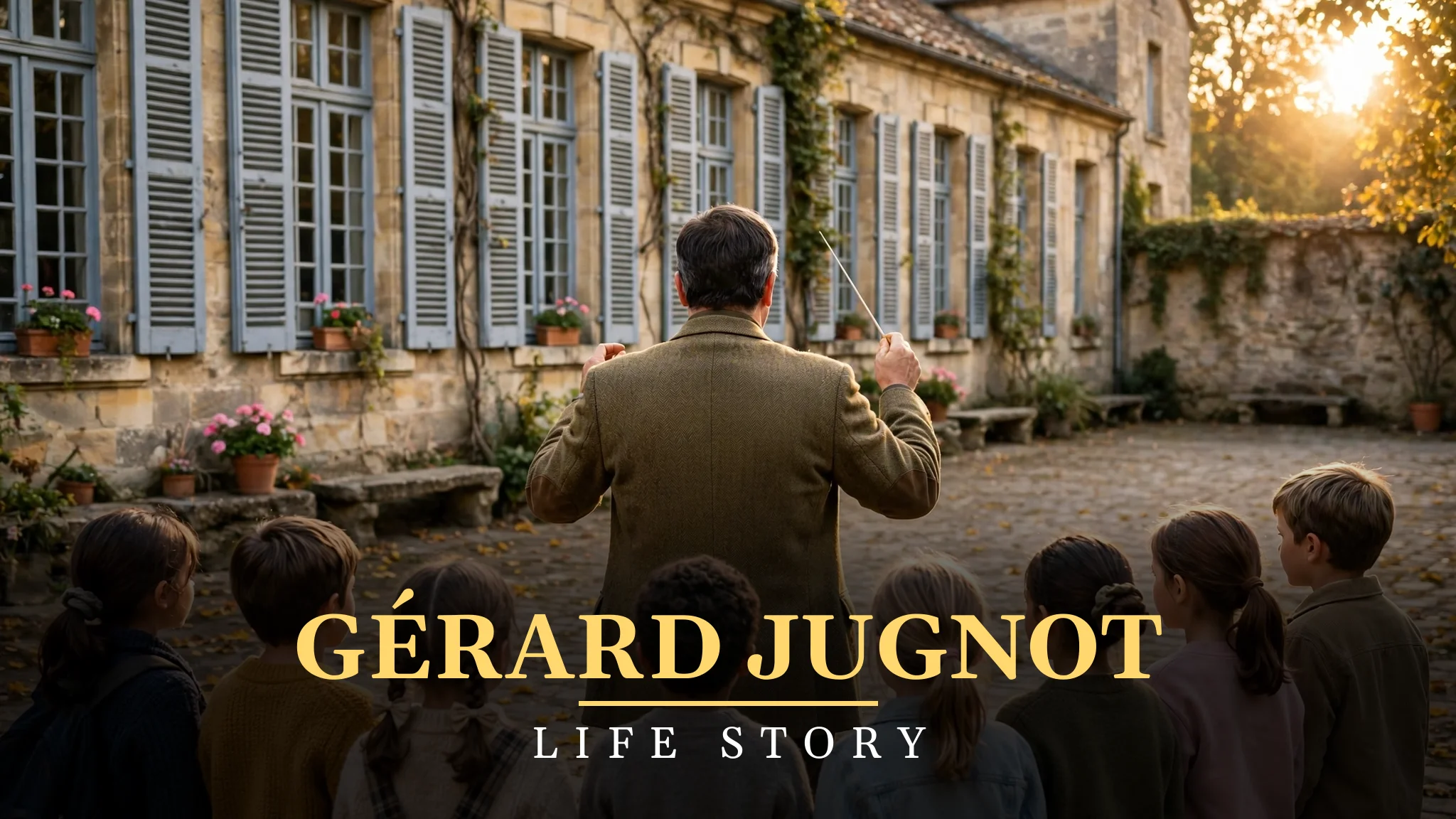
I keep thinking about the image of him with the children, holding a baton, in a stone courtyard at sunset. It is a picture from Les Choristes, but it is also a picture of Jugnot himself: a man facing children, not with anger, but with music. He is not shouting. He is conducting, guiding, listening. That is how he has lived his career: not by shouting, but by guiding, by listening, and by helping others to find their voice. In the end, I think that is his greatest gift. He helps others to sing, on screen and in life, and that is a beautiful thing to be remembered for.
I also think about his work as a director, and about the films he made about ordinary people. He directed films about a policeman, about a man who loses his job, and about a shopkeeper in the war, and each film was about a real person, with real problems. He did not make films about kings or heroes. He made films about workers, about fathers, and about people trying their best. That choice comes from his heart, and from his years with Le Splendid, where the comedy was always about real life. I think about the films I have loved, and about how many of them are about ordinary people. Those are the films that stay with me, because they are about me, about my family, and about my neighbours. Jugnot makes those films, and he makes them well.
I think about Monsieur Batignole, and about the shopkeeper who helps Jewish children escape during the war. It is a quiet film, a brave film, and a film that asks the audience to think about what they would do in a time of danger. Jugnot directed it with care, and he starred in it with humility. He did not play a hero. He played an ordinary man who does the right thing, slowly, and with fear. I think that is the truest kind of heroism, and it is the kind that Jugnot understands best. He has spent his career playing ordinary men, and he knows that ordinary men can do extraordinary things. That is a lesson for all of us: we do not need to be heroes to do good. We only need to be brave enough to help, when help is needed.
I also think about his son Arthur, and about the joy of seeing your child follow you into the theatre. Jugnot is a father who has watched his son become an actor and a director, and who has worked with him on stage and on screen. That must be a proud feeling, and a happy one. I think about the fathers who teach their children their craft, who pass on what they know, and who watch their children grow. It is a beautiful thing, and it is a part of Jugnot’s life that makes me smile. He did not only build a career. He built a family, and he shared his love of the theatre with his son.
There is something I admire about the way Jugnot has stayed warm through fifty years of fame. He could have become bitter, or tired, or distant. He did not. He stayed kind, he stayed funny, and he stayed generous with his colleagues. I think about the workplaces I have known, and about the people who made them better by being kind. Jugnot has made every film set better by being kind, and the people who have worked with him remember it. Kindness is not a small thing. It is a strength, and it makes the work better for everyone. Jugnot has shown that for fifty years, and that is a legacy worth remembering.
Finally, I think about the children in Les Choristes, and about the choir that changed their lives. A song can give a child confidence, hope, and a reason to believe. Jugnot knows that, and he has used his fame to support music in schools. I think about the children who sing in choirs today, and about the teachers who help them, and I see Mathieu in all of them. Jugnot played a teacher who changed lives through music, and he has become a man who changes lives through his work. That is a beautiful circle, and it is why his story matters. He helps others to sing, on screen and in life, and that is a gift that will last long after his films are forgotten.
I also think about his later films, and about the way he has kept working without chasing fame. He directs, he acts, he returns to the theatre, and he does it all with the same warmth he had as a young man. I think about the artists who stop working when the big successes end, who give up because the spotlight moves on. Jugnot did not give up. He kept making films, kept performing, and kept telling stories, because he loves the work, not only the fame. That is a lesson for anyone who creates: do the work because you love it, not because you want applause, and the work will sustain you long after the applause fades.
I think about the theatre, and about the small café-theatre where Le Splendid began. It was a small room, with a small audience, and a group of young friends who wanted to make people laugh. Jugnot was there, and he has never forgotten it. He returns to the theatre again and again, because he knows that a live audience is the best teacher, and the best reward. I think about the small stages in my own life, the small rooms where I learned, and I see the same truth: great things often start small, in a room with a few people who believe in each other. Jugnot started small, and he became great, and he never forgot the small room where it began.
Finally, I think about the man with the baton, facing the children in the stone courtyard at sunset. It is a picture of a teacher, a man who believes in children, and who helps them to sing. That is Jugnot for me: a man who helps others to find their voice, on screen and in life. He does not shout. He conducts, he guides, and he listens. He helps others to sing, and that is a beautiful thing to be remembered for, long after the films are over.
I also think about Une époque formidable, and about the man who loses his job, his home, and his family, and who tries to rebuild his life. Jugnot directed that film with warmth and with honesty, and he played the man with a deep sense of humanity. I think about the people who lose everything, who have to start again, and who find kindness in strangers. That is a powerful story, and Jugnot tells it with both laughter and thought. He shows that even when life is hard, there is hope, and there are people who will help. That is a message that matters, and it is one that Jugnot delivers with his whole heart.
Frequently Asked Questions
When and where was Gérard Jugnot born?
Gérard Jugnot was born on 4 May 1951 in Paris, France. He grew up in the French capital and met his future Le Splendid partners while still a student at the Lycée Pasteur in Neuilly-sur-Seine.
What is Le Splendid, and what was Gérard Jugnot’s part in it?
Le Splendid was a theatre company formed in Paris in the early 1970s by Jugnot, Christian Clavier, Thierry Lhermitte, and their friends, who wrote and performed their own plays. Jugnot was one of its central members, and the group went on to make classic French comedies such as Les Bronzés and Le Père Noël est une ordure.
What are Gérard Jugnot’s most famous films as an actor?
His most famous films include Les Bronzés, Les Bronzés font du ski, Le Père Noël est une ordure, and Les Choristes, in which he played the teacher Clément Mathieu. Les Choristes, released in 2004, became one of the most loved French films of the twenty-first century.
What films has Gérard Jugnot directed?
He has directed films including Pinot simple flic, Une époque formidable, Monsieur Batignole, and Boudu. Monsieur Batignole, released in 2002, is a moving drama set during the Second World War, in which he played a shopkeeper who helps Jewish children escape.
Who is Gérard Jugnot’s son?
His son Arthur Jugnot is also an actor and theatre director, and the two have worked together on stage and on screen. Jugnot has spoken with pride about his son following him into the theatre world.
Is Gérard Jugnot still working today?
Yes, he is still active in French film, television, and theatre, acting and directing more than fifty years after he began with Le Splendid. He continues to take on roles as fathers and grandfathers, and he remains one of France’s most loved actors.


