Country With Seven Presidents Explained
In this post
Ask someone to name the president of the United States, France or Pakistan, and you will get an answer in one second. Now ask for the president of Switzerland — and most people go quiet. Some guess a name. Others admit they have never heard of any Swiss president at all.
There is a good reason for that silence. Switzerland, a rich and famous country in the heart of Europe, has quietly refused to give the top job to one person. Instead, seven leaders run the country together, as a team of equals — and every single year, a different one of them sits in the president’s chair, without gaining a drop of extra power. It sounds like a joke. It is actually one of the most stable systems of government on Earth, and it has worked since 1848.
Seven Leaders Instead Of One
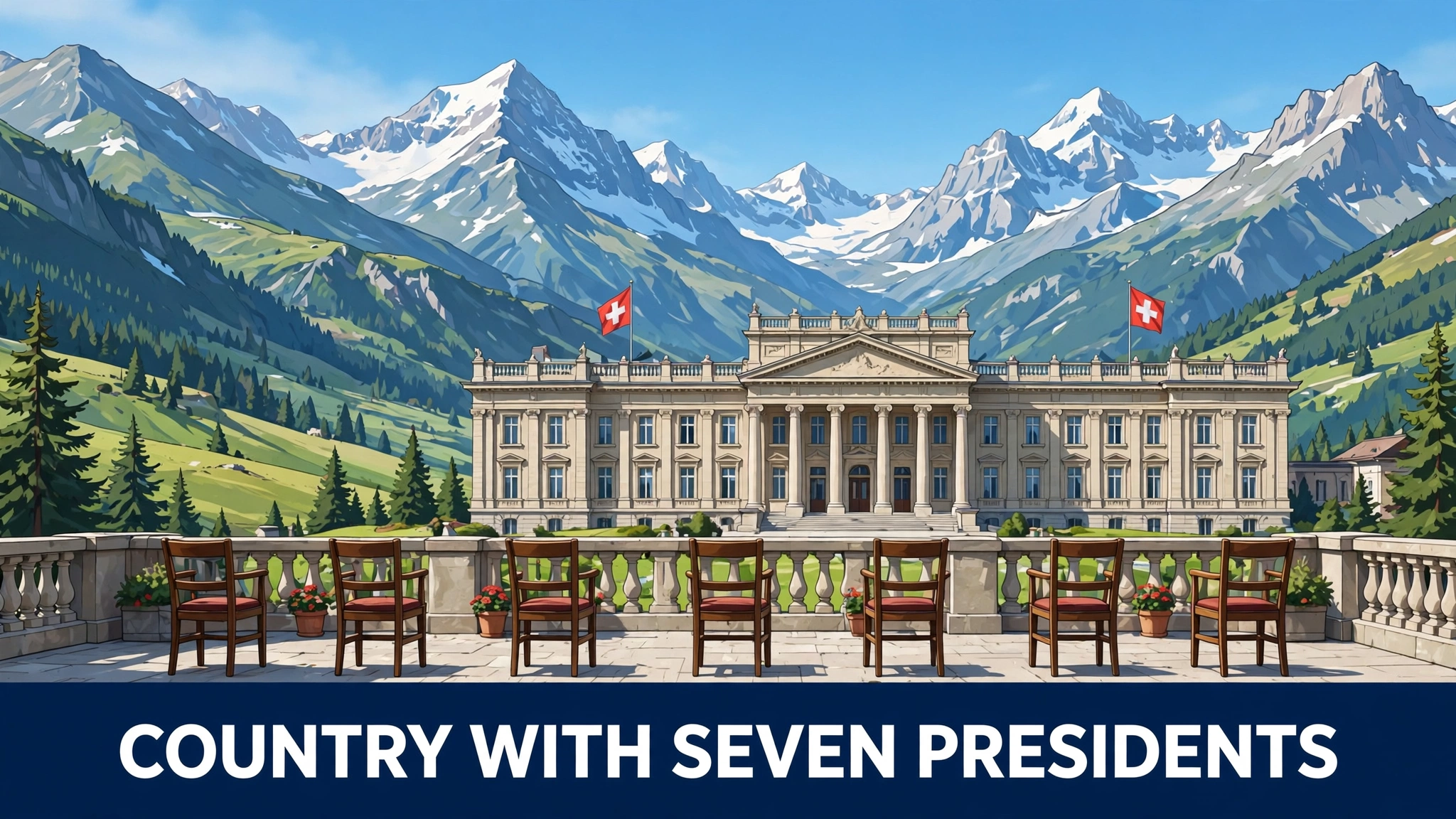
Switzerland’s government is a body called the Federal Council. It has exactly seven members — no more, no less, a number fixed in the country’s constitution since the Swiss federal state was founded in 1848.
Together, these seven people do the work that a president or prime minister does alone in most countries. They are the government, and together they also act as the country’s head of state — the role belongs to the whole team, not to any one face. That is why Switzerland has no famous single leader whose name the whole world knows. The job was designed to be shared.
Each of the seven councillors also runs one big department of the government — things like foreign affairs, finance, defence, justice, or the economy — the way a minister does in other countries. And they are drawn from the country’s main political parties and its different regions and language groups, so that the team at the top looks something like the country itself: German-speaking, French-speaking and Italian-speaking Switzerland all have a voice in the room.
Chosen By Parliament For Four Years At A Time
Here is another surprise: the Swiss people do not directly vote for these seven leaders in a big national race. There are no giant rallies for a future president, no winner-takes-all election night.
Instead, the seven members of the Federal Council are elected by the Swiss parliament — the United Federal Assembly — for a term of four years. When the four years end, parliament votes again, and sitting members are very often re-elected. Many councillors therefore serve for a long stretch of years, quietly running their departments, while the country watches politics change around them.
This produces something rare in world politics: calm. The Swiss government does not fall in a sudden crisis the way coalition governments often do elsewhere. Faces change one at a time, usually when a member chooses to retire, and the team carries on. The number of seats each big party holds on the council has traditionally followed a shared pattern — for years it has been two seats each for the three largest parties and one for the fourth — so all the major camps govern together, all the time, instead of taking turns in power and in opposition.
A President Who Is Only First Among Equals
So where does a “President of Switzerland” fit into this? Every year, parliament also chooses one of the seven councillors to be President of the Swiss Confederation for a single year.
It is very important to understand what this job is — and what it is not. The president is described by the Swiss government itself with a Latin phrase: primus inter pares, which means “first among equals”. The president chairs the council’s meetings and takes on special ceremonial and representative duties, especially when meeting foreign leaders and travelling abroad. For that one year, this person is the face you will see shaking hands at international summits.
But inside the government room, the president’s vote counts exactly the same as the other six. The president cannot overrule the team, cannot sack a fellow councillor, cannot order the others around, and keeps running his or her own department like everyone else. When the year ends, the chair simply passes on. A Swiss president is less like a king for a year and more like the member of a team chosen to lead the meetings and cut the ribbons — an honour, not a throne.
For 2026, according to the Swiss government’s official website, the president is Guy Parmelin, a federal councillor since 2016, who looks after the department of economic affairs. If that name is new to you, do not feel bad. That is rather the point of the system: the president is not meant to be a celebrity ruler.
Why The Chair Rotates Every Year
If the president has no extra power, why have one at all — and why change the person every year?
Part of the answer is practical. Someone has to chair the meetings and welcome foreign guests, and the job is real work on top of running a department. Sharing it around shares the load.
But the deeper answer is trust — or rather, a careful lack of it. The rotation normally follows seniority: the member who has served longest and has not yet had a turn moves up, with the vice president generally stepping into the chair the following year. In this way, every member of the council takes a turn at the top in an order everyone can predict. Nobody campaigns for the chair, nobody clings to it, and nobody can use a year in the spotlight to build a personal empire. The system was built, from the very beginning, so that power stays spread out and no single person can gather it all into their own hands.
Decisions Are Announced With One Voice
The seven do not merely share the top job. They also follow a famous working rule called collegiality. The council meets, usually once a week, and works through a mountain of business — the Swiss government says it deals with roughly 2,000 to 2,500 items every year, prepared by the departments and the Federal Chancellery, whose head, the Federal Chancellor, attends as the council’s chief of staff in an advisory role.
Inside the room, members may argue and disagree. But once the council has decided something, all seven present that decision to the public as one united team — even a member who personally disagreed, or whose own party dislikes it. There are no victory speeches against colleagues, no public feuds between the people at the top. From the outside, Switzerland’s government speaks with one steady voice, year after year, whichever member happens to be sitting in the president’s chair.
Why Switzerland Built It This Way
This system was born with the Swiss constitution of 1848, when the cantons — the country’s member states — came together to form one federal state. Switzerland was, and still is, a country of different languages, religions and regions packed into a small mountainous land. A single all-powerful leader, chosen by one group, was never going to be trusted by all the others.
So the Swiss chose the opposite design: a small team, drawn from the main groups, deciding together, speaking together, and rotating the honour at the top. Nearly two centuries later, the world has seen presidents, kings and strongmen rise and fall all around it — and Switzerland’s quiet committee of seven is still meeting every week, still sharing the chair, still getting on with the work.
It is a useful reminder that there is more than one way to run a country. Some nations put one person on the highest chair and hope they choose well. Switzerland put seven chairs in a row — and made sure no one of them is higher than the rest.
Frequently Asked Questions
Does Switzerland really have seven presidents? Not exactly seven presidents — it has a seven-member government, the Federal Council, whose members are all equals. Each year, one of them also takes the role of President of the Swiss Confederation. So there are seven leaders, and one of them is “president” for that year.
How much power does the Swiss president have? No more than the other six councillors. The president chairs meetings and represents the country at ceremonies and abroad, but has the same single vote as everyone else in the council and cannot overrule or dismiss the others. The official term is “first among equals”.
Who is the president of Switzerland in 2026? According to the Swiss government’s official website (admin.ch), the President of the Swiss Confederation for 2026 is Guy Parmelin. He has been a member of the Federal Council since 2016 and heads the department responsible for economic affairs. The role will pass to another councillor in 2027.
How are the seven leaders chosen? They are elected by the Swiss parliament, the United Federal Assembly, for four-year terms, and they are often re-elected, which gives the government unusual stability. Each councillor also heads one government department.
Why does Switzerland not have one strong president? The system was set up with the Swiss federal state in 1848. In a country of different languages and regions, sharing power among a team of equals was a way to make sure every major group was represented and no single person could take control. The yearly rotation of the presidency keeps it that way.
Sources
- Swiss Federal Council (admin.ch), “The seven members of the Federal Council”: https://www.admin.ch/gov/en/start/federal-council/members-of-the-federal-council.html
- About Switzerland — Swiss Federal Chancellery, “The Federal Council”: https://www.bundesreisezentrale.admin.ch/aboutswitzerland/en/home/politik-geschichte/politisches-system/bundesrat.html
- The picture on this page is an original illustration made for Talha M Blog.