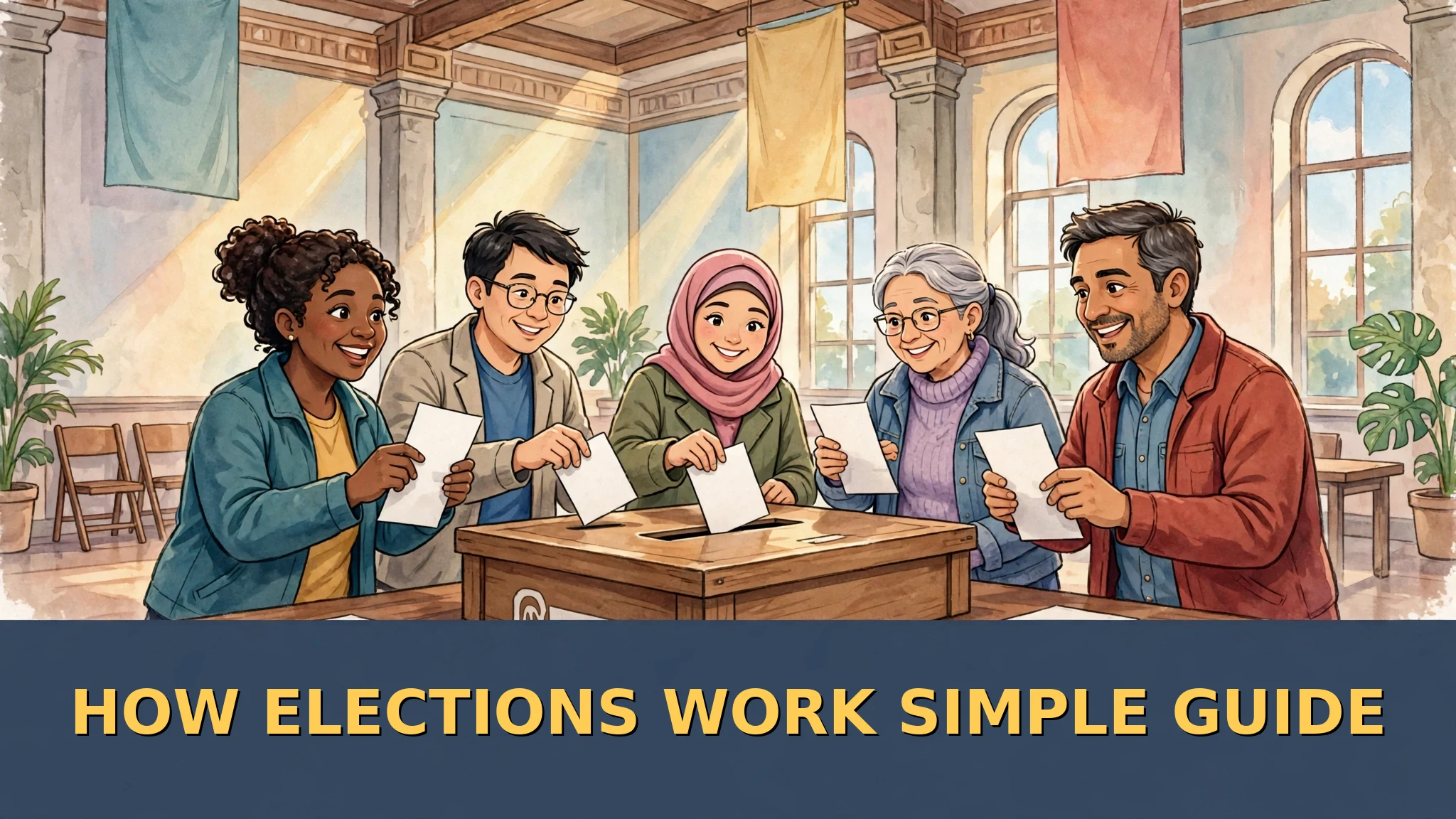
How Elections Work Simple Guide
In this post
- What Is an Election and Why Countries Hold Them
- Step 1: Who Can Vote in an Election
- Step 2: Candidates, Parties and Manifestos
- Step 3: Campaigning — Speeches, Leaflets and Promises
- Step 4: Voting Day and the Secret Ballot
- Step 5: Counting the Votes
- Step 6: Results and Forming a Government
- What If No Party Wins Clearly
- Why Every Single Vote Matters
- Sources
On one single day, millions of ordinary people quietly do something extraordinary. A farmer, a teacher, a shopkeeper and a student each walk into a room, mark a piece of paper in secret, and walk out again. Nobody shouts. Nobody fights. And by the end of that day, those small marks on paper decide who will run an entire country.
How does that work? How do millions of private choices, made in little booths and behind curtains, turn into a government? It sounds like magic, but it is not magic at all. It is a careful process with clear steps — and every step exists for a reason.
What Is an Election and Why Countries Hold Them
An election is a formal way for a group of people to choose their leaders by voting. Instead of power passing from father to son, or being taken by force, the people themselves decide who gets the job — and, just as importantly, for how long.
Countries hold elections because leaders need permission to rule. An election is that permission, written in numbers. It also gives people a peaceful way to change their leaders: if a government works well, voters can keep it; if it fails them, voters can replace it — with paper, not with violence. Some elections choose a president or a national parliament; others choose local councils and mayors. The steps, however, are almost the same everywhere.
Step 1: Who Can Vote in an Election
Not just anyone can walk in and vote. Every country keeps an official list of voters — often called the electoral roll or voter register. Your name must be on that list to receive a ballot paper. In general, a voter must be:
- A citizen of the country. Elections decide that country’s future, so they belong to its citizens.
- Old enough. In many countries, including the United Kingdom, the voting age for national elections is 18; Britannica’s student guide notes that in the UK every eligible person aged 18 and over can vote.
- Registered. In some countries the government adds citizens to the list automatically; in others, each person must register before a deadline. Either way, the list is checked and updated before election day.
Why so much care over a list? Because fairness begins here. The rule is one person, one vote — if names could be added freely on the day, one person might vote three times while another is turned away. Candidates follow rules too: usually they must be citizens, meet a minimum age, and register officially before a deadline.
Step 2: Candidates, Parties and Manifestos
The people who want the job are called candidates. Most do not stand alone. They belong to a political party: a team of people who share broad ideas about how the country should be run — what taxes should be, how schools and hospitals should work, how the economy should grow.
Parties help voters in two ways. The party name on the ballot paper is a quick signal of the candidate’s general thinking. And a party can publish one full plan instead of every candidate writing one alone. That plan is called a manifesto — a list of everything the party promises to do if it wins, exactly as Britannica’s guide for students describes it.
A country is usually divided into voting areas. In the UK these areas are called constituencies, and each one elects one member of parliament, an MP. Other countries use different names and sizes, but the purpose is the same: every part of the country gets its own voice, not just the big cities.
Step 3: Campaigning — Speeches, Leaflets and Promises
Before anyone votes, candidates must introduce themselves. This period is the campaign, and it often lasts a few weeks.
During a campaign, candidates try to convince voters that they are right for the job. Britannica describes candidates making speeches and running advertisements on television and other media. Its student guide adds the ground-level work: handing out leaflets, speaking in public debates, and visiting people door to door.
A good campaign answers three questions. What will you do if you win? Why should we trust you? And how are you different from the others? Most democracies also set rules on campaign money and media access, with one shared aim: the loudest wallet should not simply buy the election.
Step 4: Voting Day and the Secret Ballot
Then comes polling day. Across the country, polling stations open — often in schools, community centres and other public buildings. Voters arrive, show their identity, and their name is checked against the voter list. Each voter then receives a ballot paper and steps into a private booth.
Here sits the most precious rule of the whole process: everyone’s choice remains secret.
The secret ballot means you mark your choice in privacy, and nobody — not your employer, not a party worker, not the officials at the station — can find out how you voted. Britannica’s history of the ballot explains the machinery of that secrecy: voters mark uniform ballot papers printed and distributed by the government, and the ballot boxes are examined before voting begins and cannot be opened until the counting starts.
Why does secrecy matter so much? Because a vote that can be checked can be bought or forced. If a powerful person could see your ballot, they could pay you for the “right” choice or punish you for the “wrong” one. When nobody can prove how you voted, bribery loses its power and fear loses its grip. Your choice belongs to you alone.
Many countries also allow voting by mail, or early voting before the official day — helpful for the elderly, the sick, and citizens abroad. The method changes, but the choice stays secret and the vote joins the same count.
Step 5: Counting the Votes
When the polls close, the second half of the drama begins: the count. Ballot boxes are sealed and carried to counting centres. There, under the eyes of officials and observers from the different parties, the boxes are opened and the votes are counted — by hand in some countries, by machine in others. Those party observers matter more than most people realise: rivals watching the same pile of papers with their own eyes is one of the strongest protections against cheating.
Every system must then answer one question: how do these piles of votes become winners? An electoral system, as Britannica defines it, is the method and rules of counting votes to determine the outcome of elections. The main families are:
- Plurality — most votes wins. The candidate with more votes than any other wins, even if that is less than half of all votes.
- Majority — more than half. The winner must pass 50% of the vote. If nobody does in the first round, some countries hold a second round between the top two candidates.
- Proportional representation. Used in some countries to share parliament seats in proportion to each party’s share of the vote, so a party with about a third of the votes gets about a third of the seats.
Candidates may be elected directly, when voters choose the person themselves, or indirectly, when voters choose representatives who then make the final choice. Countries mix these ingredients differently, which is why election nights look different around the world — but every recipe starts with the same ingredient: your counted vote.
Step 6: Results and Forming a Government
As counting finishes area by area, results are announced through the night, and a national picture slowly appears.
In a parliamentary system — the example Britannica’s student guide uses — the party with the most elected MPs forms the government, and that party’s leader becomes the prime minister. The winning MP then represents all the people of their area, including those who voted for someone else and those who did not vote at all.
In a presidential system, the president is chosen in a separate national contest and then appoints a cabinet to run the government departments. The faces differ; the logic is the same. The count produces winners, the winners take office for a fixed term, and on a known future date the whole country will judge them again.
What If No Party Wins Clearly
Sometimes the voters, in their millions of separate decisions, produce no clear winner. In the UK this is called a hung parliament: no single party has enough seats to govern alone.
Then two or more parties may talk, bargain and agree to join together in a coalition government, sharing power under an agreement about what they will do together. Or the largest party may govern alone with fewer than half the seats — a minority government — persuading others law by law.
This is not a failure of the system. It is the system honestly reporting what the people said: no one of you convinced us completely — now work together. The decision still came from the voters, which is the entire point.
Why Every Single Vote Matters
One question remains, whispered on every election morning: does my one vote really matter, among millions?
Yes — and here is why. First, every winning pile was built one vote at a time; a margin of ten thousand is simply ten thousand individual decisions to turn up. Second, some contests, especially local ones, are decided by very small numbers of votes, so your pile can genuinely make the difference. Third, politicians study not just who won but how many people voted — an area that votes in large numbers is listened to very differently from one that stays silent.
And there is a quieter reason. The secret ballot makes the voting booth the one place where a billionaire and a labourer stand exactly equal: one person, one vote, one private choice. Generations fought for that equality — using it is how an ordinary person holds a real piece of power in their own hand.
Frequently Asked Questions
What is the difference between a candidate and a party? A candidate is one person asking for the job. A party is the team that person belongs to — a group sharing broad ideas and one common plan, the manifesto. Voters often choose based on both the person and the team.
Why is the ballot secret? So nobody can buy your vote or punish you for it. If your choice cannot be checked, it cannot be controlled. Secrecy is what makes the vote truly yours.
What happens if no party wins a majority? Parties may join together in a coalition and share power, or the largest party may govern as a minority, persuading others law by law. Either way, the government still comes from the election result.
Can one vote really change an election? Every total is built from single votes, and close contests — especially local ones — can be decided by very small numbers. High turnout also tells leaders which communities must be listened to.
How often are elections held? It depends on the country and the level of government. National elections commonly take place every four or five years; Britannica notes that UK general elections usually take place once every five years.
Sources
- Encyclopaedia Britannica — Electoral system: https://www.britannica.com/topic/electoral-system
- Britannica Kids (Students) — Elections: https://kids.britannica.com/students/article/elections/274143/media?assemblyId=217706
- Encyclopaedia Britannica — Ballot Act (Australian / secret ballot): https://www.britannica.com/print/article/50741
- The picture on this page is an original illustration made for Talha M Blog.