Cristian Castro: The Life Story Behind Mexico's Romantic Voice
In this post
- A Child Born Into Mexican Show Business
- The Teenage Singer Finds His Own Voice
- Azul and the Peak of the Pop Years
- Love, Marriage, and Life in the Public Eye
- Boleros, Tributes, and a Return to the Classics
- Hard Years, New Beginnings, and Keeping the Voice Alive
- What His Career Means for Mexican Pop
- A Voice That Still Fills a Hall
- My Take:
Cristian Castro has one of the most recognisable voices in Latin pop, a warm and powerful tenor that can turn a simple love song into something that feels large and urgent. For more than thirty years, his ballads have played at weddings, on radio stations, and in homes across Mexico and Latin America. People who grew up in the 1990s can often sing the chorus of one of his songs without thinking about it, because his music was part of daily life. He did not arrive as a stranger who had to learn how to be famous. He grew up inside the world of Mexican entertainment, and he learned its lights, its pressure, and its rewards from a very young age.
His story is also a story about family, because his mother is the famous actress and singer Veronica Castro, and his father was the comedian Manuel Valdes. That gave him a head start, but it also gave him a long shadow to step out of. From his first days as a singer, people compared him with his parents, and they asked whether he could succeed on his own voice rather than on a famous name. He answered that question with hit after hit, and with a career that has lasted far longer than most pop careers last. His voice carried him through changing styles, changing radio, and changing audiences.
What makes his life interesting is not only the fame. It is the way he has kept returning to the same thing, the romantic ballad, even when music around him changed. He has sung pop, he has sung bolero, and he has recorded tributes to the great singers of the past. He has had public marriages, public breakups, and public arguments, and he has kept singing through all of them. This is the story of a boy who was born into show business, who became a star as a teenager, and who is still singing love songs decades later.
A Child Born Into Mexican Show Business
Cristian Castro was born on 8 December 1974 in Mexico City. His mother, Veronica Castro, was already one of the best known actresses and television stars in Mexico, and his father, Manuel Valdes, known as El Loco Valdes, was a famous comedian. The boy grew up in a home where cameras, rehearsals, and famous visitors were normal. He heard music in the house, he watched his mother work, and he learned early that performing was not a game. It was a job that needed discipline, and it was a job that the public judged every day.
As a small child, he appeared in front of cameras himself. He acted in television and in films when he was still very young, and he learned how to stand in front of a crew, how to wait for his turn, and how to repeat a scene until it was right. That early work gave him confidence, but it also meant that he had very little of the quiet, private childhood that most children have. People knew his face before he knew what he wanted to be. He was the son of Veronica Castro before he was Cristian Castro the singer, and that order of things shaped his whole youth.
His parents separated when he was young, and he grew up mainly with his mother. Veronica Castro was a strong and hard working woman, and she protected her son while also pushing him to work. She understood the business, and she understood that talent alone is not enough. A singer needs training, good songs, and the ability to keep going when a record does not sell. Cristian learned those lessons at home, long before he signed his first record deal. He also learned that fame can be warm and cruel in the same week.
Music was always in his life. He listened to the great Mexican singers, and he listened to pop music from other countries. He had a natural voice, clear and strong, and people who heard him sing as a boy could tell that it was not a small voice. It had power, and it had feeling. He began to sing in public, and the response was strong. The question was not whether he could sing. The question was when he would be ready to carry a whole album, a whole tour, and a whole career on that voice alone.
The Teenage Singer Finds His Own Voice
Cristian Castro released his first album, Agua Nueva, in 1992, when he was seventeen years old. The album was a pop record, bright and young, and it introduced him as a singer in his own right. The song No Podras became a hit, and it showed that his voice could carry a romantic pop song with ease. Radio stations played it, young listeners learned the words, and record buyers began to ask for his name rather than only for his mother’s name. That was an important step, and it was one that he had waited for since childhood.
The years that followed were busy. He recorded more albums, he appeared on television, and he toured. His second album, Un Segundo en el Tiempo, came in 1993, and it kept his name on the charts. He was still a teenager, and he was learning how to be a pop star in public. He had to learn how to give interviews, how to handle praise, and how to handle criticism. He also had to learn how to protect his voice, because a singer who tours too much and rests too little can damage the very thing that makes him special.
His early style was romantic pop, with songs about first love, about longing, and about the pain of losing someone. Those themes suited his voice, which could sound tender in a quiet verse and strong in a big chorus. He was not trying to be a rock singer or a rapper. He was a ballad singer, and he understood that his strength was in melody and feeling. That choice gave him a clear place in Latin music, and it gave him an audience that stayed with him as they grew older.
By the middle of the 1990s, he was no longer only a promising young singer. He was a star in Mexico and in many other Spanish speaking countries. He had hit songs, he had fans who waited for his new albums, and he had a career that looked solid. But he also faced the problem that every teenage star faces. He had to grow up in public, and he had to show that he could make music as an adult that was just as strong as the music he had made as a boy. The next stage of his career would test whether he could do that.
Azul and the Peak of the Pop Years
The biggest chapter of Cristian Castro’s career came with the album Azul, released in 2001. The title song, Azul, became one of his most famous records, and the album sold in large numbers across Latin America. The song was a romantic ballad with a strong melody, and his voice sounded full and confident on it. It was the kind of song that people played at parties, on the radio, and at home, and it became a signature song for him. For many listeners, Azul is the first song they think of when they hear his name.
Around the same time, he recorded other songs that became hits, including Por Amarte Asi, Lloran las Rosas, and Volver a Amar. These songs showed the range of his voice. Some were soft and sad, and some were loud and full of feeling. He worked with good songwriters and good producers, and he learned how to choose songs that suited him. A great voice is not enough on its own. A singer needs the right song at the right time, and during these years Cristian often found it.
His concerts also grew larger. He sang in big venues in Mexico, in the United States, and in South America, and his fans included people of many ages. Older listeners liked his romantic style, and younger listeners liked his energy and his looks. He was a pop star who could fill a hall, and he was a singer who could hold a crowd with only a microphone and a band. That is a skill that not every recording star has, and it is one that he developed through years of live work.
The success of Azul and the songs around it gave him a place among the leading Latin pop singers of his generation. He won awards, he was nominated for major prizes, and his albums were talked about in the press. He was no longer only the son of a famous actress. He was a star with his own hits, his own audience, and his own place in the history of Latin pop. But success also brought more pressure, and the years after the peak would show how hard it is to stay at the top when music changes and when private life becomes public news.
Love, Marriage, and Life in the Public Eye
Cristian Castro’s private life has often been in the news, and it has been part of his story for many years. He married Valeria Liberman, and the couple had children together, before the marriage ended. He later married Gabriela Bo, and that marriage also ended. His relationships have been reported in magazines and on television, and he has often spoken openly about his feelings. That openness has made him popular with some people, and it has brought criticism from others. He has never been a singer who hides his life completely from the public.
He has also spoken about his relationship with his father, Manuel Valdes, which was not always close. His father was a famous and busy man, and Cristian grew up at a distance from him in many ways. Later in life, he talked about wanting a better relationship, and he talked about the pain of growing up without a father close by. Those words touched many listeners, because many people know what it is like to have a family that is loving in one way and distant in another. His songs about love and loss often sound more real because of what he has lived through himself.
His mother has remained an important figure in his life. Veronica Castro has defended her son in public, and she has also spoken honestly about his mistakes. The bond between mother and son is strong, and it has been tested by fame, by money, and by the press. Cristian has said many times that his mother is one of the most important people in his life, and her support has helped him through hard times. That family story is part of why the public follows him so closely. People feel that they know his family, and they feel that they are watching a real family grow and change.
Living in public is hard for any singer, and it has been hard for Cristian. Every marriage, every breakup, and every argument can become a headline, and a headline can stay with a singer for years. He has made mistakes, and he has said things that he later wished he had not said. But he has also kept singing, and he has kept showing up for his audience. That ability to keep working, even when his private life is in the news, is part of his story, and it is one of the reasons his career has lasted so long.
Boleros, Tributes, and a Return to the Classics
In the years after his biggest pop hits, Cristian Castro turned more and more to the classic songs of Latin music. He recorded albums of boleros, the slow romantic songs that have been part of Mexican music for many generations. He sang songs made famous by Jose Jose, by Juan Gabriel, and by other great singers. These records were not only a tribute to the past. They were also a way for him to show what his voice could do with a great melody and a simple arrangement.
His tribute work showed a different side of him. As a pop singer, he had to follow the sound of the time. As a bolero singer, he could slow down, and he could let his voice carry the feeling of the song. Listeners who loved the old songs liked his versions, and younger listeners discovered the old songs through him. He became a bridge between generations, a singer who could sing a new pop song and an old bolero in the same concert, and make both of them feel honest.
He also worked in television and in other projects, and he kept touring. His concerts often mixed his own hits with the classic songs he loved, and his fans liked that mix. They could hear Azul and Por Amarte Asi, and then they could hear a bolero that their parents and grandparents had loved. That mix made his shows feel like a journey through Latin music, and it gave his career a depth that a singer with only pop hits would not have.
The tribute albums also showed that he was thinking about his place in music history. He did not want to be only a singer of his own time. He wanted to be part of a longer story, the story of Mexican romantic song. By singing the songs of the greats, he placed himself in that story, and he invited his audience to hear the connection between the past and the present. That was a serious artistic choice, and it earned him respect from people who care about the tradition of Latin song.
Hard Years, New Beginnings, and Keeping the Voice Alive
Like many long careers, Cristian Castro’s career has had hard years. Music changed, and the pop ballad was no longer the dominant sound on the radio. Younger singers came with new styles, and streaming changed the way people listened to music. Cristian had to find a way to stay present in a world where a new song can be forgotten in a week. He did this by touring, by recording, and by staying close to his fans on social media and on television. He did not stop, and he did not pretend that the music world had stayed the same.
He also faced personal problems, and he faced criticism in the press. His behaviour at times was questioned, and his public words were sometimes harsh. He has apologised at times, and at other times he has defended himself. What is clear is that his career has not been smooth. It has had ups and downs, and it has had periods when people wondered whether he would come back with a strong record. Each time, he has returned to the stage, and he has reminded his audience of what his voice can do.
He has also become a father, and fatherhood has changed the way he talks about his life. He speaks about his children, and about wanting to be a good father, and those words add a new layer to his story. He is no longer only the teenage pop star or the romantic singer of Azul. He is a man in his fifties who has lived a full and public life, and who is still learning. That honesty, when it comes through in his interviews and his songs, is part of why people still listen to him.
Today, Cristian Castro continues to sing, to tour, and to record. His voice remains his greatest gift, and it remains the reason people buy tickets to see him. He may never have another hit as large as Azul, but he does not need one to matter. His place in Latin music is already secure, because his songs are part of the memory of a whole generation. He is a singer who has survived fame, family pressure, and changing times, and who still stands on a stage and sings a love song as if he means every word.
What His Career Means for Mexican Pop
Cristian Castro matters to Mexican pop because he kept the romantic ballad alive at a time when many singers were moving to other sounds. He showed that a love song, sung well, could still fill a hall and still move a crowd. He also showed that a Mexican singer could be a star across Latin America and in the United States, without losing his Mexican roots. His music was always in Spanish, and his style was always Latin, and that honesty helped him build a loyal audience.
He also matters because of his family story. He is part of one of the most famous families in Mexican entertainment, and his career shows how a child of famous parents can build a life of his own. It was not easy, and it was not automatic. He had to work, he had to choose good songs, and he had to learn how to be a star on his own terms. Young singers who come from famous families can learn from his example, both from what he did well and from what he found hard.
His tribute albums matter too, because they kept the bolero alive for a new generation. Many young listeners first heard the great songs of the past through his voice, and that is a real service to music. A tradition only lives if new singers sing it, and Cristian sang it with respect and with feeling. He did not treat the old songs as museum pieces. He treated them as living songs, and he gave them new life.
In the end, his career is a long one, and it is still going. He has had big hits, he has had hard years, and he has kept singing through both. That is the simple truth of his story. He is a singer who was born into show business, who found his own voice, who reached the top with Azul, and who has kept that voice alive for more than thirty years. That is a rare achievement, and it is why his name still means something in Mexican music.
A Voice That Still Fills a Hall
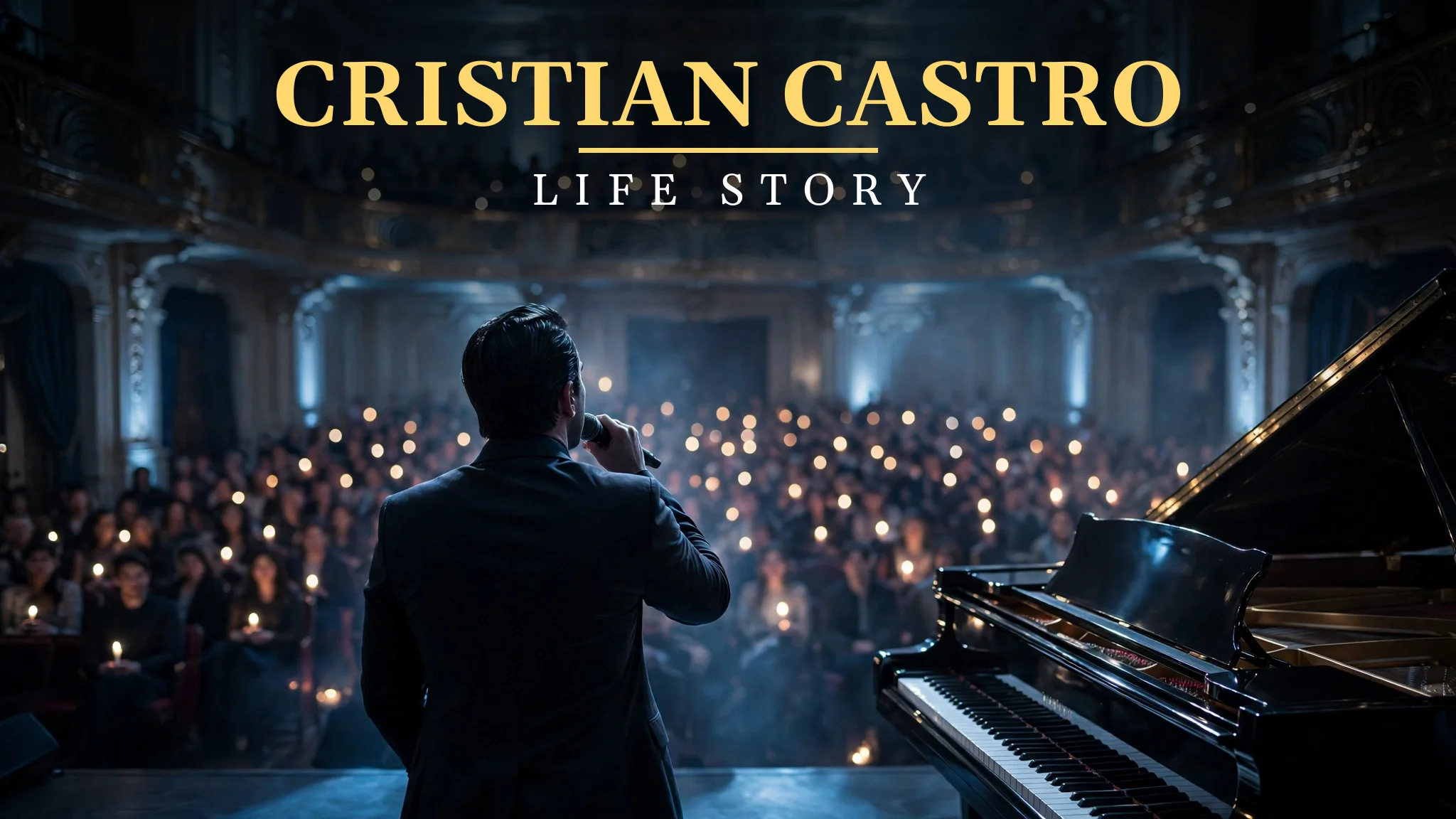
When Cristian Castro walks onto a stage today, the audience knows what to expect, and that is part of the pleasure. They know that he will sing the songs they love, and they know that his voice will still sound strong. He does not need a large show with dancers and lights to hold a room. He needs a microphone, a good band, and a song with a real melody. That simplicity is rare in modern pop, where many shows rely on effects to hide a weak voice. Cristian has never needed to hide, because his voice is the show, and his audience comes to hear it.
His concerts also show how wide his audience has become. In the crowd, there are older listeners who remember his first records, and there are younger listeners who discovered him through his tribute albums or through a song played at home. There are people who come to hear Azul, and there are people who come to hear a bolero that their grandparents loved. That mix of ages is a sign of a singer who has crossed generations, and it is something that very few pop stars achieve. Most singers belong to one decade. Cristian belongs to several.
He has also learned how to pace a concert, how to start with energy, how to slow down for a sad song, and how to end with a song that everyone can sing. That skill comes from years of live work, and it cannot be learned in a studio. A singer learns it by standing in front of real people, night after night, and by watching what makes them smile, what makes them quiet, and what makes them stand up. Cristian has done that for more than thirty years, and his shows still feel alive because of it.
The voice itself has changed a little with age, as every voice does, but it has not lost its power. It sounds deeper now, and it sounds more lived in, and that suits the romantic songs he sings. A young singer can sing about love with hope. An older singer can sing about love with memory, and that is a different and deeper kind of feeling. Cristian now sings with that depth, and his audience can hear it. They hear a man who has lived, who has loved, and who has lost, and who still believes in the song.
My Take:
When I think about Cristian Castro, I think first about his voice, because that is what has carried him through everything else. I have heard many singers who have a good voice for a few years and then lose it, or who have a good voice on a record and cannot sing the same way on a stage. Cristian is different. His voice is strong, warm, and clear, and it sounds like it belongs to a man who was born to sing love songs. When he sings Azul, I can hear why that song became so big. It is not a clever song. It is a simple song about love, and his voice makes it feel large. That is a gift, and I think it is the main reason his career has lasted so long.
I also think about what it must have been like to grow up as the son of Veronica Castro. I try to imagine being a child whose mother is famous all over Mexico, and whose father is a famous comedian, and I think it must have been both wonderful and hard. Wonderful, because the doors were open, and because music and acting were part of daily life. Hard, because everyone would always compare you with your parents, and because you would never know if people were praising you for your work or for your name. I admire Cristian for stepping out of that shadow. He did not hide behind his mother. He made his own records, he found his own hits, and he built his own audience. That takes courage, and it takes work, and I think people sometimes forget how hard that is.
What I like most about his story is that he stayed true to the ballad. In a music world that changes every year, it is easy to chase the newest sound and lose yourself. Cristian did not do that. He sang pop, and then he sang boleros, and both of those choices were honest to who he is. He is a romantic singer, and he has never pretended to be something else. I respect that. I think a singer who knows what he is good at, and who keeps doing it well, is more interesting than a singer who changes his style every year to stay fashionable. The ballad may not always be the most popular sound, but it is a sound that lasts, and Cristian has helped it last.
I also think about his private life, and I feel a mix of sympathy and frustration. Sympathy, because living in public is hard, and because every marriage and every breakup becomes a story for other people to talk about. Frustration, because at times he has said things in public that have hurt his image, and because he has sometimes seemed to make his own life harder than it needed to be. I do not want to judge him too harshly, because I do not know what it is like to live under that kind of pressure. But I do think that a singer with his talent could have had a smoother public life if he had been more careful with his words. That is a lesson for any young star. Talent opens the door, but the way you speak and the way you treat people decides how long you stay in the room.
His relationship with his father touches me, because it is a story that many people understand. A father who is busy, famous, and distant can leave a mark on a child that lasts for years. Cristian has talked about that pain, and I think it was brave of him to talk about it. Many men hide that kind of pain, and they pretend that it does not matter. He did not pretend. He said that he missed his father, and that he wanted a closer bond. I think that honesty makes his love songs feel more real. When he sings about longing, I believe him, because I know that he has felt longing in his own life, not only in a song.
I think his tribute albums are one of the smartest things he has done. Singing the songs of Jose Jose and Juan Gabriel is not easy, because those singers are loved so much that any new version will be compared with the original. Cristian took that risk, and he did it well. I like that he did not try to copy the old singers. He sang the songs in his own voice, with his own feeling, and that is the right way to honour a great song. I also like that he introduced those songs to younger listeners. A young person who hears his version of a bolero may then go and listen to the original, and that keeps the music alive. That is a real gift to Mexican music, and I think it will be part of his legacy.
If I have a criticism, it is that his career has sometimes felt uneven. He has made great albums, and then he has made albums that did not reach the same level. He has had strong years, and then he has had quiet years. I think that is partly because he has had so much happening in his private life, and partly because the music world has changed so much. I do not think he has always chosen the best songs, and I do not think he has always had the best team around him. A great voice needs great songs, and a great singer needs people who will tell him the truth. I hope that in the years ahead he works with people who push him to make his best music, because he still has the voice to do it.
What I learn from Cristian Castro is that a career is not only about the peak. It is about what you do after the peak, and about how you keep going when the charts change and when the crowds get smaller. Many singers disappear after their biggest hit. Cristian did not disappear. He kept touring, he kept recording, and he kept singing the songs that people loved. That staying power matters, and it is something that young singers should study. A hit can make you famous for a year. A voice, a work habit, and a loyal audience can keep you working for thirty years.
I also learn that family can be both a help and a weight. His mother gave him a start, and she gave him support, and she also gave him a name that people already knew. That helped him, and it also made his life harder, because he had to prove himself again and again. I think he has proved himself. He has his own hits, his own fans, and his own place in Latin music. No one can take that away from him, not even the people who only remember him as the son of Veronica Castro. He is Cristian Castro, the singer of Azul, and that name means something on its own.
In the end, I admire his voice, I admire his staying power, and I admire his love for the classic songs of Mexico. I wish his public life had been calmer, and I wish he had always chosen songs as good as his best songs. But I do not doubt his talent, and I do not doubt that his music has meant a great deal to many people. When I hear Azul, I think of a time when Latin pop was full of big romantic songs, and I think of a young singer who could sing those songs better than almost anyone else. That is a good memory, and it is a good reason to keep listening to Cristian Castro.
I also think about the way he has handled fame over such a long time. Most people cannot imagine what it is like to be known by millions of strangers, to have your face on television, and to have your private life discussed by people you have never met. Cristian has lived with that since he was a child, and it has shaped him in ways that are hard to see from the outside. I think it has made him both strong and sensitive, and I think it has made him value the moments when he is simply singing, because on stage he is in control, and the song is his own. Off stage, the story belongs to everyone else, and that must be a strange feeling to live with for thirty years.
Another thing I notice is how much his music means to people who are far from Mexico. Mexican families living in the United States often play his songs at home, at parties, and on long drives, because his voice reminds them of home. A song like Azul is not only a pop hit for those listeners. It is a link to Mexico, to Spanish, and to a time when they were younger. I think that is a beautiful part of his legacy, and it is one that he may not always see when he is on stage. He is not only singing to a crowd in front of him. He is singing to people in kitchens and cars all over the world, and his voice keeps them close to their roots.
I want to say something honest about his mistakes, because a fair account should not hide them. He has had public arguments, he has said harsh things, and he has made choices that have hurt his image. I do not think those mistakes erase his talent, but I do think they have cost him. A singer with his voice could have been even bigger, and even more respected, if his public life had been calmer. That is not a judgment from a distance. It is a sadness, because I can hear what he is capable of, and I wish the rest of his story had always matched the quality of his singing. I hope that young singers who look up to him learn from both sides of his story, from the voice and from the noise around it.
There is also a lesson in the way he has treated the old songs. Many pop stars forget the music that came before them, and they act as if music began with them. Cristian did the opposite. He went back to the bolero, he sang the songs of Jose Jose and Juan Gabriel, and he showed respect for the singers who paved the way for him. I think that respect matters, because music is a long chain, and every singer is a link in that chain. When a famous singer honours the past, he teaches his fans to honour it too, and he keeps the chain strong. I admire him for that, and I think it will be remembered as one of the best parts of his career.
I think about his mother again, and about how much she has given to his life. Veronica Castro is a star in her own right, and she has worked for decades in Mexican television and music. She raised a son in the middle of that world, and she protected him as best she could. I think their bond is one of the most interesting parts of his story, because it shows how love and work can be mixed together in a family. She was his mother and his guide, and he was her son and her fellow artist. That is a rare bond, and it has survived fame, money, and public pressure. I hope that bond stays strong, because family is the one thing that fame cannot replace.
Finally, I think about what I would say to a young person who is listening to Cristian Castro for the first time. I would say, listen to the voice first, and do not worry about the headlines. Listen to Azul, listen to Por Amarte Asi, and listen to one of his boleros, and you will hear a singer who knows how to sing a love song. Then, if you want to understand the man, look at the long career, at the ups and downs, and at the way he keeps coming back to the stage. You will see a person who is not perfect, who has made mistakes, and who has kept singing anyway. That is a human story, and it is worth hearing.
Frequently Asked Questions
When was Cristian Castro born and where did he grow up?
Cristian Castro was born on 8 December 1974 in Mexico City, and he grew up in a home shaped by Mexican show business because his mother was the star Veronica Castro. He appeared on television and in films as a child, so he learned about performing long before he became a singer.
Who are Cristian Castro’s parents?
His mother is the actress and singer Veronica Castro, one of the most famous stars in Mexico, and his father was the comedian Manuel Valdes, known as El Loco Valdes. Cristian grew up mainly with his mother, and his family story has always been part of his public life.
What is Cristian Castro’s most famous song?
Many people would name Azul, the title song of his 2001 album, as his most famous song, because it became a huge hit across Latin America. Other well known songs include No Podras, Por Amarte Asi, Lloran las Rosas, and Volver a Amar, and all of them show his gift for the romantic ballad.
When did Cristian Castro start his music career?
He released his first album, Agua Nueva, in 1992, when he was seventeen years old, and the song No Podras became a hit. He had already worked as a child actor, but that album was the start of his career as a singer in his own right.
Has Cristian Castro recorded boleros and tribute albums?
Yes, he has recorded albums of boleros and tributes to great Latin singers, including songs made famous by Jose Jose and Juan Gabriel. Those records let him show a slower and more classic side of his voice, and they introduced the old songs to younger listeners.
Is Cristian Castro still singing and touring today?
Yes, he continues to sing, record, and perform live, mixing his own hits with classic romantic songs in his concerts. His voice remains his greatest strength, and his long career has made him one of the lasting names in Latin pop.


