Juan Gabriel: The Life Story Behind Mexico's Divo of Juárez
In this post
Juan Gabriel was one of the most beloved and most prolific artists in the history of Latin music. His real name was Alberto Aguilera Valadez, and he was known as the Divo of Juárez, a title that spoke to his flamboyant style, his powerful voice, and his deep connection to the border city of Ciudad Juárez. He wrote more than eighteen hundred songs, he sold tens of millions of records, and his music was sung by millions of people across Mexico and Latin America. His songs, Querida, Amor Eterno, Hasta Que Te Conocí, and many others, are now part of the fabric of Mexican life.
He was born in Parácuaro, in the state of Michoacán, and he grew up in poverty, in an orphanage, and on the streets. He left home young, he worked hard, and he built a career that lasted for more than forty years. He was a singer, a songwriter, and a showman, and his concerts were legendary, lasting for hours and filling the biggest venues in Mexico. He was also a man who kept his private life private, and whose death in 2016 shocked the whole Spanish-speaking world.
His story is a story of talent, hardship, and triumph. It is the story of a boy who had nothing and gave the world everything, through songs that spoke of love, loss, and longing in words that everyone understood. This is the story of how Alberto Aguilera became Juan Gabriel, and why his music still matters.
A Boy From Paracuaro With Nothing
Alberto Aguilera Valadez was born on 7 January 1950 in Parácuaro, a small town in the state of Michoacán in western Mexico. He was the youngest of ten children, and his family was poor. His father died when he was young, and his mother struggled to support the family. When Alberto was a small boy, his mother placed him in an orphanage in Ciudad Juárez, a border city in the north, because she could not care for him at home. It was a hard start, and it shaped him for the rest of his life.
He grew up in the orphanage, and he learned to sing there. He sang in the choir, he learned music, and he began to write songs. The orphanage was not a happy place, but it gave him music, and music gave him a way to express the feelings he could not say in words. He was a lonely boy, and he turned that loneliness into songs. He wrote about love, about missing his mother, and about the hope that life would get better. Those early songs were the seeds of the great catalogue he would one day build.
As a teenager, he left the orphanage and lived on the streets of Ciudad Juárez. He worked odd jobs, he sang in bars and clubs, and he tried to make a living from music. He was arrested at one point and spent time in prison, a period he later spoke of as a hard lesson. He kept writing songs, and he kept singing, because music was the only thing he had. He was a young man with nothing, no money, no family at home, and no security, but he had a voice and a gift for writing, and he held onto them.
Those early years mattered because they gave him his subject. He wrote about the life he knew, about poverty, about loneliness, about love that lasts and love that ends. He did not write about a world he had never seen. He wrote about his own world, and that honesty is what made his songs feel true. The boy from Parácuaro who grew up in an orphanage was becoming a songwriter, and the songs he wrote in those hard years would one day be sung by millions.
The Long Road to a Record Deal
Juan Gabriel began his professional career in the late 1960s and early 1970s, writing songs and singing in Ciudad Juárez and Mexico City. He took the stage name Juan Gabriel, and he began to offer his songs to other singers. He wrote for many artists, and his writing began to be noticed. He had a gift for plain, direct words, and for melodies that stayed in the head, and that gift was rare. He was building a reputation as a writer, even before he became famous as a singer.
He also recorded his first albums, including El Alma Joven in 1971, which included the song No Tengo Dinero. The song is about a man who has no money but has love to give, and it became a hit. It was a simple song, and it spoke to the life he had lived. He had been poor, and he knew what it meant to have nothing but love. The song resonated with listeners, and it gave him his first success as a recording artist.
The road was long. He recorded albums, he toured, and he kept writing. He was not a singer who relied on one hit. He wrote constantly, and his catalogue grew into hundreds of songs. He sang about love, about heartbreak, about the border, and about the life of ordinary people. His songs were not fancy, and they did not need to be. They were honest, and honesty was what his audience wanted.
By the mid-1970s, he was a known name in Mexican music. He had not yet had the one song that would make him a legend, but he had something just as useful: a solid career, a loyal audience, and a reputation for writing songs that people felt. The ground was ready. What he needed now was the song that would carry his name to every radio in Mexico, and it was coming.
Querida, Amor Eterno, and the Breakthrough
Juan Gabriel’s breakthrough came with a string of hits that made him one of the biggest stars in Latin music. Querida, released in 1984, became one of his most famous songs. It is a ballad about a beloved woman, and it is sung with a passion that made listeners feel it was about them. It played on radio stations across Mexico and Latin America, and it became a song that people requested at parties, at weddings, and at concerts for years to come. It was the breakthrough he had been working toward for more than a decade.
Another of his most loved songs is Amor Eterno, which means Eternal Love. It is a song about a love that does not die, even after death, and it is one of the most moving songs in Mexican music. He wrote it for his mother, who had died, and he sang it with a grief that was real. The song became a classic, and it is still sung at funerals, at memorials, and in quiet moments across Mexico. It showed his gift for taking a personal feeling and turning it into a song that millions of people could make their own.
He also recorded Hasta Que Te Conocí, a song about a man whose life changed when he met the woman he loved. The song became another of his signature hits, and it showed his range, from joy to sorrow, from love to loss. Together, these songs made him a star whose voice was known across the Spanish-speaking world, and they made him one of the most important songwriters of his generation.
The breakthrough years also brought awards and honours. He won Latin Grammy Awards, he filled the biggest venues in Mexico, and he became a cultural figure, a man whose songs were part of the daily life of millions. He had come from an orphanage in Ciudad Juárez, he had worked for decades, and he had become a legend. The boy from Parácuaro was now the Divo of Juárez, and the name was earned, not given.
The Divo of Juarez and the Legendary Concerts
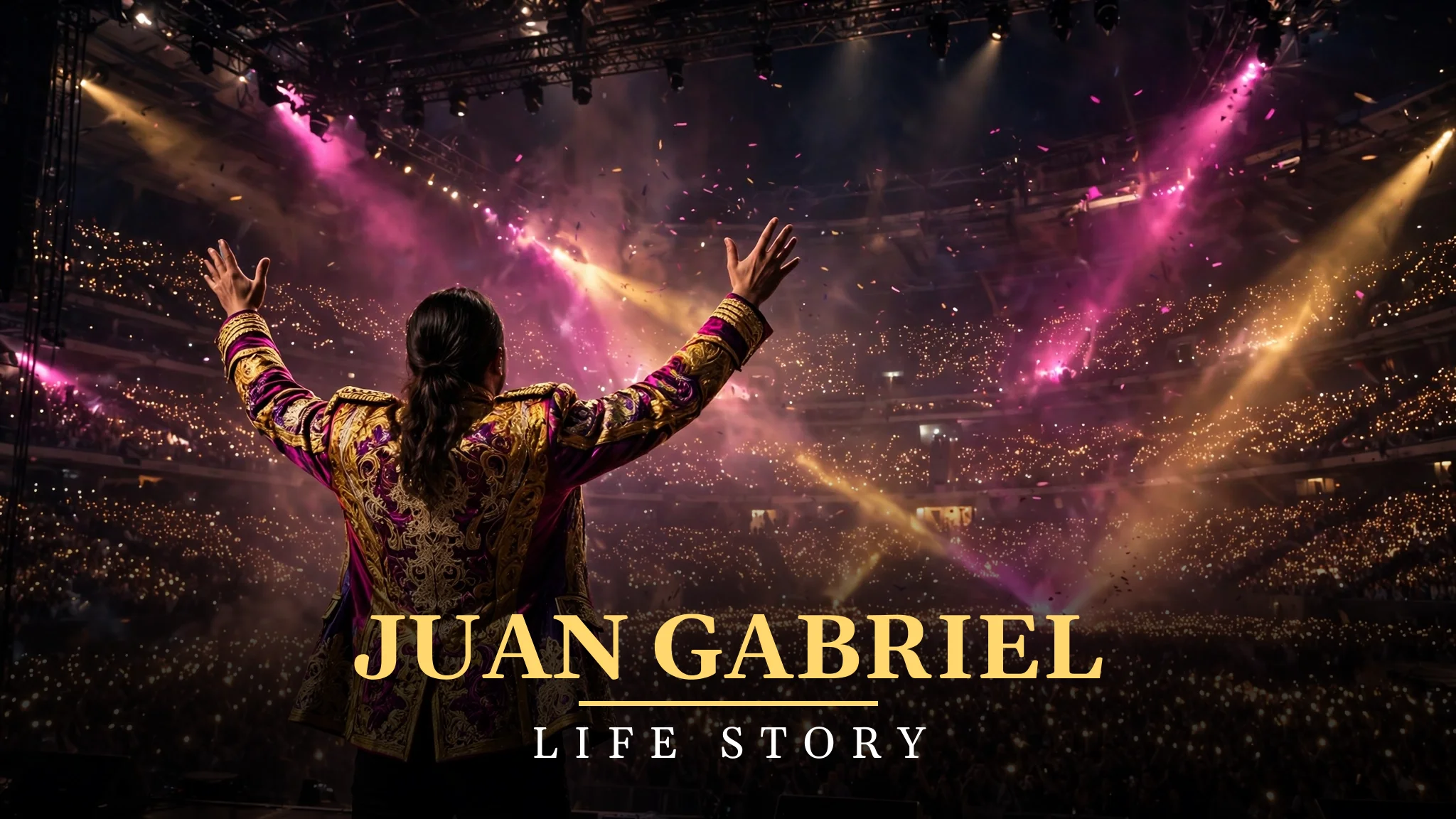
Juan Gabriel was known as the Divo of Juárez, and the title spoke to his style as a performer. He was flamboyant, he wore colourful and elaborate costumes, he danced on stage, and he gave concerts that lasted for hours. His shows were not only concerts. They were celebrations, with mariachi, with dancing, and with an energy that filled the biggest arenas in Mexico. He sang, he talked to the crowd, he told stories, and he made every person in the audience feel part of the night.
One of his most famous concerts was at the Palacio de Bellas Artes in Mexico City in 1990, one of the most prestigious venues in the country. He was the first popular singer to perform there, and the concert was a landmark moment. He sang his hits, the audience sang along, and the night became legendary. It showed that his music, once seen as popular and simple, belonged in the great halls of Mexican culture, and it confirmed his place as one of the most important artists in the country.
His concerts in the United States were also huge. He filled arenas in Los Angeles, Houston, and Chicago, and his shows drew crowds of Mexican and Mexican-American fans who had grown up with his songs. He was a voice that connected Mexico with its people abroad, a singer whose songs reminded listeners of home. His concerts were a family event, with parents bringing children who were learning the songs for the first time, and they showed the power of his music to cross generations.
He was also known for his generosity. He gave to charities, he helped other singers, and he used his fame to support causes he believed in. He was a showman, but he was also a man who cared about his people, and his fans loved him for it. The Divo of Juárez was not only a stage name. It was a identity, a man who belonged to Juárez, to Mexico, and to the millions who sang his songs.
A Private Life and a Public Legend
Juan Gabriel kept his private life private, and that privacy became part of his legend. He rarely spoke about his personal life in interviews, and he did not discuss his relationships in public. He was a man who lived for his music, and he let the songs speak for him. His fans respected that, and they did not press him. They loved the songs, and they loved the show, and that was enough.
He also wrote songs for many other singers, and his writing became one of the most respected in Latin music. He wrote more than eighteen hundred songs over his career, and many of them were recorded by other artists, including Rocío Dúrcal, who became one of the great interpreters of his work. That is a sign of a great songwriter. When other singers want to sing your songs, it means your writing speaks to more than your own voice. It speaks to the feelings that all singers want to express.
He continued to record and perform into his sixties, and his concerts remained major events. He released new albums, he toured, and he kept his voice and his audience alive. He was a man who had given his life to music, and his audience gave him their love in return, through the good years and the hard ones. He was a legend, and he knew it, but he did not act like one. He acted like a singer who loved his work, and that humility won him respect.
His private life remained his own, and he kept it that way until the end. He was a public figure who valued his privacy, and that balance was part of what made him mysterious and beloved. He was the Divo, a star of the stage, and he was also Alberto, a boy from Parácuaro who had grown up in an orphanage and never forgot where he came from.
The Death That Shocked Mexico
Juan Gabriel died on 28 August 2016, at the age of sixty-six, in Santa Monica, California, after a heart attack. His death shocked Mexico and the whole Spanish-speaking world. He had been touring, he had performed only days before, and his death came without warning. The news spread fast, and tributes came from singers, fans, and public figures across Latin America. Mexico declared days of mourning, and his funeral drew large crowds.
His body was brought back to Mexico, and he was honoured in Mexico City and in Ciudad Juárez, the city that had given him his name. Thousands of fans gathered to say goodbye, and they sang his songs in the streets. The farewell was emotional because his songs had been part of so many lives. People had danced to his songs, cried to his songs, and fallen in love to his songs. His voice had been there in their happiest moments and in their saddest ones, and losing him felt like losing a part of their own history.
The death also raised questions about his estate and his family, and those questions were discussed in the press for years. His children and his family faced a difficult time, and the public watched with interest. But the songs remained, and they were what people remembered most. The Divo was gone, but his music was still here, and it is still sung today.
His death marked the end of an era in Mexican music. He was one of the last of the great singer-songwriters, a man who wrote his own songs, sang them himself, and filled the biggest venues in the country. His passing left a gap that no one has filled, and his fans still miss him. The boy from Parácuaro who had nothing had given the world everything, and the world said goodbye with tears and with songs.
The Legacy of the Divo
Today, Juan Gabriel is remembered as one of the greatest artists in the history of Latin music. He wrote more than eighteen hundred songs, he sold tens of millions of records, and his hits, Querida, Amor Eterno, and Hasta Que Te Conocí, are classics, sung at parties, at weddings, and in quiet moments across Mexico and Latin America. They are songs about love, loss, and longing, and they will be sung for many years to come, because the feelings they describe do not change.
His legacy is also the way he changed Mexican music. He showed that a singer from an orphanage, a boy with nothing, could become a legend, and that a simple song, written honestly, could move millions. He brought his flamboyant style to the stage, he performed at the Palacio de Bellas Artes, and he proved that popular music belonged in the great halls of culture. He was a bridge between the street and the stage, between the poor and the famous, and between Mexico and the world.
He is still loved, still sung, and still missed. His songs play on radio stations, at parties, and in homes across Mexico, and new generations are discovering them. The Divo of Juárez is gone, but his music remains, and it will remain for a long time. The boy from Parácuaro who grew up in an orphanage became a poet for his people, and his songs are his monument. They are sung still, and they will be sung for a long time.
Songs for Rocio Durcal and Others
Juan Gabriel wrote more than eighteen hundred songs, and many of them were recorded by other singers. One of the most important of those singers was Rocío Dúrcal, the Spanish singer who became one of the great interpreters of his work. She recorded many of his songs, and her versions became famous across the Spanish-speaking world. Her voice, warm and clear, suited his writing, and together they made a partnership that produced some of the most loved songs in Latin music. She sang his words, and he wrote for her voice, and the result was music that belonged to both of them.
The partnership with Dúrcal shows what a great songwriter can do. He did not only write for himself. He wrote for other voices, and he shaped his songs to fit them. A song for Dúrcal sounded different from a song for himself, because her voice was different, and her feeling was different. He understood that, and he wrote with her in mind. That skill made him a better writer, because it taught him to listen, to imagine, and to shape a song around a voice, not only around his own feelings.
Other singers recorded his songs too, from Mexico, from Spain, and from across Latin America. Each cover was a new version of the same feeling, and each one showed that the song was strong enough to live in another voice. A song that only works for one singer is a good song. A song that works for many singers is a great one, and Juan Gabriel wrote many great ones. His catalogue is a library that other artists return to, again and again, when they need a song that will move an audience.
The covers also brought his songs to new audiences. A listener who had never heard Juan Gabriel might hear one of his songs sung by Dúrcal, and then go back to find the original. A listener in Spain might hear his song in a new version and discover his work for the first time. That is how a songwriter’s reach grows, not only through his own voice but through the voices of others. Juan Gabriel understood that, and he welcomed it, because a song that is sung by many people lives longer than a song sung by one.
What this side of his career shows is that he was not only a performer. He was a creator, a man whose words live in many mouths, and whose feelings are sung by many voices. The boy from Parácuaro who wrote songs in an orphanage became a songwriter for a whole continent, and his pen shaped the romantic ballad for a generation. That is a legacy any writer would be proud of, and it is one that will last as long as people sing.
His tours in his later years continued to draw large crowds, and his concerts remained a celebration. He sang his old hits, the crowd sang along, and for a night, everyone felt close to the songs they loved. That connection is the heart of his live career, and it is why his fans came back, show after show, year after year.
He also received honours in his later years, including awards that recognised his place as one of the greatest artists in Latin music. Those honours matter, but the real honour was simpler. It was the fact that his songs were sung at weddings, at parties, and in quiet moments, by people who had never met him and never would. That is the honour a singer truly wants.
My Take:
I think Juan Gabriel’s story is really about what a person can do with nothing, and I want to say why that moves me so deeply. He was born poor, he was the youngest of ten children, his father died young, and his mother placed him in an orphanage because she could not care for him. He grew up lonely, he lived on the streets, he spent time in prison, and he had no money, no family at home, and no security. And yet he became one of the greatest artists in the history of Latin music, a man who wrote more than eighteen hundred songs and sold tens of millions of records. That is not only a success story. It is a story about the power of a gift, and about what happens when a person refuses to give up on it.
What I admire most is his writing. Eighteen hundred songs is an extraordinary number. Many singers write ten songs in a lifetime. Juan Gabriel wrote eighteen hundred, and many of them became hits, not only for himself but for other singers too. That tells me something about his mind and his heart. He was always watching, always feeling, always turning what he saw into words and melody. A songwriter like that does not stop. He writes because he has to, because the songs are inside him, and they need to come out. I respect that deeply, because writing a song that millions of people make their own is one of the hardest things in music, and he did it again and again, for more than forty years.
I also admire the honesty of his songs. He wrote about the life he knew, about poverty, about loneliness, about love that lasts and love that ends, and he wrote in plain words that anyone could understand. He did not pretend to be someone else. He did not write about a world he had never seen. He wrote about his own world, and that honesty is what made his songs feel true. When he sang Amor Eterno, a song about a love that does not die, he was singing about his mother, and the grief was real. Listeners felt that, and they made the song their own, because they had felt that grief too. That is the power of honest writing, and it is a lesson for anyone who wants to create something real.
The song No Tengo Dinero is the one I think about most, because it is about having no money but having love to give. He wrote it from his own life, from the years when he had nothing, and it became a hit because millions of people had lived that life too. They knew what it meant to be poor and to love someone anyway. I think that is beautiful. A song about poverty, written by a man who was poor, can be more powerful than any song about wealth, because it is true. Juan Gabriel knew that, and he never forgot it, even when he became rich and famous.
I also think about his concerts, and what they meant to his fans. He gave shows that lasted for hours, he wore colourful costumes, he danced, he talked to the crowd, and he made every person in the arena feel part of the night. That is not easy. Many stars stand on stage and sing, and the audience watches. Juan Gabriel made the audience sing with him, and that is a different thing. It is a gift, and it is why his concerts became legendary. He was not only a singer. He was a host, a friend, and a celebration, and his fans loved him for it.
His death in 2016 is the part of his story that still hurts. He was sixty-six, he had been touring, he had performed only days before, and then he was gone. Mexico mourned him, and the whole Spanish-speaking world mourned him, because his songs had been part of so many lives. People had danced to his songs, cried to his songs, and fallen in love to his songs. Losing him felt like losing a part of their own history. I feel that too, even though I never met him. A great singer becomes part of your life, and when he goes, a part of your life goes with him.
If I had to name the lesson of his story, I would say it is about never giving up on your gift. Juan Gabriel had nothing, and he kept writing. He lived on the streets, and he kept singing. He was in prison, and he kept dreaming. He did not let his hard start decide his end. He used his gift, he worked at it, and he built a life from it. That is a lesson for anyone, in music or in any work. Your start does not have to be your end. If you have a gift, and you work at it, and you do not give up, you can change your life, and you can change the lives of others too.
What would I tell a reader who has never heard him? I would say, start with Querida, because it is his most famous song, and it shows his passion. Then listen to Amor Eterno, because it is his most moving song, and it shows his heart. Then listen to Hasta Que Te Conoci, because it shows his gift for a song that is both joyful and sad. And then listen to No Tengo Dinero, because it shows where he came from, and why his songs are true. That is a good way to hear his story in his own voice.
In the end, I think Juan Gabriel was one of the greatest artists in Latin music, a man who had nothing and gave the world everything, through songs that spoke plainly about love, about loss, and about longing. I admire his writing, I respect his endurance, and I am moved by the honesty of his life. He is gone now, but his songs remain, and they will be sung for a long time, because they speak to the heart, and the heart does not change.
I also think about Ciudad Juarez, and what it meant to him. He grew up there, in an orphanage and on the streets, and the city shaped him. It is a border city, a place where Mexico meets the United States, where two worlds touch, and where life is hard and hopeful at the same time. Juan Gabriel carried that city with him, and he became its divo, its star. He sang about the border, about the people who cross it, and about the love that survives it. That connection is part of why his fans loved him so deeply. He was not a star from far away. He was their star, from their city, and he never forgot it.
Another thing I admire is his generosity. He gave to charities, he helped other singers, and he used his fame to support causes he believed in. He was a showman, but he was also a man who cared about his people, and his fans loved him for it. A star who gives back is a star who understands that fame is not only for himself. It is a gift, and it should be shared. Juan Gabriel shared it, and that generosity is part of his legacy.
I also think about his costumes, and what they meant. He wore colourful, elaborate outfits, he danced on stage, and he gave concerts that were a celebration. Some people criticised his style, but his fans loved it, because it was honest. He was not pretending to be someone else. He was being himself, loudly and without apology, and that courage gave his fans permission to be themselves too. A singer who is free on stage teaches his audience to be free in their own lives, and that is a powerful thing.
There is also the question of his privacy, and I want to respect it. He rarely spoke about his personal life, and he did not discuss his relationships in public. In a world where many stars share everything, I admire a singer who keeps his life his own. His fans respected that too, and they did not press him. They loved the songs, and they loved the show, and that was enough. A singer does not owe the world his private life. He owes the world his songs, and Juan Gabriel gave those generously.
I also think about the Palacio de Bellas Artes concert in 1990, and what it meant. He was the first popular singer to perform there, and the concert was a landmark moment. It showed that his music, once seen as popular and simple, belonged in the great halls of Mexican culture. That matters, because it broke a barrier. Popular music is not less than classical music. It is different, and it speaks to different people, but it is just as worthy of a great hall. Juan Gabriel proved that, and he opened a door for other popular singers who came after him.
If I could give him one tribute, it would be this. He had nothing, and he gave the world everything. He gave it songs, he gave it joy, and he gave it a voice that spoke for the poor, the lonely, and the loving. That is the work of a great artist, and it is a rare gift. His songs are still sung, and they will be sung for a long time, because they speak plainly about love, about loss, and about longing, and those are things that do not change.
I also think about the young songwriters who look up to him, and what they can learn. They can learn that a song does not have to be fancy to be great. It has to be true. They can learn that a career is built slowly, song by song, and that patience pays. And they can learn that a songwriter who stays honest, who writes from his own life, will find an audience, because people always recognise the truth when they hear it. Juan Gabriel is a teacher, even if he never set out to be one, and his songs are his lessons.
Finally, I think his story is a reminder that a life can start with nothing and become everything. He was born poor, he grew up in an orphanage, he lived on the streets, and he became one of the greatest artists in Latin music. That is not only a success story. It is a story about hope, about the power of a gift, and about what happens when a person refuses to give up on it. I admire his writing, I respect his endurance, and I am moved by the honesty of his life. He is gone now, but his songs remain, and they will be sung for a long time.
I also think about the older fans who have followed him since his early years, and why they stayed. They watched him grow from a boy in Paracuaro into a legend, and they feel part of his story. That loyalty is rare, and it shows the bond he built by working steadily and honestly. He did not only sell them songs. He gave them a singer they could trust, and they trusted him for his whole life.
Another thing I notice is his generosity, and how it shaped his legacy. He supported good causes with his money, he encouraged younger singers, and he put his fame to work for the people he cared about. A star who gives back is a star who understands that fame is not only for himself. It is a gift, and it should be shared. Juan Gabriel shared it, and that generosity is part of why his fans loved him so deeply.
And I hope his songs keep being sung by new generations. He wrote more than eighteen hundred of them, and they deserve to be heard, not only by people who remember him but by young listeners who are hearing them for the first time. A great song does not age, and his songs are great. They will be sung for a long time.
Frequently Asked Questions
Where was Juan Gabriel born?
Juan Gabriel, whose real name was Alberto Aguilera Valadez, was born on 7 January 1950 in Parácuaro, a small town in the state of Michoacán in western Mexico. He was the youngest of ten children, and he grew up in an orphanage in Ciudad Juárez.
What is Juan Gabriel’s most famous song?
One of his most famous songs is Querida, a ballad about a beloved woman that became a huge hit in 1984. He is also known for Amor Eterno, Hasta Que Te Conocí, and No Tengo Dinero, all of which became classics of Latin music.
Why was Juan Gabriel called the Divo of Juárez?
He was called the Divo of Juárez because of his flamboyant style as a performer and his deep connection to Ciudad Juárez, the border city where he grew up. His concerts there and across Mexico were legendary for their energy and length.
How many songs did Juan Gabriel write?
Juan Gabriel wrote more than eighteen hundred songs over his career, one of the largest catalogues in Latin music. Many of his songs were recorded by other singers as well, including Rocío Dúrcal, who became a famous interpreter of his work.
When did Juan Gabriel die?
Juan Gabriel died on 28 August 2016, at the age of sixty-six, in Santa Monica, California, after a heart attack. His death shocked Mexico and the Spanish-speaking world, and he was honoured in Mexico City and Ciudad Juárez.
Did Juan Gabriel perform at the Palacio de Bellas Artes?
Yes, in 1990 he performed at the Palacio de Bellas Artes in Mexico City, one of the most prestigious venues in the country. He was the first popular singer to perform there, and the concert became a landmark moment in Mexican music.


