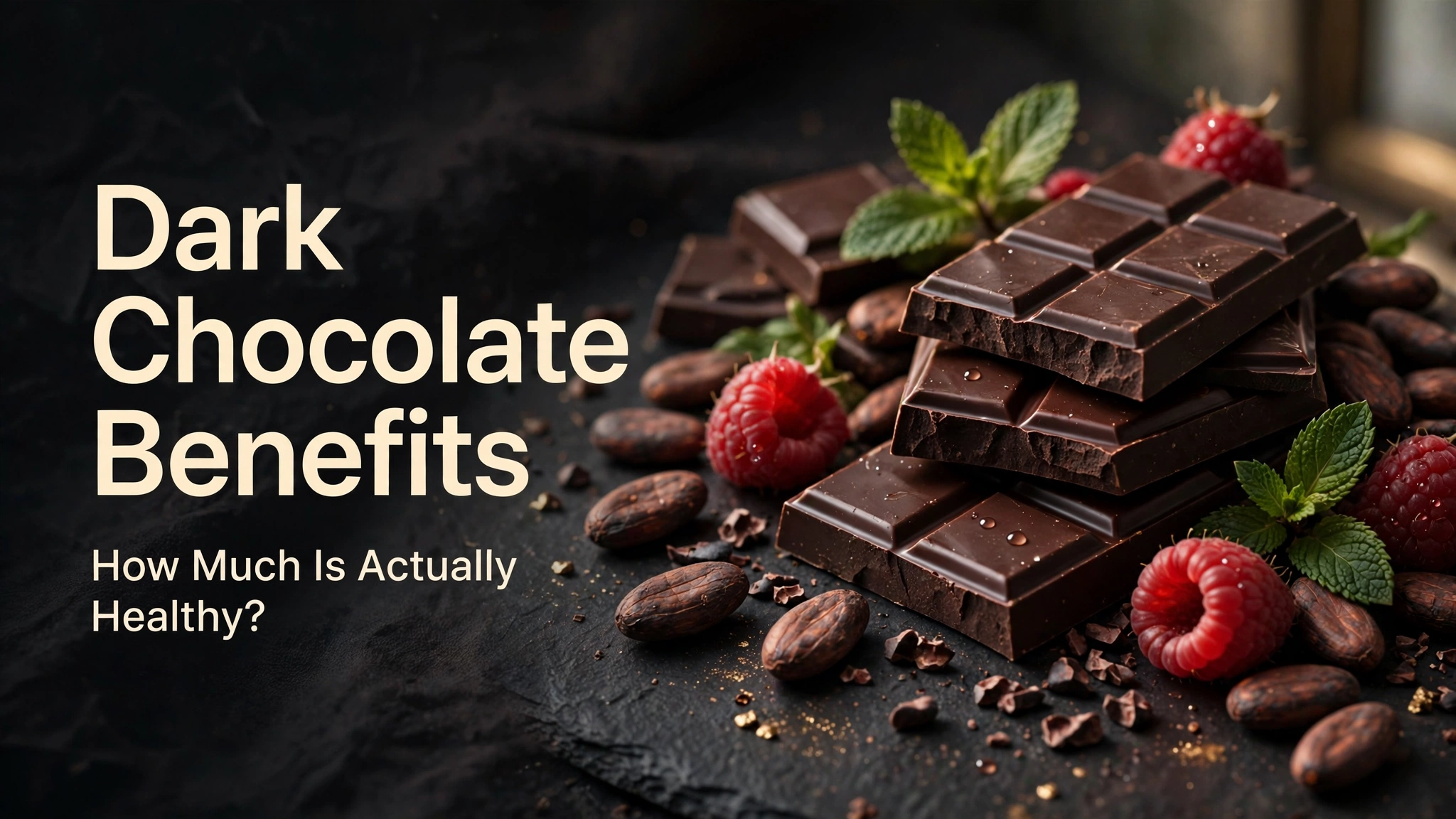
Dark Chocolate Benefits Explained: How Much Is Actually Healthy
In this post
Dark chocolate is the health food that everyone wants to believe in, because it is delicious, it is comforting, and it is sold with the promise that eating it is good for you. The headlines say it protects the heart, improves the brain, lifts the mood and even helps you live longer, and the studies behind those headlines are real. But the story is more complicated than the headlines suggest, because dark chocolate is not one thing. A small square of 85 percent cocoa chocolate and a large bar of sweetened chocolate with a little cocoa are very different foods, and the health benefit depends on which one you are eating, how much of it, and what else is in your diet.
The compound that gives dark chocolate its reputation is a group of plant chemicals called flavanols, which are also found in tea, apples and berries. Flavanols have antioxidant and anti-inflammatory effects, and they can improve blood vessel function, which is why they are linked to heart health. But flavanols are bitter, and the chocolate industry often removes them during processing to make chocolate taste sweeter and smoother. That means the chocolate that tastes best may contain the fewest flavanols, and the chocolate with the most flavanols may taste bitter and intense.
This article explains what is actually in dark chocolate, what the research shows for heart, brain and mood, how much is healthy and how much is too much, how to choose a good bar, what the sugar trap is, and whether dark chocolate deserves its reputation as a health food. It is general information, not medical advice, and it is written to help you enjoy dark chocolate honestly, without pretending it is a medicine.
This article is general information only. It is not individual medical advice. Talk to your doctor if you are pregnant, take medicine, or have a health condition, especially before taking high-dose green tea extracts.
What Is Actually in Dark Chocolate
Dark chocolate is made from cocoa solids, cocoa butter and sugar, and the percentage on the label tells you how much of the bar is cocoa. A bar labelled 70 percent cocoa contains 70 percent cocoa solids and cocoa butter, and 30 percent sugar and other ingredients. A bar labelled 85 percent contains more cocoa and less sugar, and it tastes more bitter and intense. Milk chocolate, by comparison, typically contains 10 to 30 percent cocoa, along with milk and much more sugar, and white chocolate contains no cocoa solids at all, only cocoa butter, sugar and milk.
The flavanols in dark chocolate are the compounds most studied for health, and they are a type of flavonoid, a group of plant chemicals with antioxidant properties. The most important flavanols in cocoa are epicatechin and catechin, and they have been shown to improve blood vessel function, to lower blood pressure slightly, and to reduce inflammation. But the amount of flavanols in a chocolate bar varies enormously, depending on the type of cocoa, how it is processed, and how long it is stored. The Dutching process, which treats cocoa with alkali to reduce bitterness, can remove most of the flavanols, and many commercial chocolates are Dutched.
Dark chocolate also contains theobromine, a mild stimulant related to caffeine, and small amounts of caffeine, magnesium, iron and other minerals. The theobromine is part of why chocolate feels stimulating and comforting, and it is also why chocolate is toxic to dogs, who cannot break it down. The minerals are a bonus, but they are not the reason to eat chocolate, because the amounts are small and the same minerals are available from healthier foods. The main point is that dark chocolate is a food with some beneficial compounds, but it is also a food with sugar and fat, and the balance between the two matters.
Heart Health: The Most Studied Benefit
The heart is where the evidence for dark chocolate is strongest, and it is based on both population studies and controlled trials. People who eat small amounts of dark chocolate regularly tend to have a lower risk of heart disease, and trials have found that cocoa flavanols can improve blood vessel function, lower blood pressure by a few points, and improve cholesterol levels slightly. The effects are modest, but they are consistent, and they are plausible given what flavanols do to blood vessels.
One of the largest studies, the COSMOS trial, found that a cocoa extract supplement reduced the risk of death from cardiovascular disease, though it did not significantly reduce the overall risk of heart attacks and strokes. The result was mixed, and it was based on a supplement, not on chocolate itself, but it suggested that cocoa flavanols have a real, if modest, effect on the heart. Other studies have found similar results, and the overall picture is that cocoa flavanols are good for blood vessels, and that eating dark chocolate in small amounts is likely to be good for the heart.
The important caveat is dose. The studies that show a benefit generally involve small amounts, around 20 to 30 grams per day, which is one or two small squares, not a whole bar. Eating a large bar every day provides far more sugar and calories than flavanols, and the extra weight and blood sugar are likely to outweigh any benefit from the cocoa. The heart benefit is real, but it is small, and it depends on eating a small amount, not a large one. A little dark chocolate can be part of a heart-healthy diet. A lot of it cannot.
Brain, Mood and Why Chocolate Feels Good
Chocolate is famous for making people feel better, and there are several reasons for that. It contains theobromine and a small amount of caffeine, which are mild stimulants, and it contains compounds that affect serotonin and endorphins, the chemicals associated with mood and pleasure. Eating chocolate is also a sensory experience: the taste, the smell, the texture and the ritual of eating it are all pleasurable, and that pleasure is a real benefit in itself. A food that makes you happy is not a trivial thing, and it should not be dismissed.
The research on chocolate and the brain is promising but limited. Some studies have found that cocoa flavanols can improve blood flow to the brain and improve memory and attention, especially in older adults. Other studies have found that people who eat chocolate regularly have a lower risk of cognitive decline, though these are observational studies that cannot prove cause and effect. The effects, when they occur, are modest, and they are not a reason to eat large amounts of chocolate for brain health. The brain benefits most from exercise, sleep, social connection and a varied diet, and chocolate is a small part of that pattern.
The mood effect is also worth being honest about. Chocolate can lift the mood in the short term, but it is not a treatment for depression or anxiety, and using it as a way to cope with stress can lead to overeating and to a cycle of guilt. A small square of dark chocolate, eaten slowly and enjoyed, is a pleasure. A whole bar, eaten quickly and mindlessly, is often followed by regret. The difference is not the chocolate. It is the amount, the attention and the reason for eating it. Mindful eating matters more than the cocoa percentage.
How Much Dark Chocolate Is Actually Healthy
The question of how much dark chocolate is healthy has a simple answer: a little, not a lot. Most experts suggest around 20 to 30 grams per day, which is one to two small squares, and no more than a few times a week if you are watching your weight or your blood sugar. That amount provides some flavanols without providing too many calories or too much sugar. A 30-gram portion of 70 percent dark chocolate contains around 170 calories and about 7 grams of sugar, which is a reasonable amount for a treat. A 100-gram bar contains more than 500 calories and more than 20 grams of sugar, which is a meal’s worth of energy in a snack.
The frequency matters as much as the amount. Eating a small square every day is different from eating a whole bar once a week, even though the total amount may be similar, because the daily habit is easier to control and less likely to lead to overeating. The best approach is to buy a good quality bar, break off a small piece, put the rest away, and eat the piece slowly, paying attention to the taste. That way, the chocolate is a pleasure, not a binge, and the health benefit is preserved.
It is also worth remembering that dark chocolate is not a health food in the way that vegetables or fish are. It is a treat that happens to contain some beneficial compounds, and it should be enjoyed as a treat. A person who eats dark chocolate every day but also eats a poor diet, does not exercise and smokes is not protecting their health. A person who eats a small amount of dark chocolate as part of an overall healthy diet is doing something sensible, and the chocolate is a small, enjoyable part of it. The context matters more than the chocolate itself.
The Sugar Trap and How Processing Removes Flavanols
The biggest problem with dark chocolate is sugar, and it is the reason the health claims are often misleading. Even a 70 percent dark chocolate bar contains 30 percent sugar, and a 50 percent bar, which is often sold as dark chocolate, contains half sugar. The sugar adds calories, it raises blood sugar, and it contributes to tooth decay, and these effects can easily outweigh the benefit of the flavanols. A chocolate bar that is marketed as healthy because it is dark may still contain more sugar than a person should eat in a day.
Processing is the other problem. The flavanols that make cocoa healthy are bitter, and manufacturers often remove them to make chocolate taste smoother and sweeter. The Dutching process, which is used for most commercial cocoa powder, can remove up to 90 percent of the flavanols, and the label does not tell you how much has been removed. A bar that says 70 percent cocoa may contain far fewer flavanols than another bar with the same percentage, and there is no easy way for a consumer to know. The percentage tells you how much cocoa is in the bar, not how many flavanols it contains.
The practical advice is to choose chocolate with a high cocoa percentage, ideally 70 percent or more, to look for bars that are not Dutched, and to eat a small amount. But even then, the flavanol content is uncertain, and the best approach is to enjoy dark chocolate as a treat, not as a health supplement. If you want flavanols, tea, apples and berries are better sources, because they provide flavanols without the sugar and fat. Dark chocolate is a delicious way to get some flavanols, but it is not the most efficient way, and it should not be the only way.
How to Choose a Good Bar of Dark Chocolate
Choosing a good bar of dark chocolate is a matter of taste, quality and honesty about what you are buying. Look for a bar with a cocoa percentage of 70 percent or more, and check the ingredients: the first ingredient should be cocoa mass or cocoa liquor, not sugar, and the list should be short. A good bar contains cocoa, cocoa butter, sugar and perhaps vanilla or lecithin. A bar with a long list of additives, vegetable fats or artificial flavours is a lower quality product, and it is less likely to contain many flavanols.
The origin of the cocoa can also matter, though it is not a guarantee of quality. Single-origin chocolate, made from cocoa beans from one country or region, often has a more distinctive flavour, and it is often made by smaller producers who care about quality. Fair trade and sustainably sourced chocolate are also worth considering, because the cocoa industry has serious problems with child labour and deforestation, and choosing a certified product is a small way to support better practices. The taste is the most important factor, because a bar you enjoy is a bar you will eat slowly and in a small amount.
Price is a useful guide, though not a perfect one. A very cheap bar is unlikely to be high quality, and a very expensive bar is not necessarily better. A mid-priced bar from a reputable maker, with a high cocoa percentage and a short ingredient list, is usually a good choice. And remember that the best chocolate is the one you eat slowly, in a small amount, and enjoy. A small piece of excellent chocolate is more satisfying than a large bar of mediocre chocolate, and it is better for your health too.
My Take:
I think dark chocolate is the health food that people most want to believe in, and I understand why, because it is delicious and the idea that eating it is good for you is wonderfully convenient. I like dark chocolate myself, and I eat it regularly, but I try to be honest about what it is: a treat that contains some beneficial compounds, not a medicine, and not a health food in the way that vegetables or fish are. That honesty does not make it less enjoyable. It makes it more enjoyable, because I can eat it without pretending it is something it is not.
What I find most important is the amount, because the difference between a healthy habit and an unhealthy one is often just the portion. One or two small squares a day is a pleasure that fits into a healthy diet. A whole bar a day is a lot of sugar and a lot of calories, and it is not healthy, no matter how high the cocoa percentage is. I have seen many people who eat a whole bar of dark chocolate and believe they are doing something good for their heart, and I think that is a misunderstanding that the marketing has created. The benefit is in the small amount, not in the large one.
I am also frustrated by the flavanol problem, because it means the consumer cannot know what they are getting. A bar that says 70 percent cocoa may have lost most of its flavanols during processing, and the label does not tell you. That is a failure of labelling, and it is a reason to be sceptical of health claims made for chocolate. I think the chocolate industry should be required to state the flavanol content, just as it states the cocoa percentage, because without that information the consumer is guessing. Until that happens, the best advice is to choose a high cocoa percentage, to avoid Dutched cocoa where possible, and to enjoy the chocolate for its taste rather than for its supposed health benefit.
The mood effect is the part I find most genuine, because it is the part that does not need a study to prove it. Chocolate makes people feel better, and that is a real benefit. I think we should be honest about that, and we should also be honest about the limits. A small piece of dark chocolate, eaten slowly, is a pleasure that can lift the mood and provide a pause in a busy day. A whole bar, eaten quickly and mindlessly, is often followed by guilt, and that guilt undoes the pleasure. The difference is not the chocolate. It is the way you eat it, and that is a lesson that applies to many foods, not just chocolate.
My honest opinion is that dark chocolate deserves a place in a healthy diet, but it deserves a small place, not a large one. It is a treat, and treats are important, because a diet without pleasure is a diet that no one will follow. I would rather a person ate a small square of dark chocolate every day and enjoyed it than a person who denied themselves completely and then binged on a whole bar once a week. The small, regular pleasure is healthier, it is more sustainable, and it is more enjoyable. That is the practical truth, and it is the one I would recommend to anyone who loves chocolate.
I also think the sustainability and ethics of chocolate deserve more attention, because the cocoa industry has real problems with child labour, deforestation and unfair pay for farmers. Choosing a fair trade or sustainably sourced bar is a small way to support better practices, and it is a choice that costs very little. I think that matters, because the pleasure of eating chocolate should not come at the expense of the people who grow it. A good bar of chocolate is one that tastes good and that was made fairly, and that is a standard worth holding.
Buy a good bar, break off a small piece, put the rest away, and eat the piece slowly: that one habit captures everything good about dark chocolate. The taste, the pleasure, the small health benefit, and the control over the amount, all in a single square eaten with attention. It is not a complicated rule, and it does not require a supplement or a special product, only a good bar and a little attention, and that is enough. Dark chocolate is at its best when it is enjoyed, not when it is used as medicine, and the enjoyment is the point, because a pleasure eaten slowly lasts longer, satisfies more, and asks for less than a pleasure eaten quickly and guiltily.
I also think it is worth saying that the pleasure of chocolate is not a trivial thing, and it should not be dismissed by health advice that treats food as only fuel. A small square of dark chocolate, eaten slowly and enjoyed, is a moment of happiness, and happiness is part of health. I do not think a healthy diet should be a joyless one, and I do not think people should feel guilty for enjoying chocolate. The goal is not to eliminate pleasure. It is to enjoy it in a way that does not harm you, and a small amount of good chocolate does exactly that.
Children learn how to eat from the adults around them, and chocolate is one of the first lessons. A child who is given chocolate as a reward for good behaviour learns to associate it with comfort and with achievement, and that association can last a lifetime, shaping how they eat as adults. It is better to treat chocolate as a normal food, enjoyed in a small amount, rather than as a forbidden treat or as a reward, because the forbidden version becomes the desired version, and the reward version becomes the emotional version. Kept normal, chocolate stays a pleasure rather than becoming a problem, and the child grows up with a healthier relationship with food, which is a gift worth more than any single bar.
Buy a good bar, eat a small piece slowly, and enjoy it without guilt. Dark chocolate is at its best when it is a pleasure, not a medicine, and pleasure, taken slowly, is the healthy way to have it.
Frequently Asked Questions
How much dark chocolate should I eat per day?
Around 20 to 30 grams per day, which is one to two small squares, is a sensible amount. More than that adds a lot of sugar and calories.
What cocoa percentage is best?
A bar with 70 percent cocoa or more is a good choice, because it contains more cocoa and less sugar. Milk chocolate, with 10 to 30 percent cocoa, is not a good source of flavanols.
Does dark chocolate help your heart?
Small amounts may help blood vessel function and lower blood pressure slightly, thanks to cocoa flavanols. The effect is modest and depends on eating a small amount.
Is dark chocolate good for your brain?
Some studies suggest cocoa flavanols can improve blood flow to the brain and support memory, but the evidence is limited and the effect is modest.
Why is dark chocolate bitter?
The bitterness comes from cocoa flavanols and theobromine. Processing, especially Dutching, removes flavanols and reduces bitterness, but it also removes the beneficial compounds.
Is dark chocolate safe for dogs?
No. Chocolate contains theobromine, which is toxic to dogs. Even small amounts of dark chocolate can be dangerous for dogs and should be kept away from them.
Sources
- https://www.healthline.com/nutrition/dark-chocolate-benefits
- https://www.mayoclinic.org/healthy-lifestyle/nutrition-and-healthy-eating/expert-answers/chocolate/faq-20058044
- https://www.nhs.uk/live-well/eat-well/food-types/
- https://ods.od.nih.gov/factsheets/Cocoa-HealthProfessional/
- https://medlineplus.gov/ency/article/002444.htm