Day Of Dead Versus Halloween
In this post
- Halloween: keeping the spirits away
- Day of the Dead: welcoming the dead home
- The shared roots and the key difference
- Ofrendas, marigolds, and the language of remembrance
- Costumes, skulls, and respectful celebration
- The Mexico City parade and a film’s influence
- Two festivals, two kinds of courage
- How to mark the festival respectfully
Two festivals share the same corner of the calendar, the same season of falling leaves, and the same haunting idea: that the dead are near. One fills the night with costumes, haunted houses, and screams. The other fills homes and cemeteries with marigolds, candles, photographs, and favourite foods, and welcomes the dead back to the table. People often call the second one “Mexican Halloween.” It is not. It is a different festival with a different heart, and confusing the two does a disservice to both.
Halloween falls on Saturday 31 October 2026. The Day of the Dead, Día de los Muertos, follows on Sunday 1 and Monday 2 November 2026. The dates touch, the themes rhyme, and the differences run deep. This guide explains where each festival comes from, what each one does, and why one tries to keep spirits away while the other invites them in.
Halloween: keeping the spirits away
Halloween grew from Samhain, an ancient Celtic festival marking the end of the harvest in Britain and Ireland, when the line between the living and the dead was believed to be thin. The evening before All Saints’ Day became All Hallows’ Eve, and over centuries it gathered costumes, parties, and a taste for fright. The Couchsurfing travel blog, in a guide updated in October 2026, traces this line from Celtic Britain and Ireland to the modern holiday.
The customs of Halloween are built around keeping spirits at bay. Costumes began as disguises, meant to confuse or ward off wandering spirits. Jack-o’-lanterns, first carved from turnips rather than pumpkins, were lights set out to frighten spirits away. The mood is playful and spooky: haunted houses, scary films, and a delight in being frightened safely. The dead are present in the imagery — skeletons, ghosts, graveyards — but the festival’s instinct is to hold them off, to laugh at fear, and to send the spirits back where they came from.
Modern Halloween is a festival of imagination and neighbourhood. Children trick-or-treat, adults throw parties, and the whole event leans toward the thrilling and the comic. Its heart is the scare that ends safely, the mask that comes off, and the sweets that make the fright worthwhile.
Day of the Dead: welcoming the dead home
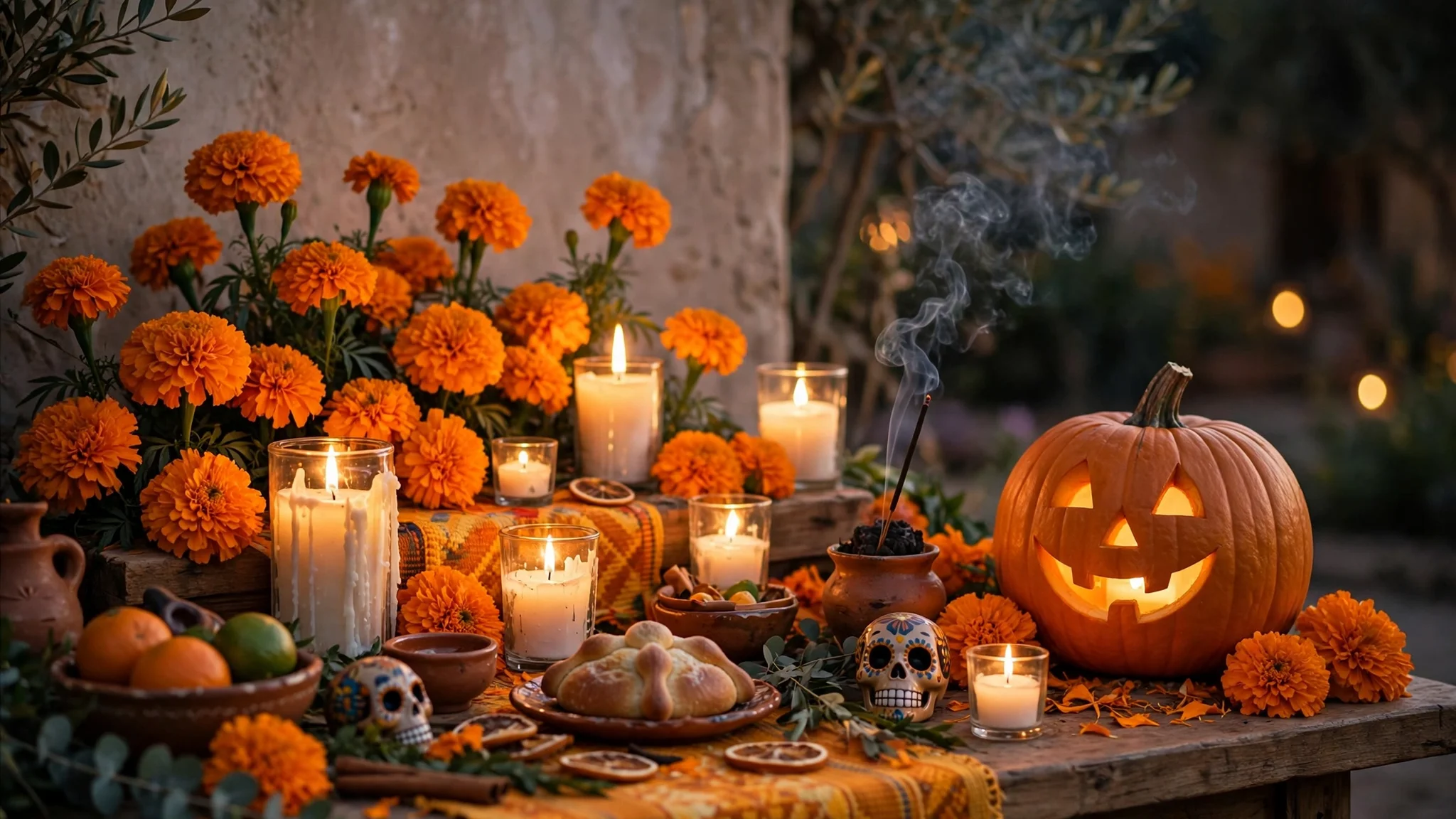
Día de los Muertos comes from Mexico, and it blends pre-Hispanic traditions honouring the dead with Catholic observances of All Saints’ Day and All Souls’ Day. The Couchsurfing guide describes it as a festival where families build ofrendas — altars — in their homes and at cemeteries, decorated with marigolds, candles, photographs, and the favourite foods and drinks of the dead. The marigold, called cempasúchil, is believed to guide spirits home by its colour and scent.
The mood is the opposite of Halloween’s fright. Families gather at cemeteries, clean and decorate graves, share meals, tell stories about the dead, and celebrate their lives. The festival honours dead children on 1 November and dead adults on 2 November, and the tone throughout is remembrance, family, and joy. The dead are not feared. They are missed, and for two days they are guests.
UNESCO recognised the festival in 2008 by adding it to its Intangible Cultural Heritage list, honouring it as a living tradition of remembrance. That recognition matters, because it marks the festival as heritage to be respected, not a costume theme to be borrowed carelessly. The painted skulls and bright colours are not decoration for a party. They are part of a language of love and memory.
The shared roots and the key difference
The two festivals share real ground. Both fall at the turn of the season, when harvest ends and winter approaches. Both carry the old idea that the boundary between the living and the dead grows thin at this time of year. Both use candles, gatherings, and remembrance of those who have died. The Couchsurfing guide notes these shared threads — the calendar, the season, and the idea of the dead visiting — and then draws the line that separates them.
The difference is the direction of the welcome. Halloween’s customs were built to keep spirits away: disguises to confuse them, lights to frighten them, noise to drive them off. The Day of the Dead’s customs are built to bring spirits home: marigolds to guide them, candles to light the way, food and photographs to say they are remembered and wanted. One festival says “stay away.” The other says “come home.” Everything else — the mood, the colours, the food, the feeling — follows from that single difference.
The difference also shapes who the festivals are for. Halloween is a public party, celebrated by strangers together, in streets and shops. The Day of the Dead is a family occasion, celebrated by people who knew the dead being honoured, at home and at the grave. One is for everyone. The other is personal, and its intimacy is part of its meaning.
Ofrendas, marigolds, and the language of remembrance
The ofrenda is the centre of the Day of the Dead, and understanding it explains the festival. It is an altar built in the home or at the cemetery, layered with offerings for the returning dead. Photographs of the dead stand at its centre, so the visitors are known and named. Candles light the way. Marigolds — cempasúchil — scatter their petals in a path, their colour and scent guiding spirits home. The favourite foods and drinks of the dead are set out, so the welcome is personal: the bread they liked, the drink they preferred, the dish they cooked.
Each element has a job. Water quenches the thirst of a long journey. Salt purifies. Incense clears the way. Sugar skulls, decorated with names, remember the dead sweetly rather than fearfully. Nothing on the ofrenda is random, and nothing is there to frighten. It is a table set for guests who are loved, and the care taken in setting it is the point of the festival.
Families visit cemeteries through the night, cleaning graves, lighting candles, and sharing food and stories. The cemetery becomes a gathering place, full of light and music and memory, and the dead are spoken of by name, with laughter as well as tears. Grief is present, but it is grief held in company, and the festival’s joy comes from the reunion, not from forgetting.
Costumes, skulls, and respectful celebration
The painted skull — La Calavera Catrina — is the most famous image of the Day of the Dead, and the most borrowed. It began as a satirical image of the wealthy, and became a symbol of the festival’s message: death comes for everyone, rich and poor alike, and facing it with humour and dignity is a form of wisdom. Face painting in the style of the skull is part of the celebration in Mexico, worn by people honouring their own dead.
Borrowing the imagery for a Halloween costume, without understanding it, is where respect breaks down. The Couchsurfing guide is clear that the Day of the Dead is not “Mexican Halloween,” and treating its symbols as a fancy-dress theme strips them of their meaning. A person honouring their grandmother with a painted skull and a marigold is doing something different from a person wearing the same paint to a fancy-dress party. The difference is not the paint. It is the remembrance.
Visitors to Mexico during the festival are welcome, and the celebration is generous, but the welcome comes with an expectation: learn what the ofrenda means, respect the cemetery as a place of family gathering, ask before photographing, and do not treat grief as a spectacle. Respect is not complicated. It is attention, paid before the camera is raised.
The Mexico City parade and a film’s influence
One of the festival’s most photographed events is surprisingly young. The large Day of the Dead parade in Mexico City was first held in 2016, and it was inspired by the opening sequence of the 2015 James Bond film Spectre, which staged a fictional Day of the Dead parade through the city. The Couchsurfing guide records both facts: the parade’s first year, and the film that inspired it.
The parade’s origin is a good reminder that traditions are not frozen. The festival itself is centuries old, rooted in pre-Hispanic and Catholic practice, and recognised by UNESCO. The parade is a new addition, a piece of celebration built for a modern city, and it has become a beloved part of the festival in its own right. Old and new sit together comfortably in the Day of the Dead, as they do in any living tradition: the ofrenda at home, and the parade in the street, both honouring the same dead.
The film connection also warns against a simple story. The Day of the Dead did not come from a film, and its meaning did not change because a parade was added. The parade is a celebration of a tradition, not the tradition itself, and the heart of the festival remains where it has always been: the family, the grave, the photograph, and the marigold path home.
Two festivals, two kinds of courage
Halloween and the Day of the Dead both face death, and they face it with different kinds of courage. Halloween’s courage is the thrill: facing fear in play, laughing at the ghost, and walking home safe. The Day of the Dead’s courage is quieter: facing loss directly, speaking the names of the dead, and setting a place for them at the table. Both are honest. Both are human. They simply answer the same season with different words.
The calendar gives each festival its own days, and that separation is worth keeping. Halloween on 31 October, with its costumes and its scares. The Day of the Dead on 1 and 2 November, with its marigolds and its memory. Knowing which is which — and why the difference matters — is the simplest form of respect a visitor can offer either one.
How to mark the festival respectfully
Visitors who want to honour the Day of the Dead rather than simply watch it should start by learning what the ofrenda means, and by treating the cemetery as a place of family gathering rather than a spectacle. Ask before photographing anyone, do not touch offerings, and do not treat grief as entertainment. The festival is generous and welcoming, and the welcome is returned with attention: read about the tradition, listen to the families, and leave the marigolds where they were laid. Respect is not a set of rules to memorise. It is the decision to learn before looking, and the festival rewards that decision with a deeper experience than any photograph can give.
Frequently Asked Questions
What is the difference between Day of the Dead and Halloween?
The key difference is the direction of the welcome: Halloween’s customs were built to keep spirits away, with disguises and lights to frighten them off, while the Day of the Dead’s customs are built to invite spirits home, with marigolds, candles, and favourite foods guiding them back. Halloween is playful and spooky, centred on fright and fancy dress, while the Day of the Dead is a family occasion of remembrance, joy, and reunion with the dead.
When is Day of the Dead in 2026?
Día de los Muertos falls on Sunday 1 and Monday 2 November 2026, following Halloween on Saturday 31 October 2026. The festival honours dead children on 1 November and dead adults on 2 November, with families building ofrendas and visiting cemeteries across the two days.
Is Day of the Dead the same as Mexican Halloween?
No, it is not. The Day of the Dead is a distinct Mexican festival blending pre-Hispanic traditions with Catholic observances, centred on welcoming the dead home with ofrendas, marigolds, candles, and photographs. Calling it Mexican Halloween strips it of its meaning, and UNESCO recognised it in 2008 as Intangible Cultural Heritage, honouring it as a living tradition of remembrance.
What is an ofrenda and what goes on it?
An ofrenda is an altar built in the home or at a cemetery, layered with offerings for the returning dead: photographs of the dead, candles to light the way, marigolds whose colour and scent guide spirits home, and the favourite foods and drinks of the people being honoured. Water, salt, incense, and sugar skulls also have their places, and every element has a job in welcoming the dead as guests.
Why is the Mexico City Day of the Dead parade so new?
The large Mexico City parade was first held in 2016, inspired by the opening sequence of the 2015 James Bond film Spectre, which staged a fictional Day of the Dead parade through the city. The festival itself is centuries old, while the parade is a modern addition that has become a beloved part of the celebration, showing how a living tradition can grow without losing its heart in the family, the grave, and the marigold path home.
Sources
- Couchsurfing Blog — Halloween vs Día de los Muertos (fetched 2026-10-28)