Dead Man Called Me Twice
In this post
Note: This is a fictional horror story. It is not real, and any resemblance to real people or places is purely coincidental.
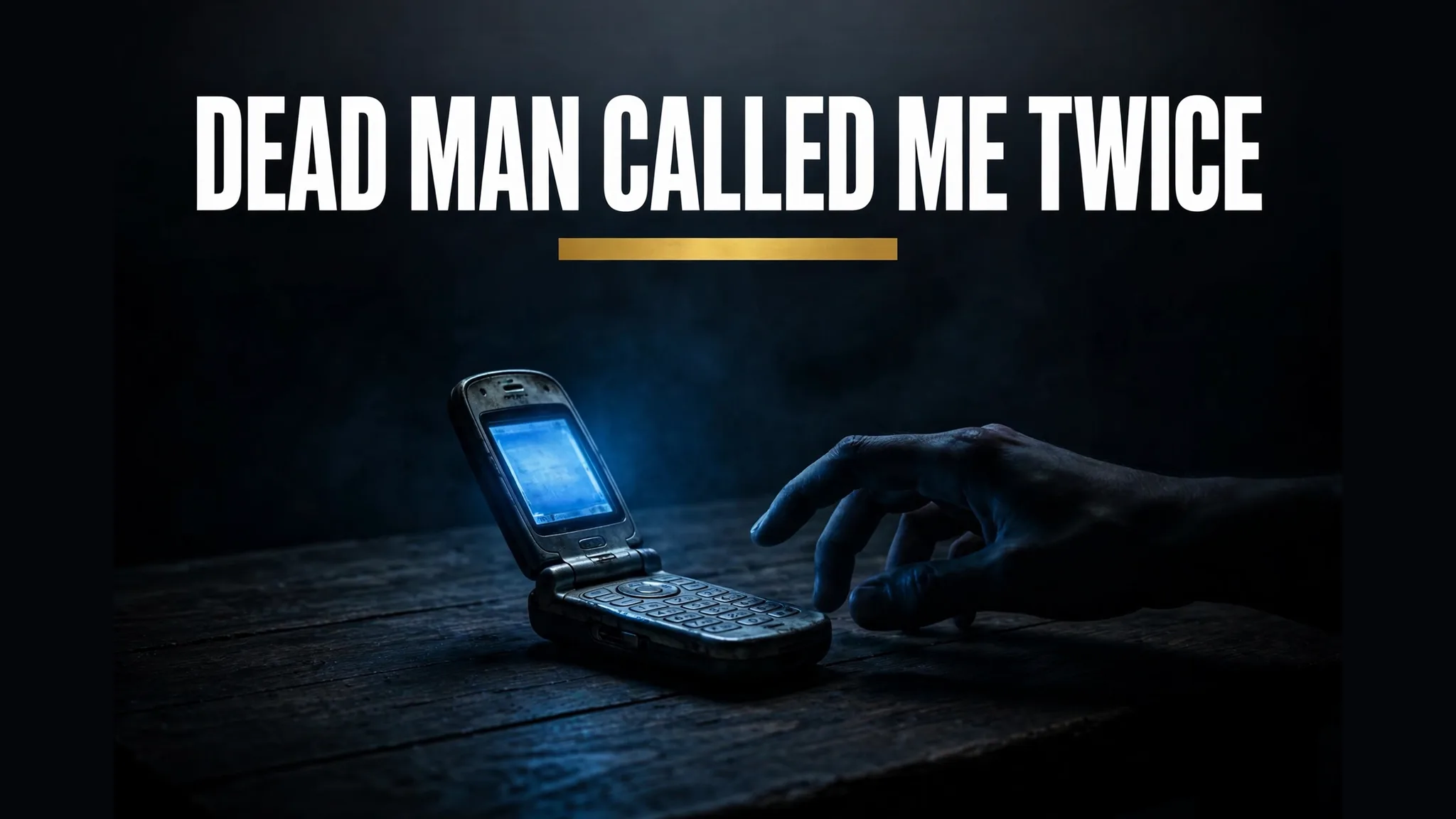
The first call came at 11:47 at night. Daniel was washing a mug in the kitchen sink, half listening to the rain against the window, when his phone lit up on the counter. The screen showed a name he had deleted from his contacts seven days earlier, after the funeral, because seeing it there had felt like leaving a door open in an empty flat. The name was Uncle Ray.
Ray had died the previous Tuesday. Daniel had carried the coffin. He had watched the earth go over it. He had stood in the rain with Ray’s widow and listened to a priest say words that were meant to be comforting and were not. So when the phone showed Ray’s name, Daniel did what any sensible person would do. He assumed it was a mistake. A crossed line. A glitch in a system too old to care about the difference between the living and the dead.
He let it ring out.
The second call came at 11:49. Two minutes later. The same name. The same number. Daniel dried his hands on a towel, picked up the phone, and stared at it until it stopped ringing. Then he sat down at the kitchen table and did something he had not done since he was a boy. He counted his breaths. One. Two. Three. Four. The rain kept falling. The fridge hummed. The house, which had felt ordinary ten minutes earlier, now felt like a room he had walked into by accident, a room where he did not belong.
His phone buzzed with a voicemail notification. He had not heard it record. He pressed play with a thumb that did not feel entirely like his own.
The First Dead Man Phone Call
The voice on the message was Ray’s voice. There was no doubt about that, and that was the worst part of it. Daniel knew Ray’s voice the way you know a song from childhood, not by thinking about it but by feeling it settle somewhere behind your ribs. It was rough from forty years of cigarettes, slow in the way of a man who never hurried a sentence, and it said, “Danny boy, you left your keys on my table. Come and get them before the rain gets in.”
Daniel had not left his keys on Ray’s table. He had never left his keys anywhere except his own pocket. But Ray had always called him Danny boy, and no one else had ever used that name, and the message ended with a sound that might have been a chuckle and might have been a cough, and Daniel sat in his kitchen until the rain stopped and the clock moved past midnight, holding a phone that had called him from a grave.
In the morning he did the sensible thing. He called the phone company. He explained, carefully, that he was receiving calls from a disconnected number. The woman on the line was polite. She checked. She told him the number had been disconnected on the day of the funeral, at the family’s request, and that no calls could come from it, because there was nothing left to call from. She used the word “impossible” twice, in the calm tone of someone who says that word often. Daniel thanked her and hung up, and then he went to Ray’s house, because Ray’s widow had asked him to collect the last boxes, and because he needed to be somewhere that made sense.
Ray’s house smelled of dust and old tea. The boxes were in the front room, taped and labelled in Ray’s blocky handwriting. Daniel worked through them methodically, the way you work through a task you do not want to think about. Books. Photographs. A clock that had stopped at 4:15. And on the kitchen table, in the middle of a room that had been empty for a week, sat a set of keys.
They were Daniel’s keys. His house key. His car key. The small brass key to his mother’s old trunk, which he kept on the same ring and never used. He had not been to Ray’s house in three weeks. He had not left anything here. And yet the keys sat on the table as if someone had placed them there deliberately, in the exact centre, where they could not be missed.
The Second Dead Man Phone Call
Daniel did not take the keys. He left them on the table, walked out of the house, locked the door behind him, and drove home too fast on wet roads. He told himself the keys were a coincidence. He told himself that grief plays tricks, that the mind under strain invents connections the way a tired eye invents shapes in the dark. He told himself all of this while his hands shook on the steering wheel.
That night the phone rang at 11:47 again. Exactly 11:47. Daniel was already awake, sitting on the edge of his bed, waiting for it the way you wait for a noise you know is coming. He answered on the second ring.
“Ray?” he said, and his voice sounded small in his own room.
There was a pause, long enough for Daniel to hear what sounded like rain on the other end of the line, though the night outside his window was clear. Then Ray’s voice said, “You didn’t take them, Danny boy.”
Daniel could not speak. His throat had closed the way throats close in dreams, when you need to shout and nothing comes out.
“You have to take them,” Ray said. “Because if you don’t, he’ll use yours instead.”
“Who?” Daniel managed. The word came out as barely more than breath.
Another pause. Then, very quietly, as if the voice were afraid of being overheard by something standing close beside it, Ray said, “The man who took my keys first.”
The line went dead. Not silent. Dead, in the particular way a phone goes dead when the other end no longer exists. Daniel sat in the dark and understood, with the terrible clarity that comes at midnight, that Ray had not been calling to frighten him. Ray had been calling to warn him. And the warning had a shape he could almost see: somewhere, someone was collecting keys. Someone was gathering the small metal objects that open the doors of the living, one set at a time, and Ray’s had been first.
The Keys on the Table
Daniel went back to Ray’s house before dawn. The street was empty. The rain had started again, thin and cold. He let himself in with the spare key Ray’s widow had given him, walked to the kitchen, and looked at the table.
The keys were gone.
In their place was a single brass key he did not recognise, old and heavy, with teeth worn smooth by years of use. Beside it, written on the back of a shopping list in Ray’s blocky handwriting, were five words: “Don’t answer the third time.”
Daniel picked up the brass key. It was warm, though the house was cold, and it stayed warm in his pocket all the way home, as if it had only just been held by a hand. He has not slept properly since. He keeps his phone beside his bed, screen down, and every night at 11:47 he watches the clock and waits to see whether it will light up.
In the daylight, Daniel tried to find a sensible explanation, the way people do when the night has frightened them and the morning demands answers. He went through the boxes from Ray’s house again, one by one, looking for anything that might explain the calls. In the bottom of the last box, beneath a stack of old magazines, he found a small notebook in Ray’s handwriting. Most of the pages were shopping lists and cricket scores. But on the final page, written in a shakier hand than the rest, were the words: “Keys open more than doors. Some keys open the way back.” Daniel read the line three times. He did not understand it, and he did not want to understand it, but he kept the notebook, because throwing it away felt like refusing a message from a man who had already gone to extraordinary lengths to send one.
It has not rung again. Not yet. But last night, when he came home late, he found his front door standing open, though he is certain he locked it. And on his kitchen table, in the exact centre, where it could not be missed, sat his own set of keys.
He has not touched them. He will not touch them. Because now he understands the rule that Ray was trying to teach him from the other side of a disconnected line: some calls are not meant to be answered, some keys are not meant to be taken, and the third call is never a warning. The third call is an invitation. And Daniel has decided, quite firmly, that he will not be home when it comes.
More stories to read
Tonight, at 11:47, a phone will ring somewhere. If the name on the screen belongs to someone who is gone, let it ring.