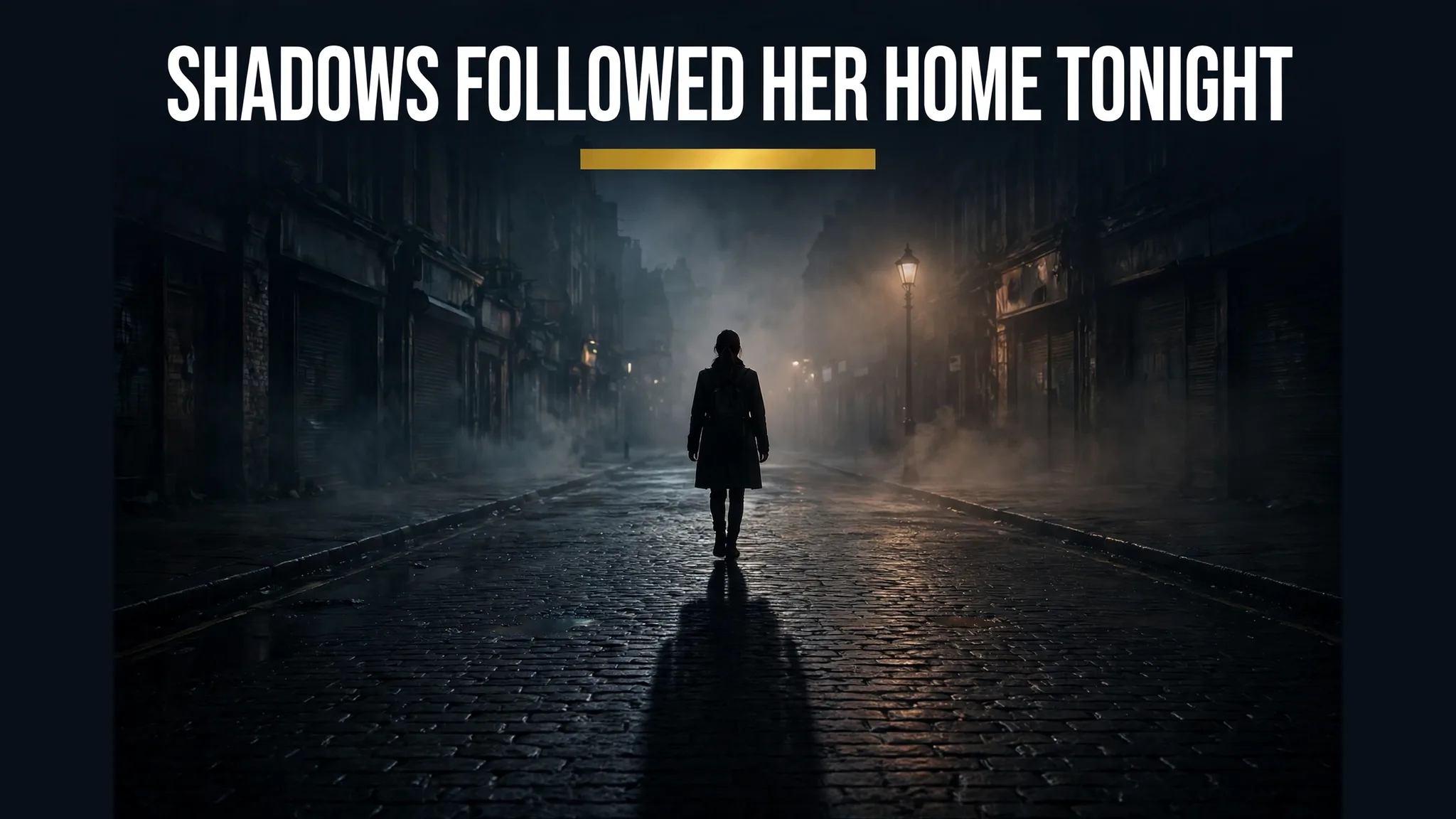
Shadows Followed Her Home Tonight
In this post
Note: This is a fictional horror story. It is not real, and any resemblance to real people or places is purely coincidental.
Maya loved the walk home. It was the best part of her day, the forty minutes between the office, where the air never moved and the lights never changed, and her small flat, where she could close the door and become a person again instead of an employee. She took the long way on purpose, through the old streets where the lamps were spaced far apart and the trees leaned over the pavements, because the long way gave her time to think, and because the dark, in those days, had never frightened her.
On the night it began, the air was warm for October, and a thin fog had settled over the town like breath on glass. Maya left the office at half past nine, earphones in, music low, and turned down Willow Street, where the lamps burned amber and the shadows of the trees lay across the road in long, tangled shapes. She had walked this street a hundred times. She knew where the pavement rose over the roots of the old oak. She knew which gate creaked. She knew the exact spot where the light from the corner shop fell across the road and made a bright island in the dark.
Halfway down Willow Street, she noticed that she was not alone.
It was not a sound that told her. It was a feeling, the particular prickle at the back of the neck that arrives before thought, the feeling of being looked at by something that does not want to be seen. She slowed, pretended to check her phone, and glanced back over her shoulder. The street behind her was empty. The fog hung motionless between the lamps. There was no one there, and yet the feeling did not leave. It grew, the way a shadow grows when the sun goes down, quietly and without permission.
A Shadow Following in the Fog
Maya walked faster. Her shoes struck the pavement in a sharp rhythm, and between her own footsteps she thought she heard another set, softer, slightly out of time, as if someone were walking just behind her and just out of step on purpose. She stopped abruptly. The other steps stopped too, but a fraction of a second too late, the way an echo arrives after the sound that made it.
She turned around fully this time, heart hammering against her ribs. Nothing. No figure. No movement. Only the fog, and the lamps, and the long shadows of the trees lying still across the road.
And then she looked down, and she saw it.
Her shadow stretched out in front of her, long and thin in the lamplight, exactly as it should have been. But beside it, close enough to touch, lay a second shadow. It had no person attached to it. It was simply there, a dark shape on the pavement, shaped roughly like a person standing, though no person stood there. As Maya stared, the second shadow shifted. Not the way a shadow shifts when a cloud passes. It moved the way a person moves when they adjust their weight from one foot to the other, a small, deliberate motion, and it leaned, very slightly, toward her.
Maya ran. She does not remember deciding to run. One moment she was standing frozen on Willow Street, and the next her feet were carrying her toward the corner shop, toward light, toward people, toward anything that was not the empty street and the shadow that had no owner. She burst into the shop, breathless, and the girl behind the counter looked up in alarm. Maya bought a bottle of water she did not want, and stood under the harsh white lights until her hands stopped shaking, and when she finally looked out of the window, the street was empty and ordinary, and there was only one shadow attached to her feet.
She told herself it was the fog. Fog plays tricks. Fog bends light and doubles shapes and makes the familiar look strange. She walked the rest of the way home quickly, staying under the lamps, and she did not look back, not once, because looking back felt like an invitation, and she had already invited enough trouble for one night.
The Shadow Following Learns Her Routine
The next night, Maya took the bus home. She told herself it was because she was tired, and that was partly true. She sat by the window and watched the streets slide past, and she felt safe in the bright, crowded bus, surrounded by strangers who were all minding their own business. When she got off at her stop, two streets from her flat, the fog was thicker than the night before, and the lamps seemed further apart.
The feeling was waiting for her at the bus stop. It arrived the moment her feet touched the pavement, a weight at the back of her neck, a certainty that she was being watched by something that had been waiting patiently for her to come back outside. She walked fast, head down, and she did not look at the ground, because she did not want to see whether there was one shadow or two. But at the corner, where the light from a streetlamp fell in a clean circle, she could not help it. She glanced down.
Two shadows. Hers, and the other one, walking beside her in perfect step this time, as if it had practised. And as she watched, too frightened to look away, the second shadow raised an arm and waved at her, slowly, the way you wave at someone you have missed for a long time.
Maya screamed. The sound tore out of her and vanished into the fog, and she ran the last two streets with her keys already in her hand, fumbling at her front door, falling into her flat and slamming the door behind her so hard the whole frame shook. She locked it. She bolted it. She dragged a chair under the handle. And then she stood in her hallway, breathing hard, and realised that the flat, which should have been the safest place in the world, felt watched too.
That was the night she understood the truth she had been avoiding. The shadow was not following her home. It had never been following her home. It had been following her, and home was simply where she stopped moving, and where it could finally catch up.
The Night the Shadow Stopped Following
On the third night, Maya did not go out. She stayed in her flat with every light on, curtains drawn, television talking to an empty room, and she told herself that shadows cannot come inside, that shadows need light to exist, and that a lit room has no dark corners for anything to hide in. At midnight, the power went out.
It was not a storm. There was no wind. The whole building went dark at once, and in the sudden blackness Maya heard, very clearly, the sound of something moving across her living room floor. Not footsteps. Something softer. Something that moved the way a shadow moves, without weight, without sound, except that this time there was a sound, a faint brushing, like cloth being dragged slowly across wood.
She did not move. She stood in the dark and listened, and the brushing came closer, and closer, until it stopped directly in front of her. And then, in the darkness of her own flat, a voice that sounded exactly like her own voice, but colder, and slower, and infinitely more patient, said, “You walk too fast. I only wanted to walk with you.”
Maya found her phone by feel and turned on its torch. The beam cut through the dark and fell on the floor of her living room. There were two shadows there. Hers, trembling in the shaking light. And the other one, standing beside her, holding out a hand that was not quite a hand, waiting, the way you wait for someone to take your hand when you offer it.
She did not take it. She ran. She ran out of the flat, down the stairs, out into the street, and she kept running until she reached the all-night cafe on the corner, where the lights never go out and the staff never ask why you are crying. She sat there until morning, drinking tea she could not taste, and when the sun came up she went home and packed a bag and left town on the first train, because she had finally understood the last and worst part of it.
A shadow that follows you is frightening. A shadow that learns your routine is worse. But the worst thing of all is this: when Maya boarded that train and looked down at the platform, there was only one shadow beneath her feet. And it was not hers. Hers had stayed behind in the flat, standing in the dark, waiting for the next person who would walk home too fast through the fog, and it was waving, slowly, the way you wave at someone you have missed for a very long time.
More stories to read
If you walk home tonight and your shadow waves at you, do not wave back. Just keep walking, and never, ever stop to count how many shadows are walking with you.