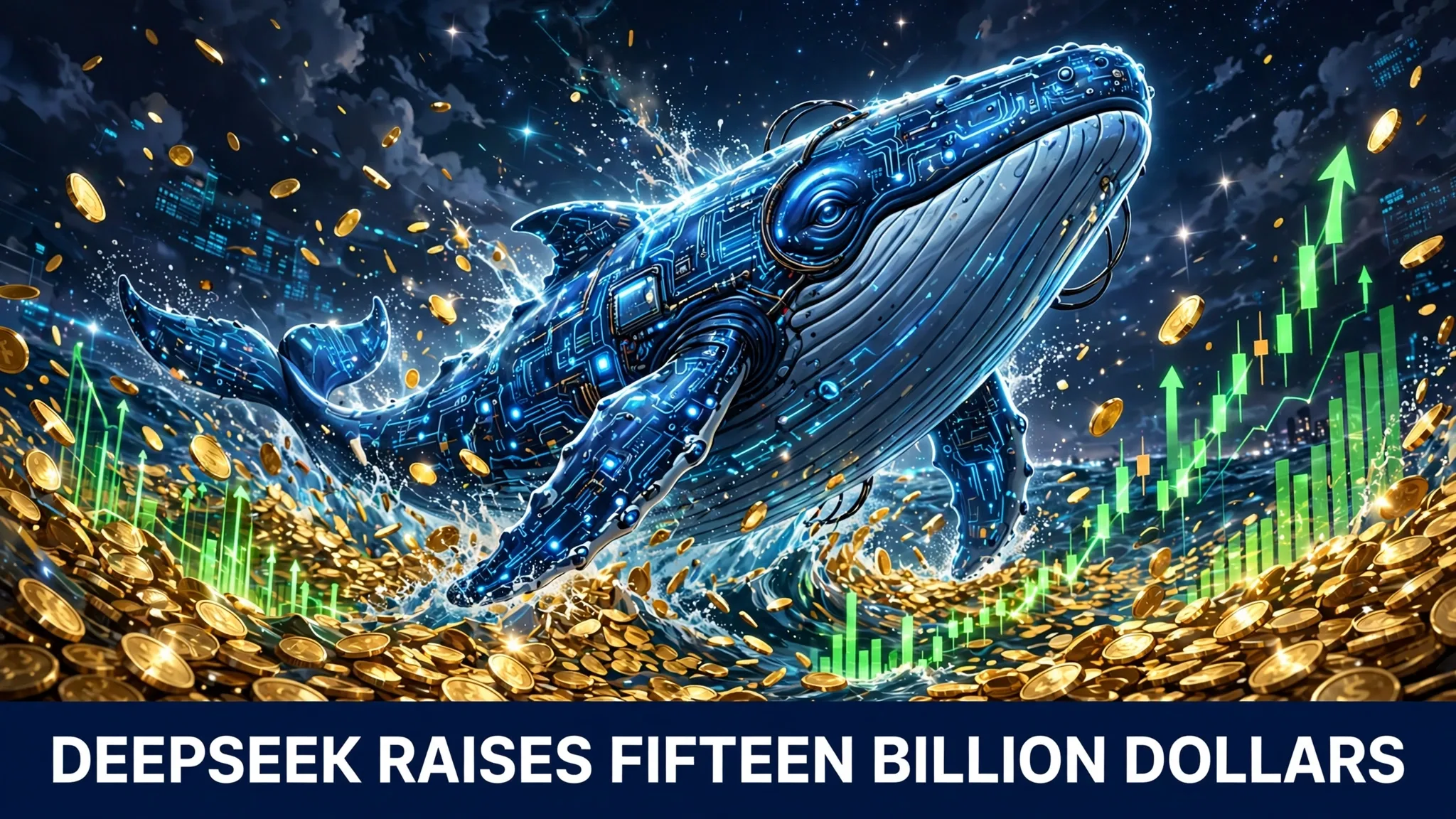
DeepSeek Raises Fifteen Billion Dollars
In this post
A Quiet Room in Washington
Picture a quiet government office in Washington. No shouting, no drama. Just a screen, an order on paper, and a simple instruction moving from desk to desk: remove DeepSeek’s AI technology from federal systems.
DeepSeek is not an American company. It is an artificial intelligence lab from China, based in the city of Hangzhou. Its tools had found their way onto computers used by United States federal civilian agencies. Now, because of security concerns, the order was clear. The technology had to go.
Decisions like this are not small. When the world’s most powerful government tells its own offices to delete a company’s product, it is sending a message to everyone watching. The message is simple: we do not trust this.
Many people expected that to be the end of the story for the week. A door in America had closed. Surely the company would spend the next days answering hard questions and calming worried partners.
Instead, the story jumped across the ocean, into a second room, where the mood could not have been more different.
A Loud Room in Hangzhou
Roughly two days after that removal order, news broke from China. DeepSeek, the same lab whose technology had just been pushed out of US government systems, had raised about $15 billion in fresh funding.
Fifteen billion dollars. In Chinese money, that is about 100 billion yuan. Reports described it as one of the biggest funding rounds in China’s history. Let that sit for a moment. One room in Washington was deleting the company’s software. Another room in Hangzhou was filling with money for the same company’s future.
This is why the tech world loves a good contrast. The ban and the cheque arrived almost together, like two boxers entering the ring at the same time. One side saw a security risk. The other side saw a future worth paying a mountain of money for.
So which room was right? Maybe both. And that is what makes this story so interesting.
The Money Behind the Cheque
A funding round of this size does not happen by accident. Big investors only write huge cheques when they believe a company can grow into something even bigger.
According to the Bloomberg report, potential investors in this round include CATL, the giant Chinese battery maker, and Tencent, the company behind WeChat, the app that much of China uses every single day for chatting, paying, and almost everything else.
Think about what those names mean. A battery giant and a social media giant, both looking at the same young AI lab and seeing a prize. Batteries power the physical world. WeChat connects the digital one. DeepSeek builds the brains. When companies from such different corners of technology all move toward the same table, it tells you the table is worth sitting at.
The money is not meant to sit in a bank and look pretty. The startup is ramping up its spending on AI infrastructure. That means the heavy, expensive machinery behind artificial intelligence: the computing power, the systems, the foundations that let AI models train, learn, and answer millions of questions.
DeepSeek is also putting weight behind open models, for both domestic and international markets. Open models are AI systems whose designs are shared more freely, so other builders can use them, study them, and create new things on top of them. It is a very different road from keeping everything locked behind a wall.
Why America Said Remove It
To understand the Washington room, you have to understand the fear inside it.
Modern AI tools do not just answer questions. They can sit inside systems, touch documents, and move information around. A government handles secrets, personal data of citizens, and plans that should never travel. When a tool comes from a rival country, officials start asking uncomfortable questions. Where does the data go? Who could see it? Could the tool be switched, watched, or used in ways the user never agreed to?
Those security concerns were the stated reason for the removal order. Federal civilian agencies were told to take DeepSeek’s technology off their systems.
You do not need to be a spy or an engineer to understand the logic. It is the same logic a family uses when it changes the locks after losing a key. You may never know who picked the key up. You change the locks anyway.
What makes this case unusual is the timing. Bans usually cool a company down. Investors usually wait, watch, and ask for discounts. Here, the cooling in one country happened beside a heating-up in another, and the heating-up won the headlines.
Why China Said Take Our Money
Now step into the Hangzhou room and look at the same company through different eyes.
Inside China, DeepSeek is not a suspicious foreign tool. It is a homegrown champion in the most important technology race of this generation. Artificial intelligence is expected to reshape medicine, transport, education, factories, and entertainment. Every major country wants strong players in this race, and no country wants to depend completely on rivals for the brains of its future machines.
From that side of the ocean, the American order almost reads like free advertising. If Washington is worried enough to act, the technology must be powerful. Why else would anyone bother removing it?
That may sound like pride, and pride is surely part of it. But there is cold business underneath the pride. AI infrastructure is expensive, and the race rewards whoever builds fastest. Fifteen billion dollars buys time, talent, computing power, and room to make mistakes without dying. In a race this fast, that kind of fuel is everything.
There is also the open model strategy. By sharing models openly, a company can become the foundation others build on. Foundations are hard to replace. Roads do not win races, but everyone has to drive on them, and the road builder gains influence with every single journey.
A Race With Two Scoreboards
Here is the strange heart of this story. The world is now scoring the same company on two completely different scoreboards.
On the American scoreboard, DeepSeek is measured by risk. The question is not how clever the technology is. The question is whether it can be trusted inside sensitive systems. On that scoreboard, the answer this week was no.
On the Chinese scoreboard, DeepSeek is measured by promise. The question is how big this lab can become, how much infrastructure it can build, and how strongly it can compete. On that scoreboard, the answer this week was fifteen billion dollars’ worth of yes.
Both scoreboards are real. A company can be risky and promising at the same time, the way a fast river is both dangerous and full of energy. Governments reach for the danger sign. Investors reach for the energy.
My own honest view is that the cheque matters more than the ban in the long run, because money builds things, and bans mostly move things around. The deleted software can be replaced in a week. Fifteen billion dollars of new infrastructure will still be standing, and still competing, for years.
What Happens Next
The report says DeepSeek’s expansion could further intensify competition among its domestic rivals in China. That is a polite way of saying the race at home is about to get rougher. When one runner suddenly receives a fortune in new shoes, fuel, and coaches, every other runner feels the pressure before the next race even starts.
Rivals will likely spend more, hire faster, and push their own open models harder. For ordinary users, competition like that is usually good news. It tends to bring better tools, lower prices, and faster improvements.
Outside China, the tug of war will continue. The company wants international markets too, according to the report, and its open models can travel even where its apps face restrictions. Software shared openly crosses borders in ways that office software cannot. A ban can clear a government building. It cannot clear the whole internet.
That is the real lesson hidden inside this week’s two rooms. In the age of AI, a closed door and an open cheque can arrive for the same company in the same week, and both can be logical. Washington protected its systems. Investors protected their place in the future. DeepSeek, standing between the two rooms, walks away as the most talked-about AI lab on the planet.
Two days. Two decisions. One company at the center of a race that is only getting louder.
Frequently Asked Questions
What is DeepSeek?
DeepSeek is an artificial intelligence lab based in Hangzhou, China. It builds AI technology and models, and it has become one of the most talked-about names in the global AI race.
How much money did DeepSeek raise?
According to a Bloomberg report, the company raised about $15 billion, which is roughly 100 billion yuan. The round was described as one of the biggest funding rounds in China’s history.
Who are the potential investors?
The report named potential investors including CATL, the Chinese battery maker, and Tencent, the company behind the WeChat app.
Why did the United States order its removal?
United States federal civilian agencies were ordered to remove DeepSeek’s AI technology from their systems over security concerns. The order came just two days before the funding news broke.
What will DeepSeek spend the money on?
The startup is ramping up spending on AI infrastructure and on open models, aimed at both domestic and international markets.
Will this affect other Chinese AI companies?
Very likely, yes. The report notes that DeepSeek’s expansion could further intensify competition among its domestic rivals, which may push the whole Chinese AI field to move faster.
Sources
- Bloomberg reporting as summarised in Disclosure News (News Burst, 23 October 2026): https://www.disclosurenews.it/news-burst-23-october-2026-get-the-news/