Desi Arnaz: The Life Story Behind Cuba's TV Pioneer
In this post
- Santiago de Cuba, Wealth, and a Childhood Lost
- Miami, Music, and the Conga Drum
- Hollywood, Lucille Ball, and a Love Story
- I Love Lucy and a Show That Changed Television
- Desilu and the Business That Built Television
- Later Years, Divorce, and a Quiet Farewell
- Why Desi Arnaz Still Matters to Television
- My Take:
There are actors who become famous for a role, and there are pioneers who change the way television is made, and Desi Arnaz was both. He was a Cuban musician, actor, and producer, best known as Ricky Ricardo in I Love Lucy, one of the most loved television shows in American history, and as the co-founder, with his wife Lucille Ball, of Desilu Productions, a company that changed television forever. He was a bandleader who played the conga, a comedian who spoke English with a Cuban accent, and a businessman who invented the way television is still made today.
Desi Arnaz was born on 2 March 1917, in Santiago de Cuba, in eastern Cuba, into a wealthy family, and he died on 2 December 1986, in Del Mar, California, in the United States, at the age of sixty-nine. In between those two dates, he lost his family’s wealth in the Cuban Revolution, he fled to the United States as a teenager, he became a famous bandleader in New York, he married Lucille Ball, he starred in I Love Lucy, and he built a television empire that produced The Untouchables, Star Trek, and Mission: Impossible. His life was a journey from wealth to exile, from music to television, and from a small town in Cuba to the centre of American entertainment.
What makes his story worth telling is how he turned loss into a new life, and how he used his talent, his charm, and his business sense to change an industry. He was not only Ricky Ricardo. He was a pioneer who invented the multi-camera sitcom, who insisted on filming before a live audience, and who created the rerun, a simple idea that made television a permanent art, and that made I Love Lucy a show that is still watched today, more than seventy years after it first aired. This is the story of how a young Cuban refugee became one of the most important figures in American television.
His story is about Cuba, about America, about love, and about a man who never forgot where he came from, even as he built a new life far from home.
Santiago de Cuba, Wealth, and a Childhood Lost
Desi Arnaz was born in Santiago de Cuba, in 1917, into a wealthy and prominent family. His father was the mayor of Santiago, and his family owned land, and a large house, and Desi grew up in a world of comfort, with servants, with music, and with a sense of being part of Cuba’s elite. He was a handsome boy, with a love of music, and with a charm that made people like him, and he seemed destined for a life of privilege, in Cuba, as a member of a respected family.
That life ended suddenly, in 1933, when a revolution in Cuba, led by Fulgencio Batista, overthrew the government, and Desi’s family lost its wealth, its land, and its position. His father was arrested, and the family was forced to flee, losing almost everything they owned. Desi was sixteen years old, and he went from a life of wealth to a life of exile, in a matter of weeks. It was a shock, and it was a loss that shaped the rest of his life, teaching him that wealth can disappear, and that a man must make his own way, with his own talent, and his own work.
The family fled to Miami, Florida, in the United States, with little money, and with a new language to learn. Desi, who had been a rich boy in Cuba, was now a poor refugee in America, and he had to work to survive. He worked in different jobs, he learned English, and he began to play music, because music was a talent he had, and a way to earn a living. It was a hard start, and it was a brave one, because a sixteen-year-old boy who has lost everything must grow up quickly, and must find a way to live in a new world.
He did not forget Cuba, and he did not forget Santiago, and that memory stayed with him, in his music, in his accent, and in his heart, for the rest of his life. He was a Cuban in America, and he carried Cuba with him, in his songs, in his rhythms, and in his pride. That identity, Cuban and American at once, would become the heart of his most famous role, as Ricky Ricardo, a Cuban bandleader living in New York, married to an American woman, and trying to make a life in a new country.
Miami, Music, and the Conga Drum
In Miami, Desi Arnaz began to make a living from music, playing guitar, singing, and leading a band. He had a natural talent for rhythm, and he became known for playing the conga drum, a Cuban instrument that he helped to popularise in the United States. The conga was a new sound to American audiences, with its deep, driving beat, and Desi played it with energy, with joy, and with a showmanship that made people want to dance. He became a bandleader, and his band, the Desi Arnaz Orchestra, played in clubs, in hotels, and on tour, across the United States.
His music was a mix of Cuban rhythms, of rumba, of son, and of American popular music, and it was a sound that was both exotic and familiar to American audiences. He sang in Spanish and in English, with a Cuban accent that became his trademark, and he charmed audiences with his smile, his energy, and his humour. He was not only a musician. He was an entertainer, and he knew how to hold a stage, how to make a crowd laugh, and how to make them dance.
In the late 1930s and early 1940s, his band became popular in New York, where he played at the Copacabana and other famous clubs, and where he was noticed by Hollywood. He appeared in films, including Too Many Girls in 1940, where he met Lucille Ball, a red-haired actress who would become his wife, and his partner in life and in business. That meeting, on a film set, changed both of their lives, and it would lead to one of the most famous marriages, and one of the most successful partnerships, in American entertainment.
Music was Desi’s first career, and it was the foundation of everything that followed. It taught him how to perform, how to lead a band, and how to run a business, and it gave him a name, and a following, that he would later use in television. He was a bandleader who became an actor, and an actor who became a producer, and each step was built on the one before it, with music at the centre.
Hollywood, Lucille Ball, and a Love Story
Desi Arnaz met Lucille Ball in 1940, on the set of the film Too Many Girls, and they fell in love quickly, marrying later that year, on 30 November 1940. It was a passionate marriage, between two strong, talented, and ambitious people, and it was a marriage that would last for twenty years, through fame, through success, and through difficulties that would eventually end it. Lucille was a red-haired comedienne, with a gift for physical comedy, and Desi was a Cuban bandleader, with a gift for music and for charm, and together they made a pair that audiences loved.
Their marriage was not easy, and it was marked by Desi’s work on the road, by his drinking, and by the pressures of fame, but it was also a partnership, in which each supported the other’s career, and in which they built a business together that would change television. Lucille believed in Desi, and Desi believed in Lucille, and together they took a risk that few couples would take: to make a television show about their own marriage, with Desi playing a Cuban bandleader, and Lucille playing his American wife.
That show was I Love Lucy, and it began in 1951, on CBS, and it became one of the most popular shows in American history. It told the story of Lucy and Ricky Ricardo, a couple living in New York, with Lucy always getting into trouble, and Ricky always trying to keep her out of it, and it was funny, warm, and full of love. The show was a hit from the start, and it made Lucille Ball and Desi Arnaz two of the most famous people in America, and it made their marriage a public story, watched by millions every week.
Their love story, on screen and off it, was a central part of American life in the 1950s, and it is still remembered today, as a story of two people who loved each other, who worked together, and who built something together that neither could have built alone. It ended in divorce in 1960, after twenty years, but the show, and the partnership, left a legacy that neither of them could have imagined when they first met on a film set in 1940.
I Love Lucy and a Show That Changed Television
I Love Lucy ran from 1951 to 1957, for six seasons, and it became one of the most watched shows in American television history. It was a sitcom, a situation comedy, about a married couple, and it was filmed before a live studio audience, with three cameras, a method that Desi Arnaz insisted on, and that became the standard for television comedy. Before I Love Lucy, most television shows were performed live, and were lost after they aired. Desi insisted on filming the show, on high-quality film, so that it could be rerun, and so that it could be sold to other stations. That idea, the rerun, changed television forever, and it made I Love Lucy a show that is still watched today, more than seventy years later.
Desi played Ricky Ricardo, a Cuban bandleader, with a thick accent, with a temper, and with a love for his wife that was clear, even when he was angry with her. His performance was a breakthrough, because it showed a Latino man as a leading character, on American television, at a time when Latinos were rarely seen on screen. He played Ricky with charm, with humour, and with a dignity that made audiences love him, and that made his Cuban identity a part of the show, not a joke, but a source of warmth and of music.
The show’s humour came from Lucille Ball’s physical comedy, from her schemes, and from the chemistry between Lucy and Ricky, and it was a humour that worked for audiences of all ages. It was a family show, watched by millions, and it became a part of American culture, with its catchphrases, its episodes, and its characters, including Fred and Ethel Mertz, the Ricardos’ neighbours, played by William Frawley and Vivian Vance. The show won awards, including Emmy Awards, and it is still regarded as one of the greatest television shows of all time.
Desi was not only the star of the show. He was also its producer, and he ran the production with a business sense that was ahead of its time. He insisted on filming in Hollywood, rather than in New York, where most television was made, so that he and Lucille could live in California, and he insisted on owning the show, rather than letting the network own it. That ownership gave Desilu, the company he and Lucille founded, the rights to the reruns, and it made them wealthy, and it gave them control over their work, in a way that few television stars had at the time.
Desilu and the Business That Built Television
Desilu Productions, founded by Desi Arnaz and Lucille Ball in 1950, became one of the most important television production companies in America. It produced I Love Lucy, and after that show ended, it produced other shows, including The Untouchables, a crime drama, Star Trek, a science fiction series that became a cultural phenomenon, and Mission: Impossible, a spy series that also became a classic. Those shows were made by Desilu, and they were sold to networks, and they made Desilu a major force in television, with a studio, with a staff, and with a reputation for quality.
Desi ran Desilu with a sharp business mind, and he made decisions that were ahead of their time. He bought a studio, he hired talented writers and directors, and he invested in shows that other producers thought were too risky, including Star Trek, which was a science fiction show about a starship, and which many networks thought would fail. Desi believed in it, and he kept it alive, and it became one of the most loved shows in television history, with films, with sequels, and with a fan base that is still active today. That belief, in a show that others doubted, is a mark of his vision as a producer.
He also pioneered the use of film for television, the use of multiple cameras, and the use of a live audience, and those methods became the standard for sitcoms, and for many other shows, for decades. He showed that television could be made with the same care as film, and that a television show could be a permanent work of art, not a one-time performance that was lost after it aired. That idea, that television could last, is Desi’s most important legacy, and it is why I Love Lucy is still watched, and why Star Trek is still loved.
Desilu grew large, and it became a major studio, but it also faced difficulties, as Desi’s marriage to Lucille ended, and as the business grew more complex. In 1962, Lucille Ball bought Desi’s share of Desilu, and she became its sole owner, and Desi left the company he had helped to build. It was a sad ending to a partnership, but it was also a sign of how successful the company had become, and of how important Desi’s work had been in building it.
Later Years, Divorce, and a Quiet Farewell
After his divorce from Lucille Ball in 1960, and after leaving Desilu in 1962, Desi Arnaz lived a quieter life, in California, where he ran a ranch, where he wrote his autobiography, A Book, published in 1976, and where he reflected on his life, his career, and his marriage. He remarried, to Edith Mack Hirsch, in 1963, and he lived with her until her death in 1985, a year before his own death. It was a quieter chapter, after a loud and famous life, and it was a time for reflection, and for family.
He remained a beloved figure, and he was honoured for his work in television, with awards, and with tributes, and he was remembered as Ricky Ricardo, as a bandleader, and as a pioneer. He appeared in public rarely, but when he did, he was greeted with love, by fans who remembered I Love Lucy, and by colleagues who remembered his work as a producer. He was a man who had changed television, and who had lived a remarkable life, from wealth in Cuba, to exile in America, to fame in Hollywood, and to a quiet life in California.
Desi Arnaz died on 2 December 1986, in Del Mar, California, from lung cancer, at the age of sixty-nine. His death was mourned in the United States, and in Cuba, and tributes came from actors, from producers, and from fans, who remembered him as Ricky, as a musician, and as a pioneer. Lucille Ball, his former wife, spoke of him with love, and with sadness, and their children, Lucie and Desi Jr., mourned their father, and remembered him as a man who had given them a remarkable life, and a remarkable legacy.
His autobiography, A Book, told his story in his own words, with honesty, with humour, and with a love for Cuba, and for Lucille, that was clear even after their divorce. It is a book that is still read today, by fans of I Love Lucy, and by students of television history, who want to understand how a Cuban refugee became a pioneer, and how a bandleader became a businessman who changed an industry. That book, and his work, are his legacy, and they will last.
Why Desi Arnaz Still Matters to Television
Desi Arnaz matters because he changed the way television is made, and because he did it as a Cuban immigrant, who arrived in the United States as a teenager, with little money, and with a new language to learn. He invented the multi-camera sitcom, he insisted on filming before a live audience, and he created the rerun, and those three ideas are still used today, in sitcoms, in dramas, and in many other shows. That is a remarkable legacy, and it is one that few people in television history can claim.
He also matters because he was a Latino star on American television, at a time when Latinos were rarely seen, and he played Ricky Ricardo with dignity, with humour, and with a Cuban identity that was a part of the show, not a joke. He showed that a Latino man could be a leading man, a husband, a father, and a star, and that his accent, his music, and his culture were a strength, not a weakness. That representation mattered, and it still matters, for Latino viewers who see themselves in Ricky, and in Desi.
His work as a producer matters too, because Desilu produced Star Trek, Mission: Impossible, and The Untouchables, shows that are still loved, and still watched, today. Those shows would not exist without Desi’s belief, and without his business sense, and they are a part of his legacy, as much as I Love Lucy is. He was not only an actor. He was a builder, and he built a company that built television.
Desi Arnaz is still remembered, still watched, and still studied, as a pioneer, as a musician, and as a star. He is the Cuban bandleader who became Ricky Ricardo, the refugee who became a producer, and the man who changed television forever. His story is a reminder that an immigrant, with talent, with work, and with a vision, can change an industry, and can change a culture.
My Take:
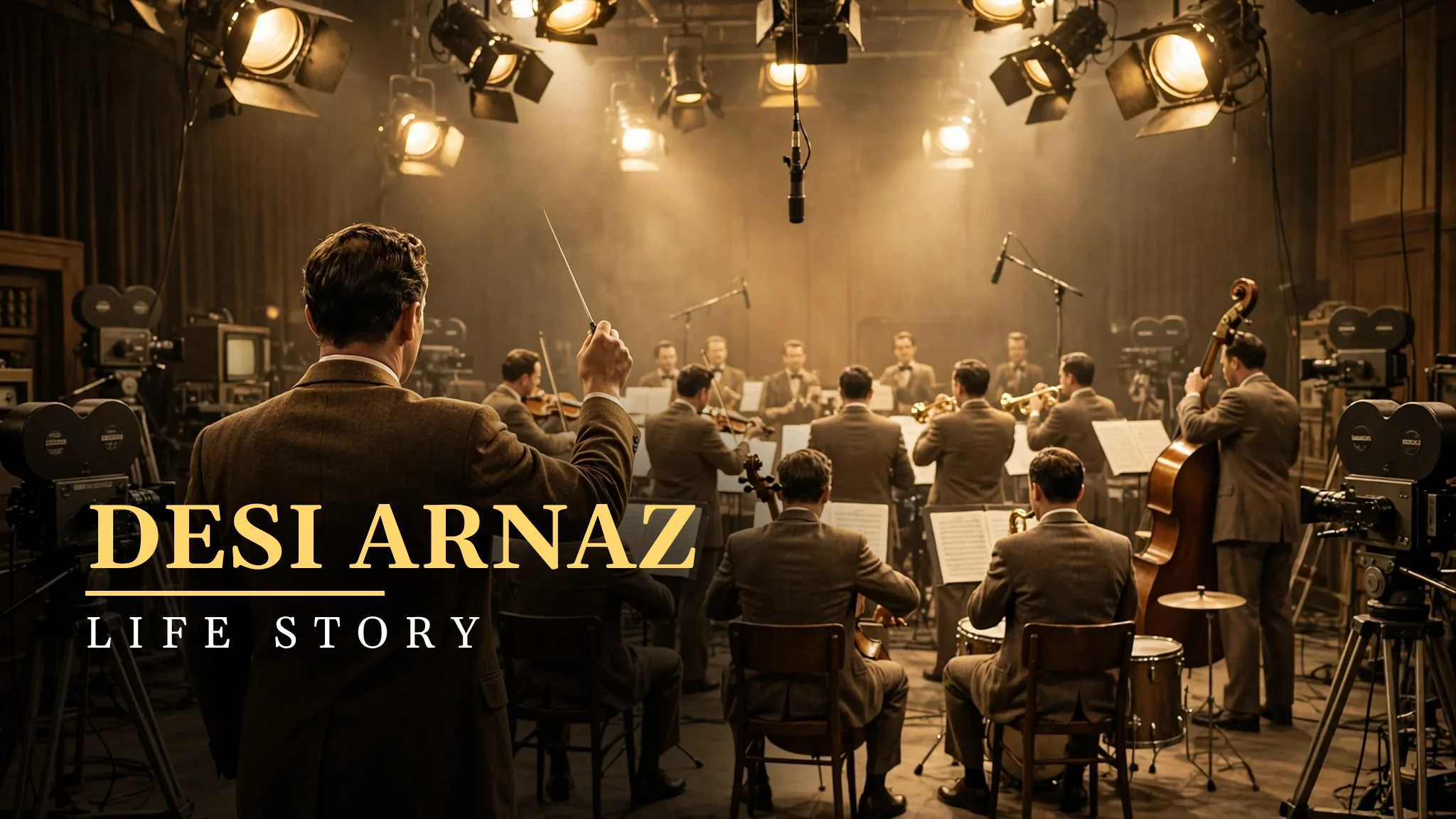
When I think about Desi Arnaz, I think about a conga drum, and a man in a suit, conducting an orchestra, with a smile, and with a Cuban rhythm that makes a whole studio want to dance. That image stays with me, because Desi was a musician first, and a television star second, and his music was the heart of his work, even when he was acting. I admire that, because it shows that a man can change careers, and can change an industry, without forgetting where he started, and without losing the music that made him who he was.
I admire his business sense more than anything else in this story. He was not only a performer. He was a producer who understood that a television show could be owned, that it could be filmed, and that it could be rerun, and that those simple ideas could make a show last forever. That kind of thinking takes a vision that most performers do not have, and Desi had it. He saw television not only as an art, but as a business, and he built a company, Desilu, that made that art last. I respect that, because it is easy to be a star, and it is hard to be a builder, and Desi was both.
What moves me most is his journey, from wealth in Santiago de Cuba, to exile in Miami, to fame in Hollywood. He lost everything at sixteen, and he had to start again, with little money, and with a new language, and he did it with music, with charm, and with hard work. That is a story that many immigrants understand, and it is a story that gives hope, because it shows that a loss, even a great loss, does not have to be the end. It can be a beginning, if you are willing to work, and to believe in yourself. Desi believed, and he worked, and he built a new life, and a new career, that was even greater than the one he had lost.
I also think about his marriage to Lucille Ball, and about how it was both a love story, and a partnership, and a tragedy. They loved each other, they worked together, and they built Desilu together, but their marriage ended in divorce, after twenty years, and that ending was sad, for both of them, and for their children. I feel sympathy for them, because it is hard to be married, and to work together, and to live in the public eye, all at once, and it is a wonder that they lasted as long as they did. Their love story, on screen and off it, is a part of American history, and it is remembered with both joy and sadness.
There is a sadness in this story too, and it is the sadness of a man who lost his home, and who never returned to Cuba, in the way he might have wished. He left Santiago as a teenager, and he lived the rest of his life in the United States, and he carried Cuba with him, in his music, in his accent, and in his heart, but he could not go back to the life he had lost. That is a deep pain, and it is one that many exiles know, and I feel sympathy for him, because no amount of fame can make up for a home that is lost. His music was a way of keeping that home alive, and I think that is why it mattered so much to him.
I have a particular respect for his role as Ricky Ricardo, and for the way he played a Cuban man on American television, with dignity, and with humour. At a time when Latinos were rarely seen on screen, and when they were often played as stereotypes, Desi played Ricky as a real man, a husband, a father, and a bandleader, who loved his wife, and who worked hard. That representation mattered, and it still matters, for Latino viewers who see themselves in Ricky, and who feel that their culture, their accent, and their music are a strength, not a weakness. Desi gave them that, and I am grateful for it.
I have a criticism as well, and I will say it plainly. Desi’s personal life, especially his drinking, and his behaviour on the road, hurt his marriage, and hurt his family, and that is a part of his story that cannot be ignored. He was a talented man, and a visionary producer, but he was also a flawed man, who made mistakes, and who paid for them, with the end of his marriage, and with a quieter later life. I do not say this to take away from his achievement, but to remember that even a pioneer is a human being, with faults, and with regrets, and that his story is more honest when we remember both sides.
What I learn from Desi is that an immigrant can change an industry, if he has talent, if he works hard, and if he sees what others do not see. Desi saw that television could be filmed, that it could be rerun, and that it could be owned, and those ideas changed television forever. That is a lesson for anyone who is new to a place, and who sees it with fresh eyes. A newcomer can see what an insider cannot, and that fresh vision can be a gift, if you are brave enough to act on it. Desi acted, and television changed.
I think about the future, and about whether a new Desi Arnaz will ever come. I do not think so, not in the same way, because television has changed, and the world has changed. But I think his ideas will keep being used, and his shows will keep being watched, and his name will keep being remembered, as a pioneer, as a musician, and as a star. That is a kind of immortality, and it is one that few people ever reach. Desi reached it, and I am glad.
If I had to choose one moment to explain Desi to a stranger, I would choose the moment when Ricky Ricardo shouts “Lucy, you got some ‘splainin’ to do!”, a line that became famous, and that is still quoted today. It is a funny line, and it is a line that shows Desi’s accent, his temper, and his love for Lucy, all at once. I think that line tells you everything you need to know about Desi Arnaz, and about why I Love Lucy still matters. It is a line about a husband, a wife, and a marriage, and it is a line that has lasted for more than seventy years.
I will end by saying that Desi Arnaz’s story is a story about a young Cuban refugee, a conga drum, a love story, and a television revolution. He lost his home, he found a new home in America, he married Lucille Ball, he starred in I Love Lucy, and he built Desilu, a company that changed television forever. That is a remarkable achievement, and it is one that deserves to be remembered. I am glad to have learned his story, and I will remember it, every time I watch I Love Lucy, and every time I think about the man who made television last.
I think about Santiago de Cuba again, and about the wealthy boy who lost everything at sixteen. That loss must have been terrifying, and it must have taught Desi a lesson that stayed with him for life: that wealth can disappear, and that a man must rely on his own talent, and his own work. I think that lesson is why he became such a sharp businessman, because he knew, from experience, that a fortune can be taken away, and that only work, and ownership, can protect you. He learned that young, and he never forgot it.
I also think about the conga drum, and about how Desi helped to make it famous in the United States. The conga is a Cuban instrument, with a deep, driving beat, and Desi played it with joy, and with a showmanship that made American audiences want to dance. I think that is a beautiful thing, to bring a sound from your home to a new country, and to make that sound loved by people who had never heard it before. Desi did that, and he did it with a smile, and with a rhythm that is still heard today.
There is something I find moving about the way Desi and Lucille built Desilu together, as a husband and wife, with a shared dream, and a shared risk. They put their money, their time, and their reputations into a company, and they made it work, even when others doubted them. That partnership, built on love, and on work, is a rare thing, and it is a part of their story that I admire, even though their marriage ended. They built something together that lasted longer than their marriage, and that is a remarkable achievement.
I wonder what Desi felt when he first saw Star Trek, and when he realised that a show he had believed in, when others doubted it, was becoming a success. It must have been a proud moment, and also a vindication, because he had taken a risk on a science fiction show about a starship, and that risk had paid off. I think about that moment, and I feel happy for him, because a producer who believes in a strange idea, and who keeps it alive, deserves to see it succeed. Desi did, and Star Trek is still loved today, in part because he believed in it.
I also reflect on the rerun, and on how simple, and how revolutionary, that idea was. Before Desi, a television show was performed live, and then it was gone. After Desi, a show could be filmed, and shown again, and again, and it could live forever. That idea changed television, and it changed the way we think about television, as an art that can last, not only as a moment that passes. I think that is Desi’s greatest gift to television, and it is one that we still enjoy today, every time we watch a rerun of I Love Lucy, or of any other classic show.
I think about Lucie and Desi Jr., Desi’s children, and about how they grew up in the public eye, as the children of two famous parents, and how they have carried their parents’ legacy. It must be hard to be the child of a legend, and to live in the shadow of a show as famous as I Love Lucy, but Lucie and Desi Jr. have done it with grace, and they have kept their parents’ memory alive. I think about that, and I feel respect for them, and for Desi, who gave them a remarkable life, even if it was not a simple one.
I have another thought about representation, and about how Desi’s role as Ricky Ricardo mattered for Latinos in America. At a time when Latinos were rarely seen on television, Desi played a Cuban man, with an accent, with a culture, and with a dignity that made audiences love him. That was a breakthrough, and it opened a door for other Latino actors, even if that door opened slowly. I think that is a part of his legacy that is often forgotten, because we focus on his business sense, but it is just as important, and it deserves to be remembered.
I also think about the future, and about whether television will ever have another pioneer like Desi. I do not think so, not in the same way, because television has changed, and the industry has changed, but I think his ideas will keep being used, and his shows will keep being watched, and his name will keep being remembered. That is a kind of immortality, and it is one that few people in television history have achieved. Desi achieved it, and I am glad.
I want to say something about his autobiography, A Book, and about how he told his own story, with honesty, and with humour. A man who writes his own life, and who does not hide his mistakes, is a brave man, and Desi was brave in that book, talking about his marriage, his drinking, and his regrets, as well as his successes. I think that honesty is a part of his legacy, and it is a part of why his story feels real, not only as a legend, but as a man.
Finally, I want to say that Desi Arnaz’s story gives me hope about the power of a newcomer. He arrived in America as a refugee, with little money, and with a new language, and he changed an industry, because he saw it with fresh eyes, and because he was brave enough to act on what he saw. That is a lesson for anyone who is new to a place, and who feels like an outsider. Your fresh eyes are a gift, and if you use them well, you can change the world, just as Desi did.
Frequently Asked Questions
Who was Desi Arnaz and what is he best known for?
Desi Arnaz was a Cuban musician, actor, and producer, born in 1917 in Santiago de Cuba, best known as Ricky Ricardo in I Love Lucy and as co-founder of Desilu Productions.
How did Desi Arnaz change American television?
Desi Arnaz pioneered the multi-camera sitcom filmed before a live audience, insisted on filming I Love Lucy on film, and created the rerun, ideas that are still used in television today.
When did Desi Arnaz marry Lucille Ball?
Desi Arnaz married Lucille Ball on 30 November 1940, after meeting her on the film Too Many Girls, and their marriage lasted until their divorce in 1960.
What shows did Desilu Productions make?
Desilu Productions, founded by Desi Arnaz and Lucille Ball, produced I Love Lucy, The Untouchables, Star Trek, and Mission: Impossible, among other shows.
When did Desi Arnaz leave Cuba and why?
Desi Arnaz left Cuba as a teenager in 1933, after a revolution overthrew the government and his wealthy family lost its land and position, fleeing to Miami with his family.
When did Desi Arnaz die and where?
Desi Arnaz died on 2 December 1986 in Del Mar, California, in the United States, at the age of sixty-nine, from lung cancer.


