Duncan Laurence: The Life Story Behind the Eurovision Winner
In this post
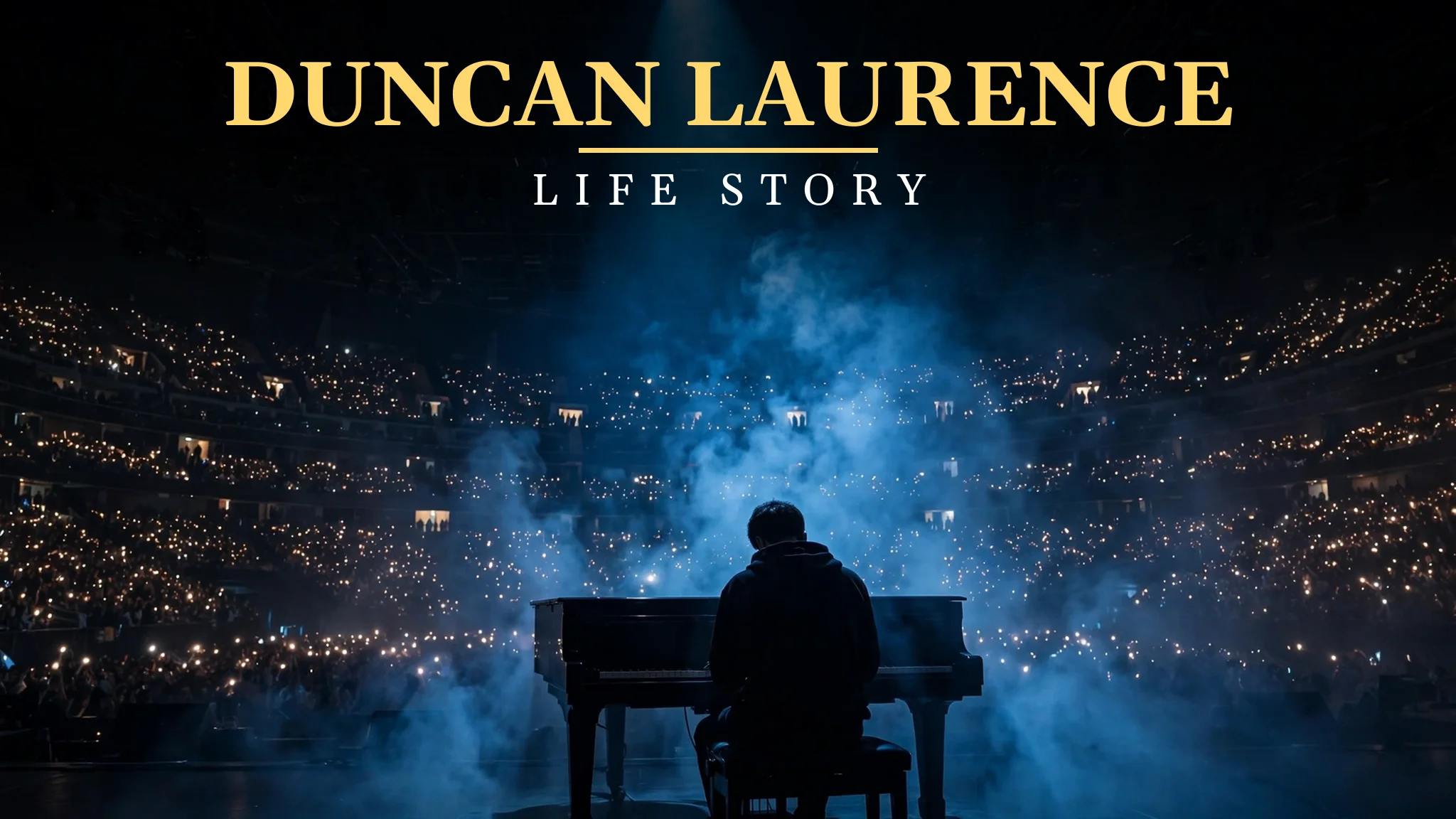
Duncan Laurence is a Dutch singer who won the Eurovision Song Contest in 2019 with the song Arcade. Before that night in Tel Aviv, most people outside the Netherlands had never heard his name. After it, his song travelled around the world, his voice became known in many countries, and the Netherlands celebrated its first Eurovision win in more than forty years. His story is not a story of sudden luck. It is a story of a young man who wrote songs in his bedroom, studied music, tried a television talent show, and kept working on his craft until the right song found the right moment.
He was born Duncan de Moor, and he grew up in the town of Spijkenisse, not far from Rotterdam. Music was part of his life from an early age. He learned to play the piano, he wrote his own songs, and he dreamed of a life in music. As a teenager, he faced a hard time at school, and music became the place where he felt safe and understood. He later spoke openly about being bullied, and about how writing songs helped him to deal with the pain of those years. That honesty would later become a large part of who he is as an artist.
What makes Duncan different from many pop stars is the quiet way he sings. He does not shout, and he does not try to impress with loud tricks. He sings softly, he lets a song grow slowly, and he trusts the words to do the work. Arcade is a good example of that style. It is a slow, emotional song about a broken heart, and it won the biggest song contest in Europe because people felt something real in it. His life since then has been about building on that moment, writing new songs, playing concerts, and finding his place in a music world that moves very fast.
Growing Up in Spijkenisse
Duncan Laurence was born on 11 April 1994 in Spijkenisse, a town in the province of South Holland in the Netherlands. His birth name was Duncan de Moor. He grew up in a normal Dutch family, in a normal town, far from the bright lights of the music business. As a small boy, he was drawn to music. He learned to play the piano, and he spent long hours at the instrument, working out melodies and trying to put his feelings into sound. The piano became his best friend, and it stayed at the centre of his music for the rest of his life.
School was not easy for him. He has spoken in interviews about being bullied as a teenager, and about how lonely those years could feel. When a young person is picked on every day, it can leave marks that last for years. For Duncan, the answer was music. He wrote songs about what he was feeling, and the songs gave him a voice when he felt that nobody was listening. He has said that writing helped him to understand himself, and that the piano was the place where he could be honest without fear. That early pain shaped his music in a deep way, and it is one reason why his songs sound so sincere.
As he grew older, he decided that music was not just a hobby. It was the thing he wanted to do with his life. He applied to the Rock Academy in Tilburg, one of the best-known music schools in the Netherlands, and he was accepted. At the academy, he studied songwriting and performance, and he learned how to work with other musicians, how to shape a song from a small idea into a finished piece, and how to stand on a stage and hold an audience. The years at the academy gave him the skills he needed, and they also gave him confidence. He was no longer a boy hiding behind a piano. He was a young artist with a clear direction.
He also began to write songs for other people, and he learned that a good song can take many forms. Some songs are loud and fast, and some are slow and quiet. Duncan was drawn to the slow, quiet ones, the ones that tell a story about love, loss, and hope. He believed that a simple piano and an honest voice could reach people just as well as a big production. That belief would later guide him when he chose the song that would change his life.
The Voice of Holland and the First Steps
In 2014, Duncan took part in the fifth season of The Voice of Holland, the Dutch version of the television singing contest. He joined the team of coach Ilse DeLange, a well-known Dutch singer, and he performed in the live shows. He sang with feeling, and his soft, emotional style stood out from the louder singers in the contest. He reached the semi-final, but he did not win the show. For many young singers, leaving a talent show without winning feels like the end of the road. For Duncan, it was only the start.
The show gave him something valuable. People in the Netherlands saw his face, heard his voice, and remembered his name. He also learned how television works, how a live show feels, and how to perform under pressure. He met musicians, producers, and people from the music business, and he began to build the contacts that a young artist needs. He did not become famous overnight, and he did not release a hit straight after the show. Instead, he went back to writing songs, and he worked on his craft in a quiet, steady way.
In the years after The Voice, he wrote songs for other artists, and he kept working on his own music. He moved to Amsterdam, where the Dutch music scene is centred, and he joined the community of songwriters and musicians who work there. He performed at small shows, he recorded demos, and he waited for the right chance. That patience is an important part of his story. Many young singers rush to release music before they are ready, and the music is forgotten quickly. Duncan took his time, and when the chance came, he was ready for it.
He also became part of the team behind the Dutch Eurovision entry in a small way before his own turn came, working as a songwriter. That experience taught him how the contest works, how a song is chosen, and how much work goes into three minutes on a stage. It also put him in the room with the people who would later trust him with the Dutch entry for 2019. His road to Eurovision was not a shortcut. It was a slow walk, built on years of writing, learning, and waiting.
Arcade and the Night in Tel Aviv
In early 2019, Duncan Laurence was chosen to represent the Netherlands at the Eurovision Song Contest in Tel Aviv, Israel, with the song Arcade. The song was written by Duncan together with Joel Sjöö, Wouter Hardy, and Will Knox. It is a slow, piano-led song about a heart that has been broken and a person who keeps searching for love even when it hurts. The words speak of a lover who is gone, and of the feeling of being lost in a game that you cannot win. It was a brave choice for Eurovision, because the contest is often won by loud, colourful, fast songs. Arcade was none of those things. It was quiet, honest, and sad.
The Dutch team decided to keep the performance simple. Duncan stood at the piano, or sat at it, with very little staging, and he let the song speak. He did not need dancers, fireworks, or big tricks. He needed a good voice, a good song, and a moment of stillness in a loud show. When he performed in the second semi-final, the audience listened, and the song qualified for the final. The bookmakers began to pay attention, and people started to say that the Netherlands could win for the first time since 1975, when the group Teach-In won with Ding-a-Dong.
The final took place on 18 May 2019. Duncan performed Arcade with calm and control, and the audience in the hall in Tel Aviv was quiet as he sang. When the votes were counted, the Netherlands had won. Duncan had scored 498 points, ahead of Italy and Russia, and the Dutch flag was raised as the winner. It was a huge moment for the Netherlands, and a huge moment for Duncan. He was twenty-five years old, and he had just won the biggest song contest in Europe with a song he had helped to write, in a style that was entirely his own.
After the win, he returned home to a hero’s welcome. The Netherlands celebrated, and Arcade began to climb the charts in many countries. The song reached the top of the Dutch charts, and it did well in other parts of Europe. For Duncan, the win changed everything. He was no longer a young singer from Spijkenisse who had once been on The Voice. He was a Eurovision winner, and the whole music world knew his name.
Small Town Boy and Life After the Win
After Eurovision, Duncan released his first album, Small Town Boy, in November 2020. The title was a nod to his roots in Spijkenisse, and the album was a collection of songs about love, loss, and growing up. It included Arcade, as well as songs such as Love Don’t Hate It and Someone Else. The album showed that he was not a one-song artist. He had a voice, a style, and a way of writing that could fill a whole record. Critics praised the album for its honesty, and fans liked the way it sounded like a real person telling real stories.
The years after a Eurovision win are not always easy. Many winners find it hard to follow a huge hit, and some are forgotten quickly. Duncan faced that challenge, and he dealt with it by working steadily. He toured, he played concerts, and he wrote new songs. He performed at festivals, he appeared on television, and he built a fan base that cared about his music, not just about one contest. He also worked with other artists, and he kept his connection with the Dutch music scene strong.
In 2021, something unexpected happened. Arcade became a huge hit again, this time on the social media platform TikTok, where millions of people used the song in their videos. The song entered the charts in the United States, it reached the Billboard Hot 100, and it became one of the most-streamed Eurovision songs of all time. It was a rare thing: a song that had already won Eurovision finding a second life, two years later, with a new generation of listeners. For Duncan, it was proof that a good song can last, and that it can find new people in new ways.
He also became a coach on The Voice Kids in the Netherlands, passing on what he had learned to young singers. He understood what it felt like to be a young person with a dream, and he wanted to help others who were at the start of the same road. That role suited him, because he had always been open about his own struggles, and he could speak to young people with honesty and kindness.
Skyboy, New Music, and the Years That Followed
In 2023, Duncan released his second album, Skyboy. The album was more personal than the first, and it showed a singer who had grown up, seen the world, and thought about who he is. The songs dealt with love, identity, and the search for a place to belong. He worked with new producers and writers, and he tried new sounds, while keeping the piano and his voice at the centre. The album did not try to copy Arcade. It tried to show where Duncan was in his life, and what he wanted to say next.
Around the same time, his personal life also changed in a happy way. In 2023, he married Jordan Garfield, an American songwriter. The two of them had worked together, and they shared a love of music and songwriting. Duncan has been open about his sexuality, and he has spoken about the importance of being yourself, even when it is hard. His honesty about who he is has made him a role model for many young people, especially in the Netherlands, where he is seen as a singer who is true to himself.
He continued to tour and to play live, and he performed at events connected with Eurovision, where he is always welcomed as a past winner. He also wrote songs for other artists, and he kept building his career as a songwriter as well as a singer. The music business is full of people who have one big moment and then disappear. Duncan has tried to be different. He has worked on his songs, he has stayed close to his fans, and he has kept making music even when the attention of the world moved on to the next contest.
In the years since 2019, he has also learned how to live with fame. He is a well-known person in the Netherlands, but he has kept his life fairly private. He shares his music, he talks to his fans, and he is open about the things that matter to him, but he does not chase attention for its own sake. That balance is hard to find, and it is one of the reasons why his story still feels real and human.
The Voice Behind the Piano: His Style and His Songs
Duncan Laurence sings in a way that is easy to recognise once you have heard it. His voice is soft, warm, and a little rough at the edges, and he does not try to make it sound bigger than it is. He lets the words come first, and he lets the piano carry the feeling. Many pop singers build their songs around a loud beat or a catchy trick, but Duncan builds his songs around a melody and a story. That choice comes from his years at the piano, where he learned that a song does not need much to be strong. It needs a true feeling, a clear tune, and a voice that believes in the words.
His songwriting often returns to the same themes, because they are the themes of his own life. He writes about love that has gone wrong, about looking for someone who understands you, about the feeling of being different, and about the hope that things will get better. These are not new themes in pop music, but Duncan writes about them in a way that feels personal. He does not use big, empty words. He uses small, honest pictures, and he lets the listener fill in the rest. That is why so many people feel that Arcade is about their own life, even though Duncan wrote it about his own heart.
He also works closely with other songwriters, and he has said that the best songs often come from a room where people trust each other. A song can start with one line on a piano, or with a few words in a notebook, and then grow as the writers add ideas. Duncan likes that slow process. He does not rush a song, and he is happy to spend days on a single verse until it feels right. That patience shows in the finished work, because his songs sound calm and complete, as if every word has earned its place.
On stage, he is a quiet performer. He does not jump around, and he does not talk too much between songs. He sits at the piano, he sings, and he lets the audience come to him. That style suits his music, and it suits his personality. He has always been a private person, and the stage is the place where he speaks through songs rather than through speeches. Fans who see him live often say that the concert feels close and personal, even in a large hall, because his voice and his piano make the room feel small.
His sound has changed a little over the years, as any artist’s sound should. The first album was built around the piano and the voice, with simple arrangements and a gentle mood. The second album added new colours, with more modern sounds and a wider range of feelings. But the heart of his music has stayed the same. It is still about a person, a piano, and a story that matters. That is the thread that runs through everything he has made, from his first songs in Spijkenisse to his latest work, and it is the reason why his fans trust him to be honest.
What His Story Means Today
Today, Duncan Laurence is remembered as the singer who brought Eurovision back to the Netherlands, and as the voice behind one of the most loved songs of the contest’s modern era. Arcade is still played on the radio, it is still streamed by millions of people, and it is still sung by fans at Eurovision events. The song has become a classic of the contest, and it is often named as one of the best winning songs of recent years. That is a lasting achievement, and it is one that few singers ever reach.
His wider legacy is about more than one song. He showed that a quiet, emotional song can win a contest that is famous for noise and colour. He showed that a young man from a small town can reach a huge stage without changing who he is. He also showed that being open about pain, about bullying, and about who you are can be a strength, not a weakness. Many young people who heard his story felt less alone, and that is a kind of success that cannot be measured in chart positions.
He continues to make music, and he continues to perform. His fans wait for new songs, and they follow his work with interest. He has a place in Dutch music that is secure, because he is not only a Eurovision winner. He is a songwriter, a performer, and a person who has used his voice to say something honest. The story of Duncan Laurence is still being written, and the best chapters may still be ahead of him.
My Take:
When I think about Duncan Laurence, the first thing I feel is relief. Relief that a quiet song won. Eurovision is a loud place, full of bright lights, fast songs, and big shows, and for years it felt as if only the loudest act could win. Then a young man sat at a piano, sang a slow song about a broken heart, and the whole of Europe listened. That tells me something important about people. We may enjoy noise and colour, but when we are asked to choose, we often choose the thing that feels true. Arcade felt true, and that is why it won.
I admire Duncan because he did not change himself to fit the contest. He could have chosen a fast dance song, he could have added dancers and tricks, and he could have tried to be someone else for three minutes. He did not. He sang in his own style, with his own piano, and he trusted the song. That takes courage, because when you are honest on a big stage, there is nowhere to hide. If people do not like it, they are not rejecting a trick. They are rejecting you. He took that risk, and it paid off, and I think that is a lesson for anyone who wants to create something. Be yourself first, and let the world decide.
What I find most moving about his story is the way he talks about being bullied. Many famous people hide their hard years, because they want to look strong. Duncan talks about them openly. He says that music saved him, that writing songs helped him to understand his feelings, and that the piano was a safe place. I think that honesty helps other people. A teenager who is bullied today might hear his story and think that the pain will not last forever, and that the thing that makes them different now might be the thing that makes them special later. That is a powerful message, and it comes from a real life, not from a speech written by someone else.
I also think about his time on The Voice of Holland. He did not win. He reached the semi-final, and then he went home. For many young singers, that would feel like failure. They might think that the door had closed, and that they would never get another chance. Duncan did not think that way. He went back to writing, he kept learning, and he waited for the right moment. Five years later, he won Eurovision. That gap matters. It shows that a talent show is not the end of the story. It is only one step, and what you do after it matters more than where you finish in it. I wish more young people understood that. One loss does not define you. What defines you is what you do next.
There is something I like about the way Arcade came back to life on TikTok. It is a strange thing for a song to win a contest in 2019 and then become a hit in America in 2021, two years later, because teenagers were using it in short videos. It shows that a good song does not have one moment. It can have many moments, in many places, with many different people. Duncan did not plan that. He could not have planned it. But because the song was honest, it was ready when the moment came. I think that is true of all good work. You cannot control when people will find it. You can only make it as good and as honest as you can, and then wait.
I think about his second album, Skyboy, and I respect the fact that he did not try to write Arcade again. It would have been easy to copy the same sound, the same slow piano, the same sad words, and hope for another hit. He chose to write about where he was in his life, about love and identity and belonging. That is what a real artist does. A real artist grows, and the work grows with them. The audience may not always follow at once, but in the long run, honesty lasts longer than copying. I believe Duncan understands that, and I think his best work may still be ahead of him.
His openness about his sexuality is another part of his story that I admire. He has spoken about being himself, and he married the person he loves. In a world where many famous people hide who they are because they are afraid of losing fans, Duncan chose to be open. That choice takes strength, and it helps other people who are afraid to be themselves. I do not think a singer has to be a role model, but when a singer is honest about who they are, it can change a young person’s life. A teenager who hears Duncan’s story might feel a little braver, and that is worth more than any award.
I also like the way he has handled fame. He is famous in the Netherlands, and he is known around the world, but he does not seem to chase attention. He makes music, he plays concerts, he talks to his fans, and he keeps his private life fairly private. That balance is hard. Many people who become famous young lose themselves, because the attention never stops and the pressure never ends. Duncan seems to have kept his feet on the ground, and I think that is because he knows who he is. He was a boy from Spijkenisse who loved the piano, and he is still that person, only with a bigger stage.
One thing that stays with me is the idea of the small town boy. The title of his first album says it all. He is from a small town, and he did not pretend to be from somewhere else. He did not change his story to sound more exciting. He sang about where he came from, and people loved him for it. That tells me that you do not need to come from a big city to do big things. You need talent, patience, and the courage to keep going when the world is not watching. Spijkenisse is not a famous place, but it made a singer who won Eurovision, and that is a good reminder for anyone who feels that their town is too small for their dreams.
I think about the night of the final in Tel Aviv, and I imagine how it felt to stand on that stage. The hall was full, the cameras were on, and millions of people were watching at home. Duncan sang quietly, and the hall went quiet with him. That is a rare thing. Most performers try to fill a hall with sound. He filled it with silence, and with feeling. I think that is the mark of a great singer. It is not about how loud you can be. It is about how much you can make people feel with a small amount of sound. Arcade does that, and Duncan does that, and I think that is why the song has lasted.
There is also a lesson here about patience. Duncan waited years between The Voice and Eurovision. He waited for the right song, the right team, and the right moment. In a world that tells young people to hurry, to go viral, to be famous by twenty, his story says something different. It says that it is fine to take your time, to learn your craft, and to be ready when the chance comes. He was twenty-five when he won Eurovision, and he was ready because he had spent years getting ready. I think that is a better path than rushing, and I hope more young artists follow it.
I wonder sometimes what it feels like to have a song that belongs to the whole world. Arcade is not just Duncan’s song now. It belongs to the people who played it at their weddings, to the teenagers who used it in their videos, to the fans who sang it in their cars. That must be a strange and wonderful feeling, to write something in a small room and then hear it everywhere. It also carries a weight, because people will always ask for that song, and they will always compare new songs to it. Duncan has carried that weight well, and he has not let it stop him from writing new music. That takes a strong mind.
If I have one small criticism, it is only that I wish more people knew his work beyond Arcade. He has written other good songs, and his albums show a singer with range and depth. But the world often remembers one song and forgets the rest, and that is not fair to an artist who has worked so hard. I hope that in time, more people will listen to Small Town Boy and Skyboy, and hear the full story of who Duncan Laurence is. He is more than a Eurovision winner. He is a songwriter with a real voice, and his story deserves to be heard in full.
In the end, what I take from Duncan Laurence is simple. Be honest, be patient, and do not be afraid to be quiet in a loud world. He was bullied, he was not the loudest singer, and he did not win his first talent show. He kept writing, he kept playing the piano, and he kept being himself. Then one night in Tel Aviv, the whole of Europe listened to a quiet song, and a boy from Spijkenisse became a winner. That is not a story about luck. It is a story about a person who knew who he was, and who waited until the world was ready to hear him. I think that is a story worth remembering, and a life worth learning from.
One more thought stays with me, and it is about the piano. Duncan’s music always comes back to the piano, and I think that is no accident. The piano was there when he was a boy, it was there when he was bullied, and it was there when he won Eurovision. It is the instrument that holds his whole story together. When I hear Arcade, I do not just hear a song. I hear a boy who found a way to say what he felt, and a man who never forgot where he learned to say it. That is what makes his music feel real, and that is why I believe people will still be listening to it for a long time.
I also think about the people who work with him, the songwriters and producers who sit in a room with him and help a song to grow. Music is often talked about as if one person does everything alone, but most songs are made by a team. Duncan seems to understand that, and he gives credit to the people around him. That humility matters. A singer who thinks he can do everything alone will soon run out of ideas. A singer who listens, learns, and shares the work will keep growing. Duncan’s career shows the second path, and I think it is the better one.
There is a quiet strength in the way he has dealt with the pressure of being a Eurovision winner. Some winners feel trapped by their winning song, and they spend years trying to escape it. Duncan has not tried to escape Arcade. He sings it with pride, he knows what it means to people, and he also writes new songs that show where he is now. That balance, between honouring the past and moving forward, is hard to find, and I admire the way he has found it. He does not live in 2019. He visits it, and then he comes back to the present and keeps working.
When I listen to Arcade now, years after that night in Tel Aviv, it still works. The song has not grown old, because it was never built on a fashion or a trick. It was built on a feeling, and feelings do not go out of date. That is the best test of any song, and Arcade passes it. I hope Duncan keeps writing songs that pass the same test, and I believe he will.
Frequently Asked Questions
Where was Duncan Laurence born and how old is he?
Duncan Laurence was born on 11 April 1994 in Spijkenisse in the Netherlands, and his birth name is Duncan de Moor. He was twenty-five years old when he won the Eurovision Song Contest in 2019.
What song did Duncan Laurence win Eurovision with?
He won the Eurovision Song Contest in 2019 with Arcade, a slow piano song about a broken heart that he wrote with Joel Sjöö, Wouter Hardy, and Will Knox. It was the first Dutch Eurovision win since Teach-In won with Ding-a-Dong in 1975.
Did Duncan Laurence take part in The Voice of Holland?
Yes, he took part in the fifth season of The Voice of Holland in 2014, where he joined the team of coach Ilse DeLange and reached the semi-final. He did not win the show, but the experience helped him to build his career.
What is Duncan Laurence’s first album called?
His first album is called Small Town Boy, and it was released in November 2020. It includes Arcade, Love Don’t Hate It, and Someone Else, and its title is a nod to his roots in Spijkenisse.
Why did Arcade become famous again in 2021?
Arcade became popular again in 2021 when millions of people used it in videos on TikTok, and the song then entered the charts in the United States and reached the Billboard Hot 100. It became one of the most-streamed Eurovision songs of all time.
Is Duncan Laurence married?
Yes, Duncan Laurence married American songwriter Jordan Garfield in 2023. He has spoken openly about his sexuality and about the importance of being yourself.
What is Duncan Laurence’s second album?
His second album is called Skyboy, and it was released in 2023. It is a more personal record about love, identity, and belonging, and it shows how his songwriting had grown since his first album.


