Emergency Fund vs Savings: The Difference
In this post
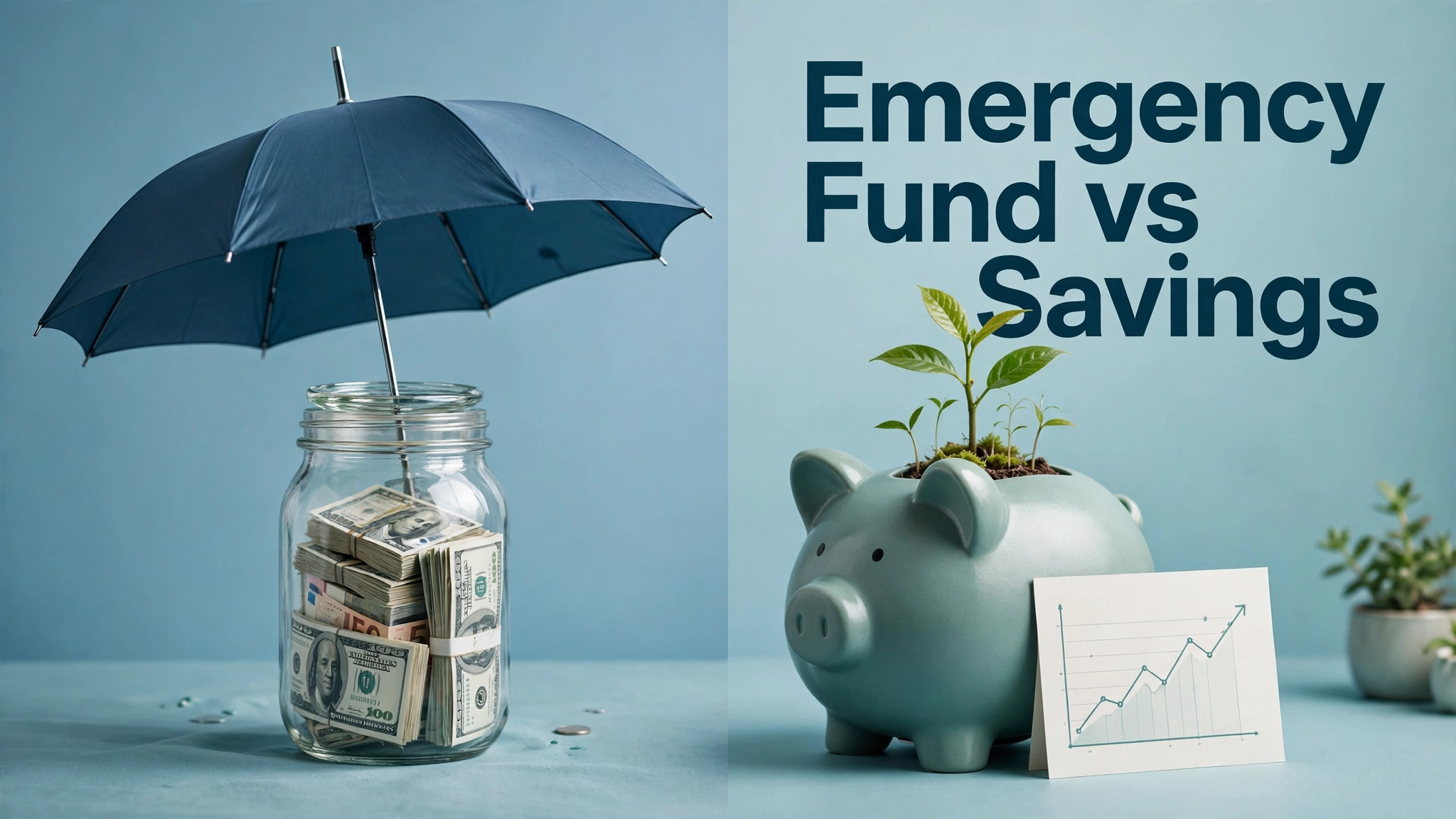
People often use emergency fund and savings as if they mean the same thing, then discover the difference during a crisis. A general savings balance can be spent on holidays, gifts, a new phone, or a house deposit, and that flexibility is useful. An emergency fund has a narrower, stricter job: to cover essential costs when income stops, an urgent bill arrives, or a necessary repair cannot wait. When the two pots are mixed, a planned goal quietly consumes crisis protection, and a crisis quietly destroys a planned goal. Separating them, even in small amounts, creates clarity that protects both purposes.
The difference is not only about labels. It is about rules for use, speed of access, target size, and emotional discipline. Emergency money should be accessible quickly, held safely, and used only for genuine urgency. Goal savings can be less liquid, tied to a date, and spent proudly when the goal arrives. Understanding those rules helps you decide how much to hold in each pot, where to keep it, and what counts as a real emergency versus an inconvenient expense. Both pots matter, but they should not compete blindly; they need a clear priority order that fits your income and risks.
For most households, the sensible order is: cover essentials, build a small starter emergency cushion, address high-interest debt, then grow both emergency and goal savings together. That order may vary with personal circumstances, and this guide is general information only, not individual financial advice. The key point is that an emergency fund is insurance you pay to yourself, while savings are progress toward a chosen future. One protects stability, the other builds aspiration, and a healthy financial life needs both.
What an Emergency Fund Really Is
An emergency fund is money reserved for unexpected, essential, and urgent costs that cannot be postponed without serious harm. Examples include job loss, reduced hours, urgent medical costs, essential home repairs such as a broken heating system in winter, a car repair needed to get to work, or an emergency family expense. It is not for sales, holidays, upgrades, gifts, or predictable costs such as annual insurance, school fees, or festive spending, even if those feel urgent when they arrive. Predictable costs belong in separate sinking funds, not in emergency money.
Access speed matters. Emergency money should be available within days, without penalties, market losses, or borrowing. A separate savings account that can be withdrawn quickly is a common choice, because it is separate from daily spending but still accessible. Cash kept at home may be accessible, but it carries theft and loss risks and earns no interest. Investments that can fall in value are poor emergency holdings, because a market drop may coincide with a job loss or crisis. The goal is certainty: when an emergency happens, the money is there in full.
Size depends on essential monthly costs, income stability, household size, and safety nets. A common guideline is three to six months of essential expenses for many households, with freelancers, single-income households, or people in volatile industries sometimes aiming higher. That full target can feel overwhelming, so start with a starter goal of one week, then one month, of essentials. A starter fund already prevents many small crises from becoming loans. Calculate essentials honestly: housing, utilities, food, transport to work, insurance, loan minimums, and essential phone costs, not total lifestyle spending.
What General Savings Are For
General savings are money set aside for planned goals, future choices, and long-term security beyond immediate emergencies. Goals may include a holiday, wedding, education, home deposit, vehicle replacement, business investment, retirement, or simply future flexibility. Unlike emergency money, goal savings are meant to be spent when the goal arrives, and spending them is success, not failure. That psychological difference matters: raiding goal savings for every minor want undermines progress, while refusing ever to spend them defeats their purpose.
Goal savings can use different accounts and timelines. Short-term goals within a year usually suit accessible savings accounts, because the money will be needed soon and should not be exposed to market risk. Medium-term goals over several years may suit a mix of savings and, for suitable investors, diversified investments, though risk and suitability vary and professional advice may help. Long-term retirement savings often use pension or retirement accounts with tax and withdrawal rules that differ by country. The right vehicle depends on time horizon, risk tolerance, and local options, not on a single online recommendation.
Naming goal savings by purpose improves discipline. A holiday fund, deposit fund, education fund, or new vehicle fund is harder to spend casually than an unnamed balance. Set a target amount and date, calculate a monthly contribution, and review progress quarterly. If a goal date moves, adjust contributions rather than abandoning the goal or borrowing to meet it. Goal savings give future choices: the ability to move, study, travel, or handle a planned life change without debt. That freedom is different from emergency protection, but equally valuable.
Key Differences in Purpose, Access, and Rules
Purpose is the clearest difference. Emergency funds answer the question: what if something essential goes wrong? Goal savings answer: what do I want to build or enjoy next? That distinction determines spending rules. Emergency money should have a strict definition of use, agreed in advance, ideally written down. Goal money should have a target and date, so spending is planned. When both pots share one account and one vague rule, every purchase can be justified as either an emergency or a goal, and neither purpose survives.
Access rules also differ. Emergency money needs fast, penalty-free access, even if interest is modest. Goal money can accept notice periods, fixed terms, or investment fluctuations if the goal date allows it, because early access is not essential. Keeping emergency money in a long-term investment or fixed account that penalises withdrawal defeats its purpose. Conversely, keeping long-term goal money in a daily spending account invites casual spending. Separate accounts, clear names, and different access levels make the distinction practical, not just theoretical.
Size and priority differ too. Emergency size is based on essential costs and income risk, while goal size is based on the price and date of the chosen goal. A household with stable dual incomes and strong safety nets may need a smaller emergency target than a single-income freelancer, even if both have similar lifestyles. Goal priorities are personal: one household may prioritise a deposit, another education, another travel. The shared rule is that emergency protection should not be sacrificed entirely for a goal, and goal progress should not be frozen forever by fear. A balanced plan grows both, with emergency protection first in the early stages.
How Much to Keep in Each Pot
Start by calculating one month of essential expenses, not total spending. List housing, utilities, basic food, transport to work or essential travel, insurance, loan minimums, and essential communications. Multiply that figure by your target months to estimate a full emergency fund, but do not let the full figure paralyse you. A starter target of one week of essentials, then two weeks, then one month, creates momentum. Celebrate each milestone, because each one reduces reliance on borrowing for the next small crisis.
For goal savings, work backwards from each goal. If a holiday costs a certain amount in twelve months, divide by twelve for a monthly contribution, allowing for price changes. If multiple goals compete, rank them by importance and date, and fund the most important first, or split contributions proportionally. Avoid funding every goal at once with tiny amounts that never reach any target. One or two active goals, plus emergency building, is usually more effective than ten underfunded goals that feel like failure.
Adjust targets when life changes. A new child, a job change, a move, a health issue, or a shift to freelancing all change essential costs and income risk, so emergency targets should be reviewed. Similarly, goal prices and dates change, and savings plans should adapt without guilt. Review both pots quarterly: is emergency money intact, has any withdrawal been repaid, are goal contributions on track, and does any account still fit its purpose? A short quarterly review keeps both pots honest and relevant.
Building Both Pots on a Low or Irregular Income
Building two pots on a low income sounds impossible, but small, separated contributions make it feasible. On payday, move a fixed small amount to emergency savings first, then a fixed small amount to the highest-priority goal, before discretionary spending. If only a tiny total is available, split it, for example, most to emergency until the starter fund is complete, then rebalance toward goals. The amounts matter less than separation and consistency. Even a small weekly transfer builds a visible cushion over months.
Irregular income requires a buffer approach. In higher months, top up emergency savings first, then goals, rather than raising lifestyle spending to match the good month. In lower months, pause goal contributions temporarily if needed, but protect emergency money and avoid withdrawing it for non-emergencies. If an emergency withdrawal happens, make repayment a line in the next budget, even in small instalments, so the fund recovers. A fund that is used and rebuilt is working correctly; it is not a failed plan.
Automate where possible, using scheduled transfers on payday to separate accounts. Automation removes daily willpower from the decision and ensures saving happens before spending. If automation is not available, use envelopes, separate accounts, or a weekly transfer ritual. Keep emergency savings slightly harder to reach than spending money, for example, without a linked spending card, but still withdrawable within days. That friction prevents casual use while preserving emergency access. Goal savings can be similarly separated by purpose, with clear names and target dates.
Common Mistakes and How to Fix Them
The most common mistake is holding only one pot and calling it both emergency and savings. A holiday then consumes crisis protection, or a car repair cancels a deposit plan, and both goals feel like failures. Fix this by opening separate accounts or sub-accounts, naming them clearly, and writing a one-line rule for each. The act of separation, even with small balances, changes behaviour because spending now requires a conscious transfer and a reason.
Another mistake is counting credit as an emergency fund. A credit card limit is not savings; it is borrowing with interest and repayment risk. It can be a last-resort bridge in a true emergency, but relying on it as a plan turns a crisis into debt. Similarly, counting investments that may fall, fixed deposits with penalties, or money owed by others as emergency funds creates false security. Emergency money should be cash or near-cash, available in full, without depending on markets or other people.
A third mistake is never replenishing after use. An emergency fund that is spent and forgotten leaves the household unprotected for the next crisis. Treat replenishment as part of recovery: set a small monthly repayment until the fund returns to target, and pause lower-priority goals briefly if needed. Finally, avoid over-saving for emergencies at the expense of all life goals. Once a reasonable emergency target is reached, shift focus to goals, debt, and long-term plans. Financial health is balance, not fear-driven hoarding.
When to Use Each Pot: Clear Examples
Clear examples prevent the most common confusion. Use emergency money when a boiler breaks in winter and the home becomes unsafe, when a car repair is essential to reach work and no cheaper safe alternative exists, when income stops suddenly, or when an urgent medical cost cannot be delayed. Do not use it for a holiday sale, a new phone upgrade while the old phone works, a wedding outfit, a festive overspend, or a predictable annual bill that should have had its own sinking fund. If the expense can be postponed safely for a month while you save, it is usually not an emergency, even if it feels disappointing to wait.
Use goal savings when the planned date arrives and the target is met: pay for the holiday, transfer the house deposit, buy the planned vehicle, or fund the course. Use them also when a goal changes deliberately, for example moving a holiday fund to education after a thoughtful family decision, with the change recorded and agreed. Do not drain a goal fund casually for daily wants, because that turns progress into a cycle of starting over. If a goal becomes impossible, repurpose its savings consciously to a new goal, rather than letting the money drift into spending without a decision.
Borderline cases need a written test: is it unexpected, essential, and urgent? If all three are true, emergency use is justified. If only one or two are true, consider a sinking fund, a delayed purchase, or a goal adjustment instead. For example, a broken washing machine may be urgent and essential for a large family, but if a laundrette provides a temporary alternative, part of the cost may be managed without draining the whole emergency fund. Keep a note of each emergency withdrawal, including reason, amount, and repayment plan, so future decisions remain honest and the fund can be rebuilt with a clear target.
My Take:
My clear take is that separation is more important than size. I have seen households with modest balances but separate emergency and goal pots handle crises calmly, while households with larger mixed balances panic because no one knows what the money is for. I think the first step should always be to split the money and write the rule, even if each pot starts small. A labelled emergency account with a strict use rule protects you psychologically as well as financially, because it removes the daily debate about whether a purchase is justified. Clarity is a form of wealth.
I also believe starter emergency funds deserve more celebration than full six-month targets. Online advice often presents three to six months as the starting point, which can feel impossible and lead people to save nothing. I would celebrate one week of essentials saved, then one month, as genuine achievements. Those milestones already change behaviour: a small repair no longer requires borrowing, a missed shift no longer creates panic, and confidence grows. A perfect emergency fund that never gets started helps no one. A starter fund that exists helps immediately.
On goal savings, my opinion is that named, dated goals beat vague saving. An unnamed balance is easy to spend because it has no story and no deadline. A deposit fund with a target date, or an education fund with a monthly contribution, creates a reason to protect the money and a clear moment to enjoy spending it. I think people should allow themselves to spend goal savings proudly when the goal arrives, rather than feeling guilty for using money they saved for exactly that purpose. Saving is not hoarding; it is delayed, chosen spending.
I am firm that credit is not an emergency fund, and I think that misconception causes real harm. A credit limit feels like safety until interest, minimum payments, and reduced limits turn a crisis into long-term debt. I would keep credit as a last resort, not a plan, and build even a small cash cushion before relying on borrowing. That cushion may not cover every disaster, but it buys time, reduces borrowing, and prevents a small emergency from becoming a financial cascade. Time and reduced debt are valuable even when the amount seems modest.
Finally, I believe balance is the real goal. An emergency fund without any life goals can feel like permanent fear, while goals without emergency protection can collapse at the first crisis. I would build emergency protection first, then grow both pots together, adjusting as life changes. Review quarterly, replenish after use, and let goals evolve without guilt. If your money system gives you stability in a crisis and progress toward a chosen future, it is working, regardless of whether it matches someone else’s perfect percentages. That practical balance, not a single number, is what financial security actually feels like.
The three-question test is something I would put on every household fridge: unexpected, essential, urgent. If an expense fails even one test, it probably does not belong in the emergency fund, no matter how tempting it feels. I think most emergency fund raids happen not in true crises, but in moments of disappointment, sales pressure, or poor planning for predictable costs. A written test removes emotion from that moment and protects the fund for the day it is truly needed. That discipline is not stinginess. It is respect for future-you, who may face a real crisis and need that money intact.
I also believe goal changes should be deliberate, not accidental. Life changes, goals change, and moving money from one goal to another can be wise, but only when it is a decision, not a drift. I would write down the old goal, the new goal, and the reason, so the transfer feels like progress rather than failure. Without that record, every goal fund becomes a general pot again, and the original purpose is lost. Deliberate repurposing keeps savings meaningful even when plans change, which they often do.
Finally, I think households should normalise replenishment conversations after an emergency. Using an emergency fund is not a shameful event; it is the fund doing its job. The shame, if any, would be in never rebuilding it and facing the next crisis unprotected. I would treat repayment like a bill for a few months, celebrate when the target is restored, and then return to goal saving with confidence. That cycle, use and rebuild, is financial resilience in practice, not in theory. It proves the system works under real pressure, which is the only proof that matters.
One more point I want to add is about guilt after using savings correctly. People often feel they have failed when they spend goal savings on the goal itself, or emergency savings on a genuine emergency, as if saving were meant to be permanent. I think that guilt is misplaced and harmful, because it discourages future saving. Money saved for a purpose and then used for that purpose is a success, not a loss. I would celebrate both moments: the day the goal is funded and the day it is enjoyed, and the day an emergency fund protects a household and is then rebuilt. Saving is a cycle, not a museum collection.
I also believe financial advice should be kinder about imperfect systems. A household with separate pots, small balances, and occasional setbacks is doing far better than a household with no system at all, even if its balances look modest online. Progress should be measured against your own starting point, not against idealised figures. If your emergency fund is growing, your goals are moving, and crises no longer force borrowing, your system is working. Keep it, refine it quarterly, and let it grow at a pace your income allows, without shame about speed.
Finally, I want to encourage anyone starting with very little: begin today, even with a tiny separate transfer, because the system matters more than the starting amount. A small emergency pot and a small goal pot, kept separate and reviewed quarterly, will teach you more about your money than any perfect plan left unwritten. Over months and years, those small transfers compound into stability and choice, and the habit itself becomes a source of confidence. Financial security is rarely built in one dramatic decision; it is built in small, repeated, separated decisions, and today is a good day to make the first one.
Frequently Asked Questions
What is the main difference between an emergency fund and savings?
An emergency fund is reserved strictly for unexpected, essential, urgent costs, while general savings are for planned goals and future choices. Emergency money needs fast, penalty-free access and a strict use rule, whereas goal savings are spent proudly when a target date and amount are reached.
How much should I have in an emergency fund?
A common guideline is three to six months of essential expenses, but the right amount depends on income stability, household size, and safety nets. Start with one week, then one month, of essential costs, and build gradually. Essential costs mean housing, utilities, food, transport to work, insurance, and loan minimums.
Can I use my emergency fund for a holiday or sale?
No, holidays, sales, upgrades, and predictable costs are not emergencies, even if they feel urgent. Using emergency money for wants removes crisis protection and turns a planned goal into a future borrowing risk. Keep separate goal savings for holidays and planned purchases.
Where should I keep an emergency fund?
Keep it in a separate, safe account that can be withdrawn within days without penalties or market losses. Avoid investments that can fall in value, fixed accounts with withdrawal penalties, and money held only as a credit limit. Slight separation from daily spending helps prevent casual use.
Should I save for goals before building an emergency fund?
Generally, build at least a small starter emergency cushion first, then grow both pots together. If high-interest debt exists, address minimums and a starter cushion in parallel, then prioritise debt and emergency growth before large goal saving. Adjust the order to your circumstances.
What counts as a real emergency?
Real emergencies are unexpected, essential, and urgent: job loss, urgent medical costs, essential home or vehicle repairs needed for safety or work, and similar crises. Predictable annual bills, gifts, holidays, and non-essential upgrades do not count, even when they arrive suddenly in your budget.